
Jacob Zuniga’s Cybertruck towing report is the kind of data I wish more owners posted.
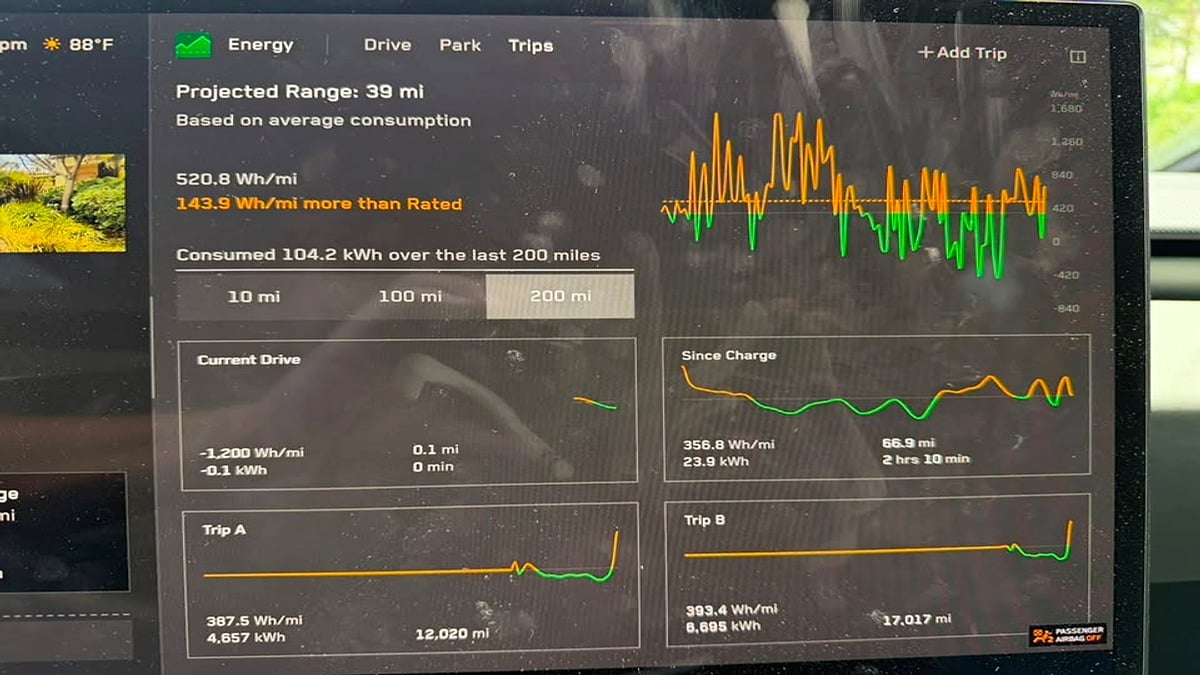
Just a truck, a 22-foot Airstream Sport, a climb from the coast to Julian, and an Energy screen showing 520.8 Wh/mi over the last 200 miles.
- At 520.8 Wh/mi, the Cybertruck delivered roughly 1.92 miles per kWh while towing, which is significantly better than many EV truck towing reports that exceed 800 Wh/mi with less aerodynamic trailers.
- The 104.2 kWh used over 200 miles suggests that even with a trailer, the truck maintained a usable real-world towing range that aligns with practical trip planning rather than worst-case assumptions.
- The relatively modest 41 percent increase in energy consumption highlights how trailer design, especially aerodynamics, can matter more than weight alone when it comes to EV towing efficiency.
The truck consumed 104.2 kWh across that distance. The owner says his normal consumption runs around 370 Wh/mi, so the Airstream added about 41 percent to his usual energy use.
That is a remarkably civilized penalty for towing.
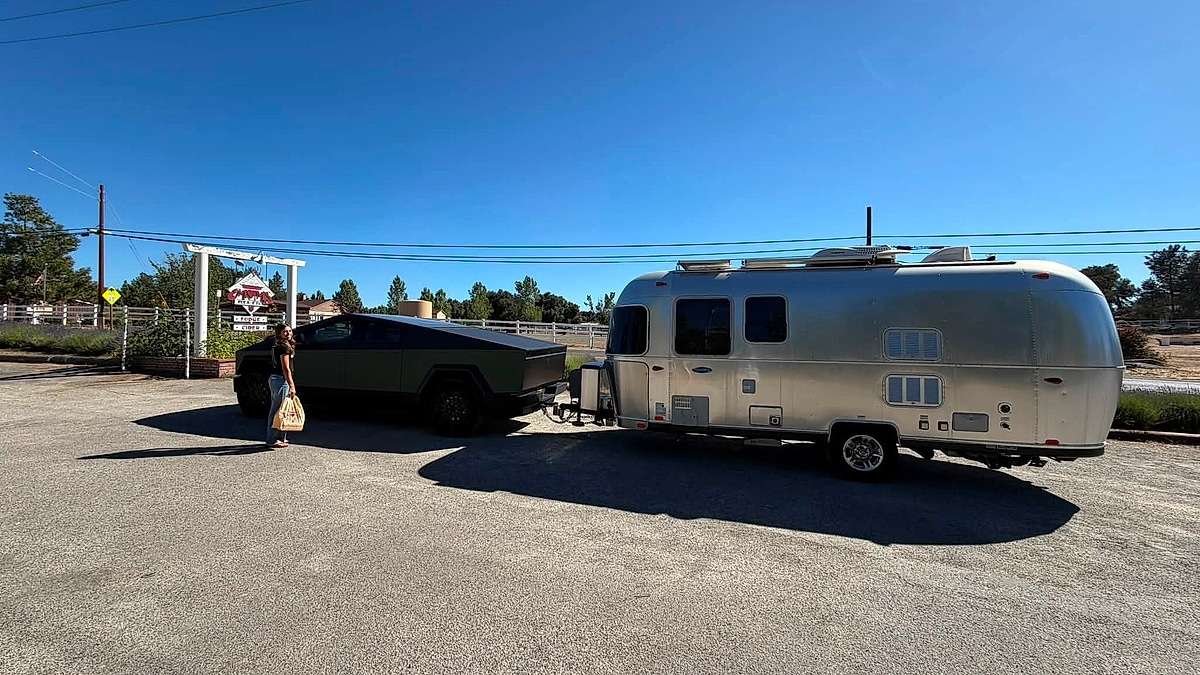
The trailer matters here. Airstream’s old Sport 22FB was narrow, rounded, and relatively light, with a 4,500-pound GVWR and single axle. Zuniga’s trailer also had Falken Wildpeak all-terrain tires, which probably gave up some efficiency compared with smoother trailer tires. Even so, the Cybertruck averaged 1.92 miles per kWh while doing most of a 200-mile loop with the trailer attached.
A boxy camper would have written a different story.
The Airstream Did The Truck A Favor
The Cybertruck has the torque to pull this load without fuss. That part barely interests me.
A 22-foot Airstream does not behave like a flat-fronted bunkhouse. Its rounded aluminum shell cuts a cleaner hole through the air than most travel trailers. The Sport 22FB is also only about 7 feet 3 inches wide, far narrower than many modern RVs. A smaller frontal area and curved body reduce the ugly wake that usually punishes electric trucks while towing.
That explains why another Cybertruck owner can tow a heavier or taller trailer and see 900, 1,000, or 1,200 Wh/mi, while Zuniga saw 520.
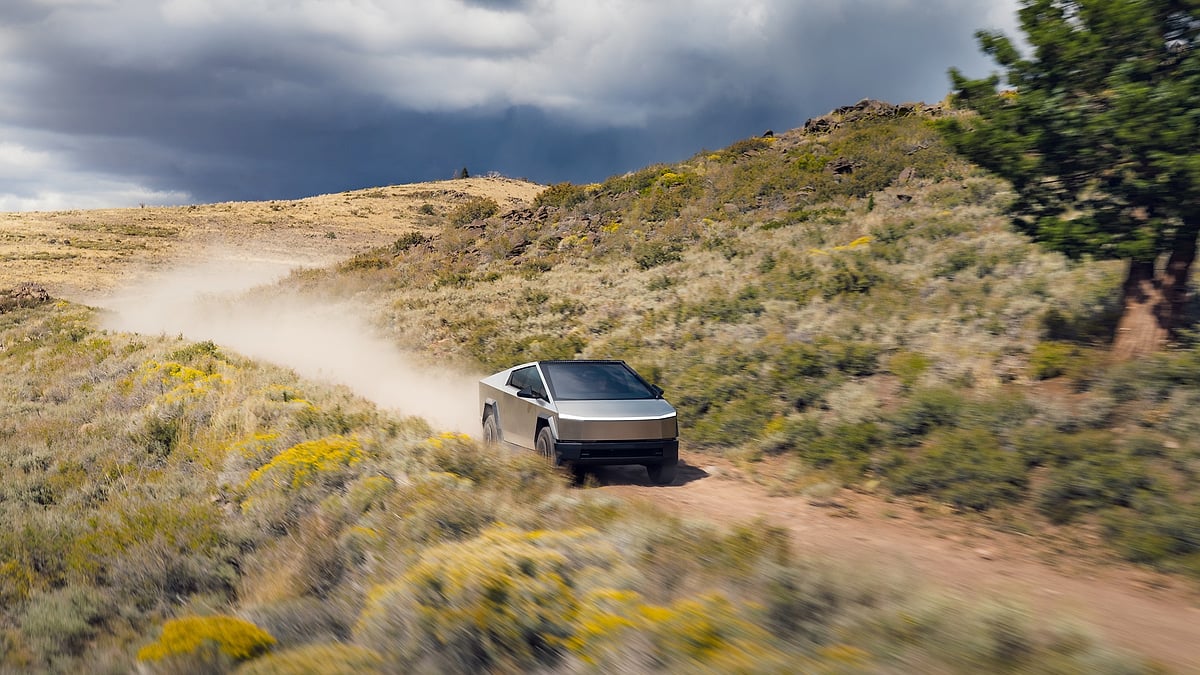
Weight affects acceleration and climbing. Shape dominates the highway.
A travel trailer’s brochure weight only gives half the story. Width, height, nose shape, roof gear, tires, speed, and wind can turn two similar-weight campers into completely different energy loads.
This Airstream landed in the Cybertruck’s sweet spot: light enough, narrow enough, and slippery enough to keep the truck from becoming a charging-station hostage.
The 4,000-Foot Climb Makes The Number Better
He drove about 60 miles each way to Julian, climbing from the coast toward a mountain town that sits above 4,200 feet. That climb makes the 520 Wh/mi result more impressive. The uphill leg would have forced the truck to work hard, and the downhill leg would have recovered some energy through regeneration.
The screenshot shows why the average deserves respect. Over the last 200 miles, the Cybertruck used 104.2 kWh. At that rate, a 100-kWh usable driving window gives roughly 192 miles. An 85-kWh window gives roughly 163 miles. A conservative 75-kWh window gives about 144 miles.
That is the planning range I would use, not the showroom range.
For this trailer, in similar conditions, the Cybertruck looks like a comfortable 140-to-160-mile towing truck if the driver wants to reserve it. Push the battery harder, and the math stretches. Add wind, rain, cold, higher speed, or a taller trailer, and the margin shrinks fast.
The number is useful because it is specific.
520 Wh/mi. Airstream Sport. Coastal climb. Julian's round trip. Mostly towing.
That gives another owner a starting point.
His Lifetime Efficiency Makes The Tow Look Even Cleaner
The screenshot also shows Trip A at 387.5 Wh/mi over 12,020 miles and Trip B at 393.4 Wh/mi over 17,017 miles. Zuniga says his norm is around 370 Wh/mi, which matches the truck’s broader history closely enough.
The Airstream raised consumption by roughly 130 to 150 Wh/mi, depending on which baseline you use.
That is a small jump for a travel trailer.
I would expect worse from many campers weighing less. A tall square trailer at 65 mph can punish an electric pickup far more than an Airstream with another thousand pounds on the scale. That is why I keep coming back to shape. Airstream’s rounded aluminum shell is an old-school design that happens to suit the EV era.
There is a quiet irony there. The most futuristic pickup on sale just got a boost from one of the oldest trailer silhouettes in America.
The Owner’s Takeaway Is The Right One
Zuniga said he expected worse.
I would have too.
A 22-foot trailer, all-terrain trailer tires, mountain elevation, and a Cybertruck should not be assumed to return anything close to efficient road-trip behavior. Yet the result came in clean. The Cybertruck did not become a 90-mile tow rig. It did not need exotic technique. It pulled the Airstream at a number that a careful owner can actually plan around.
That does not make every Cybertruck towing trip easy.
A bigger trailer changes the math. A blunt front wall changes the math. Headwind changes the math. Speed changes the math harder than most owners expect.
But this combination worked because the trailer was helping instead of fighting.
If I were shopping for a camper behind a Cybertruck, this post would push me toward the narrowest, lowest, roundest trailer I could live with. The weight rating still matters for safety. The shape decides how often I see a charger.
Zuniga’s trip shows the difference.
The Cybertruck did not tow well because 4,500 pounds is light. It towed well because the Airstream was a clean 4,500 pounds.
Cybertruck Owners, Post The Trailer Shape With The Wh/Mile
If you tow with a Cybertruck, share trailer weight, height, width, shape, speed, route, elevation, tire type, Wh/mi, and whether the trip included climbing or descending. The trailer profile explains the range more clearly than weight alone.
Two images by Jacob Zuniga
About The Author
Noah Washington is an automotive journalist based in Atlanta, Georgia, covering sports cars, luxury vehicles, and performance culture. His reporting focuses on explaining the engineering, design philosophy, and real-world ownership experience behind modern vehicles.
Noah has been immersed in the automotive world since his early teens, attending industry events and following the enthusiast communities that shape how cars are built and driven today. His work blends industry insight with enthusiastic storytelling, helping readers understand not just what a car is, but why it matters.
Noah is also a member of the Southeast Automotive Media Association (SAMA), a professional organization for automotive journalists and industry media in the Southeast.
His coverage regularly explores sports cars, luxury vehicles, and performance-driven segments of the automotive industry, including the evolving culture surrounding Formula Drift and enthusiast builds.
Read more of Noah's work on his author profile page.
You can also follow Noah here:
Set Torque News as Preferred Source on Google
Follow us today...