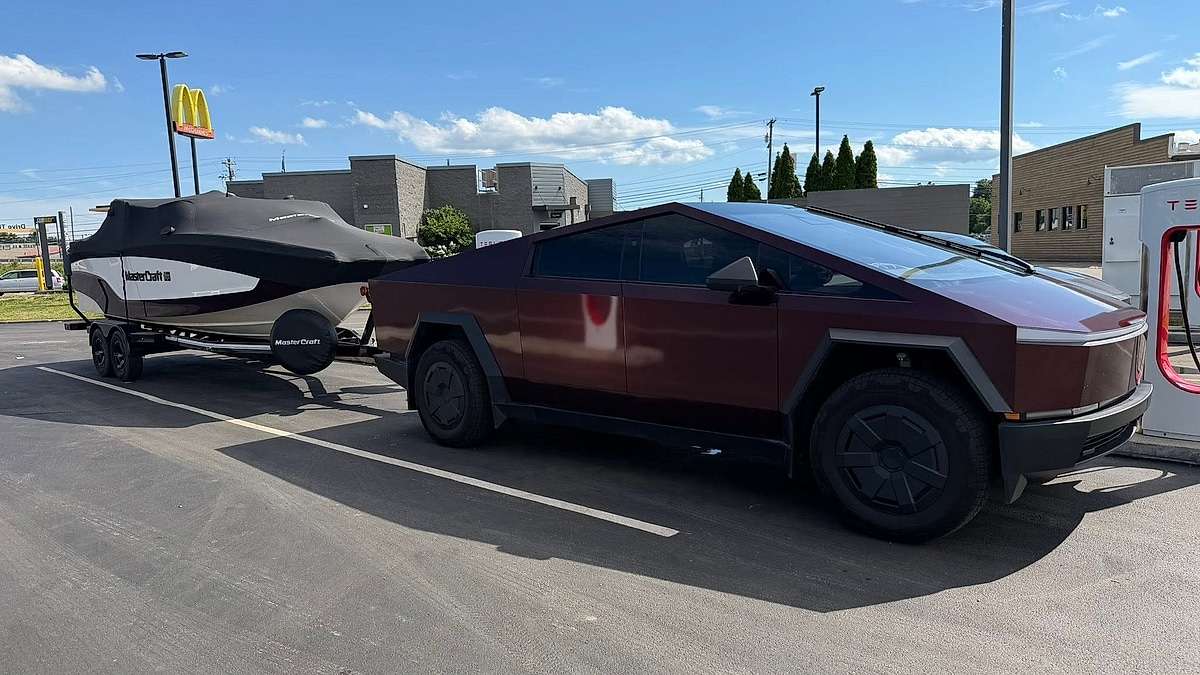

A Cybertruck towing a 6,500-pound boat for 350 miles is perfect bait for the usual online blood sport. Tesla loyalists wait for a victory lap. Critics wait for a flatbed.
The owner gave both camps something less exciting and far more valuable: numbers.
He reported energy consumption around 700 Wh per mile at approximately 55 mph. His charging stops came about 145 miles apart, and he reached them with roughly 15 percent battery remaining. He had tried moving faster and found that the added consumption forced more charging, erasing whatever time the higher speed had saved.
- Plan charging stops based on real-world consumption, not EPA range, and always build in a buffer for unexpected conditions.
- Expect trailer aerodynamics to impact efficiency more than weight alone, especially at highway speeds.
- Prioritize charger locations with easy trailer access to avoid time-consuming unhooking and maneuvering.
At 700 Wh per mile, a 145-mile leg uses 101.5 kWh. If that represents about 85 percent of the available battery, the owner’s figures point toward roughly 170 miles from full to empty under the same conditions.
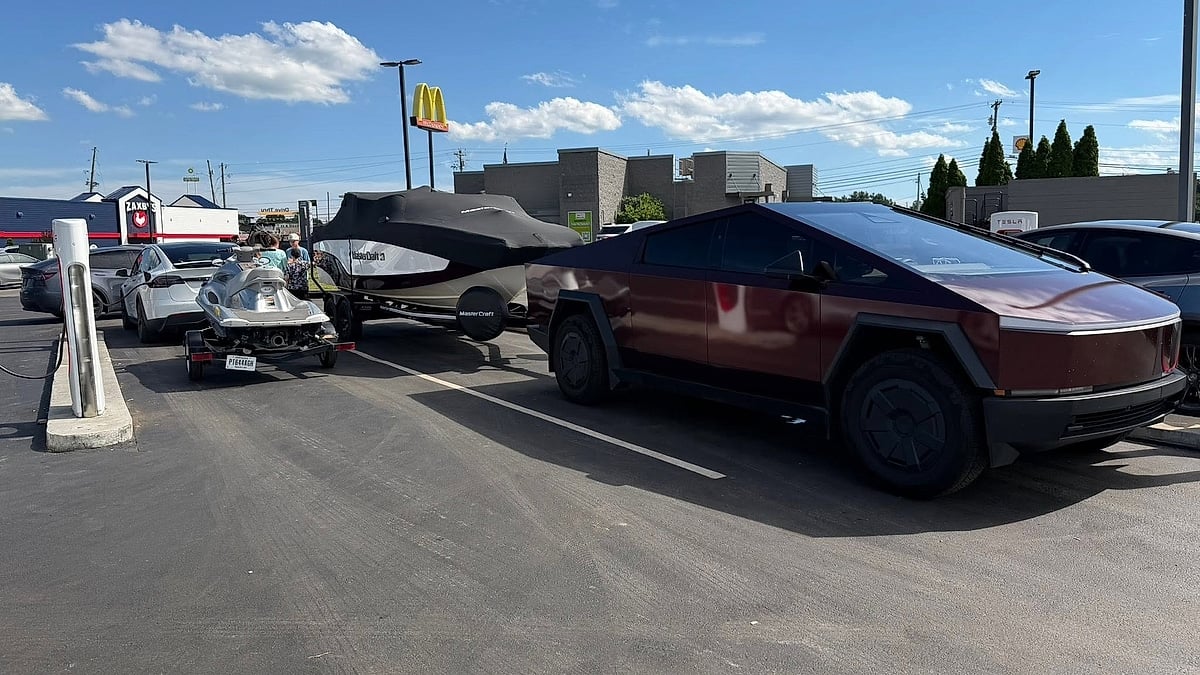
Nobody towing a boat should plan around the final electron.
His working number was 145 miles, leaving around 25 miles of reserve. That gap covered the things an EPA estimate never meets: wind, grade, traffic, a missed exit, a charger set back from the highway, or the driver who parks a Corolla in the only stall long enough for a truck and trailer.
The published range belongs to the Cybertruck sitting by itself.
The 145-mile legs belonged to the rig.
The Speedometer Was Lying About Progress
At 65 mph, a driver can cover 350 miles almost an hour sooner than at 55 mph, assuming the truck never stops.
The charger ruins that assumption.
A large boat presents a broad, turbulent shape to the air. Weight demands energy during acceleration and climbing. Drag demands payment every second the rig remains at speed. Once the combination is cruising, air becomes the larger enemy.
Aerodynamic power rises roughly with the cube of speed. Increasing road speed from 55 to 65 mph raises the aerodynamic power demand by about 65 percent for the same shape. That does not mean the truck’s total consumption rises by exactly 65 percent, since tires, drivetrain losses, grade, and other loads remain in the equation. It does explain why ten extra mph can punish an electric tow rig so severely.
The motors hide the effort. There is no downshift, no rising exhaust note, no engine straining against the grade. The truck simply pulls harder from the battery.
The driver sees 65 mph and feels as though the trip is moving faster. Meanwhile, the projected arrival percentage falls, the charging stop gets longer, or another stop appears in the route.
One extra fast-charge session can consume the hour gained on the highway. Add the detour, parking maneuver, cable connection, payment, and time needed to rejoin traffic, and the higher cruising speed can send the driver backward on the clock.
The owner found his balance at 55 mph. He surrendered ten road miles each hour and protected the charging plan.
That was a good trade.
An 11,000-Pound Rating Does Not Plan The Trip
Tesla publishes an 11,000-pound maximum tow rating for the Cybertruck Premium AWD and Cyberbeast. A 6,500-pound boat sits below that headline figure, although actual compliance still depends on tongue weight, payload, axle ratings, hitch hardware, tires, passengers, and cargo.
Power was never likely to be the issue.
Electric motors produce the kind of low-speed torque that makes a heavy trailer feel strangely light leaving a ramp or merging onto the highway. The Cybertruck can accelerate with a boat more cleanly than plenty of gas trucks that sound much busier doing the same work.
The difficult part begins after the truck settles into topography and airflow.
A tow rating tells the owner whether the vehicle was engineered to handle a certain load under specified conditions. It says nothing about charger spacing across a particular route. It cannot tell the driver whether the next station has room for a trailer or whether a headwind will turn a comfortable 145-mile leg into a nervous 160-mile crawl.
The owner’s 700 Wh-per-mile figure answers the road-trip question far better.
At that consumption:
- 100 kWh buys about 143 miles.
- 90 kWh buys about 129 miles.
- 80 kWh buys about 114 miles.
Those figures can be placed directly over a charging map. The owner can decide how much reserve to carry and whether the route has enough margin before the boat leaves the driveway.
For an unfamiliar trip, I would begin with shorter legs. A 20-percent arrival target would give more room for weather, elevation, and station trouble. After several runs with the same boat, speed, and loading, the reserve could be tightened using actual experience.
The first trip should teach the next one.
The Model X And Jet Ski Explain Why Weight Is A Poor Shortcut
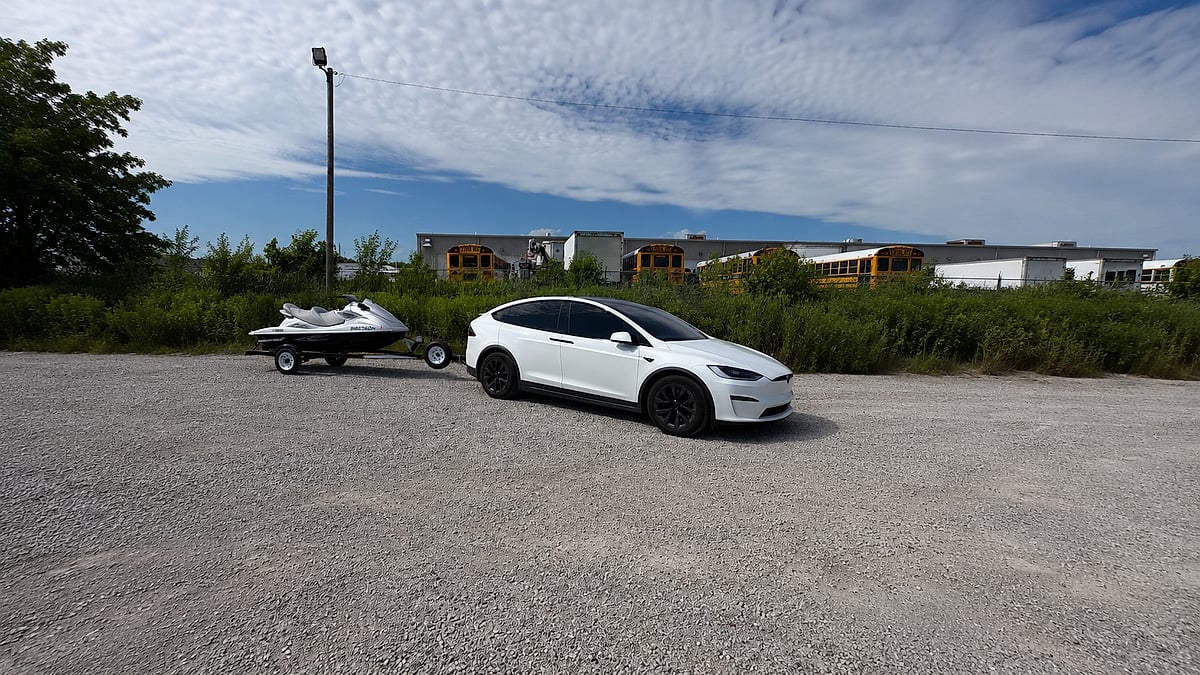
The same owner said his Tesla Model X towed a roughly 900-pound jet ski without a meaningful change in range.
The light weight helped. The shape helped more than many towing discussions acknowledge.
A jet ski rides low and can remain partly sheltered inside the tow vehicle’s wake. A large boat, pontoon, enclosed cargo trailer, horse trailer, and travel trailer each present a different aerodynamic problem. Two trailers with the same scale weight can produce radically different consumption at highway speed.
A tall camper can punish range harder than a heavier open trailer. A boat with a tower, canvas, or wide beam can create more drag than its weight suggests. A low utility trailer may disappear behind the tow vehicle well enough to preserve surprising efficiency.
This is why “How far can an electric truck tow?” rarely produces a useful answer.
The trailer belongs in the description.
Owners should report loaded weight, height, width, shape, highway speed, wind, temperature, terrain, tire pressure, and energy use. Without those details, one person’s 100-mile towing range and another person’s 170-mile result appear to contradict each other.
They may be pulling entirely different walls through the air.
The Parking Lot Can Break Perfect Battery Math
The owner’s charging plan worked because he could reach the chargers and use them with the boat attached.
That part still depends too heavily on luck.
Many charging sites were laid out for solo passenger cars. Short cables, curbs, nose-in stalls, narrow lanes, and badly placed equipment can make a compatible station nearly useless to a tow vehicle. A truck may reach the charger with the expected 15 percent remaining and then discover that the rig cannot fit.
Unhitching adds chocks, jack operation, coupler work, electrical disconnection, safety chains, parking, reconnection, and a final light check. Ten minutes at each end of two stops adds 40 minutes to the trip. A stubborn coupler or crowded lot can take longer.
That delay can exceed the highway time saved by driving faster.
Trailer-friendly charger information should include approach direction, pull-through availability, cable reach, turning room, trailer-length limits, recent photographs, and whether the rig can leave if another driver occupies the neighboring stall.
A map icon showing “charger available” is incomplete.
For a tow driver, access begins at the driveway entrance and ends when the trailer clears the lot.
How I Would Use The Owner’s Numbers
I would treat 700 Wh/mile as the starting point.
Not the Cybertruck’s EPA range. Not the tow rating. Not the best-case number from an empty truck on flat ground. This owner gave the number that matters: 6,500 pounds of boat, about 55 mph, 350 miles, and roughly 700 Wh/mile.
That is the number I would build the route around.
I would enter the boat’s loaded weight and dimensions into the Cybertruck’s trailer profile, then run the first highway leg at 55 mph. After the truck has enough miles to settle into a real estimate, I would compare the predicted arrival percentage with the actual result.
If the truck says it will arrive with 20 percent and shows up with 14, the plan needs more buffer. If it keeps landing close to the estimate, then the profile is doing its job.
I would also test the same boat at 60 and 65 mph over a familiar road. Not for a few miles. Long enough for hills, traffic, wind, and small mistakes to average out. Write down the Wh/mile at each speed.
In this case, 55 mph made 145-mile charging legs work, with about 15 percent left at each stop. Going faster burned enough extra energy that it meant more charging, not less travel time.
The Cybertruck’s tow rating says it can pull the boat.
The 700 Wh/mile figure says how the trip will actually feel.
For this route, I would put 700 Wh/mile at the top of the plan and leave the EPA range number out of it.
Share Your Real-World EV Towing Numbers
If you’ve towed with a Cybertruck, or any EV, drop your numbers in the comments. What were you pulling, how fast were you going, and what did your Wh per mile look like?
The more real-world data we share, the easier it gets for the next person to plan a trip without guessing.
Image credits: Handy Husband
About The Author
Noah Washington is an automotive journalist based in Atlanta, Georgia, covering sports cars, luxury vehicles, and performance culture. His reporting focuses on explaining the engineering, design philosophy, and real-world ownership experience behind modern vehicles.
Noah has been immersed in the automotive world since his early teens, attending industry events and following the enthusiast communities that shape how cars are built and driven today. His work blends industry insight with enthusiastic storytelling, helping readers understand not just what a car is, but why it matters.
Noah is also a member of the Southeast Automotive Media Association (SAMA), a professional organization for automotive journalists and industry media in the Southeast.
His coverage regularly explores sports cars, luxury vehicles, and performance-driven segments of the automotive industry, including the evolving culture surrounding Formula Drift and enthusiast builds.
Read more of Noah's work on his author profile page.
You can also follow Noah here:
Set Torque News as Preferred Source on Google
Follow us today...