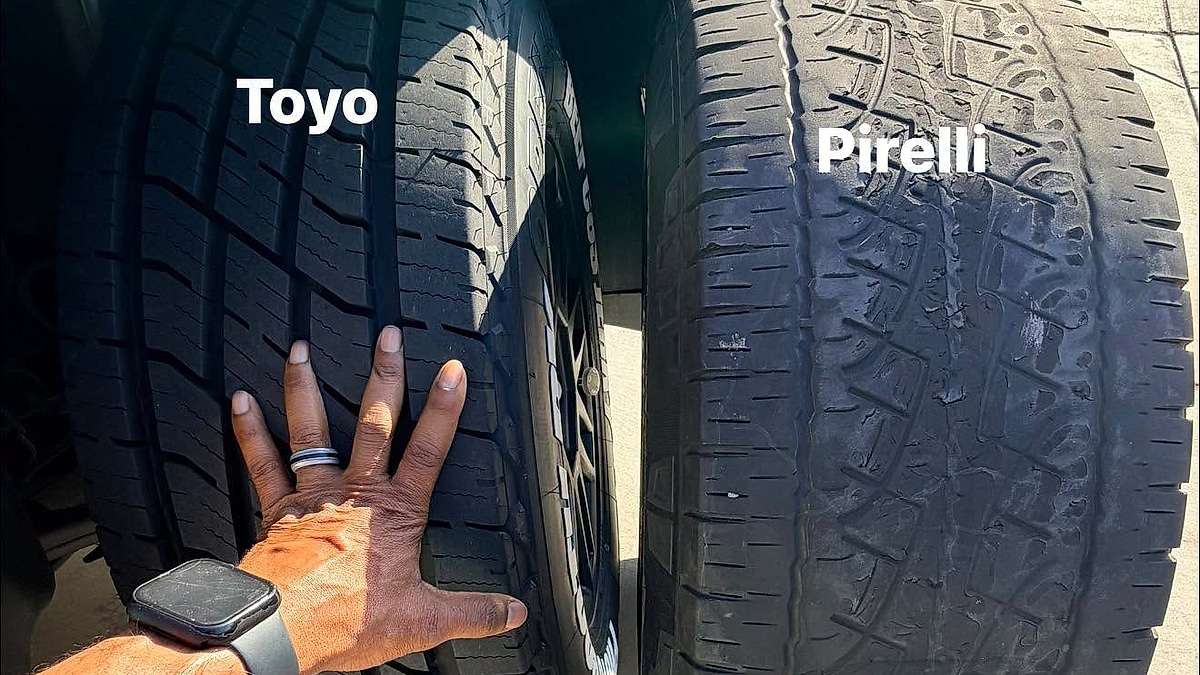

A Cybertruck owner replaced his Pirelli Scorpion tires after 19,000 miles and says the Toyo Open Country H/T tread depth alone tells the story.
BennettBianca Reid’s post has the tone of someone who has already spent the money, stared at the old tires, mounted the replacements, and decided the debate is over.
His Cybertruck Premium wore out its Pirelli Scorpion tires in about 19,000 miles. He says he rotated them every 5,000 miles. He says his driving was not reckless, pointing to a 97% FSD score and mostly Standard and Hurry mode before switching to Standard and Chill. He also blames the Cybertruck’s rear-wheel steering for some of the wear, though he does not treat that as the whole explanation. Then he put Toyo Open Country H/T tires on the truck.
His reaction was immediate: the Toyos had far deeper tread than the Pirellis ever appeared to have. He described his fingers disappearing into the Toyo grooves, while the Pirelli tread depth felt shallow from the start. He expects at least double the tire life and says he would be satisfied with that.
A Cybertruck owner did the thing heavy-EV owners keep doing after their first replacement bill: he stopped treating the factory tire as sacred.
The Pirelli Scorpion Was Built For A Compromise
Tesla’s Cybertruck all-season tire choice makes sense on paper.
The Pirelli Scorpion ATR T0 in 285/65R20 is a Tesla-marked, EV-focused tire. It carries the ELECT marking, PNCS noise-reduction technology, and an 116H XL service description. Tesla’s service material describes it as the range-focused highway option for the truck, separate from the Goodyear Wrangler Territory RT all-terrain fitment. That tells you what Tesla wanted.
Factory Tread Depth Gives The Toyo A Significant Head Start
- Pirelli Scorpion ATR Cybertruck-spec tires are commonly listed around 10/32-inch tread depth.
- LT285/65R20 Toyo Open Country H/T II tires are commonly listed around 15.7/32-inch tread depth.
- Tesla recommends Cybertruck tire rotations every 6,250 miles or when tread-depth difference reaches 2/32 inch.
A quiet tire. A range-friendly tire. A tire that could carry the truck, fit the aero package, ride acceptably, keep cabin noise under control, and handle the strange mission of a 6,000-plus-pound stainless EV pickup with rear-wheel steering and enormous torque.
The factory tire was never going to please everyone.
A tire optimized around range and refinement can give up tread depth, casing stiffness, long-wear behavior, puncture toughness, or aggressive tread block volume. A tire that looks sensible on the EPA cycle can look weak after a year under a driver who uses the truck hard, rotates regularly, and still sees the tread disappear before 20,000 miles.
That is what happened here.
Reid’s conclusion is blunt: the Scorpion did not have enough tread from the start, and the Cybertruck punished it quickly.
Tread Depth Is Visible, But Tire Life Is More Complicated
The Toyo looks deeper because it is deeper.
Common LT285/65R20 Open Country H/T II listings show roughly 15.7/32-inch tread depth. The Cybertruck-spec Pirelli Scorpion ATR is commonly listed at 10/32 inch. That difference is huge when the owner is standing beside the truck with his fingers in the grooves. A deeper tread gives the Toyo an obvious visual advantage.

It also gives the owner more rubber to spend before the tire reaches replacement depth. That does not guarantee double or triple life by itself. Tread compound, casing design, heat, alignment, rotation discipline, inflation pressure, road surface, driver inputs, load, toe behavior, regen, and tread squirm all decide how fast that rubber turns into dust.
One commenter said tread depth does not equal tire life.
He is right.
He is also missing why the owner reacted so strongly.
A 10/32-inch factory tire on a very heavy EV truck has less room for error. Once the Cybertruck starts eating shoulders, scrubbing in parking lots, or wearing unevenly from torque and steering geometry, the tread reserve disappears quickly. A tire starting around 15.7/32 gives the owner more margin before the same wear pattern becomes a replacement bill.
Depth is not the whole answer.
It is still a very persuasive beginning.
The Cybertruck Is Brutal On Tires By Design
Reid points to torque and rear-wheel steering, and he should.
The Cybertruck is a heavy electric pickup with immediate power, large tires, and a four-wheel-steering system that changes how the rear tires behave during low-speed turns. Rear-wheel steering helps the truck feel smaller. It improves maneuverability. It makes parking lots less ridiculous. It also means the rear tires are doing work that normal fixed rear tires do not do.
That matters in daily life.
Parking lots. Driveways. Tight turns. U-turns. Slow maneuvers. FSD steering inputs. All of those can add scrub. A heavy truck with huge torque already asks a lot from its tires. Add rear steering and repeated low-speed corrections, and tire wear can become part of the ownership cost in a way owners feel quickly.
Chris Hamrick made a sharp comment in the thread: FSD can hurt tires because it may turn the wheel without the kind of rolling motion a careful driver would use. That is worth paying attention to. A human who knows tires will often let the vehicle creep before adding steering angle. Automated steering may prioritize path control rather than tire sympathy.
That does not mean FSD destroyed the Pirellis.
It does mean driver-assistance behavior should be part of the wear conversation.
19,000 Miles Is A Bad Result For A Truck Tire
A 19,000-mile replacement interval on a Cybertruck tire is expensive enough to make owners angry.
Some commenters reported better results on Goodyears. One said he got 42,000 miles out of his Goodyears before switching. Others mentioned 20,000 miles with plenty of tread left, or 26,000 to 29,000 miles before changing. That range tells us the Cybertruck tire story is not one-size-fits-all.
Roads matter. Alignment matters. Pressure matters. Driving mode matters. Towing matters. Rotation matters. Tire model matters.
Reid rotated every 5,000 miles, which is even more frequent than Tesla’s 6,250-mile recommendation. That makes his 19,000-mile result harder to dismiss. A driver neglecting rotations and then complaining at 19,000 miles would be easier to blame. This owner claims he did the maintenance and still got roughly one year.
That is exactly when brand loyalty starts to crack.
Once a truck owner believes the factory tire is the weak link, the next set becomes an experiment.
The Toyo H/T Delivers The Road-Focused Performance This Setup Demands
A highway-terrain Toyo is a very different answer than another Pirelli Scorpion ATR.
The Toyo Open Country H/T family is designed around long tread life, highway use, year-round manners, wet-road stability, and predictable wear. The LT285/65R20 H/T II fitment commonly carries a much higher load index than the Pirelli and far deeper tread. It also weighs more.
That trade is important.
The Toyo may last longer. It may feel more durable. It may resist squirm and wear differently under the Cybertruck’s weight. It may also cost range, ride quality, steering crispness, or noise compared with the Pirelli. A heavier LT tire can change how the truck accelerates, coasts, rides over small impacts, and reports road texture through the cabin.
Owners who only look at tread depth may miss the rest.
Reid seems willing to accept that trade. His priority is tire life. After 19,000 miles from the Pirellis, that priority makes sense.
Load Rating May Be The Toyo’s Quiet Advantage
One commenter wondered whether load range partly explains the difference.
That is a smart place to look.
The Cybertruck-spec Pirelli Scorpion ATR is a 116H XL hard-metric tire, commonly listed with a 2,760-pound max load. The LT285/65R20 Toyo Open Country H/T II E-rated tire is commonly listed with a much higher load rating, around 3,860 pounds single. That does not increase the Cybertruck’s official axle rating, and Tesla warns that higher-load tires do not raise the vehicle’s GAWR. Still, a stiffer, heavier-duty tire may tolerate the abuse differently.
The Pirelli was engineered to meet Tesla’s target for range and comfort.
The Toyo may be better aligned with an owner who wants tread depth, casing strength, and mileage. That does not make it a perfect Cybertruck tire. It makes it a more truck-like tire.
That may be exactly what many Cybertruck owners want after their first fast-wearing OE set.
The Price Of Longer Life May Be Range And Traction
Greg Clark’s comment in the thread deserves more attention: longer tread life can come with reduced traction.
That is often the bargain.
A harder compound may wear longer but grip less. A deeper tread may last longer but squirm more when new. A heavier LT tire may resist wear but reduce efficiency. A highway-terrain tread may run quieter than an all-terrain, but it may give up some off-road bite. A tire that earns an owner 40,000 miles may feel less sharp than one that dies at 20,000.
Cybertruck owners need to decide what they are buying.
The Pirelli’s 520 A B UTQG rating suggests a tire balanced around treadwear, traction, and temperature performance, with Tesla-specific tuning for EV duty. The Toyo’s H/T family leans toward highway wear and durability. The owner wants mileage. He switched to Chill. He wants to stop buying tires every year.
That is a rational choice.
But if the Toyos give him double the miles and cost him some wet grip, emergency braking feel, or energy efficiency, the trade deserves an honest update later.
The replacement set should be judged after 5,000, 10,000, and 20,000 miles, not after the first photo of deep tread.
Standard/Hurry To Standard/Chill Was Probably The Smartest Move
Reid changed from Standard and Hurry to Standard and Chill.
That may help more than he expects.
Tire wear on an EV truck is not only about dramatic launches. It is also about every little acceleration event, every regen deceleration, every steering correction, every tight turn, and every time the driver asks the tire to handle torque while the truck’s weight is still shifting.
Chill mode can smooth the power delivery. Smoother power delivery reduces how often the tire is asked to absorb a sudden torque spike. On a vehicle with this much mass and instant response, the boring setting may be the tire-friendly setting.
That does not mean Cybertruck owners need to drive like monks.
It means they should stop pretending driving mode has no cost.
If a driver wants maximum tire life, Chill belongs in the experiment. So does tire pressure discipline, alignment checks, rotation records, and avoiding stationary steering whenever possible.
The Model X Lesson Applies, With Limits
Reid says he tripled tire mileage on his Model X after switching from a staggered setup to a uniform wheel size.
That experience shaped his Cybertruck decision.
The logic is sound. Square setups rotate better. Rotation extends tire life when wear is uneven. A staggered setup can trap wear on one axle, especially on heavy EVs. The Cybertruck already uses the same size front and rear in factory form, so the Model X lesson does not transfer perfectly. Still, his bigger point holds: tire setup can completely change EV ownership costs.
EVs expose tire mistakes quickly.
A heavy vehicle with instant torque can make a premium tire look weak. A square setup, regular rotations, sensible alignment, and a tire chosen for the owner’s real use can rescue the budget.
Reid tried the factory answer.
Now he is testing a tire built around a different priority.
What I Would Watch Over The Next 10,000 Miles
The Toyo update should include more than tread depth.
Start with efficiency. Compare Wh/mile or mi/kWh before and after on the same route, same speed, same pressure, and similar weather. The Toyo’s heavier construction may cost energy, especially at highway speed. If the owner gets double the tire life but loses range, many Cybertruck drivers may still accept it. They deserve the number.
Next, watch wet grip. A fresh deep tread can feel planted in rain, but compound matters. Cybertruck owners should pay attention to ABS behavior, emergency braking feel, and cornering confidence in storms.
Then watch noise. The Pirelli has PNCS foam technology to reduce cabin noise. The Toyo H/T may be quiet for a truck tire, but the Cybertruck cabin can make tire differences obvious. A tire that sounds fine at 40 mph may drone at 75.
Finally, track actual wear. Measure all four tires at inner, center, and outer tread blocks every 5,000 miles. Photos are useful. Measurements are better. If the Toyos wear evenly after 10,000 miles, the experiment gets serious. If the shoulders start vanishing early, alignment or steering scrub may still be the larger problem.
Do Not Skip Alignment On A Cybertruck Eating Tires
A Cybertruck that kills tires at 19,000 miles needs an alignment conversation.
Even wear across all four Pirellis would point more toward tire compound, vehicle weight, torque, and use. Uneven wear tells a different story. Shoulder wear, feathering, cupping, inside-edge wear, or front-to-rear mismatch can reveal toe, camber, pressure, rotation, or suspension issues.
Rear-wheel steering makes that inspection more important, not less.
A Cybertruck owner switching to deeper Toyos should get the alignment checked early, then again if the truck starts wearing the new tires strangely. Otherwise the Toyos may hide the same problem longer because they start with more rubber.
That is an expensive way to delay the diagnosis.
The new tires deserve a clean baseline.
The Pirelli May Be The Wrong Tire For This Owner, Even If It Is Not A Bad Tire
Reid calls the Pirelli Scorpion trash.
I understand why he feels that way.
A 19,000-mile tire life on a truck this expensive will make any owner feel robbed. The visible tread-depth difference made the replacement decision feel obvious. He did his rotations, watched the tires vanish, and bought something that looks built to last longer.
Still, there is a more useful way to frame it.
The Pirelli may be the wrong tire for his use. It may be too range-focused, too shallow, too comfort-oriented, or too compromised for a driver who wants long tire life on a high-torque truck. Other owners may get better results from the Pirelli. Some may value range and quietness enough to accept faster wear. Some may drive smoother roads, tow less, use different modes, or have better alignment from day one.
For this owner, the factory tire failed the value test.
That is enough.
The Cybertruck Needs A Tire-Life Conversation That Goes Beyond Brand Loyalty
Cybertruck owners are going to learn fast.
This truck is heavy. It has rear steering. It has strong acceleration. It has unusual tire demands. It has owners coming from Teslas, pickups, SUVs, and performance cars, each with different expectations. Some will expect EV efficiency. Some will expect pickup durability. Some will expect both.
Tires will expose the conflict.
The Pirelli Scorpion ATR is the range-and-refinement answer. The Goodyear Territory RT is the more all-terrain answer. The Toyo Open Country H/T is the long-wear highway-truck answer. Bridgestone, Michelin, Nitto, BFGoodrich, and others will keep entering the conversation as owners burn through original sets and start collecting real mileage reports.
That owner data will matter more than launch-day tire theory.
Reid’s report is useful because it gives a number, a maintenance habit, a driving-mode change, and a clear replacement choice. It also gives future Cybertruck owners a testable claim: Toyos should double or triple the Pirelli mileage.
Now the tires have to prove it.
Real-World Charging Performance Sets Expectations For Owners
If you are happy with Cybertruck range, noise, and traction on the Pirellis, keep measuring and rotating.
If your Pirellis are dying before 20,000 miles, stop arguing with the tread. Check alignment. Check pressures. Review driving mode. Look at rear-steer scrub. Measure tread depth across the full tire. Then choose the next set based on the job you actually need.
For Reid, that job is tread life.
The Toyo Open Country H/T makes sense for that mission. It starts with a deeper tread, a more truck-like construction, and a reputation built around highway durability. It may cost him some efficiency, quietness, or grip. Maybe it will not. The first 10,000 miles will answer that better than any comment thread.
The Cybertruck’s factory Pirelli may be optimized for Tesla’s range and comfort targets.
This owner wants tires that survive the truck.
That is the reality he is testing now.
Would You Switch From Pirelli To Toyo On A Cybertruck?
If you own a Cybertruck, what tire did you start with, how many miles did it last, how often did you rotate, and what did you replace it with? Include tread depth, driving mode, tire pressure, alignment history, towing use, and whether rear-wheel steering seems to be eating the shoulders.
Thanks for reading guys. Come back tomorrow, or check our Torque News Home Page for more interesting automotive news articles.
First image by BennettBianca Reid on Facebook.
About The Author
Noah Washington is an automotive journalist based in Atlanta, Georgia, covering sports cars, luxury vehicles, and performance culture. His reporting focuses on explaining the engineering, design philosophy, and real-world ownership experience behind modern vehicles.
Noah has been immersed in the automotive world since his early teens, attending industry events and following the enthusiast communities that shape how cars are built and driven today. His work blends industry insight with enthusiastic storytelling, helping readers understand not just what a car is, but why it matters.
Noah is also a member of the Southeast Automotive Media Association (SAMA), a professional organization for automotive journalists and industry media in the Southeast.
His coverage regularly explores sports cars, luxury vehicles, and performance-driven segments of the automotive industry, including the evolving culture surrounding Formula Drift and enthusiast builds.
Read more of Noah's work on his author profile page.
You can also follow Noah here:
Set Torque News as Preferred Source on Google
Follow us today...