
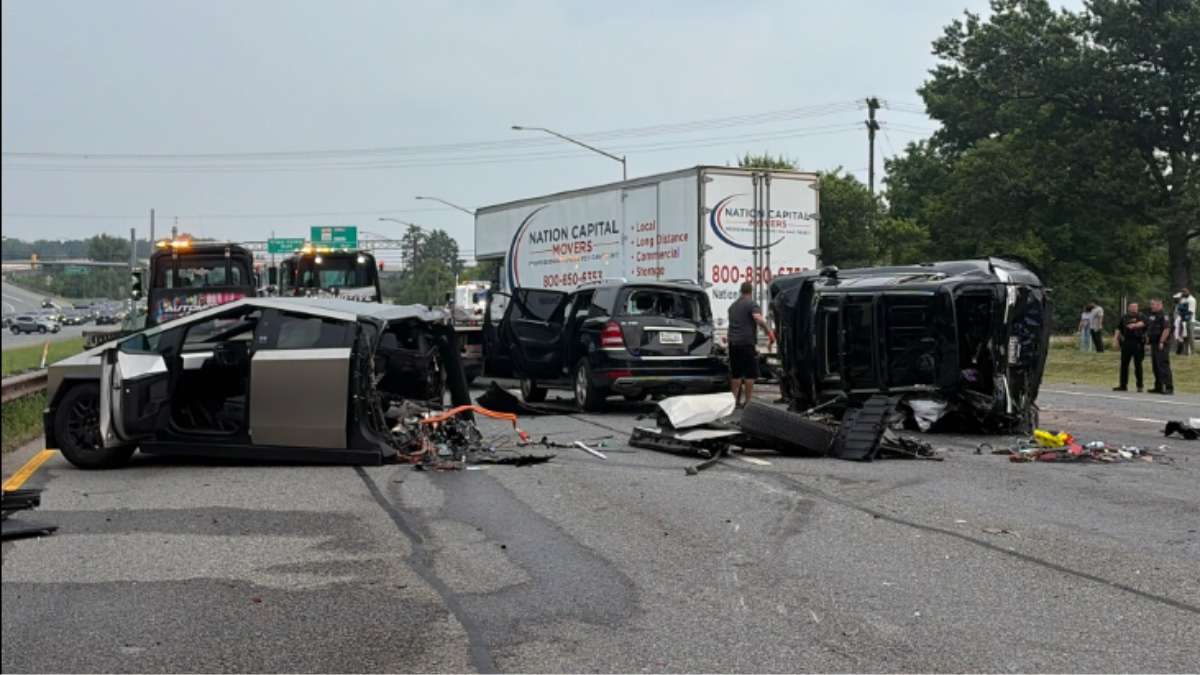

A moving truck went out of control on a Maryland highway and tore a Tesla Cybertruck clean in half. The cabin should have gone with it. It did not, and the reason why connects directly to a rare look at how Tesla actually crash tests the Cybertruck and to an owner who already called this truck the safest vehicle in the world months before this crash ever happened.
I want you to picture this for a second, because I did too when I first saw the photo.
Saturday afternoon, July 18, Columbia Pike and Fairland Road in Silver Spring, Maryland. A moving truck loses control and plows through traffic like a bowling ball through pins, striking at least ten vehicles. When the dust settles, one of those vehicles, a Tesla Cybertruck, is sitting on its side in two separate pieces. The rear section is torn away from the cab. High voltage cables are hanging out in the open air for the whole world to photograph.
If you only saw that image cold, with no context, you would assume the worst. I know I would have ten years ago, back before I had covered enough of these stories to know better. But here is the part that stopped me in my tracks, and the part that should stop you too. Montgomery County Police confirmed that every single person involved, all ten hospitalized, including three children, walked away with only minor injuries. Eighteen people total were evaluated at the scene. Nobody needed anything close to a trauma unit.
Thank God, and that's the engineering doing exactly what it was built to do.
The Cab Stayed a Cab
Here is the detail that automotive journalists like me obsess over and that most casual readers skip right past. The Cybertruck did not just survive this crash. It survived it in the one way that actually matters. The occupant cell, the boxed steel cage that surrounds the driver and passengers, stayed intact while the rear structure absorbed and redirected the violence of the impact.
This is not a new theory Tesla is testing out on the fly. Torque News has covered rare footage of Tesla's own internal Cybertruck crash testing, and the whole point of that engineering approach is to let the body sacrifice itself so the cabin does not have to. Crumple zones are not a design flaw. They are the plan.
One commenter under the original DriveTeslaCa post on X put it about as well as I could. Randy Witt wrote that breaking the back off the truck absorbs energy, which in turn saves the people inside, and that distributing crash energy away from the humans in the vehicle is the entire point even when the wreckage looks catastrophic.
"Breaking the back off the truck absorbs energy, which saves the occupants. Looks bad but it’s actually good - safely distribute the energy of a crash and move it around and away from the soft, squishy humans," Randy wrote.
He is right, and it is exactly the same principle behind why one Cybertruck owner told us after being t boned by a drunk driver at 60 miles per hour that police said any other vehicle would have flipped.
Why There Was No Fire
Now let me address the question everyone asks the second they hear the word Tesla and the word crash in the same sentence. Where is the fire?
There was not one. No flames, no thermal runaway, nothing but a truck in two pieces sitting quietly on the pavement while firefighters worked the scene. One user in the same X thread, going by Steve, asked a completely fair question. He wanted to know how you split a battery pack that runs the length of the frame in half without triggering a leak or a fire. It is a smart question, and it deserves a real answer instead of internet speculation.
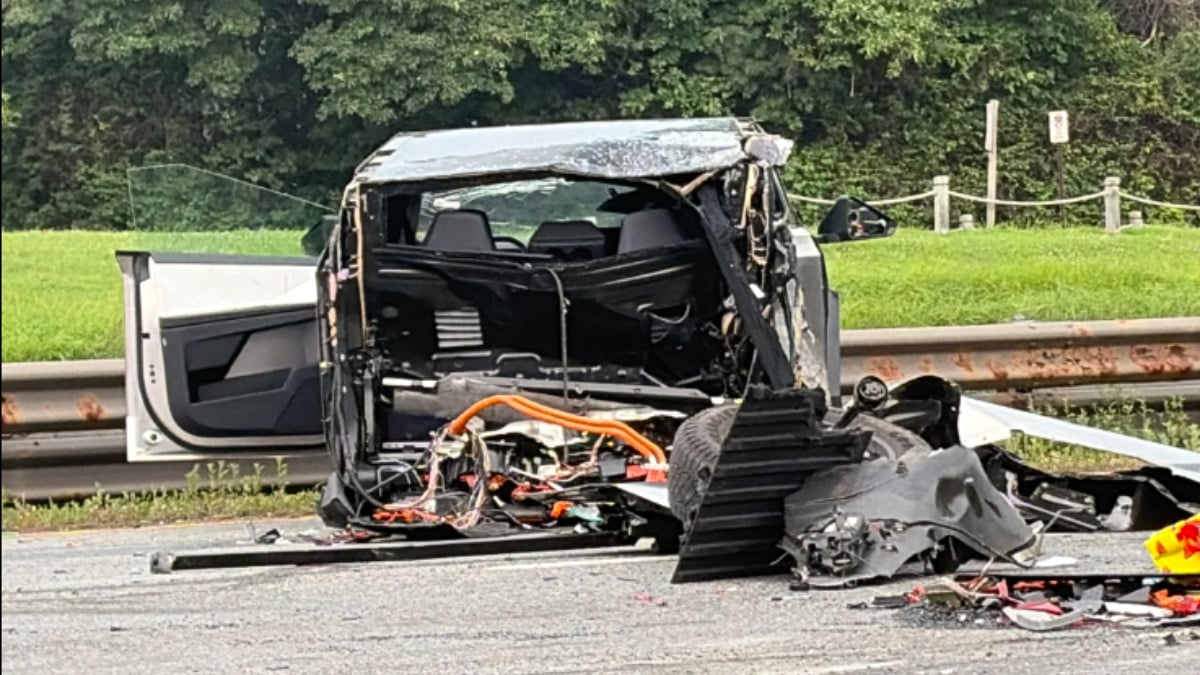
Tesla's battery architecture is built with structural separation and containment in mind, and Torque News has tracked this pattern for years, including one incident where a Cybertruck's fire claims after an off road battery strike turned out to be far more suspicious than the viral video suggested. We have also dug into cases the internet assumed were battery fires and were not even close, like the Cybertruck explosion outside a Las Vegas hotel that turned out to be a homemade device in the truck bed rather than the battery itself.
The bigger picture matters here too. We have also debunked outright fake images of Cybertrucks supposedly engulfed in flames, and the real fire statistics from federal safety data tell a story most people never hear. Electric vehicles catch fire at a dramatically lower rate than gasoline vehicles, and this Maryland crash, with a truck torn completely in two, is about as extreme a real world stress test as you will find on a public road.
Not the First Time This Truck Has Been Tested
This is far from the only time a Cybertruck has been put through something it should not have survived and came out the other side with the people inside intact. Torque News readers have shared stories of an accident where a driver's airbags never even deployed because the truck absorbed the hit so well that the other vehicle was totaled instead, and of debris falling off a truck on the highway and striking a Cybertruck, where the owner credited the stainless steel body and shatter resistant glass for keeping the damage minimal.
I am not here to tell you the Cybertruck is a perfect vehicle. It is not, and Torque News has never shied away from covering the legitimate criticism around Cybertruck crash testing and the misinformation that swirls around it in both directions. Federal testing backs up the bigger picture though. NHTSA gave the Cybertruck a five star overall safety rating, including the lowest overall probability of injury of any pickup truck the agency has tested.
What The Automotive World Is Saying
Word of this crash spread fast, and it was not just Tesla fans talking about it. Carscoops covered the scene and called it the most visually extreme Cybertruck related accident the outlet has come across so far, which tells you something given how many wild Cybertruck stories have made headlines this year.
That framing matters. This was not a controlled lab test with padded barriers and crash dummies. This was a real moving truck, out of control, striking ten vehicles on a public highway in the middle of the day. The kind of chaos no engineer can fully simulate on a test track. And still, the people inside that Cybertruck got to go home to their families.
The Lesson Underneath The Wreckage
If there is one thing fifteen years of covering this industry has taught me, it is that a vehicle's true character does not show up in a showroom. It shows up on the worst day of someone's life, on a stretch of highway they never expected to end up on. Steel bends. Metal tears. Trucks split apart. But when the people walk away because the machine did its job, that is when you know the engineering was not just marketing talk.
This crash will not end the debate over the Cybertruck's design, its price, or its polarizing looks. It probably should not. But it does add one more real world data point to a growing list, and that list keeps pointing in the same direction.
So here is what I want to know from you. If you were one of those ten people involved in this crash, would this outcome change how you feel about EV safety going forward? And do you think stories like this one deserve more national coverage than they usually get? Drop your thoughts in the comments below, I read every single one.
Images by Montgomery County Department of Police.
Return tomorrow, or check our Torque News Home Page for more interesting automotive news articles.
About The Author
Armen Hareyan is the founder and Editor-in-Chief of Torque News and an automotive journalist with over 15 years of experience writing car reviews and industry news. Now based in the Charlotte region (Indian Land, SC, he founded Torque News in 2010, which since then has been publishing expert news and analysis about the automotive industry. He can be reached at Torque News on X, Linkedin, Facebook, and Youtube. Armen holds three Masters Degrees, including an MBA, and has become one of the known voices in the industry, specializing in the landscape of electric vehicles and real-world stories of actual car owners. Armen focuses on providing readers with transparent, data-backed analysis bridging the gap of complex engineering and car buyer practicality. Armen frequently participates in automotive events throughout the United States, national and local car reveals and personally test-drives new vehicles every week. Armen has also been published as an automotive expert in publications like the Transit Tomorrow, discussing how will autonomous vehicles reshape the supply chain, and emerging technologies in vehicle maintenance.
Set Torque News as Preferred Source on Google
Follow us today...


Comments
Funny how only one of the 5…
Permalink
Funny how only one of the 5 vehicles is identified by brand. And the best part, thank God, all are safe.
The Cybertruck is engineered…
Permalink
The Cybertruck is engineered to dissipate the energy in a wreck, the passenger cabin is safe. And it didn’t catch fire like an ICE care would with a gas tank.