
Eight miles is a comfortable walk and a miserable towing reserve.
A Cybertruck owner posting as MidwestCruiser00 was preparing for an off-grid camping trip close to home. He filled the trailer’s water tank, loaded a generator, kept the rest of the payload light, and entered the camper’s specifications into the truck. The Cybertruck answered with 107 miles of estimated range.
The first charging opportunity on the route was 99 miles away.
“Any variation in wind or speed and I may not make it,” he wrote in an owner-group post. He considered holding the combination to 60 mph on an interstate posted at 80 mph if the trip required a charging stop.
The owner had no complaint about power or stability. “It pulls the camper like nothing is attached,” he wrote.
“I wouldn’t notice if it weren’t for extreme battery drain.”
That sentence separates the Cybertruck’s two towing identities. At the hitch, it feels abundantly capable. On the map, an eight-mile cushion can make a gust of wind feel like a mechanical problem.
The Truck Had 7.5 Percent of Its Estimate in Reserve
The arithmetic is severe because it is so simple.
Subtract the 99-mile leg from the displayed 107 miles, and eight remain. Those eight miles represent about 7.5 percent of the truck’s estimate. That is a raw dashboard margin, not a promised arrival reserve. The post does not provide the starting battery percentage, predicted arrival percentage, weather, elevation, trailer weight, trailer dimensions, or the exact route.

Tesla’s Cybertruck towing instructions explain why the owner was right to enter a trailer profile. The manual says accurate mass, dimensions, and auxiliary settings help the truck estimate consumption. It also warns that towing significantly reduces range and tells drivers to reduce speed.
The 107-mile figure, therefore, deserves neither blind trust nor dismissal. It is the Cybertruck’s best estimate from the information available at that moment. The owner still has to manage the reserve.
Tesla’s navigation documentation describes the more useful number: predicted battery percentage at the next stop. The system accounts for driving style and predicted speed, along with wind, temperature, air density, and humidity when the necessary data are available. It updates the arrival estimate while the truck moves.
For a 99-mile towing leg, I would watch that arrival percentage more closely than the static range in miles. Set a deliberate arrival reserve, navigate to the actual charger, and pay attention to the trend during the first 15 to 20 miles. If the prediction is falling steadily, buying early buys more than waiting for a yellow warning near the end.
Sixty MPH Costs Time and Buys Air
At a steady 60 mph, 99 miles takes about one hour and 39 minutes. At 80 mph, the same distance takes roughly one hour and 14 minutes. The mathematical difference is about 25 minutes before traffic, stops, construction, and trailer-safe speeds enter the calculation.
The energy difference can be much larger than the time difference.
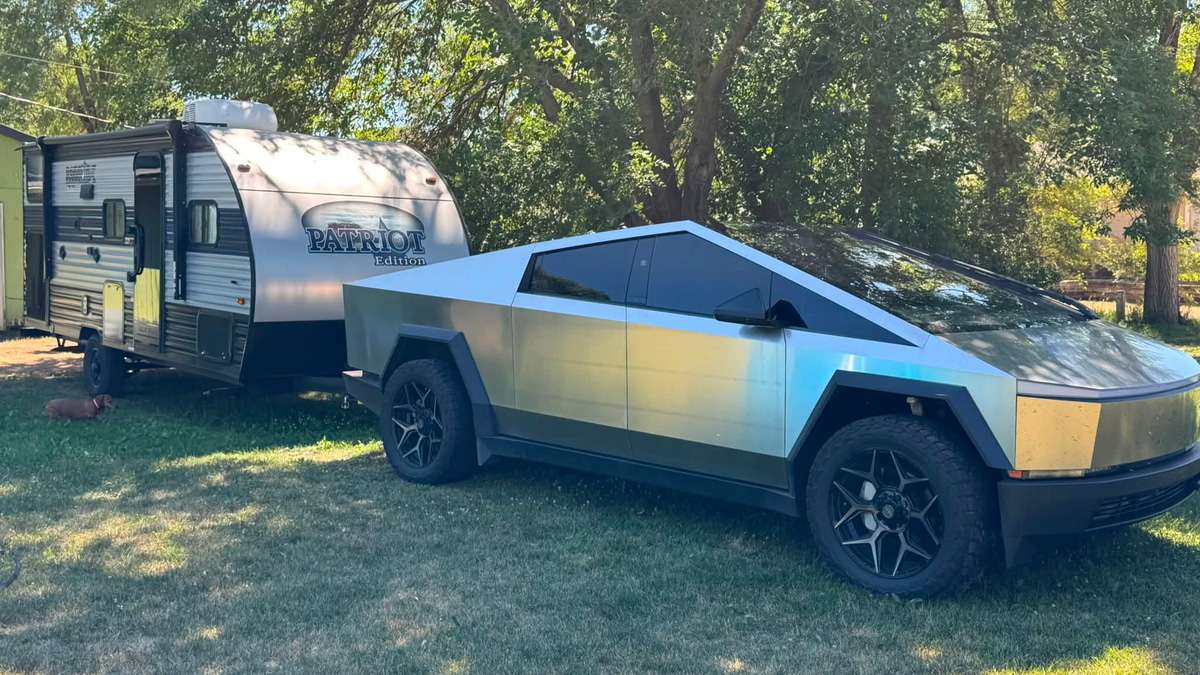
Aerodynamic drag rises rapidly with speed. The supplied photograph shows a conventional travel trailer with a tall front wall extending well above the Cybertruck’s roofline. The pickup’s stainless-steel wedge meets the air first, then delivers disturbed flow to a much larger box. The trailer keeps presenting that frontal area for every second the combination remains at highway speed.
Trailer mass still matters during acceleration, climbing, braking, and over uneven roads. On a flat interstate at a steady pace, shape and speed often dominate the energy bill. The owner’s light cargo load cannot make the camper’s front wall disappear.
Tesla lists elevated speed, wind, heavy cargo, and trailer towing among the factors that increase energy consumption. Slowing to 60 mph is therefore a rational response to a thin range margin, even if surrounding traffic requires careful lane choice and heightened awareness. Trailer tire ratings, local laws, road conditions, and safe traffic flow remain more important than defending any particular speed.
The Comment Thread Produced Five Different Cybertrucks
Other owners replied with towing ranges from roughly 100 to 175 miles. Read casually, the figures look contradictory. Read with the trailers attached, they start making sense.
Amber Hardy reported traveling from Phoenix to Northern California with a 35-foot Brinkley i294 and typically seeing 100 to 120 miles between charges. Spencer Bradley Suggs said he averaged 150 miles between stops from Oklahoma to Texas and arrived with about 15 percent remaining, adding that he drives slowly and stays in the right lane. Anders Tharaldsen reported about 140 miles with a 10 percent buffer while towing a 4,000-pound camper at 55 mph.
Andrew Amble claimed an average of 175 miles between charges with a 32-foot Airstream, crediting its aerodynamics. That number lacks the speed, weather, route, starting percentage, ending percentage, and energy consumption needed for a clean comparison. Its direction is plausible. A rounded Airstream can ask less from a tow vehicle than a lighter trailer with a blunt face.
A previous Torque News owner report documented the same pattern more completely. A Cybertruck towing a 4,500-pound, 22-foot Airstream Sport averaged 520.8 Wh/mi over 200 miles, or about 1.92 mi/kWh. The rounded, relatively narrow trailer raised that owner’s normal consumption by a reported 41 percent.
Another owner towing a pop-up camper at 70 mph reported using exactly twice the normal energy and treated 150 miles as the planning limit. Even a pop-up can place a wide flat section above the truck’s wake and pay heavily for speed.
Sergio Rodriguez supplied the most dramatic screenshot in the current discussion. One display showed 112 miles since charging, 111 kWh used, and 989 Wh/mi. That works out to roughly 1.01 mi/kWh. His broader Trip B showed 506 Wh/mi over 1,641 miles, but the screenshot does not establish how many of those miles included his 37-foot trailer. Treating the lower lifetime-style figure as a towing average would produce a result that the image does not support.
The owner reports are useful once their limits remain attached. They do not define a Cybertruck towing range. They define several combinations of truck, trailer, speed, route, weather, and reserve.
Arrival Is Only Half of an Off-Grid Range Plan
MidwestCruiser00 also asked what happens after the rig reaches camp.
An off-grid destination can turn a successful one-way arrival into a stranded round trip. The truck needs enough energy to return to a charger, reach a campground with suitable electrical service, or use another legitimate charging source. The generator in the owner’s payload may provide emergency energy, but small portable generators charge a large EV slowly and introduce fuel, noise, exhaust, and connection requirements.
There is another operational detail for anyone hoping to charge the Cybertruck while powering the camper from the bed. Tesla’s cargo-outlet instructions say the AC outlets may be disabled whenever an AC charging cable is connected, even when the truck is not actively charging. Tesla says the outlets remain available during DC fast charging.
That means an owner should not assume the truck can accept AC power from a campsite or generator while simultaneously feeding the trailer through its outlets. Verify the exact operating mode before building a camping plan around it. Never backfeed a truck outlet or improvise a connection outside the manufacturer’s instructions.
A campground with 50-amp service can be strategically valuable on a charger-sparse route because the overnight stop becomes the charge stop. For true boondocking, the return-energy requirement should be entered into the plan before departure, not discovered after the awning is open.
The Next Post Needs Wh/Mile, Not Another Range Guess
MidwestCruiser00 has already supplied the part most towing discussions miss: the exact emotional consequence of the estimate. A 107-mile display facing a 99-mile charger gap changes speed, lane choice, departure charge, and willingness to continue.
The next trip can turn that concern into transferable data.
Record the loaded trailer weight, tongue weight, height, width, starting battery percentage, departure temperature, wind, average speed, elevation change, arrival percentage, miles traveled, and Wh/mi. Photograph the Energy screen at departure and arrival. Note whether the truck’s prediction gained or lost percentage during the leg.
Those details would tell another owner whether this tall camper is truly a 107-mile combination under ordinary conditions or whether the initial estimate was conservative. They would also show how much range the driver recovered by choosing 60 mph.
The Cybertruck did the easy-looking part. It moved the camper without drama. The route planner exposed the constraint that torque cannot solve.
Cybertruck owners towing full-height travel trailers, what trailer profile, average speed, Wh/mi, and arrival reserve do you use when the next charger is close to the edge of the prediction?
One image by MidwestCruiser00
About The Author
Noah Washington is an automotive journalist based in Atlanta, Georgia, covering sports cars, luxury vehicles, and performance culture. His reporting focuses on explaining the engineering, design philosophy, and real-world ownership experience behind modern vehicles.
Noah has been immersed in the automotive world since his early teens, attending industry events and following the enthusiast communities that shape how cars are built and driven today. His work blends industry insight with enthusiastic storytelling, helping readers understand not just what a car is, but why it matters.
Noah is also a member of the Southeast Automotive Media Association (SAMA), a professional organization for automotive journalists and industry media in the Southeast.
His coverage regularly explores sports cars, luxury vehicles, and performance-driven segments of the automotive industry, including the evolving culture surrounding Formula Drift and enthusiast builds.
Read more of Noah's work on his author profile page.
You can also follow Noah here:
Set Torque News as Preferred Source on Google
Follow us today...