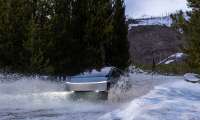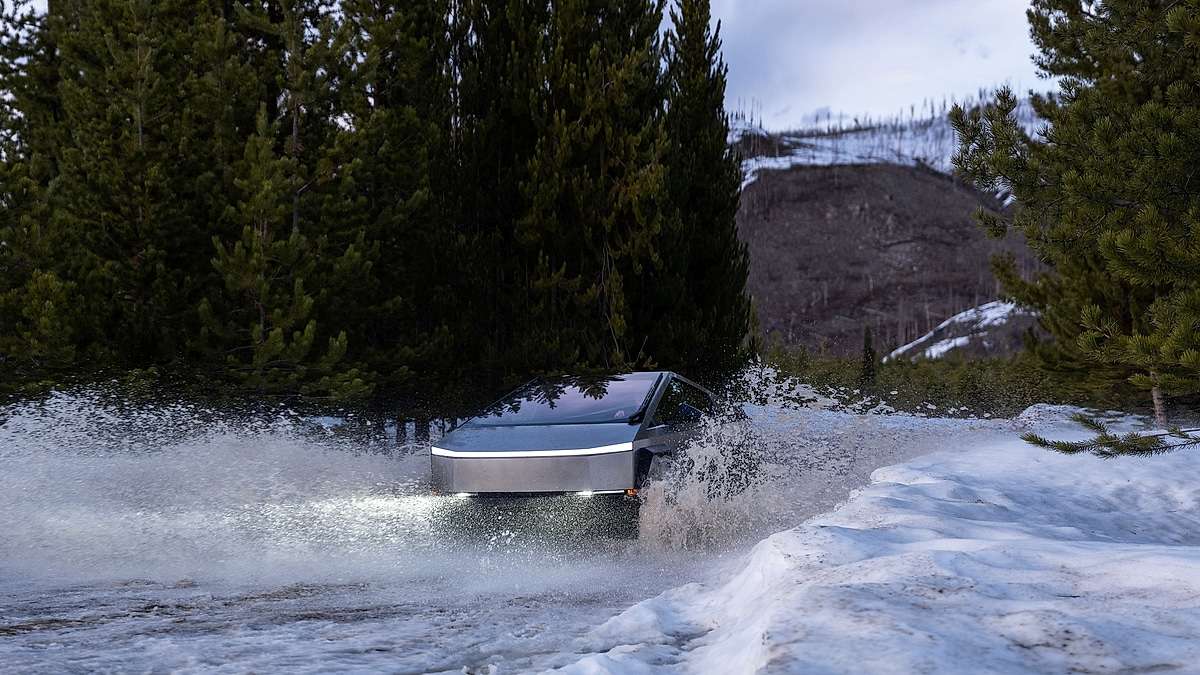

Gary Love took his Cybertruck and threw it at the map.
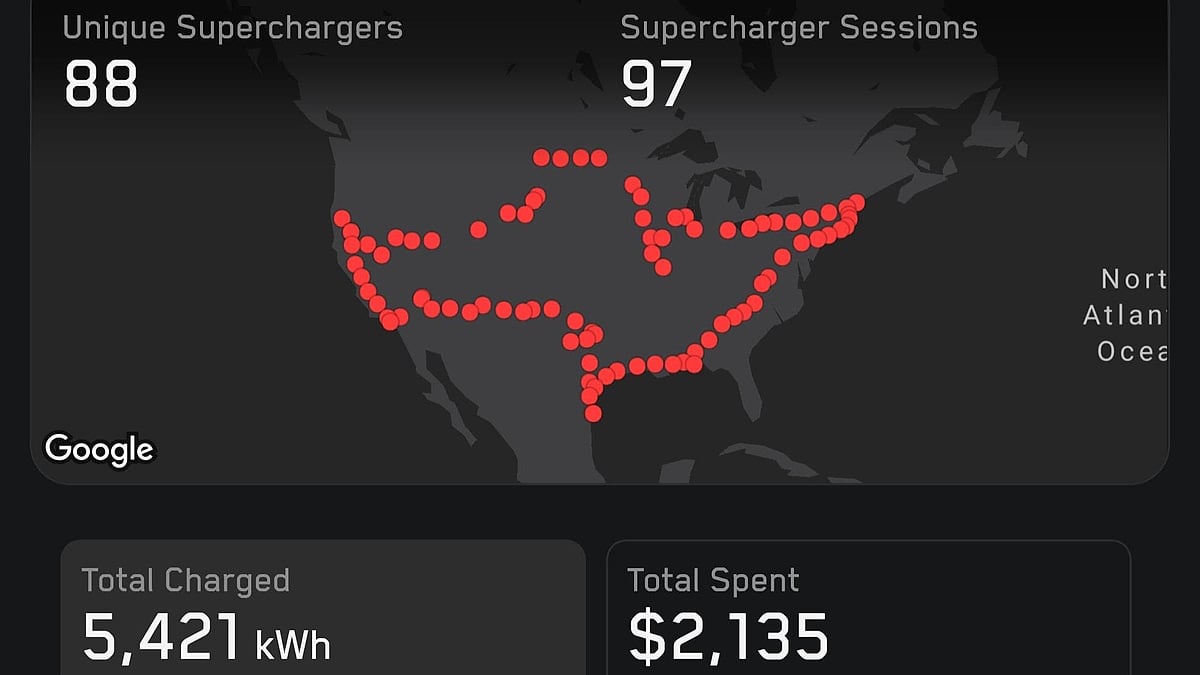
From June 1 to June 17, he crossed 35 states, logged 10,396 miles using FSD, and left behind a Supercharger trail that looks like someone drew a red dotted horseshoe around America. The charge-stat screen shows 88 unique Superchargers in the last 31 days and 97 Supercharger sessions. His written trip summary lists 1,755 minutes plugged in, or 29 hours and 15 minutes.
- 10,396 miles driven across 35 states in 17 days using FSD (Supervised)
- 97 Supercharger sessions at 88 unique locations, totaling 29 hours and 15 minutes charging
- $1,913.31 spent on charging, averaging about 18.4 cents per mile
That sounds like a lot of charging until the mileage lands beside it.
Over 10,396 miles, his charging time works out to about 10 seconds per mile traveled. Spread across the trip, it comes to roughly 1 hour and 43 minutes of charging per day. The average session was 18.7 minutes. The shortest was 5 minutes. The longest was 61.
A driver can waste more time than that in a Buc-ee’s restroom line behind a family wearing matching vacation shirts.
The trip cost him $1,913.31 in charging fees, according to his post. That puts the energy cost at 18.4 cents per mile. The Tesla charge-stat screen, which appears to cover the broader last-31-day window, shows $2,135 spent and 5,421 kWh charged. If that energy figure roughly aligns with the trip, the Cybertruck consumed about 1.9 miles per kWh across a brutal highway-heavy month.
The Supercharger Map
A single charging stop tells you almost nothing.
A 10,000-mile month tells you whether the network has bones.
Love used 88 different Superchargers. That matters more than the peak-kW bragging rights attached to any one cabinet. The map shows a route crossing the West, dipping through the Southwest and Texas, cutting across the South, running up the East Coast, and filling in the Midwest. The Cybertruck was not surviving on one perfect corridor. It was using the Tesla network as a national road system.
That is the advantage Tesla still owns.
A charging network becomes valuable when the driver stops thinking of it as a collection of individual stations and starts treating it like infrastructure. Love’s trip suggests he could plan, adjust, charge, and keep moving without turning every stop into a separate research project.
There were 97 sessions across 10,396 miles. That averages roughly 107 miles between Supercharger sessions, though that does not mean he always needed to stop that often. On a trip this long, charging becomes mixed with food, bathrooms, lodging, traffic, weather, route choices, and the owner’s appetite for reserve. Some stops are short top-ups. Some are real battery sessions. Some are just convenient moments to plug in while the driver does something human.
That is why the average stop matters.
Eighteen-point-seven minutes is short enough to disappear into a normal travel rhythm if the site is placed well. It is long enough to add meaningful energy. It is also short enough to mock the old idea that EV road trips require sitting beside a charger like a monk guarding a candle.
The Cost Was Good, Not Amazing
Love’s $1,913.31 trip cost works out to $0.184 per mile.
That is respectable for a stainless-steel electric pickup covering more than ten thousand miles at interstate scale.
At $3.50 per gallon, 18.4 cents per mile is roughly equivalent to a gasoline truck getting about 19 mpg. At $4 per gallon, it is closer to a 22-mpg equivalent. That comparison depends entirely on local fuel prices and charging rates, but it frames the number honestly.
It crossed America at a cost many full-size gas trucks would recognize as favorable, especially considering the route length and the likely highway pace. The highest charging price Love listed was 48 cents per kWh. The lowest was free at a hotel. The 31-day screenshot shows $2,135 spent against 5,421 kWh, which averages about 39 cents per kWh.
A hotel plug or free destination charge can soften the bill. A pricey Supercharger in a high-demand corridor can harden it again. The owner who pays attention saves money. The owner who just follows the navigation pays whatever the route demands.
Love appears to have paid for convenience and speed more than absolute economy. On a 17-day, 35-state run, that is a reasonable choice.
The FSD Number Needs Plain Language
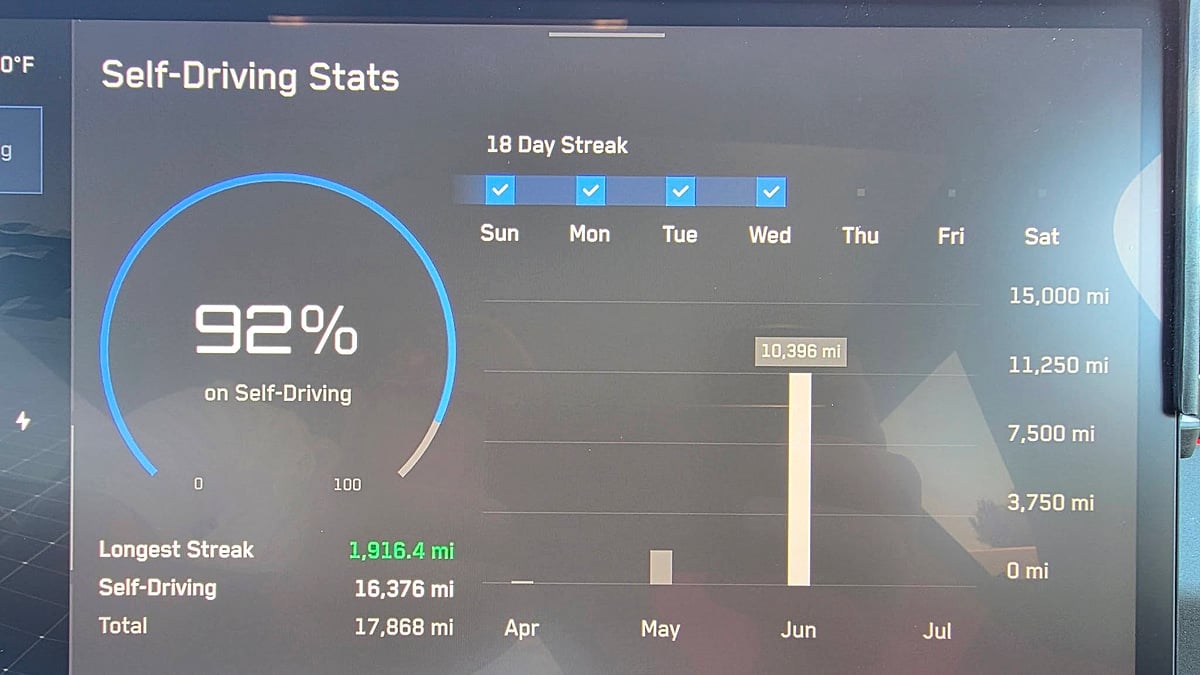
Love says he logged 10,396 miles using FSD.
The Cybertruck’s self-driving screen shows 92 percent on self-driving, 16,376 self-driving miles, 17,868 total miles, and a June bar marked 10,396 miles. It also shows an 18-day streak and a longest streak of 1,916.4 miles.
Tesla calls the system Full Self-Driving (Supervised). The supervised part is not fine print. The driver remains responsible. The driver watches the road. The driver takes over when needed. The system can reduce workload, but it does not turn the Cybertruck into a private train car.
That matters because the wrong telling of this trip turns it into nonsense. A 10,396-mile supervised driver-assist run across 35 states is impressive enough without pretending the truck was autonomous in the science-fiction sense.
The useful claim is narrower and stronger.
A Cybertruck owner spent 17 days crossing the country and used FSD for the vast majority of the driving. If the system handled that much highway, city, construction, merge, lane-change, and traffic work under supervision, then FSD has moved from novelty to a road-trip tool for owners willing to monitor it constantly.
That is a real ownership change.
Not because the driver disappears.
Because the fatigue changes.
This Is What A Modern Endurance Test Looks Like
Old road-trip endurance tests were mechanical.
Could the engine hold together? Would the transmission cook? Would the cooling system survive the heat in summer? Would the driver finish with ringing ears, numb legs, and the smell of hot oil following him into the motel?
The Cybertruck’s test was different.
Could the charging network support a 10,396-mile month? Could the truck maintain efficiency and route flexibility across 35 states? Could FSD reduce the work of sitting behind the wheel for days on end? Could the owner keep charging stops short enough that the trip felt like movement rather than waiting?
The numbers say yes.
They also reveal the cost of doing it hard. Twenty-nine hours and 15 minutes plugged in. Nearly two thousand dollars in trip charges. Ninety-seven Supercharger sessions. A total energy draw that could power some homes for months.
This is not the fantasy version of EV ownership where every mile is silent, cheap, effortless, and morally clean.
It is the working version.
The truck ate electrons, crossed states, used the charging network constantly, and kept going.
That is more interesting than perfection.
The Average Session Was More Important Than The Longest One
The 61-minute-long session will get attention because it sounds like the old EV complaint.
An hour at a charger. Terrible. Unacceptable. Gas wins. Cue the usual chorus.
That misses the shape of the trip.
The shortest stop was 5 minutes. The average was 18.7. Across 97 sessions, the long stop became one entry in a much larger pattern. Road trips are not judged by the worst stop unless the worst stop becomes normal. Love’s data says it did not.
A 5-minute stop can add enough buffer to skip a worse decision later. A 15-to-20-minute stop can overlap with bathrooms, food, phone calls, route checks, or stretching. A one-hour stop may reflect a meal, a low arrival, a hotel decision, a busy charger, or a deliberate longer reset.
The average is the number to watch.
At under 20 minutes, Love’s stops were not controlling the whole trip. They were part of the rhythm.
The Cybertruck Still Needed Help
The owner’s trip also shows what the Cybertruck does not solve by itself.
A 10,000-mile month still needs route judgment. It needs charging awareness. It needs a driver who understands compatible stations, arrival buffers, price variation, weather, traffic, and the limits of FSD. It needs someone willing to stop 97 times without turning the whole process into a grievance.
The truck provided the platform.
The driver provided the method.
That is why this trip deserves attention. It is not a clean laboratory test. It is a messy owner record filled with the numbers that actually matter: miles, sessions, time, cost, unique chargers, self-driving percentage, and real route coverage.
The Cybertruck made the trip possible.
The Supercharger network made it practical.
FSD made it less punishing.
The owner still had to do the work.
A national charging network only works if the stops stay short enough to keep the day moving. A 10,396-mile trip only becomes plausible if charging does not devour the schedule. A Cybertruck only becomes a real cross-country tool if its refill routine feels manageable after the tenth, fortieth, and ninetieth stop.
Love’s data says it did.
Not cheaply enough to silence every gas-truck comparison. Not autonomously enough to let anyone check out. Not perfectly enough to end the conversation.
Enough to cross 35 states in 17 days.
That is plenty.
Cybertruck Owners, What Is Your Longest Supercharger Month?
If you have done a long Cybertruck trip, share miles driven, kWh charged, total charging cost, average session length, number of Supercharger stops, and how much of the route you drove with FSD supervised.
Two images by Gary Love
Let us know in the comments.
About The Author
Noah Washington is an automotive journalist based in Atlanta, Georgia, covering sports cars, luxury vehicles, and performance culture. His reporting focuses on explaining the engineering, design philosophy, and real-world ownership experience behind modern vehicles.
Noah has been immersed in the automotive world since his early teens, attending industry events and following the enthusiast communities that shape how cars are built and driven today. His work blends industry insight with enthusiastic storytelling, helping readers understand not just what a car is, but why it matters.
Noah is also a member of the Southeast Automotive Media Association (SAMA), a professional organization for automotive journalists and industry media in the Southeast.
His coverage regularly explores sports cars, luxury vehicles, and performance-driven segments of the automotive industry, including the evolving culture surrounding Formula Drift and enthusiast builds.
Read more of Noah's work on his author profile page.
You can also follow Noah here:
Set Torque News as Preferred Source on Google
Follow us today...