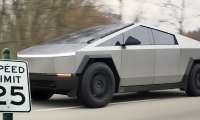

A Cybertruck owner on Staten Island found his vehicle "dead" after a 40 mph highway incident, resulting in a totaled truck and a $10,000 debt for a vehicle he'd owned for just 18 months. The driver, Marlon Pando, reported the truck began sliding in a circle before impacting a median barrier, with video evidence suggesting a catastrophic front suspension failure where "something cracked, busted the tire, and actually cracked the rim." This wasn't a high-speed impact; it was a sudden, uncontrollable event at moderate highway speed.
The specific nature of the failure, a cracked rim and busted tire following an apparent suspension component failure at 36,000 miles, raises significant concerns about the Cybertruck's long-term durability and the integrity of its suspension design. For a vehicle marketed on its robust, stainless-steel exoskeleton, a failure of this magnitude in the underlying mechanicals at relatively low mileage is a critical issue that extends far beyond one owner's unfortunate crash.
The Cybertruck's front suspension appears to have a critical vulnerability that can lead to sudden, dangerous loss of control, and Tesla needs to address it before more owners face similar or worse outcomes.
"Anyone aware of who I should talk to about this? Other than a lawyer... My Cybertruck is dead! After just getting on a Staten Island highway, doing about 40 miles an hour, the truck started sliding in one circle, hit the middle rail, and turned around and stopped while I was facing oncoming traffic. No one got hurt, but my truck is totaled, and I will owe about 10K. I don't have Gap Insurance.
My 1st accident ever after driving for close to 40 years. As you will see on the video, something cracked, busted the tire, and actually cracked the rim. I loved this truck, and this is my 2nd Tesla and would even consider another. Could this be a factory recall or a new issue others are dealing with? Had the truck for 18 months and used it to deliver organic Pillows and Mattresses all over the USA. It has 36,000 miles.
Any advice would be greatly appreciated. Pretty sad ..."
Pando's account of a sudden, unprovoked loss of control at 40 mph, culminating in a suspension component failure, is precisely the kind of scenario that demands immediate scrutiny from the manufacturer. His claim of "something cracked, busted the tire and actually cracked the rim" points directly to a mechanical failure preceding the impact, rather than being a consequence of it. This isn't a driver error; it's a vehicle integrity question.
Tesla Cybertruck: Front Suspension Durability Concerns
- The Cybertruck features an adaptive air suspension system, offering up to 16 inches of ground clearance and 12 inches of wheel travel, designed for both on-road comfort and off-road capability. This complex system relies on robust components to manage the truck's significant curb weight, which can exceed 6,800 pounds.
- Owner Pando reported a catastrophic front suspension failure at 36,000 miles, leading to a cracked rim and busted tire after the vehicle allegedly began sliding at 40 mph. This mileage is well within the expected lifespan of major suspension components, which typically last 50,000 to 100,000 miles under normal driving conditions.
- Unconfirmed reports from other owners and technicians have circulated regarding potentially loose or improperly torqued suspension bolts in early production Cybertrucks. Such a defect could compromise steering and stability, leading to sudden component failure and loss of control, especially under load or during dynamic maneuvers.
- The incident resulted in a totaled vehicle and a $10,000 out-of-pocket expense for the owner, who lacked gap insurance. This shows the financial vulnerability of owners if a manufacturing defect is proven and not covered by warranty or recall, placing the burden of proof and financial loss squarely on the consumer.
The immediate response from some corners of the internet, however, often defaults to blaming the driver or external conditions. Jason Dorrington, in the comments, suggested sharing dashcam footage to show "vehicle steering angle and road conditions," and then offered a questionable defense: "The wheel is intended to be shattered by the extension on the knuckle to avoid push back into the cab.
This feature protects the occupants." This is a dangerous misinterpretation of engineering principles; while crumple zones and breakaway components are designed to absorb energy, no wheel assembly is "intended to be shattered" as a primary safety feature during a low-speed incident. The wheel and suspension are designed to maintain control and structural integrity, not fail preemptively.
Jim Kono offered more sound advice, suggesting an insurance company's forensic study to determine fault, which is exactly what should happen here. The burden of proof for a manufacturing defect often falls on the owner, but the evidence of a pre-impact component failure, especially a structural one, would shift that significantly. What Pando describes is not typical for a vehicle with 36,000 miles, regardless of how "heavy-duty" it's marketed to be.
Anthony Dowd's comment, however, introduces a critical detail: "There is a rumor of some that may loosen." He was referring to suspension bolts. Reports of loose suspension bolts, particularly in early production vehicles, have plagued several manufacturers over the years, leading to recalls and serious safety concerns. If a critical suspension bolt on a Cybertruck, especially one with 36,000 miles, were to loosen or fail, it could absolutely lead to the sudden loss of control and subsequent damage Pando describes.
Kip Garrison's assertion that "it was definitely bad weather" and "Dude lost control 100%" is a dismissive, uninformed take that ignores the owner's description and the potential mechanical issues. Even in bad weather, a vehicle should not spontaneously "start sliding in one circle" at 40 mph due to a suspension failure. This kind of immediate driver-blaming, without any evidence, is precisely why manufacturers can often deflect responsibility for systemic issues.
This situation echoes historical patterns where manufacturers initially dismiss owner reports of mechanical failures as isolated incidents or driver error, only for a pattern to emerge later. The question isn't whether Pando was driving perfectly, but whether the vehicle's components performed as designed. A cracked rim and busted tire from an internal failure, not an external impact, points to a design or manufacturing flaw that needs to be investigated thoroughly.
Pando's Cybertruck incident is a flashing red light for Tesla's quality control and the long-term durability of a critical safety system. The evidence of a pre-impact suspension failure, coupled with unconfirmed but persistent rumors of loose suspension bolts, demands an immediate, transparent investigation from Tesla and the NHTSA. Owners should not have to rely on social media speculation to understand if their $80,000-plus vehicle has a fundamental flaw that could lead to a sudden loss of control.
Image Sources: Tesla Media Center
About The Author
Noah Washington is an automotive journalist based in Atlanta, Georgia, covering sports cars, luxury vehicles, and performance culture. His reporting focuses on explaining the engineering, design philosophy, and real-world ownership experience behind modern vehicles.
Noah has been immersed in the automotive world since his early teens, attending industry events and following the enthusiast communities that shape how cars are built and driven today. His work blends industry insight with enthusiastic storytelling, helping readers understand not just what a car is, but why it matters.
Noah is also a member of the Southeast Automotive Media Association (SAMA), a professional organization for automotive journalists and industry media in the Southeast.
His coverage regularly explores sports cars, luxury vehicles, and performance-driven segments of the automotive industry, including the evolving culture surrounding Formula Drift and enthusiast builds.
Read more of Noah's work on his author profile page.
You can also follow Noah here:
Set Torque News as Preferred Source on Google
Follow us today...