
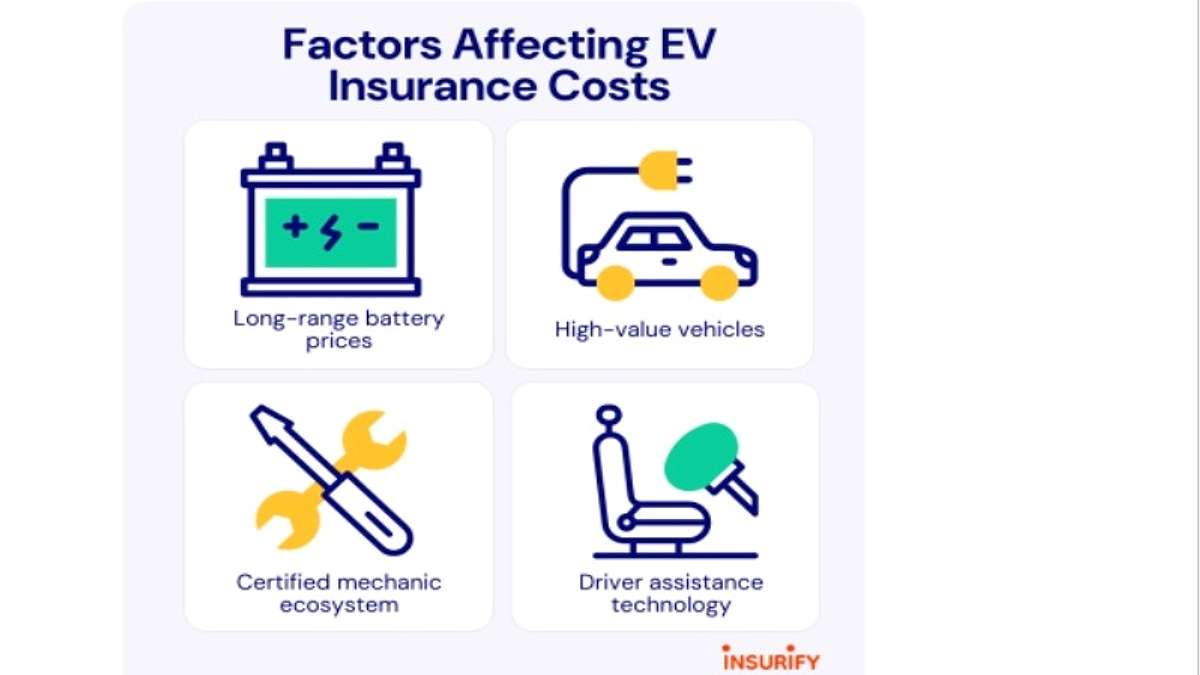

A new study will be all over the news today. The experts at Insurify crunched the numbers on battery electric vehicle insurance and compared the costs to conventional gas vehicles in the same size and price range. Insurify found that, on average, the EVs had a $941 higher annual insurance cost. When comparing only newly-purchased vehicles, the EV penalty was $501.The upshot is that the extra cost to insure an EV muddies any plan of saving money on fuel. We scrutinized the report, which compared EVs to conventional gas-powered cars, and found that it had excluded the simplest option for those who want to save money on transportation - hybrids. We asked for some additional information, and what Insurify sent us was a revelation.
Insurance Cost - Affordable Hybrids vs. EVs
At Torque News, we cover all types of vehicles, but when we cover topics related to cost savings, we step back and ask, are Mercedes-Benz, Audi, and BMW shoppers really looking at EVs as cost-saving options? We think not. It makes no sense to spend lavishly on a luxury model and then try to shave a few bucks a week by switching to an EV. Folks who need to save money look at affordable EV models, and they are smart enough to know that hybrids offer a competitive energy cost with no charging hassles, particularly for those who cannot charge at home.
We asked Insurify for the average annual American-market insurance costs for the most affordable EVs sold today. We then compared them to a cross-shopped hybrid model in the same price and size range. Here’s what the data Insurify provided us with shows:
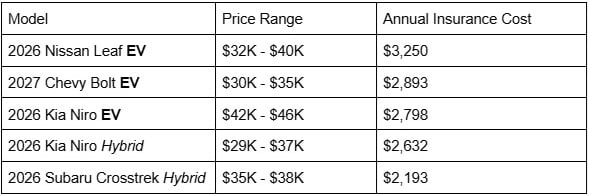
As you can see, the two hybrid vehicles on the list offer the lowest annual insurance cost. The Kia Niro EV vs. the Niro Hybrid is the most interesting comparison. Clearly, the Niro EV’s ten grand vehicle purchase price premium negates any energy savings by itself. On top of that, the Niro Hybrid has a $166 lower annual insurance premium.
It’s the Subaru Crosstrek Hybrid that blows the EVs out of the water when it comes to annual insurance cost. This hybrid will save its owner between $605 and $1,057 on insurance costs each year compared to similarly-priced EVs, and it’s the only model on our list that is all-wheel drive.
Insurify’s EV Insurance Penalty Roundup
Let’s face it, Tesla dominates American-market EV deliveries, so we need to examine some Tesla examples. Here are the three Tesla models currently on sale straight from the Insurify study:
Tesla Model 3 $4,489
BMW 3-Series $3,689
EV Penalty $800
Tesla Model Y $4,021
Audi Q5 $3,011
EV Penalty $1,010
Tesla Cybertruck $4,135
Chevy Silverado (gas) $2,754
EV Penalty $1,381
As you can see, the EV insurance penalty is roughly a thousand dollars per year on high-end vehicles.
Your Costs Will Vary, and Why It Costs More To Insure EVs
Bear in mind that we are comparing national averages in these examples. What you pay for insurance will be largely dictated by where you live, your driving record, the price of the vehicle you are insuring, and the accident repair costs associated with the exact model you choose. Many other factors are also rolled into the quote you get from your insurer.
Insurify does see some trends that help to explain why EVs cost more to insure. Here are some facts that Insurify listed that help to illustrate why EVs are expensive to insure and why Tesla models, in particular, are expensive to cover:
- Battery replacement costs drive high insurance premiums. The Bolt’s battery replacement cost is $9,000. The Model 3 and Model Y have a battery replacement cost of about $13,500.
- All five available Tesla models are among the 10 EVs with the highest insurance costs.
- Tesla’s Model S has an unusually high claims frequency: Despite making up just 0.5% of market share, it accounts for 3.97% of repairable battery EV claims.
The EV Insurance Penalty Is Not Uniform - Massachusetts Tops the Nation
Insurify looked at where EVs cost more to insure compared to other powertrain options. The group discovered that Massachusetts has the highest penalty. It costs a whopping 54% more to insure an EV in Massachusetts than a gas car. In California, the penalty is 21%. “The Boston metro has a high concentration of affluent urban buyers who are early EV adopters, but the body shop network hasn’t kept pace,” said Daniel Lucas, senior carrier partnerships manager at Insurify. “When your car needs a specialist and the nearest qualified shop has a three-week wait, that’s not just an inconvenience; it shows up in your premium.”
Depreciation Is the Real Savings Killer With EVs
As bad as the insurance penalty is for EVs, the real deal breaker is depreciation. EVs have the highest depreciation of any type of powertrain, and hybrids hold their value the best. Check out our prior story, EVs Lose Value So Fast They Offset Gas Savings as Hybrids Come Out Ahead, for detailed comparisons showing how badly depreciation spoils any hopes of gas savings by switching to an EV.
The Bottom Line for Cost-Conscious Shoppers
So where does this leave the budget-minded buyer? The fuel savings of an EV for those who can charge at home are real, but they don’t sit alone on the ledger. Once you stack a higher insurance premium on top of a steeper purchase price and the worst depreciation of any powertrain, the math that once made EVs look like an easy money saver gets a lot murkier. The Kia Niro tells the whole story in one nameplate. Buy the EV, and you pay more up front and a little more every year to insure it. Buy the hybrid, and you keep most of the energy efficiency while sidestepping the charging hassle and the insurance premium.
None of this means an EV is the wrong choice. For drivers who can charge at home, drive more than average annual miles, and plan to keep the car long enough to outrun depreciation, the numbers can still work. But any shopper switching purely to save money owes it to their wallet to run the full comparison, and that means insurance and resale value, not just the price at the pump. For a lot of those buyers, an affordable hybrid easily wins the contest that the EV was supposed to dominate. And if you can’t charge at home, a hybrid is the slam dunk choice.
Please remember that your own quote is the only one that matters. Where you live moves the needle more than almost anything else, and a driver in Ohio is playing an entirely different game than one in Massachusetts, where the study showed that insuring an EV runs 54 percent more than a comparable gas car. Get real price quotes and insurance quotes on the exact EV and hybrid models you are considering before you sign anything. Do that easy homework, and a lot of shoppers will find the smart money was on a hybrid all along.
John Goreham is a 14-year veteran of Torque News. An accomplished writer and a long-time expert in vehicle testing, Goreham also serves as the Vice President of the New England Motor Press Association and has a growing social media presence. He’s also a 10-year staff writer and community moderator for Car Talk. Goreham holds a B.S. in Mechanical Engineering and an undergraduate Certificate in Marketing. In addition to vehicle and tire content, he offers deep dives into market trends and opinion pieces. You can follow John Goreham on X and TikTok, and connect with him on LinkedIn.
Graphic courtesy of Insurify. Chart by John Goreham using data from Insurify.
Set Torque News as Preferred Source on Google
Follow us today...




Comments
The conclusions the author…
Permalink
The conclusions the author makes are not supported by the survey he links which compares gas cars with EVs and makes no claims about hybrids. Beyond the author making claims unsupported by the article he links, the other issue I take with both Insurify and the authors' unscientific extrapolation of cherry-picked data he request from Insurify to write his article, is that the EV has a higher base price than the comparable gas model and neither the author nor Insurify attempt to control for cost. Higher priced vehicles tend to have higher priced parts and therefore higher value claims when damaged. It appears that the study has noticed that higher priced cars also cost more to insure.
From the study: "Where a manufacturer has an EV and gas-powered version of the same model, like the Ford F-150, Insurify used it as a comparable model. Where this wasn’t the case, Insurify used a gas-powered model from the same manufacturer of the same size class (crossover SUV, midsize sedan, etc.) as an EV to determine a comparable model."
The average Ford Lightning is more expensive because it is laden with more technology than the average gas powered F-150 so that doesn't seem to hold as a valid comparison. If I were doing the study, I would disaggregate the data for the F-150 to see if my methodology was valid. I would want to know the insurance premiums for a F-150 Raptor vs. a top trim level (King Ranch?) vs. a white body fleet truck vs. a Lightning. If they're aggregating all gas version of the F-150, the low cost, no frills fleet truck will overwhelm the higher trims and distort the data.
Then I read the state-by-state case study about Oregon. I live there. I know a lot about vehicle thefts there because I defend those criminally accused of unauthorized use of a vehicle. I have never seen a case where an EV was stolen. Thieves steal 90s and 2000s base model cars with poor or no anti-theft devices, not technology defined computers on wheels. Insurify tells me that EV insurance is higher because older model Hondas, Toyotas, Kias and Ford trucks are stolen. Why do cars not stolen get affected by the insurance rate of cars that are stolen? There's no information except an inference that EVs get stolen at the same rate as all other cars.
Insurify then writes gibberish about how wildfires and attendant floods where people don't live and cars don't park cause higher claims to people who have none of those risks. I don't understand? There are very few roads where there are wildfires and very few houses so very few cars are burned down. How is this causing claims? We'll put aside that the soil structure of the places with trees also discourages flash flooding so they are inventing a cause for a vehicle claims that rarely occurs. Drivers getting stuck on Oregon's drivable beaches (which are presumptively vehicle right-of-ways) during low tide and not being able to rescue them before the tide comes in causes the vast majority of Oregon's flood damage claims. But you'd have to know something about Oregon and not speculate on causation.
I'd expect that EVs have higher claims because insurers are still declaring EVs totaled if there is a risk of damage to the battery tray; but the rate at which an EV is totaled versus a gas car was not studied even as that answer exists within the collected insurance data. Since no one, the author of this article or the author of the study, isn't doing anything more than speculation; the conclusion don't have strong, if any, reliability.
Thank you for your…
Permalink
In reply to The conclusions the author… by Matt Song (not verified)
Thank you for your thoughtful analysis. Our insurance cost data for the hybrids came directly from Insurify. I do like your point in your first paragraph about EVs costing a lot more than other equally-sized vehicles. According to Cox Automotive's May 15th Market Monitor, the EV price penalty average was $6,214. Your comment is very much appreciated.