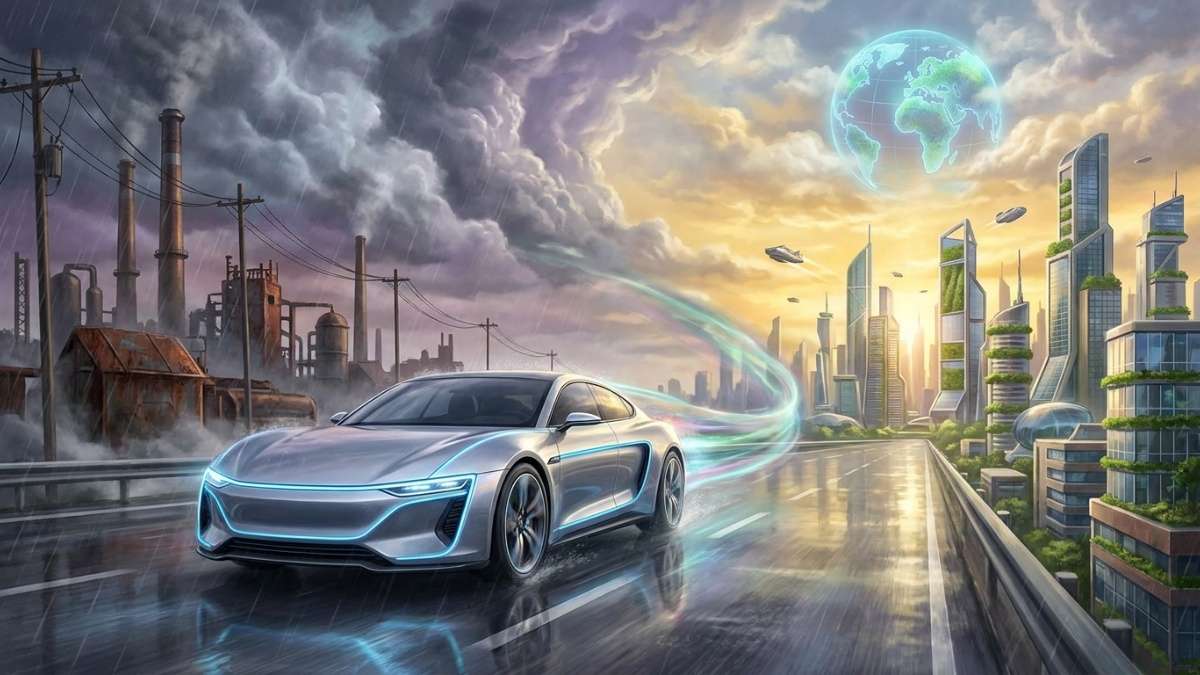

If you listen to the current mainstream narrative in the United States, you might walk away believing the electric vehicle (EV) revolution has completely stalled. We are constantly inundated with headlines about legacy automakers scaling back EV production, consumers suffering from range anxiety, and a general cooling of demand. However, if you step back and look at the global board, a very different and far more disruptive picture emerges.
The reality is that the EV transition isn’t failing; it is relocating. We are witnessing a massive geographic shift in automotive power. While the U.S. and Chinese domestic markets are experiencing their own unique forms of market indigestion, other regions are stepping on the accelerator. In fact, global EV sales recently surged 30%, driven largely by an unexpected vanguard: Europe and emerging markets like Southeast Asia, India, and Latin America.
This pivot from regional dependence to a broader global ecosystem is a classic market disruption event. In the technology sector, we saw a similar phenomenon when smartphones displaced feature phones. Companies that clung to their legacy profit centers in mature markets were completely blindsided by agile competitors who captured the rest of the world. The global automotive industry is currently standing on the edge of that exact same precipice. Let’s break down what this geographic shift means for the established players, who will dominate the landscape by the end of the decade, and who is quietly driving toward a dead end.
The Stagnation of Traditional Giants
To understand the rise of the emerging markets, we first have to understand the stagnation of the established ones. The U.S. market is currently hobbled by a combination of high interest rates, a tragically fragmented and unreliable public charging infrastructure, and the bizarre politicization of what should merely be a superior drivetrain technology. Consequently, domestic legacy automakers have panicked. They are heavily retreating into the perceived safety of plug-in hybrids and extending the lifecycles of their internal combustion engine (ICE) trucks and SUVs to protect short-term margins.
China, on the other hand, faces a different problem: brutal saturation. China has led the global EV charge for the past decade, building a massive, vertically integrated supply chain. However, their domestic economy is currently facing significant headwinds, and their internal EV market has devolved into a hyper-competitive, margin-crushing price war. There are simply too many Chinese EV brands fighting for the same domestic consumer.
Because the U.S. is stalling out on adoption and China is choked by internal oversupply, the global growth engine had to shift. The Chinese automakers, desperate for sustainable margins, have turned their sights outward, intersecting perfectly with a rising middle class in developing nations that are ready to leapfrog legacy auto infrastructure.

Europe and Emerging Markets Take the Wheel
Europe presents a fascinating contradiction. Despite some pushback from conservative political factions and the loud grumbling of legacy European auto executives begging for regulatory relief, the continent is largely pressing forward with its 2035 ban on new ICE vehicle sales. This regulatory certainty has forced continuous adoption. But more importantly, Europe is becoming the primary battleground where Chinese expansion meets legacy defense.
Yet, the true disruption is happening in emerging markets. If you look at India, Brazil, Thailand, and Indonesia, the transition to electric mobility is not being driven by $80,000 luxury SUVs. It is being driven by pure, brutal economics. In these regions, affordable Chinese EVs - often priced well under $20,000 - are flooding the market. Consumers in these countries are discovering that the total cost of ownership for an EV is drastically lower than a gas-powered car, especially in nations that have to import expensive foreign oil.
Just as developing nations skipped the costly process of laying copper wire for landline telephones and jumped straight to cellular networks, they are now leapfrogging the complex, maintenance-heavy internal combustion engine ecosystem and jumping straight to electric mobility. This is a volume game, and volume brings economies of scale that are rapidly making these emerging markets the center of gravity for the global automotive supply chain.
What This Means for U.S. and European Automakers
For U.S. and European automakers, this global shift is nothing short of an existential threat. Let’s start with the Americans. By pulling back their EV investments and pivoting back to gas-guzzling trucks and hybrids, companies like Ford and General Motors are playing a very dangerous game. They are securing their quarterly earnings at the cost of their global future.
If American automakers fall behind on battery chemistry, software integration, and manufacturing efficiency—which they inevitably will if they slow down production—they will become functionally uncompetitive outside of North America. They risk shrinking into hyper-regional, niche manufacturers protected only by heavy U.S. tariffs. You cannot win a global technology race by hiding behind a tariff wall; you only delay the inevitable.
European automakers are in a slightly different, though equally perilous, boat. Volkswagen, Mercedes-Benz, and Stellantis recognize the threat. They have the regulatory mandate to build EVs, but they are currently paralyzed by legacy software architectures and high domestic manufacturing costs. They are watching agile Chinese competitors build cars 30% cheaper and significantly faster.
In response, we are seeing Europeans attempt to buy their way out of the problem. A prime example is Stellantis’s strategic investment in Chinese EV maker Leapmotor, essentially admitting they need Chinese tech to build affordable EVs for Europe and the rest of the world. It is a smart, albeit humbling, survival tactic. European companies that cannot form these life-saving joint ventures, or dramatically overhaul their internal software and production cultures, will be eaten alive in their home markets by 2030.
The Companies and Countries Destined to Dominate in 2030
When we look forward to the end of the decade, the global automotive map will be radically redrawn.
China will absolutely dominate global automotive volume by 2030. Companies like BYD and Geely have achieved a level of vertical integration - controlling everything from lithium mines to battery cell manufacturing to shipping logistics - that legacy automakers can only dream of. BYD is no longer just a Chinese automaker; it is a global juggernaut. By successfully penetrating markets in South America, Southeast Asia, and Europe with high-quality, wildly affordable vehicles, BYD is positioning itself to be the Toyota of the 21st century.
South Korea will be the other major national winner. The Hyundai Motor Group (Hyundai, Kia, Genesis) has executed arguably the most competent EV strategy of any legacy automaker. They built a dedicated, highly efficient EV platform (E-GMP) early, mastered charging speeds, and combined it with striking design. They are aggressive, global, and not slowing down their EV investments despite U.S. market hesitation. They will seamlessly capture market share left on the table by retreating American and Japanese brands.
Finally, Tesla will remain a dominant force, but its role will shift. Tesla is increasingly looking less like a traditional automaker and more like a platform and robotics company. If they can successfully execute on localized production in emerging markets (like their planned ventures in India or Mexico) and license their software and charging standards, they will secure a highly profitable, dominant position at the premium and technological edge of the market.
The Looming Exits and Failures of 2030
Disruption requires casualties, and by 2030, the automotive graveyard will be notably crowded.
First to go will be the underfunded, pure-play EV startups. Companies that lack massive manufacturing scale or deep-pocketed corporate backers are already on life support. Brands like Fisker have already essentially collapsed, and others like Lucid and Rivian face ticking clocks. Unless they are acquired by larger legacy players desperate for their technology (similar to how Amazon backed Rivian, though patience is finite), these bespoke EV makers will burn through their capital before they ever reach the economies of scale required to compete with BYD or Hyundai.
More shockingly, we will likely see the death or complete absorption of several legacy brands. Japanese automakers, aside from perhaps Toyota (which has the cash reserves to survive a late, panicked pivot), are in grave danger. Nissan and Honda have been far too slow to capitalize on their early EV leads. Furthermore, heavily regionalized legacy brands that lack the capital to develop their own EV platforms—such as Chrysler, or smaller European marques like SEAT—will either be shuttered by their parent companies or relegated to mere branding badges slapped onto borrowed Chinese or Korean platforms.
U.S. giants like GM and Ford will not die by 2030, but they will likely be forced into a humiliating retreat. Unless they radically change course, they will exit major global markets, ceding Europe and the developing world entirely, surviving only as heavily protected domestic entities selling profitable trucks and SUVs to the American Midwest. In the tech world, we call this the "BlackBerry maneuver" - surviving by retreating to a niche, while the rest of the world moves on without you.

Wrapping Up
The narrative that the electric vehicle market is collapsing is a uniquely American myth, born from a mix of infrastructure growing pains, political friction, and legacy corporate anxiety. In truth, the global automotive industry is undergoing a ruthless and permanent realignment.
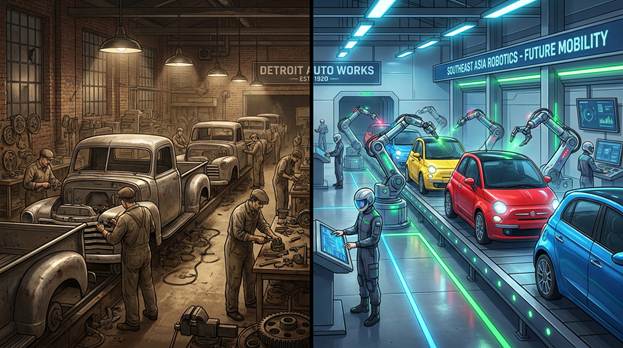
Europe’s regulatory environment and the explosive demand for affordable mobility in emerging markets are more than offsetting any localized slowdowns in the U.S. or China. We are transitioning from an era where Detroit, Wolfsburg, and Toyota City dictated global automotive trends to a decentralized ecosystem where Shenzen, Seoul, and emerging manufacturing hubs in Southeast Asia hold the reins.
The corporate survivors of 2030 will not be the companies that build the most expensive cars, nor will they be the companies that successfully lobby for the highest tariffs. The winners will be the companies that recognize the global demand for affordable, technologically advanced electric mobility and have the vertical integration and operational ruthlessness to deliver it. The rest will simply be footnotes in the history of industrial disruption.
Disclosure: Images rendered by Artlist.io
Rob Enderle is a technology analyst at Torque News who covers automotive technology and battery developments. You can learn more about Rob on Wikipedia and follow his articles on TechNewsWord, TGDaily, and TechSpective.
Set Torque News as Preferred Source on Google
Follow us today...