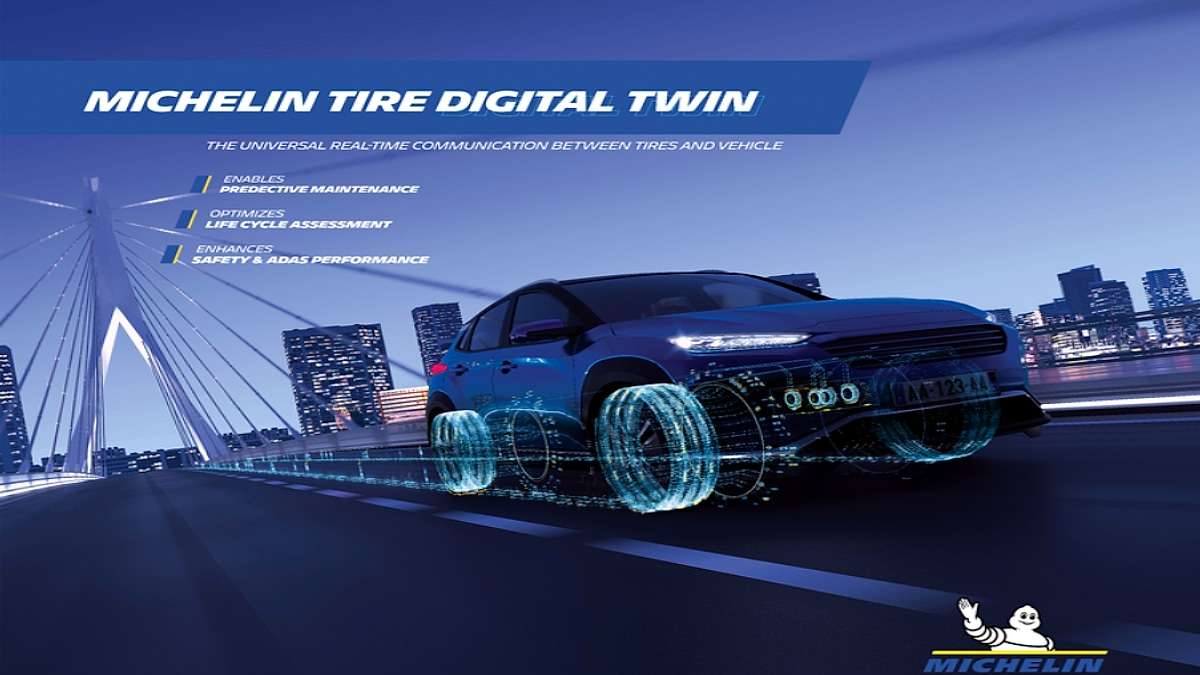

A new sensor-free software platform, designed to enhance overall vehicle performance and sharpen the driving experience, has been developed by Michelin and key partners, including Hyundai and Brembo (the brake experts). It works by linking up with the software already running inside the car, and it works across every tire brand and with virtually any brand or model of vehicle on the road.
At the core of the platform is Michelin's Tire Digital Twin software, which enables predictive maintenance and offers the opportunity to improve vehicle performance. To pull this off, Michelin drew on 130 years of accumulated knowledge in tire physics and paired that background with modern mathematical modeling, cutting-edge artificial intelligence, and data science. The result is a system that turns the data already flowing through a vehicle into useful guidance for drivers, all without leaning on any physical sensors mounted inside the tires.
"Thanks to its universal digital twin, Michelin has built a platform that optimizes the driving experience by connecting vehicle dynamics, driver preferences and tire performance in real time," said Philippe Jacquin, Michelin Group executive vice president research & development and member of the Group Executive Committee. "Every tire, whatever the brand, has its very own embedded intelligence. Michelin is bringing a new dimension to the role of tire manufacturer, and is once again proving its commitment to enhancing reliability for all road users."
Think of this new technology as a living digital copy of a real tire. It keeps a constant watch on each tire and forecasts its condition at any moment, weighing pressure, wear, load, grip, and the conditions outside, then checking all of it against the data gathered by the vehicle itself.
For the driver/owner behind the wheel, the payoff is a series of early warnings rather than unwelcome surprises. Since the software knows how a healthy tire ought to perform and measures that against how the car is actively behaving, it can sniff out trouble long before it turns into a problem. Here is a sample of what Torque News sees this technology predicting:
- Low tire pressure. The twin notices when a tire slips beneath its ideal pressure and warns the driver early, heading off the damage to fuel economy, traction, and tread life before it sets in, and it does so without any valve-mounted hardware.
Worn or aging tires. Tracking tread loss across thousands of miles lets the system estimate when a tire is nearing the end of its safe stretch and prompt a swap before the rubber wears past a trustworthy depth.
2. Alignment issues. Faint, lopsided wear and telltale steering cues can betray a car that has drifted out of alignment, a fault that quietly chews through tires and tugs the vehicle sideways long before a driver picks up on it.
3. Suspension problems. When load and grip readings look off from one wheel to the next, that pattern can expose a tired shock, strut, or related component, reshaping how the tires meet the pavement.
4. Brake problems. Feeding genuine tire information into braking calculations allows the platform to spot fading braking performance and lend a hand in producing stops that are both shorter and steadier.
Rather than just handing raw data over to the car and its driver, the digital twin reaches into the embedded systems and works alongside them to tease out better results. With it in play, a vehicle can read grip ahead of time, drive steadier, trim fuel use, and reshape its stopping distances as circumstances change.
Because everything is woven together, drivers feel the difference on each trip through clear, up-to-the-second readings on how the tires are performing. In practice, that translates to crisper, more dependable handling, and none of it asks the driver to do anything differently. The steady supply of trustworthy data, pulled straight from vehicle signals, also makes predictive maintenance possible and stretches the working life of the tires. When a driver follows through on what the system suggests, tire performance and longevity is maximized.
One of the platform's defining traits is that it runs solely on the data a vehicle already produces, so no extra tire-mounted sensors are needed. That lets it pair with any tire model and augment any vehicle, whether that means a family sedan, a pickup truck, or a sports car.
Michelin expects this system to work with emerging Software Defined Vehicle (SDV) architectures. Bringing this technology to market took more than ten years of research and development, a slew of patents, and a validation program spanning several million miles of testing. The whole thing runs on existing in-vehicle data married to the physical and mathematical models Michelin engineered in-house.
By embedding the tire’s digital twin, Michelin recasts the passive tire as a rich source of data and uses it to help improve not just the tire life and performance, but also braking and handling by leveraging the vehicle's own data ecosystem. As SDVs and self-driving cars go mainstream, including tire technology will be critical.
This technology puts Michelin Group at the forefront of the field and casts it as an ally for automakers moving toward vehicles that lean ever more heavily on software. High-profile collaborations with industry leaders such as Brembo and Hyundai will help enable large-scale industrial rollout.
The tie-up with Brembo puts the benefits of the Michelin digital twin on clear display where ABS is concerned. Folding live tire status into the braking software has boosted the braking system's capabilities, shaving stopping distances by over ten feet while keeping the car more stable under hard braking.
Watch Torque News for updates on this newly emerging technology.
John Goreham is a 14-year veteran of Torque News. An accomplished writer and a long-time expert in vehicle testing, Goreham also serves as the Vice President of the New England Motor Press Association and has a growing social media presence. He’s also a 10-year staff writer and community moderator for Car Talk. Goreham holds a B.S. in Mechanical Engineering and an undergraduate Certificate in Marketing. In addition to vehicle and tire content, he offers deep dives into market trends and opinion pieces. You can follow John Goreham on X and TikTok, and connect with him on LinkedIn.
Set Torque News as Preferred Source on Google
Follow us today...