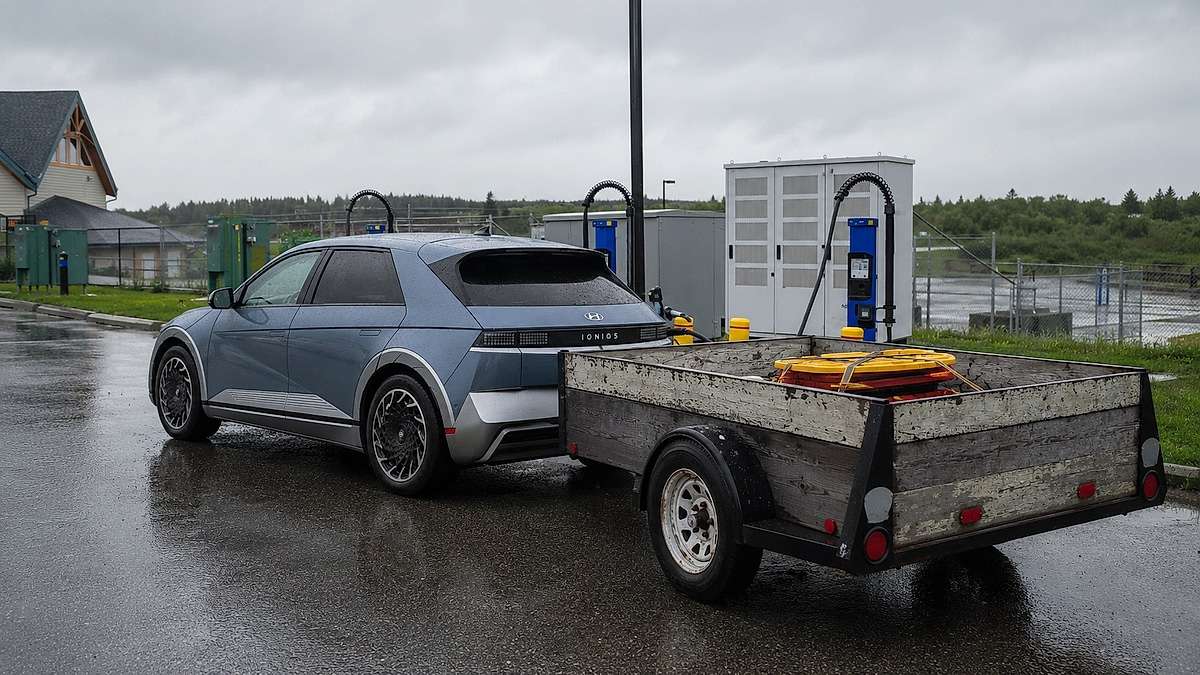

Tyler Harvey’s photo from Chiniki Gas Bar says more about Western Canada’s EV road-trip problem than a dozen infrastructure announcements.
Rain on the pavement. A Hyundai Ioniq 5 backed near the chargers. A small utility trailer still hooked up. Four blue-and-white Kempower dispensers standing beside a large power cabinet. A Smitty’s-style roadside building in the background. No glassy charging lounge. No ribbon-cutting theatre. No lifestyle nonsense.
The gas bar was out of gas.
The chargers worked.
That little contradiction is the whole story.
Harvey posted after his 10th round trip between Seattle and Calgary in a 2022 Ioniq 5. He says the Canadian side of the route improved for a while in 2022, then slid backward. Petro-Canada became a network he no longer trusted. Parkland and On the Run removed many of the FreeWire units he had found disappointing.
Three Details From The Photo That Drivers Will Notice First
- The trailer stayed attached, which suggests the site has enough space and cable reach to avoid a miserable unhitching routine.
- The chargers sit in a visible roadside location, which helps with safety, wayfinding, and confidence during bad weather.
- The empty gas bar irony works because the travel-stop model still fits EV drivers: food, bathrooms, lighting, and a reason to stop.
Tesla Superchargers opened up, but his first-generation Ioniq 5 does not get the good stuff there. He sees about 100 kW on V3 Superchargers, useful in a pinch, dull for an 800-volt Hyundai built to do much better.
Then Chiniki Gas Bar showed up with four new Kempower chargers.
That is the part worth saving.
The Seattle-to-Calgary Route Exposes Weak Infrastructure Faster Than A City Commute Ever Will
A local EV driver can forgive a bad charger. A home charger hides a lot of sins.
A Seattle-to-Calgary run offers less mercy. That route asks an EV driver to cross borders, climates, mountain corridors, rural stretches, provincial networks, and the weird dead zones where charger maps look more optimistic than the pavement feels. The Ioniq 5 helps because it charges fast when the hardware cooperates. It punishes bad infrastructure because the driver knows exactly how quick the stop could have been.

A 2022 Ioniq 5 on a healthy 150-kW to 350-kW CCS charger can turn a stop into a short pause. At a 50-kW charger, the same car becomes an excuse to order food. At a Tesla V3 Supercharger, the car may sit around 100 kW, which beats desperation but wastes the point of the Hyundai’s 800-volt architecture.
That does not make Tesla access useless. It makes it the wrong tool when better CCS hardware exists.
Harvey put it bluntly in the thread: if he wants slow, he can use a BC Hydro 50-kW stop and enjoy a meal. That is the line of someone who has made the trip enough times to know the difference between a backup and a preferred stop.
Chiniki Works Because It Solves The Real Problem
The photo shows what road-trip charging needs to become in the boring places where EV adoption will either grow up or stall out.
Multiple chargers. Long, flexible cables. Clear physical layout. A location already used by travelers. Food nearby. Room around the stalls. Enough hardware that one dead dispenser does not turn the stop into a crisis.
That last part is the killer.
Single-unit fast chargers made early EV road trips feel like a coin toss. If the unit worked, you were a genius. If the screen froze or the cable faulted, you became a weather reporter, a tow-truck negotiator, and a philosopher. Four dispensers change the emotional math. A driver towing a trailer, traveling with kids, running late, or arriving in rain has options.
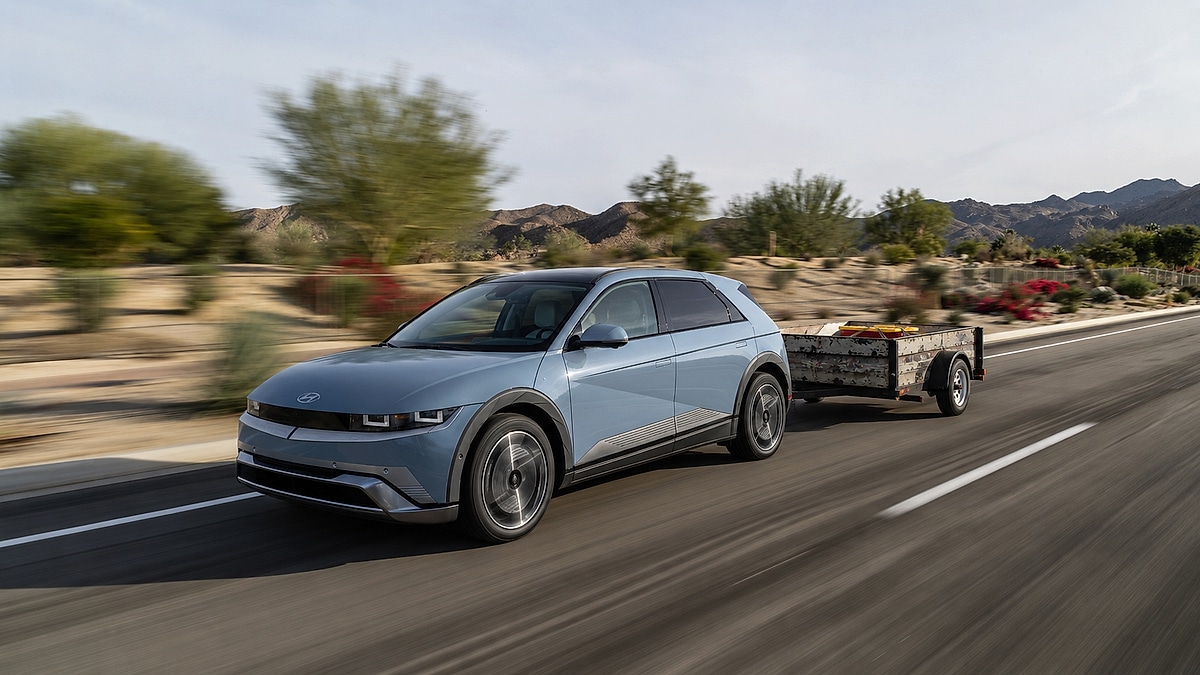
The Ioniq 5 in Harvey’s photo appears to have a small trailer attached. That detail should not be overlooked. Charger placement and cable reach are not abstract design issues when a driver is towing, carrying bikes, hauling gear, or arriving with a roof box and a tired passenger. The best charger is the one that does not make you perform parking-lot origami before it gives you electricity.
Kempower’s satellite-style layout fits that reality better than many older installations. The power electronics sit in a cabinet. The dispensers stay slim. Power can be distributed across stalls. The site can grow if the owner has room and utility capacity. A gas bar can install chargers without pretending to become a Silicon Valley showroom.
That is exactly why this stop feels important.
Petro-Canada And On The Run Show Why Early Charging Bets Aged Poorly
Harvey’s complaint about Petro-Canada and On the Run will sound familiar to many Canadian EV drivers.
The promise was strong. Build chargers at fuel stations and convenience stores. Use familiar roadside locations. Let travelers stop where they already stop. Petro-Canada even branded its network as an electric highway, which was clever because Canada needs exactly that.
The problem was the ownership experience at the plug.
Drivers remember broken chargers more vividly than working ones. One bad stop at night can poison a network for years. A charger that shows up on a map and fails in person is worse than no charger at all, because it creates false confidence. The trip plan collapses at the curb.
Parkland’s FreeWire experiment made sense on paper. Battery-integrated chargers could reduce grid-upgrade pain and speed deployment at convenience stores. That was a real idea, especially in places where utility capacity can slow everything down. The hardware and business story did not age cleanly. When the equipment supplier struggles, parts, support, uptime, and operator confidence become the driver’s problem.
That is why Harvey’s sadness about those sites disappearing makes sense even if he disliked the reliability. Losing bad chargers still leaves holes. Replacing them with better chargers is progress. Leaving the stalls empty is retreat.
BC Hydro Becoming The Adult In The Room Is Good News For Ioniq 5 Owners
Harvey calls BC Hydro one of the bright spots, and that tracks with the direction of the network.
BC Hydro has pushed past 800 charging ports and started adding higher-power hardware, including 180-kW hub sites and 400-kW ultra-fast chargers. That is the kind of expansion that can change a route because it gives drivers repeatable choices. It also gives 800-volt cars a chance to stretch their legs.
Public utility charging will never have the same brand glamour as Tesla Superchargers. Fine. I do not need glamour at 8 p.m. in the rain. I need a working charger, transparent pricing, clean stall placement, and enough ports that I do not have to gamble the day on one handle.
The Ioniq 5 is a perfect test vehicle for this. On mediocre infrastructure, it feels wasted. On strong CCS infrastructure, it becomes one of the easiest road-trip EVs to live with. The car did its part back in 2022. The route has been catching up unevenly ever since.
That is what makes Harvey’s 10th trip useful. He is not judging the network from a launch event or a single lucky stop. He has watched the corridor over multiple years.
The Supercharger Opening Did Not Fix Everything For 800-Volt Hyundais
Many EV drivers celebrated broader Supercharger access, and I get why. More plugs reduce fear. Tesla’s network earned its reputation by being easy to find and usually easy to use.
The Ioniq 5 reveals the catch.
Hyundai’s older CCS cars can use V3 Superchargers with an adapter, but the voltage mismatch keeps charging speeds well below what these cars can do at proper 800-volt stations. Around 100 kW may sound fine to someone coming out of an older Bolt or a short-range compliance EV. To an Ioniq 5 owner, it feels like eating soup with a fork.
There is also the cable and stall geometry problem. Tesla sites were designed around Tesla charge-port placement. Non-Tesla vehicles often have to park awkwardly, block neighboring stalls, or think too hard about a task that should take five seconds.
Harvey adds another reason: he would rather avoid supporting the company. That is his call. The technical point stands even if you ignore the politics. Supercharger access helps the map. High-power CCS still gives an Ioniq 5 the better road-trip rhythm.
The Gas Bar Model Still Has A Future
I like Harvey’s take on the convenience-store model because it comes from use, not theory.
EV charging should not force every driver into a boutique plaza with artisanal coffee and a startup name. Most road trips need the same things gas drivers have always needed: a bathroom, a snack, lighting, a safe place to stand, trash cans, and a fast exit back to the road. Put reliable high-power chargers there, and the model works.
Chiniki Gas Bar adds another layer because it shows how independent and Indigenous-owned roadside businesses can become important charging anchors. That could matter across Canada’s rural corridors. The strongest charging network will not come from one company painting every station the same color. It will come from utilities, local businesses, First Nations, convenience stores, restaurants, and site hosts who understand their roads better than corporate planners in another province.
The gas bar running out of gas makes the scene almost too perfect. The old fuel supply failed that day. Electricity did not.
Do not over-romanticize it. One working stop does not solve Seattle to Calgary. One photo does not prove a network. But it gives a glimpse of the charging future I actually want: practical, regional, redundant, and attached to places travelers already use.
Road-Trip EV Drivers Need Corridors, Not Hero Stations
A hero charger is the station everyone talks about because it saves a route. A real corridor makes that hero less necessary.
That is where Western Canada still has work to do. Drivers should have enough high-power choices that a down charger becomes an inconvenience instead of a day-altering event. The route should not depend on Petro-Canada being perfect, Tesla being ideologically acceptable, or one FreeWire box deciding to behave.
The Ioniq 5 raises the bar because it turns charging power into time you can feel. Give it a strong charger, and it moves. Starve it with old hardware and the trip stretches. That contrast makes the car a useful judge of the network.
Harvey’s post also says something about EV owner maturity. Early adopters used to celebrate any plug that worked. That standard is gone. A working plug at 50 kW in a lonely lot may still help, but it no longer earns applause on a major travel route. Drivers want ports, uptime, speed, cable reach, payment that works, and a site they would use with family in the car.
That is not entitlement. That is the infrastructure growing up.
Chiniki Should Be Studied, Then Repeated
The Chiniki stop looks ordinary in the best possible way.
A wet roadside lot. A restaurant nearby. A gas bar. A charger cabinet. Four dispensers. A Hyundai that can take advantage of decent hardware. A driver who has done the Seattle-Calgary grind enough times to recognize a good stop when he sees one.
This is how EV travel becomes normal in places where the glossy rollout maps have not been enough.
If BC Hydro keeps adding higher-power hubs, if independent stops like Chiniki keep installing serious equipment, and if the convenience-store networks replace weak hardware with durable modern systems, the Seattle-to-Calgary trip changes. The driver stops planning around failure and starts choosing around preference.
That is the real goal.
For Ioniq 5 owners, my advice is simple: treat Tesla access as backup, favor 150-kW and higher CCS sites when they have good recent check-ins, and pay close attention to new Kempower-style hubs where multiple dispensers share power from a central cabinet. Those sites can be the difference between a charging stop and a trip delay.
And if a gas station has no gas but four working fast chargers?
That might be the most honest sign of where road travel is headed.
Which Charging Stops Have Earned Your Trust On Western Canada Road Trips?
If you drive an Ioniq 5, EV6, Ioniq 6, GV60, or another 800-volt EV through Western Canada, which charging stops have improved since 2022, and which ones have fallen off your route planning list completely?
Let us know in the comments below.
One image by Tyler Harvey on Facebook.
About The Author
Noah Washington is an automotive journalist based in Atlanta, Georgia, covering sports cars, luxury vehicles, and performance culture. His reporting focuses on explaining the engineering, design philosophy, and real-world ownership experience behind modern vehicles.
Noah has been immersed in the automotive world since his early teens, attending industry events and following the enthusiast communities that shape how cars are built and driven today. His work blends industry insight with enthusiastic storytelling, helping readers understand not just what a car is, but why it matters.
Noah is also a member of the Southeast Automotive Media Association (SAMA), a professional organization for automotive journalists and industry media in the Southeast.
His coverage regularly explores sports cars, luxury vehicles, and performance-driven segments of the automotive industry, including the evolving culture surrounding Formula Drift and enthusiast builds.
Read more of Noah's work on his author profile page.
You can also follow Noah here:
Set Torque News as Preferred Source on Google
Follow us today...