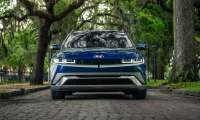

Pres Waterman, a Hyundai Ioniq 5 owner, recently reported a "dramatic" change in the vehicle's turning radius when upgrading from a 2023 Ioniq 5 Limited to a 2026 model. What he describes as a significant functional difference in everyday maneuvers, such as backing into a parking spot, is not reflected in the published specifications. This discrepancy between driver perception and manufacturer data exposes a critical gap in how vehicle dynamics are communicated and understood.
One owner struggles to park. It's about a manufacturer making subtle changes that profoundly impact the user experience, often without clear communication or explanation.
Hyundai's minimal stated change in turning radius for the 2026 Ioniq 5 directly contradicts the "dramatic" real-world experience of owners, suggesting a deeper, unacknowledged alteration in vehicle dynamics.
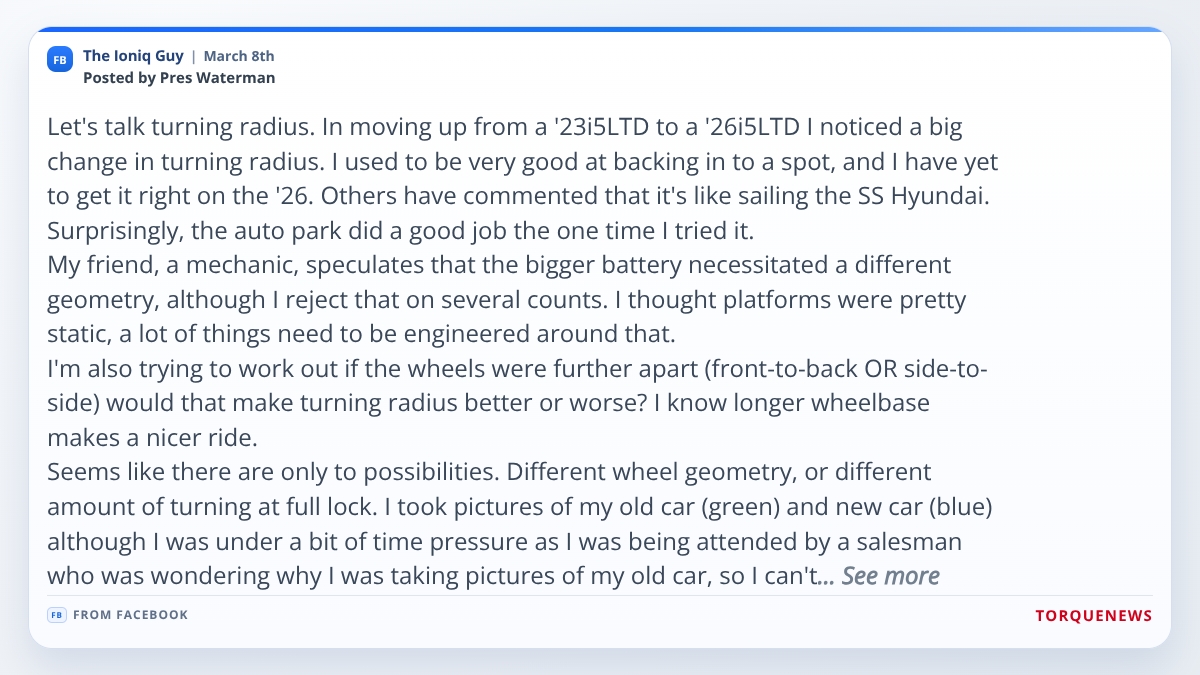
"Let's talk turning radius. In moving up from a '23i5LTD to a '26i5LTD, I noticed a big change in turning radius. I used to be very good at backing in to a spot, and I have yet to get it right on the '26. Others have commented that it's like sailing the SS Hyundai. Surprisingly, the auto park did a good job the one time I tried it.
My friend, a mechanic, speculates that the bigger battery necessitated a different geometry, although I reject that on several counts. I thought platforms were pretty static; a lot of things need to be engineered around that.
I'm also trying to work out if the wheels were further apart (front-to-back OR side-to-side), would that make the turning radius better or worse? I know longer wheelbase makes a nicer ride.
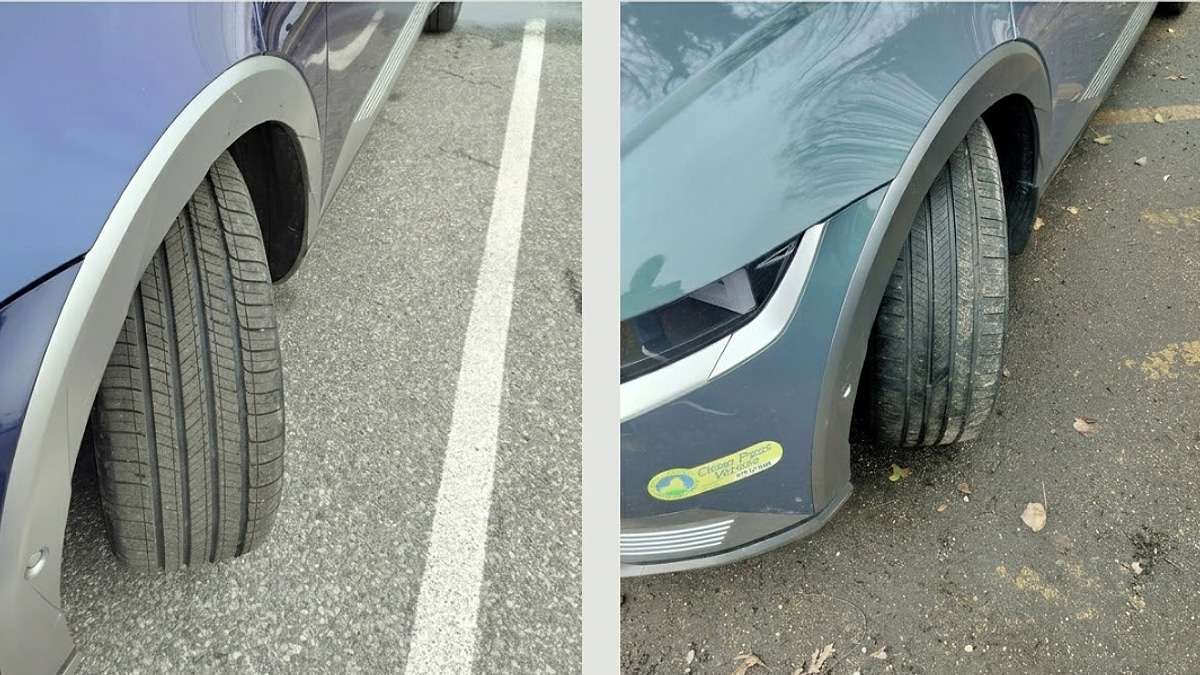
Seems like there are only two possibilities. Different wheel geometry, or a different amount of turning at full lock. I took pictures of my old car (green) and new car (blue), although I was under a bit of time pressure as I was being attended by a salesman who was wondering why I was taking pictures of my old car, so I can't guarantee the exact same camera angles. Oddly, the new one seems the same or slightly more.
To counter my previous point, I believe that in normal driving, the front wheels were showing power delivered (FWD), and the new one shows rear (RWD). So that would be a non-trivial engineering change, but still, it would seem the new car can turn even better, not worse.
Does anyone know of any engineering changes from '23 to '26?
If anyone would know, Corbin would!"
Waterman’s observation that the 2026 Ioniq 5 feels significantly less agile than his previous 2023 model immediately hits a nerve with other owners. The sensation of "sailing the SS Hyundai" points to a vehicle that feels cumbersome and oversized in tight spaces, a stark contrast to the nimble electric vehicle experience many expect.
Hyundai Ioniq 5: Turning Radius Discrepancy
- The 2023 Hyundai Ioniq 5 Limited has an official turning radius of 19.65 feet, a figure that provides a baseline for its maneuverability. This specification affects how the vehicle performs in tight urban environments and parking situations.
- The 2026 Hyundai Ioniq 5 Limited is listed with a turning radius of 19.7 feet, representing a mere 0.05-foot increase from the previous model year. This minimal change suggests that, on paper, the vehicle's ability to turn should remain virtually identical. Owners report a "dramatic" and "unacceptable" difference in real-world maneuverability, with the 2026 model feeling significantly less agile than its predecessor. This subjective experience shows a potential disconnect between engineering specifications and driver perception.
- The Ioniq 5's E-GMP platform allows for flexible battery configurations and motor layouts, but subtle changes in suspension geometry, steering rack calibration, or even tire choices can impact perceived turning ability. These unstated modifications may contribute to the reported discrepancy.
When a vehicle's handling characteristics shift noticeably between model years, it raises questions about engineering priorities, validation processes, and the company's maintenance of a consistent driving feel for its loyal customer base.
The Ioniq Guy, another owner, offered a counterpoint to Waterman's experience, stating: "I noticed no difference between my 2022 and 2025 on the street that I regularly parallel park on and make U-turns on. From curb to curb, I just barely make it. If there is any difference, we're talking less than a foot. In practice, I notice no difference." This comment shows the subjective nature of driving feel, but also the potential for subtle changes to affect different drivers in varying environments. What one driver considers negligible, another finds infuriatingly difficult.
The official data, however, provides a different picture. Scott Hinckley, commenting on the thread, pointed out the minimal difference: "The turn radius of the 2023 is 19.65', the 2026 is 19.7'. That's only 6/10 of an inch difference." This 0.05-foot, or 0.6-inch, increase in turning radius is statistically insignificant. It's the kind of margin that could easily be attributed to tire variations, alignment tolerances, or even measurement error. Yet, Waterman's experience of having to "hug the left curb and pull all the way forward beyond the house next door" to park in his driveway suggests something more profound is at play than a fraction of an inch.
The disparity between the official specification and the owner's lived experience is where the real story lies. Manufacturers often publish minimum turning radius figures, but these numbers don't always capture the full dynamic behavior of a vehicle. Factors like steering feel, steering ratio, and even the programming of electronic power steering can dramatically alter how a car feels when maneuvering, even if the absolute physical turning circle remains largely unchanged.
Dave Flavor, another owner, echoed Waterman's frustration, stating, "My least favorite thing about the MY25 is the turning radius, coming from a MY22 Tucson. Parking spaces are often a 3- or 5-point turn. And I know how to drive. It’s like steering the Queen Mary." This sentiment, comparing the Ioniq 5 to the "Queen Mary," reveals a widespread perception among some owners that the vehicle is simply not as maneuverable as its dimensions or specifications suggest. The fact that he's coming from a Tucson, a smaller SUV, further makes clear the perceived regression in agility. This isn't a problem unique to the 2026 model year but seems to be a consistent complaint for some Ioniq 5 owners, suggesting a fundamental design characteristic rather than a recent change.
Waterman's speculation about wheel geometry, wheelbase, and the shift from FWD to RWD power delivery touches on genuine engineering considerations. While the Ioniq 5 is primarily RWD, some trims offer AWD, which can influence steering geometry. A fundamental shift in power delivery or a subtle change in suspension components, even if not explicitly listed as altering the turning radius, could affect the steering lock or the vehicle's dynamic response in tight situations. This is where the engineers' choices diverge from the drivers' expectations.
The Hyundai Ioniq 5's turning radius, despite minimal official changes, presents a significant practical challenge for a segment of its owners. This is a design choice that prioritizes other characteristics over low-speed maneuverability. These characteristics might include ride comfort or packaging for larger batteries.
Hyundai needs to acknowledge this perceived deficiency and provide clearer guidance or, better yet, engineering solutions that bridge the gap between published specifications and the frustrating reality for drivers who feel like they're piloting a much larger vehicle.
Image Sources: Hyundai Media Center
About The Author
Noah Washington is an automotive journalist based in Atlanta, Georgia, covering sports cars, luxury vehicles, and performance culture. His reporting focuses on explaining the engineering, design philosophy, and real-world ownership experience behind modern vehicles.
Noah has been immersed in the automotive world since his early teens, attending industry events and following the enthusiast communities that shape how cars are built and driven today. His work blends industry insight with enthusiastic storytelling, helping readers understand not just what a car is, but why it matters.
Noah is also a member of the Southeast Automotive Media Association (SAMA), a professional organization for automotive journalists and industry media in the Southeast.
His coverage regularly explores sports cars, luxury vehicles, and performance-driven segments of the automotive industry, including the evolving culture surrounding Formula Drift and enthusiast builds.
Read more of Noah's work on his author profile page.
You can also follow Noah here:
Set Torque News as Preferred Source on Google
Follow us today...