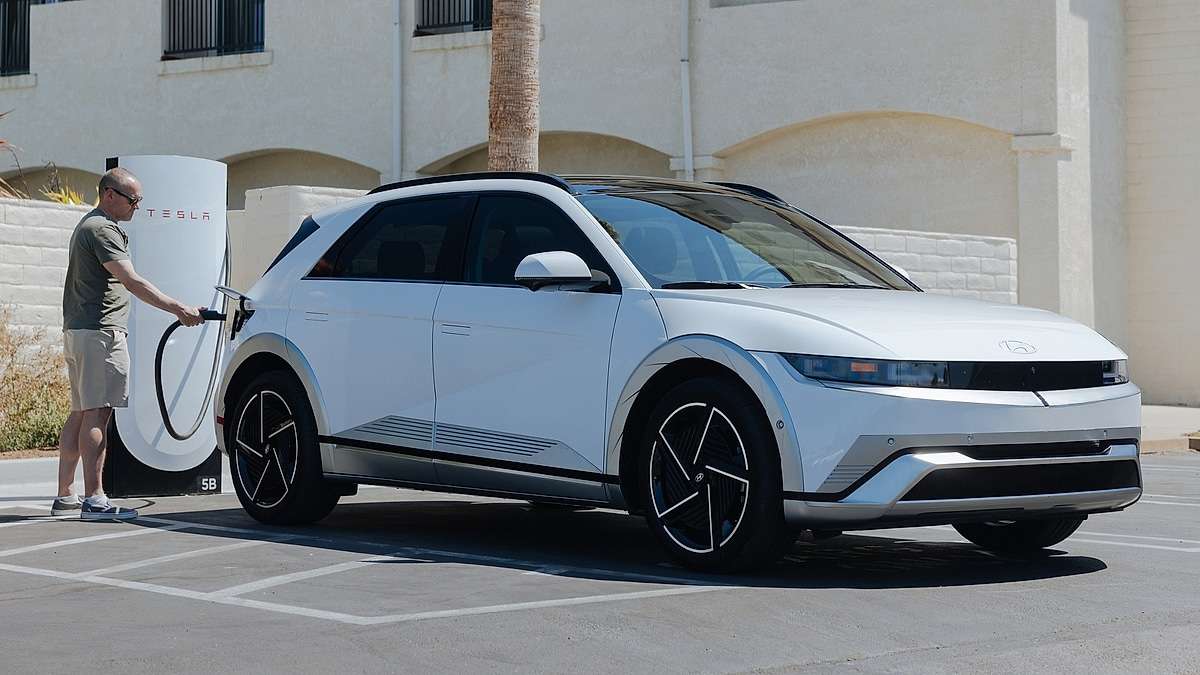

Clifford Creighton’s 2022 Hyundai Ioniq 5 has just passed 288,903 miles, reporting consistent charging performance and an impressive 327 miles of range at 97% charge. This mileage figure, achieved in just over two years of ownership, is a significant outlier in a market still grappling with long-term electric vehicle durability perceptions. The core problem this data point addresses is the persistent skepticism surrounding EV battery and drivetrain longevity, particularly in high-use scenarios.
This data challenges the industry's often conservative projections for EV lifespan and the public's ingrained fears about battery degradation. While manufacturers frequently cite 8-year/100,000-mile battery warranties, real-world data beyond these thresholds remains scarce, leaving a vacuum filled by speculation. Creighton's Ioniq 5 provides data suggesting current EV technology, even early models like the 2022 Ioniq 5, may be far more robust than many believe.
The industry's narrative on EV longevity has been unduly cautious, and this Ioniq 5's performance proves that high-mileage electric vehicles are not only possible but can maintain significant utility.
Creighton, a prominent member of the "The Ioniq Guy" Facebook group, posted:
"Just to show, I have no answers. On my way to 300,000 miles. Today, 288903 miles. Charged to 97%, still charging great, great since replacing all water pumps. 327 miles or 322 at 97%. Believe it or not, still driving every day #2022HI5SELAWD #hyundai."
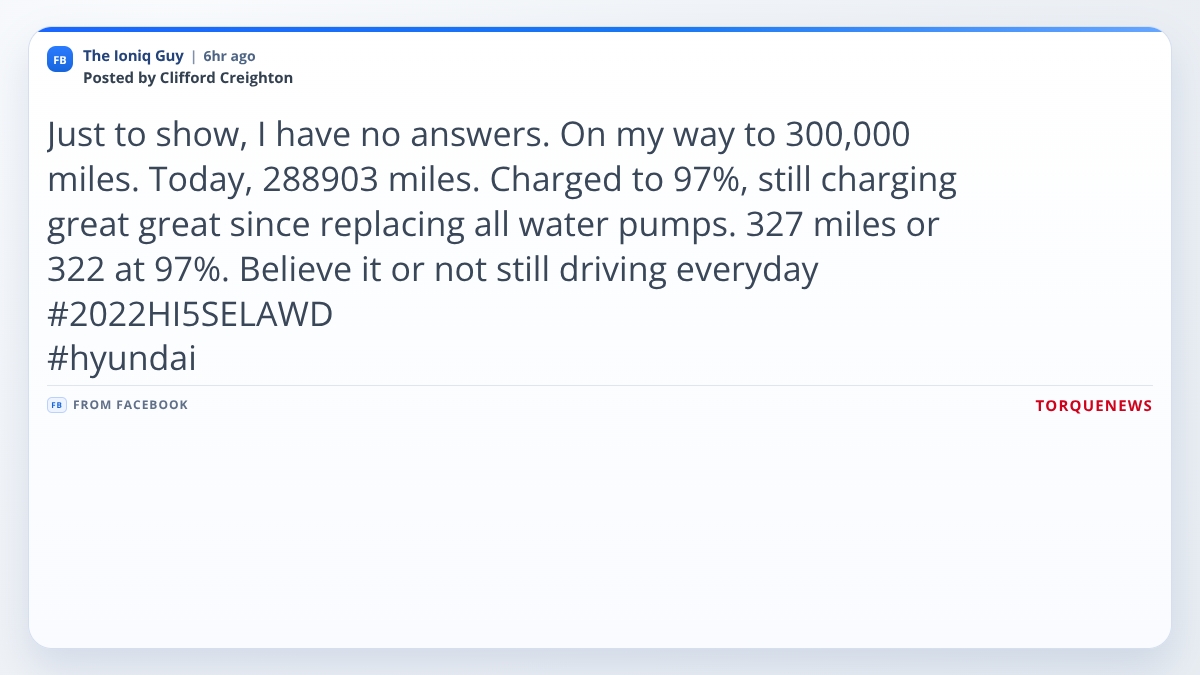
Creighton’s post shows a critical detail: the "great great" charging performance since replacing "all water pumps." This isn't a minor maintenance item; it points to an early-life component failure that, once addressed, allowed the vehicle to perform as intended for hundreds of thousands of miles. It suggests that while initial manufacturing defects or design flaws can occur, they don't necessarily doom an EV to an early grave, provided they are correctly diagnosed and repaired. This is a crucial distinction often lost in broad discussions about EV reliability.
The comments section immediately reveals the broader context of Creighton's achievement. Chris Trent, another Ioniq 5 owner, wrote: "You are getting way ahead of us, we just hit 112k last week." This exchange reveals that while Creighton's mileage is exceptional, other Ioniq 5 owners are also accumulating significant distances, albeit at a slower pace. It hints at a pattern of higher-than-average usage for these vehicles, possibly due to their efficiency or suitability for ride-share operations, which is a key factor in understanding the data.
2022 Hyundai Ioniq 5: High-Mileage Performance Insights
- The 2022 Hyundai Ioniq 5 in question has accumulated 288,903 miles, achieving this figure in just over two years of ownership, indicating a rigorous daily use cycle. The owner reports a consistent range of 327 miles at a 97% charge, suggesting minimal battery degradation despite the high mileage.
- The owner noted "great great" charging performance since replacing "all water pumps," which are critical components in the EV's thermal management system. This repair shows that early-life component failures, once addressed, do not necessarily impede long-term vehicle reliability or performance.
- The vehicle's primary use as a ride-share car means it operates under a high-duty cycle, accumulating miles rapidly, often at lower speeds with frequent charging cycles. This use case provides a unique and valuable data set for understanding EV durability beyond typical consumer driving patterns.
- Hyundai, like other EV manufacturers, could gain significant engineering insights by studying high-mileage vehicles such as this Ioniq 5. Analyzing components like the battery pack and electric motor after nearly 300,000 miles offers invaluable real-world degradation data for future product development and validation.
The question of how Creighton achieved such mileage is quickly addressed by other users. Skip Burroughs asked, "What do you drive, like 35 mph everywhere you go?" David Baker then provided crucial context, stating, "He's a ride-share driver, so it is likely a lot of his driving is at lower speeds." This detail is vital. Ride-share vehicles operate under an entirely different duty cycle than the average commuter car.
They accumulate miles rapidly, often in urban or suburban environments with frequent stops and starts, and at lower average speeds. This type of driving can be less taxing on certain components than sustained high-speed highway travel, but it also means more charge cycles and more wear on suspension and braking systems.
The Ioniq 5's endurance through this rigorous ride-share schedule for nearly 300,000 miles, with only the water pump replacement noted, indicates fundamental engineering strength. This high-mileage Ioniq 5 provides tangible, real-world evidence supporting those claims, showing the platform's capacity for extreme durability. This suggests that Hyundai's underlying architecture for the Ioniq 5 is capable of withstanding extreme use cases, a fact that should be loudly trumpeted by the manufacturer.
David Baker’s second comment brings up a point that manufacturers frequently overlook: "You should definitely notify Hyundai of the great dependability of your car. A lot of times when certain milestones are reached, the manufacturer will trade you for a new model or new parts so they can reverse engineer them to find out why yours works when others don't." This isn't just a polite suggestion; it's a critical opportunity for Hyundai. High-mileage vehicles like Creighton's are invaluable data sources. They offer real-world, accelerated aging data that laboratory tests simply cannot replicate.
Hyundai, and indeed any EV manufacturer, should be actively seeking out these outliers. The opportunity to dissect a battery pack that has undergone 288,903 miles of real-world charging and discharging cycles is worth far more than any simulated test. It allows engineers to understand degradation mechanisms, validate models, and identify components that either excelled or failed under stress. Ignoring such a valuable resource is a missed opportunity for future product development and a disservice to their engineering teams. This is where the gap between marketing and engineering becomes obvious: the marketing department wants to sell new cars, but the engineering department needs to understand why the old ones last.
The robust design of the battery management system and electric motor, often the primary concerns for EV longevity, is evident. While the water pump replacement shows that even new technologies have their initial kinks, the car's subsequent performance at nearly 300,000 miles, particularly in a demanding ride-share role, should force a re-evaluation of public and industry perceptions of EV longevity. Hyundai has a golden opportunity here to learn from a real-world test case and publicly champion the resilience of its product, rather than letting this invaluable data point fade into the background.
Image Sources: Hyundai Media Center
About The Author
Noah Washington is an automotive journalist based in Atlanta, Georgia, covering sports cars, luxury vehicles, and performance culture. His reporting focuses on explaining the engineering, design philosophy, and real-world ownership experience behind modern vehicles.
Noah has been immersed in the automotive world since his early teens, attending industry events and following the enthusiast communities that shape how cars are built and driven today. His work blends industry insight with enthusiastic storytelling, helping readers understand not just what a car is, but why it matters.
Noah is also a member of the Southeast Automotive Media Association (SAMA), a professional organization for automotive journalists and industry media in the Southeast.
His coverage regularly explores sports cars, luxury vehicles, and performance-driven segments of the automotive industry, including the evolving culture surrounding Formula Drift and enthusiast builds.
Read more of Noah's work on his author profile page.
You can also follow Noah here:
Set Torque News as Preferred Source on Google
Follow us today...