
Battery-electric vehicle deliveries remain terrible in America based on all of the available data. With the U.S. now in its fifth month since federal EV subsidies ended on September 30, 2025, any hangover effect of the “pull-forward” of EVs into Q3 should be long over. What we are now seeing is the considerably smaller market potential for EVs without massive price supports. And it’s ugly this month. All except for one EV manufacturer - Toyota.
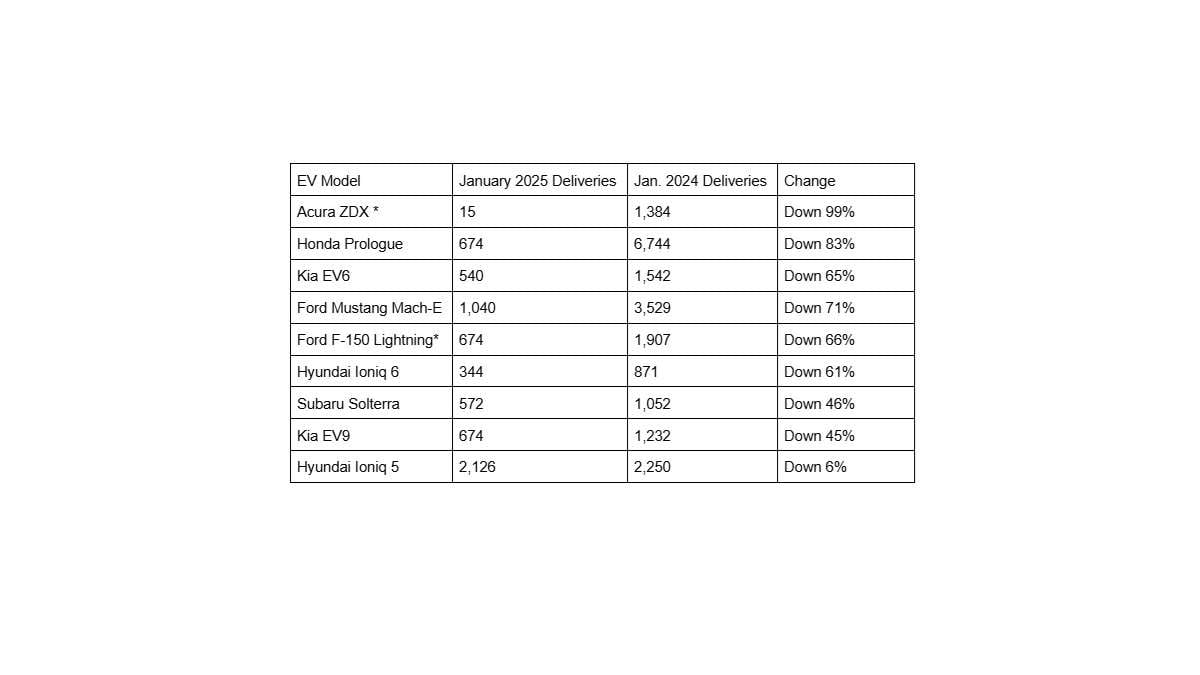
Not every brand releases monthly sales figures for the U.S. by model. Heck, Tesla never does. Many good sources of data are available at quarter-end that we don't have in the tweener months. The data shown below in our chart is directly from manufacturers. Since just two Tesla models, the Y and the 3, make up about 45% of the total EV market in the U.S., consider these other EVs as canaries in the coal mine. If they are all dying, and most are, then the warning should be pretty clear. The relative strength or weakness of these models helps us to understand how the non-Tesla EV market is doing. Our top-of-the-page image shows the chart we compiled using the available delivery data from companies that report it each month.
How Are Manufacturers Doing Overall In January 2026?
Manufacturers are reporting growth. In 2025, the auto industry grew by about 2-3%, and many manufacturers saw growth rates more than double that. GM, Ford, Toyota, and many more manufacturers all saw healthy gains in 2025. In January of 2026, many are reporting record sales. Toyota is up 8%.
Honda / Acura
For this past January, Honda reported 2% growth, despite losing thousands of EV deliveries, and said in its press release that it “Posted Strong Sales to start 2026.” By contrast to its strong overall start, Honda’s EVs tanked. One was outright killed, and the other was down by 83%. However, Honda’s green vehicle sales are healthy due to its strong hybrid push. As Honda put it, “Civic hybrid set a new January sales record…”. Civic’s hybrid sales were up 16%, and overall, Honda’s hybrids outpaced the company’s overall growth.
Hyundai / Kia
Both Hyundai and Kia reported “Record-Breaking” deliveries for January with Hyundai up 2% and Kia an impressive 13%. However, as with Honda, EV deliveries were significantly down. Hyundai added its battery-electric 3-row Ioniq 9 to the mix in May, but its January deliveries didn’t offset the losses from other EV models. Just 580 units were delivered in its ninth month since the launch.
Like with Honda, Hyundai calls its brightest segment hybrids, saying, “Hybrid total sales surge 60%, driving Hyundai’s electrified momentum.” Kia had a very similar result. Despite battery-electric deliveries dropping, its overall electrified vehicles, which means hybrids + BEVs, was up a whopping 45%. Clearly, hybrids are saving the day for Kia and Hyundai.
Ford
Ford makes fantastic EVs. I have named the Mustang Mach-E Best Overall EV at another publication. I’ve tested the Lighting four times, always had positive reviews. However, Ford’s deliveries in January were down by a staggering amount. Yes, the Lightning has been discontinued, but (slow) sales of the existing plentiful inventory continue.
Subaru
The news from Subaru is confusing. The company called January a “standout month,” but the report also says that deliveries declined 9.1%. Subaru says that its sales were impacted by winter storm Fern, and we believe it. With much of Subaru’s strength in colder areas, this seems logical, as many locations lost a business week. The news for Subaru’s single EV model, the Solterra was not good, no matter how you slice it. Down 45% and less than 600 total EVs delivered as acompany. We don’t honestly know if the Solterras delivered were the outgoing or the incoming generation, and to be fair, this is a model in transition. Yet, it fits the overall EV trend line - down.
Nissan
The all-new Leaf entered the U.S. market in Q4 of 2025. We can’t hide the fact that we are rooting for this affordable model to do well. We spoke to Nissan today, and they’d prefer to keep Leaf’s current delivery volume under wraps as its launch continues. That’s more than understandable.

Toyota
We saved Toyota for last because it bucked the downward trend in EVs. The Toyota BZ saw sales go up. In fact, the BZ outsold the Hyundai Ioniq 5 in January. Suddenly, Toyota has a top-selling EV in America. The Lexus RZ battery-electric vehicle also had a great month. Toyota showed strong growth in January in virtually every category. Overall, deliveries rose 8%, despite the top-selling RAV4 undergoing its generation change.
With the RAV4 at the critical moment in its new generation launch, the inventory was temporarily constricted. I know because I was at the factory not long ago and saw the team that makes it working towards the changeover. If you’re a RAV4 Hybrid hater, don't get too worked up. It would still have been the third-best-selling electrified vehicle in America if not for other Toyota hybrids. By mid-year, Toyota will again be crushing the green vehicle numbers since every RAV4 is electrified moving forward. We find it both interesting and also amusing that Toyota had the best EV delivery results both in terms of numbers and percent increases of the brands we could find data on.
What's your take? Are the terrible delivery results shown by the January 2026 data indicative of a bump in the road or a sign of EVs settling into about four to five percent market share in America for the foreseeable future? Tell us in the comments below.
John Goreham is the Vice President of the New England Motor Press Association and an expert vehicle tester. John completed an engineering program with a focus on electric vehicles, followed by two decades of work in high-tech, biopharma, and the automotive supply chain before becoming a news contributor. He is a member of the Society of Automotive Engineers (SAE int). In addition to his fourteen years of work at Torque News, John has published thousands of articles and reviews at American news outlets. He is known for offering unfiltered opinions on vehicle topics. You can connect with John on LinkedIn and follow his work on his personal X channel or on our X channel. John employs grammar and punctuation software when proofreading, and he sometimes uses image generation tools.
Set Torque News as Preferred Source on Google
Follow us today...