The automotive industry is currently navigating the most treacherous and disruptive market transition since the invention of the internal combustion engine. For decades, observing the strategic maneuvering of both Silicon Valley tech giants and legacy manufacturers has taught me one incontrovertible truth about corporate survival: brand equity is the absolute most fragile asset a company possesses. You can spend a century building an ironclad reputation for very specific product attributes, only to risk destroying it entirely on a single misguided product pivot.
When Ferrari recently unveiled the 2027 Ferrari Luce, Maranello did not just introduce its first electric vehicle to the global market. It introduced a five-seat, family-hauling, center-opening-door anomaly designed by former Apple executives that completely betrays what makes a Ferrari a legendary automotive icon. As a market analyst who has watched countless tech companies fail by abandoning their core user base to chase industry trends, the launch of the Luce feels frustratingly and tragically familiar. Rather than managing this electrification transition with surgical precision, brands like Ferrari are treating their legendary badges like cheap marketing wrappers, slapping them onto products that fundamentally contradict their established corporate identity.

The Mustang Mach-E Syndrome
To truly understand the magnitude of Ferrari’s strategic blunder with the electric Luce, we only need to look back at what Ford Motor Company did a few years ago with its most sacred property. Ford faced a strategic dilemma. They needed to sell a high-volume electric crossover to compete with Tesla, but traditional EVs lacked the visceral emotional resonance necessary to attract traditional automotive enthusiasts. Ford's executive solution was to essentially hijack the Ford Mustang brand, slapping the iconic galloping pony onto a heavy, four-door electric family SUV, subsequently naming it the Mustang Mach-E.
Did the Mustang Mach-E sell? Yes, it found initial market success among tech-focused early adopters. However, it deeply alienated a massive swath of loyal Mustang buyers who rightfully argued that a silent, heavily digitized, family-oriented crossover shares absolutely zero structural or emotional DNA with a lightweight, two-door, V8-powered muscle car. Ford traded long-term brand equity for a short-term marketing sugar high. They diluted the inherent meaning of the "Mustang" badge to the point where the name no longer signifies a visceral American muscle car, but rather serves as a generic umbrella term for a corporate product line. Ford chased Tesla’s ghost, outfitting the Mach-E with a massive central touchscreen that sacrificed the traditional driver-centric cockpit, proving they valued tech emulation over heritage preservation.
Ferrari is now committing the exact same error, but at a vastly higher price point and with infinitely more brand risk at stake. The Luce is not a low-slung, ultra-focused, two-seat hypercar. It is a 197.9-inch long, five-seat liftback. It stands as the very first five-seater in Ferrari's storied history. To make matters substantially worse from a brand alignment perspective, Ferrari outsourced the exterior and interior design to LoveFrom, the design firm led by Jony Ive and Marc Newson. These are product-design superstars famous for sleek, minimalist Apple products like the iPhone and the Magic Mouse.
A traditional Ferrari should never look like a minimalist consumer electronic device. A Ferrari should look like it was violently sculpted by the wind at the Fiorano test track—aggressive, uncompromising, and deeply passionate. By prioritizing aerodynamic efficiency and a sterile minimalist aesthetic over traditional Italian emotion, Ferrari has essentially built an Apple Car and affixed a Prancing Horse emblem to the hood. Even the interior features a "torque meter" and simulated gear shifts via steering wheel paddles, proving Ferrari knows the EV lacks a mechanical soul and is desperately trying to synthesize one.

Why a Separate EV Brand Was the Logical Choice
When a massive technology shift forces a company to build a product that fundamentally contradicts its core brand values, the standard strategic move in the technology and automotive industries is to create a sub-brand or an entirely new spin-off entity. This concept is deeply rooted in the business theory of the Innovator's Dilemma. When disruptive technology arrives, you cannot house it within the legacy business unit because the legacy business will either reject it or corrupt it. Think of how Toyota created the Lexus brand to enter the luxury market without the economy-car baggage of the Toyota name, or how Volvo wisely spun off Polestar to handle its high-performance electric aspirations.
Ferrari actually possessed the perfect historical precedent to execute this strategy flawlessly. In the late 1960s and early 1970s, Enzo Ferrari stubbornly refused to put the sacred Ferrari badge on any vehicle with fewer than twelve cylinders. His brilliant strategic solution was the creation of the Dino brand. This separate marque protected the absolute exclusivity and mechanical purity of the V-12 Ferrari name while still allowing the corporate entity to compete aggressively in the lower-priced, V-6 sports car market.
For its painful transition into electrification, Ferrari should have resurrected the Dino badge—or created a completely new subsidiary marque specifically dedicated to electrification and future mobility tech. A separate brand would have granted Ferrari's brilliant engineers the unencumbered freedom to experiment with center-opening doors, five-seat layouts, and synthesized audio technology without angering the fiercely loyal "Ferraristi." It would have provided a protective corporate firewall around the core Ferrari brand. If the ultra-luxury EV market collapsed - as current industry trends strongly suggest it might—Ferrari's main brand would remain completely untarnished. Instead, Maranello pushed all their chips into the center of the table with the Luce, permanently intertwining their racing legacy with a polarizing electric liftback.
A Failure to Learn from Industry Mistakes
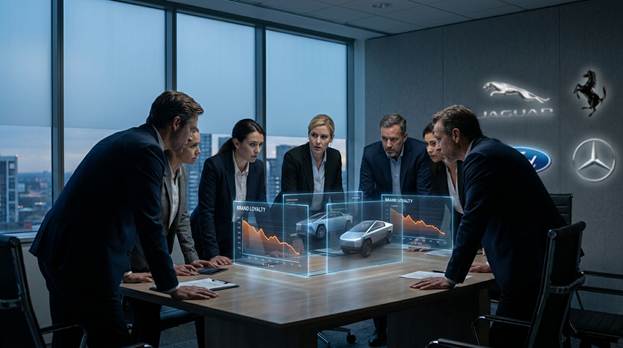
What continuously baffles me as a veteran industry observer is the collective amnesia currently infecting automotive boardrooms. Ford, Jaguar, and Ferrari are distinctly different companies operating in different market segments, yet they are stumbling blindly into the exact same strategic traps. Jaguar is currently in the midst of completely torching its century-old heritage, alienating its traditional buyer base in a highly risky bid to become a purely electric ultra-luxury brand. They have paused sales of internal combustion cars, essentially telling their loyal, long-term customers to go away and wait until their radical new EVs eventually arrive.
Why do these multi-billion-dollar companies continuously fail to learn from one another? The unfortunate answer is a toxic corporate mixture of executive hubris and an over-reliance on Silicon Valley group-think. The legacy automotive industry became so intensely terrified of being financially disrupted by Tesla that they massively overcorrected. They falsely assumed that to beat technology companies, they had to literally become technology companies.
However, a legacy automaker's greatest weapon against a sterile, tech-driven EV startup is its established heritage and mechanical emotion. Ford willfully forgot this advantage when designing the Mach-E. Jaguar is actively forgetting it with its entire corporate restructuring strategy. And now, Ferrari is tragically forgetting it by allowing tech-industry designers to dictate the aesthetic shape and digital soul of the Luce. Lamborghini's CEO recently noted that buyer interest in ultra-high-end electric vehicles is currently "close to zero," prompting them to cancel their own EV plans. Ferrari looked at that same market data and decided to drive straight off the cliff anyway.
How Ferrari Should Have Designed and Marketed Their First EV
If I were actively advising Ferrari’s board of directors, the overarching corporate strategy for their first electric vehicle would have looked drastically different from the Luce project.
First, let us address the design and architecture. An electric Ferrari should absolutely never be a family-friendly, five-seat vehicle. It should have been conceived as a spiritual successor to legendary cars like the LaFerrari or the F40—a low-slung, ultra-lightweight, two-seat track-focused hypercar. The design process should have been kept strictly in-house at the Ferrari Centro Stile. By utilizing the unique packaging benefits of electric motors—such as a remarkably low center of gravity and the complete absence of a bulky transmission tunnel—Ferrari could have created a vehicle with an unprecedentedly low cowl and a highly aggressive, predatory stance. Instead, the Luce sits taller and stretches longer than Ferrari's own Purosangue SUV. It represents a fundamental packaging nightmare for a brand built on nimble sports cars.
Second, we must examine the marketing and product positioning strategy. Ferrari is currently attempting to mass-market a $640,000 electric vehicle to a stubborn customer base that is actively rejecting battery technology. Instead, the very first electric Ferrari should have been introduced as a highly exclusive, limited-production "XX" track car. By positioning the new EV powertrain not as an eventual replacement for the beloved V-12, but rather as a highly specialized technological tool for achieving ultimate lap times, Ferrari could have completely bypassed the emotional pushback from purists.
This strategic approach would have allowed Maranello to quietly develop its proprietary 800-volt architecture, thoroughly test its quad-motor torque-vectoring systems, and refine its synthesized audio technology in a highly controlled, low-risk environment. More importantly, it would have generated an overwhelming sense of exclusivity. Ferrari owners famously clamor for limited-run track cars. If Ferrari had built only 99 units of an experimental electric track monster, the allocation would have sold out instantly. They would have generated immense global hype and definitively proven their EV performance capabilities without once threatening the emotional integrity of their core road-car lineup.
Instead, Ferrari gave the world artificial gear shifts, simulated engine braking via regenerative steering wheel paddles, and a heavily engineered audio system that awkwardly amplifies the mechanical noise of the rear axle just to prove the car is doing something. Attempting to patch over the intrinsic silence of an electric vehicle with amplified mechanical whine is exactly like putting a digital LCD face on a mechanical Rolex watch; it entirely misses the fundamental point of both mediums.
Wrapping Up
The global transition to electrification represents the ultimate existential stress test for legacy automotive brands. Navigating this shift requires a remarkably delicate balance between aggressively embracing new technology and fiercely protecting the emotional core of a brand's historical heritage. Ford compromised the Mustang’s identity to sell more crossovers. Jaguar is currently gambling its entire corporate existence on a radical, unproven electric reinvention. Now, Ferrari has unfortunately joined the ranks of automakers willingly sacrificing their legendary legacy on the altar of fleeting tech-industry trends.
The 2027 Ferrari Luce, with its Apple-inspired aesthetic, unprecedented five-seat layout, and digitally synthesized soul, is undoubtedly a remarkable piece of modern engineering. However, it is fundamentally a terrible Ferrari. Had Maranello utilized a separate sub-brand like Dino, or carefully introduced their electric technology via a limited-run, track-only hypercar, they could have easily navigated this perilous market transition without completely alienating their most loyal enthusiasts. Instead, they have repeated the exact same tragic mistakes their competitors have made, definitively proving that while legacy automakers can build incredibly complex machines, they still deeply struggle to understand the fragile psychology of their own iconic brands.
Disclosure: Images rendered by Artlist.io
Rob Enderle is a technology analyst at Torque News who covers automotive technology and battery developments. You can learn more about Rob on Wikipedia and follow his articles on TechNewsWord, TGDaily, and TechSpective.
Set Torque News as Preferred Source on Google
Follow us today...