
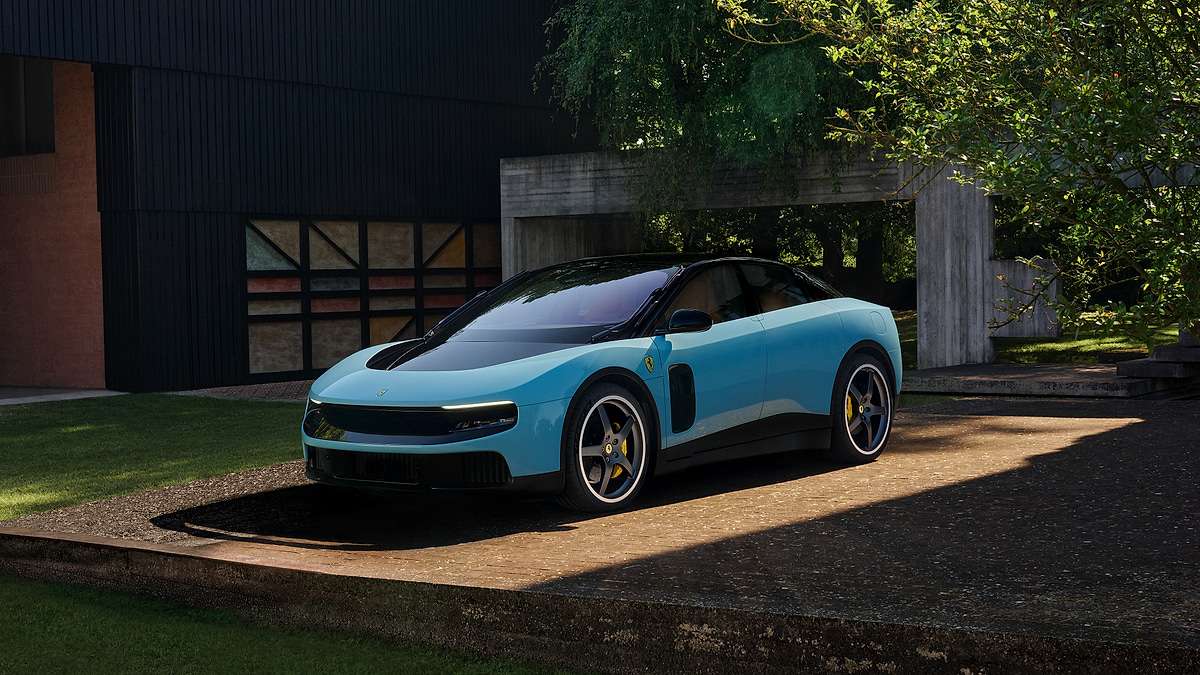

Luca di Montezemolo, former chairman of Ferrari from 1991 until 2014, slammed the Luce: “Remove the Prancing Horse, we risk destroying a legend”, but his “at least the Chinese won’t copy it” dig exposes Ferrari’s actual strategy, The Luce costs $645,000 with 1,035 hp and 2.5s 0-60, yet a Xiaomi SU7 Ultra beats those specs for one, tenth the price.
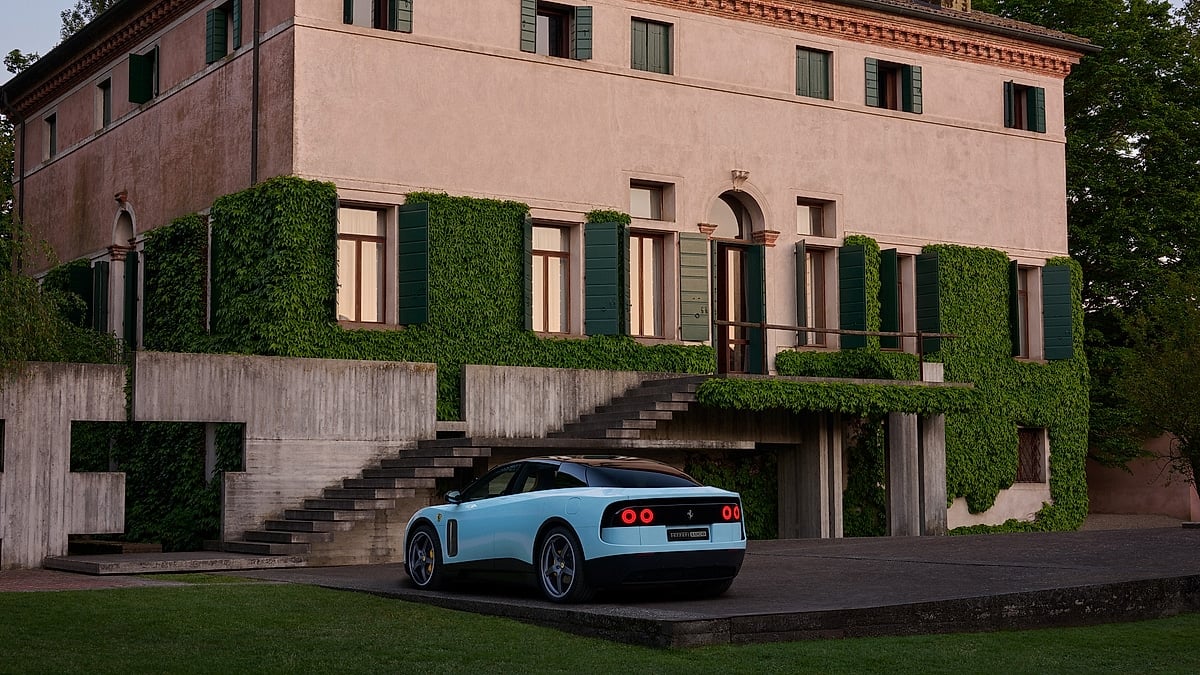
LoveFrom spent five years on a fully electric Ferrari with 40+ glass interior parts, 13,000 laser-drilled shifter holes, and a 4-hour machined steering wheel hub. Ferrari's stock dropped 8.4% post, reveal, Wall Street sees a $645,000 against $70K Chinese rivals, but Ferrari’s building a cultural moat, not a spec sheet
Luca di Montezemolo thought he was delivering a eulogy. He handed Ferrari a blueprint instead.
“If I were to say what I really think, it would be unpleasant,” the former chairman told Italian media at a Confindustria assembly in May.
“I hope someone removes the Prancing Horse from that car. We risk destroying a legend.”
Then the dagger: “At least the Chinese won’t copy it!”
He meant it as dismissal. But peel that quote apart, and you find the exact reason Ferrari built this car.
The Luce isn’t trying to win on horsepower. Those wars are over, and the Chinese won. The Xiaomi SU7 Ultra delivers 1,548 hp for about $70,000. BYD sells thousand-horsepower sedans. A $645,000 four, door with 1,035 hp, as reported by Reuters, isn’t a performance story. It’s a boutique product. So Ferrari did something smarter. They built something the Chinese literally cannot replicate, not because of patents, but because of cultural density.
At the interior reveal in San Francisco’s Transamerica Pyramid, Jony Ive walked journalists through a cabin that took five years to create. His design collective LoveFrom spent six months writing four research books on philosophy and Ferrari’s cultural significance before drawing a line. Manzoni told the assembled press that the initial proposal had come back.
“Completely cohesive… and very disruptive.”
The production EV barely changed, which almost never happens in automotive development, where committees usually water everything down.
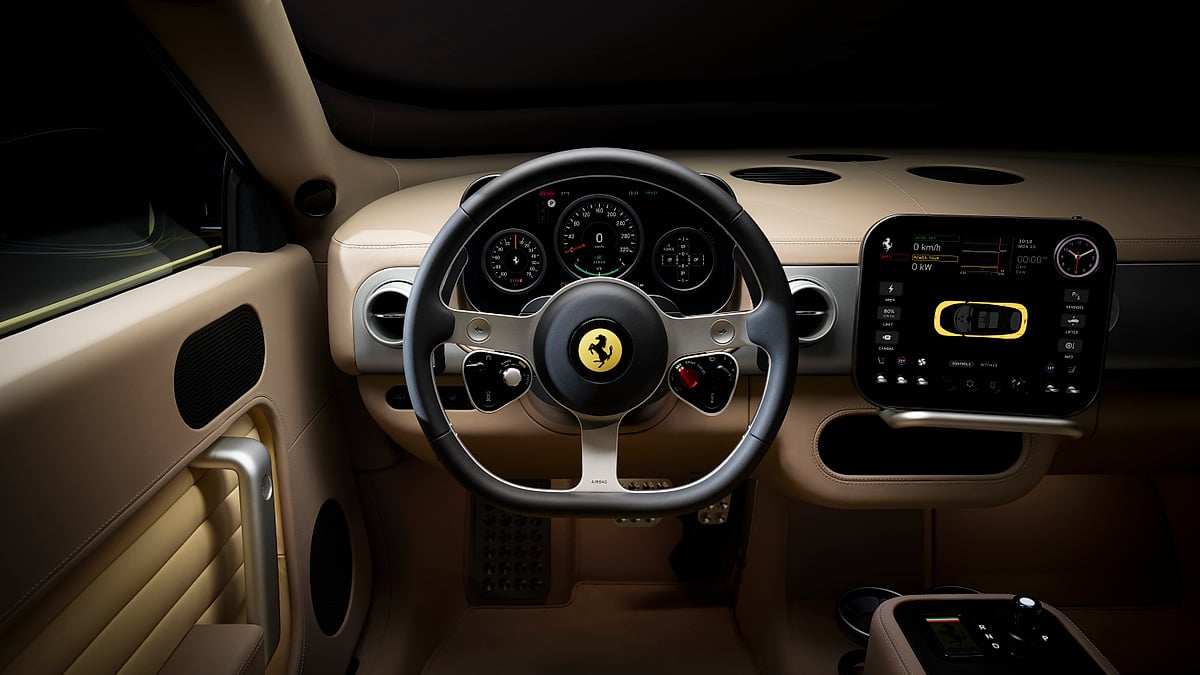
Here’s what that process produced: a steering wheel from 19 CNC-machined parts in recycled aluminum, taking 4+ hours to machine the hub from a solid billet. Glass toggle switches, each feeling different, so you identify them by touch. A binnacle with two overlapping Samsung OLED displays, three holes physically cut through the top panel, a world first, plus a mechanical needle spinning between them with sub-millimeter clearance. A Corning Fusion5 glass key with an E Ink display that triggers a sequential cabin light, up ceremony. The shifter required Corning to laser-drill 13,000 holes, each 40 microns wide, a third of a human hair. The typical car has one or two glass parts. The Luce has more than 40.
When Ive addressed the press, he said something that stuck:
“What would be lovely would be for the thinking to be talked about, not the shapes.”
Any OEM can sketch a pretty dashboard. What Ive and Ferrari built embeds Italian design philosophy so deeply into every surface that cloning it would require cloning the culture that produced it. You can’t reverse-engineer a gesture. You can’t copy the way an Italian engineer and a British designer argued for months about a steering wheel spoke angle until they drove to Fiorano and asked the test drivers.
Montezemolo’s line lands differently when uncopyability is the point. Ferrari can’t compete with BYD on kilowatts per dollar. What it can only do is build a car so dense with intention that the product itself becomes a moat. Not a patent moat. A cultural moat.
Ferrari’s own framing confirms this. In the Luce documentary series, Manzoni called the project “a capsule collection”, fashion language for a limited experimental line. He added:
“I wouldn’t say that all the design features of this car will be used for developing future products. We would like to keep this car with a very specific identity.”
This isn’t Ferrari’s future. It’s a $640,000 experiment to see if the brand survives being something its own former chairman hates.
The stock market didn’t get it. Shares dropped 8.4% post, reveal, per Bloomberg. Oddo BHF noted “largely negative” reactions among “Ferrari’s most passionate fans.” Pierre, Olivier Essig at Air Capital told Bloomberg the Luce looks like “a mix between Honda Accord EV and Tesla 3” and said he’d prefer Chinese cars “for a fraction of the price.” He’s not wrong about the fraction. He’s wrong about it being the same thing. The Luce’s performance isn’t measured on a drag strip. It’s measured in human decisions per surface.
The Patek Philippe comparison sharpens the point. In a video interview, a journalist revealed one of LoveFrom’s secret research books containing this passage:
“It’s hard not to see parallels between valuable historic brands like Patek Philippe, who survived… primarily because it retained its traditional mechanical movements.”
Swiss watchmaking survived quartz because Patek made movements that quartz couldn’t replicate at the level of cultural meaning. It survived by being uncopyable.
That’s what Ferrari’s betting $640,000 on. Not that 1,035 hp is worth $645,000. But that there’s a buyer who’ll pay for a car carrying so much intention that a Shenzhen factory couldn’t reproduce it with a billion-dollar budget. They might be right. They might be wrong. But treating it like a spec, sheet play is why the stock dropped.
Why Ferrari Signalling A Warning Call For Everyone
Ferrari is the canary in the coal mine for every luxury manufacturer facing Chinese EV competition. If the “cultural moat” strategy works, we’ll see Porsche, Aston Martin, and Lamborghini follow suit. If it fails, the European luxury auto sector has to compete on specs against companies that out-engineer and underprice them by orders of magnitude. The Luce isn’t a car. It’s a test case for whether Western automotive luxury has a future at all.
What’s your take? Would you pay $645,000 for a car that’s intentionally uncopyable, or does Montezemolo have a point?
Drop your opinion below in the comments.
About The Author
Noah Washington is an automotive journalist based in Atlanta, Georgia, covering sports cars, luxury vehicles, and performance culture. His reporting focuses on explaining the engineering, design philosophy, and real-world ownership experience behind modern vehicles.
Noah has been immersed in the automotive world since his early teens, attending industry events and following the enthusiast communities that shape how cars are built and driven today. His work blends industry insight with enthusiastic storytelling, helping readers understand not just what a car is, but why it matters.
Noah is also a member of the Southeast Automotive Media Association (SAMA), a professional organization for automotive journalists and industry media in the Southeast.
His coverage regularly explores sports cars, luxury vehicles, and performance-driven segments of the automotive industry, including the evolving culture surrounding Formula Drift and enthusiast builds.
Read more of Noah's work on his author profile page.
You can also follow Noah here:
Set Torque News as Preferred Source on Google
Follow us today...







Comments
I must say you have a very…
Permalink
I must say you have a very different take on all of this. When Ferrari stock tumbles, upon revealing a new model, well, that tells us everything you need to know. There is no putting lipstick on a pig, this is a disaster full stop. Luca knows a thing or two about selling cars and branding.
Tesla stock also went down…
Permalink
In reply to I must say you have a very… by James Butler (not verified)
Tesla stock also went down when the Cybertruck was revealed and the Cybercab I believe. True innovation won't be accepted by everyone and new designs will always be polarizing for new audiences.
Personally I'm not a fan of the Cybertruck design but the cries for originality by car guys and then us being upset when it actually happens is quite frustrating to see again and again... it's just showing itself with the Ferrari Luce a lot more.