When Your EV Concept Becomes a Meme
BMW posted the Vision Driving Experience concept to Instagram last month and lost control of the comment section. The image I shared below shows four cars: top-left is the Mercedes-AMG GT 4-Door Coupé rear, top-right is the Ferrari Luce from the front in orange, bottom-left is a Mercedes EQS, and bottom-right is a blue BMW i5. Four EV designs, four different ways to get proportions wrong.
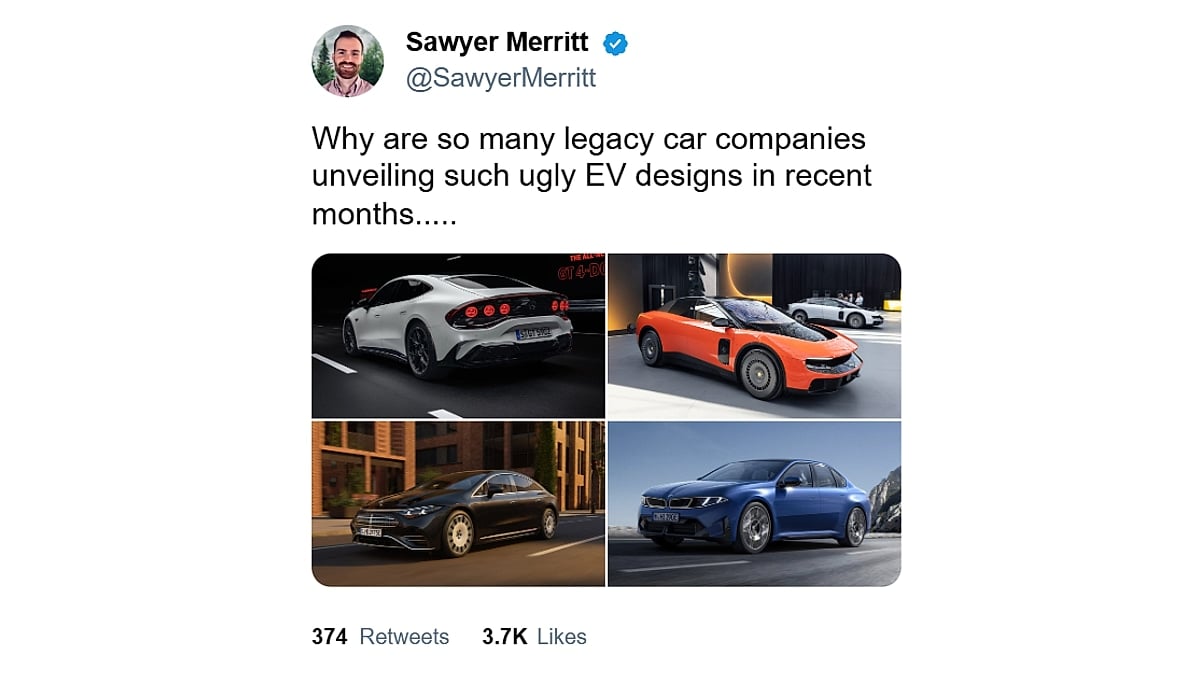
The Mercedes EQS facelift added a faux grille with chrome slats. Car and Driver:
“The 2025 Mercedes EQS Somehow Looks Worse.”
The car still depreciates by $65,143 in its first year. A forum quote has stuck with me:
“We just leased an e-tron despite the better range and tech in the BMW. Why? Cause the iX is ugly. Just awful.”
Better range. Better tech. Lost the sale because the proportions triggered a visceral nope response. There’s a pattern here, and it isn’t that EVs are inherently ugly.
Why Legacy EVs Look Wrong
Legacy automakers are trapped by constraints they treat as enemies instead of raw material. Aerodynamic efficiency demands slippery shapes. Battery packaging forces tall floors and thick C-pillars. Pedestrian safety requires taller front ends. Combined, these push EVs toward a default: high beltline, stubby hood, upright greenhouse, proportions that read heavy from every angle.

Legacy automakers look at these constraints and ask: how do we make this look like our ICE lineup? Mercedes bolted a fake grille onto the EQS. BMW’s iX looks like someone described an X5 over a bad phone connection. The electric M3 concept’s rear reads as BMW trying to translate “3 Series” into a language aerodynamics don’t speak. The cars look wrong because they’re EVs in costume.
Chinese manufacturers make this failure impossible to excuse. NIO shipped over 122,000 vehicles in 2024. BYD sold 4.3 million EVs and plug-in hybrids. The NIO ET5 and BYD Seal embrace the skateboard platform aesthetically instead of fighting it. Xpeng’s P7 doesn’t apologize for being electric. These companies started without a century of ICE design baggage. It’s not that EVs are hard to design well. It’s that legacy European brands lack the creative courage to start fresh.
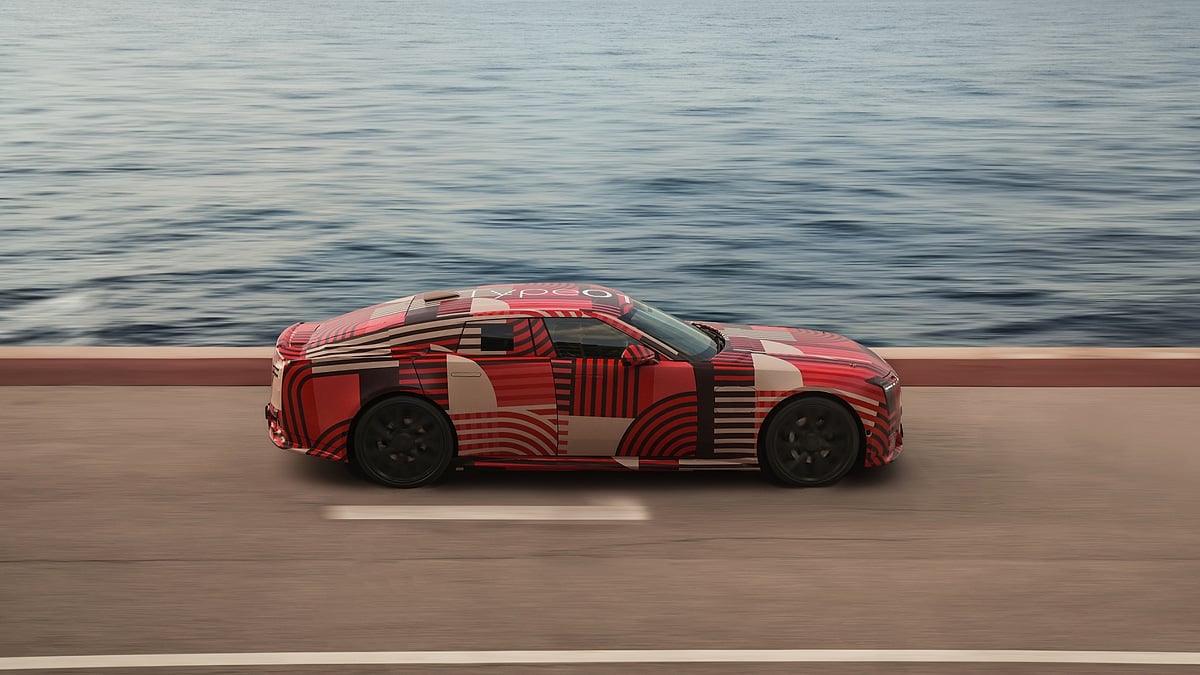
Flavio Manzoni, chief designer officer at Ferrari diagnosed it in an interview about electric cars:
“Most of the companies are not really willing to make something extraordinarily new. Everybody is looking at the past, not at the future.”
Legacy automakers will spend billions on EV platforms, but they won’t risk making an EV that doesn’t look like their past. By protecting their design heritage, they’re producing cars that get roasted on social media and lose sales to competitors with inferior engineering.
The Ferrari Luce: A $645,000 Bet on Feeling Something
I need to get the commodity stuff out of the way. The Ferrari Luce has four motors producing 1,035 horsepower. It hits 62 mph in 2.4 seconds. Top speed is 193 mph. The 122 kWh battery runs on an 880V architecture. EPA range will likely land around 280 miles. Price is approximately $645,000. Five seats, made possible by the absence of a transmission tunnel. Weight is approximately 5,070 lbs (2,300 kg), the heaviest Ferrari ever built, and will command respect. Europeans get their cars in October 2026. US buyers wait until Q2 2027. Revealed May 25, 2026, in Rome.
There. That’s the spec sheet. But the spec sheet is not the story.
The Luce is not a sports car. It’s not an SUV. It’s described as somewhere between a shooting brake, a wagon, and a sedan, and that’s wrong too. What it actually is: a new category. A five-seat Ferrari with four doors and a design language that departs from every Ferrari road car before it. Manzoni calls it “a new capsule collection,” borrowing fashion terminology because automotive terminology doesn’t have room for what this is.

One detail tells you how far Ferrari went: the Luce’s two wiper blades park vertically along the A-pillars when not in use, similar to the Cybertruck’s single wiper. The windshield and front end are seamless with no traditional cowl. It’s the kind of detail most automakers wouldn’t bother engineering. Ferrari bothered.
The weight distribution is 47:53 front-to-rear. The front axle disconnects for pure rear-wheel-drive mode. The quad-motor setup enables true torque vectoring, not brake-based fakery. These are the decisions of a company that asked: if we start over, what does an electric Ferrari actually need to be?
What Jony Ive Actually Did Here
The interior is where Jony Ive’s fingerprints are unmistakable. Five years of collaboration between Ferrari and LoveFrom, the design firm Ive founded with Marc Newson in 2019. Ive and Newson worked alone in a San Francisco studio for the first eight months, conceiving the interior before any Ferrari engineers saw it.
The rule was simple: no plastic. Zero. Every surface is glass, aluminum, steel, or leather. The steering wheel is CNC-machined from 100% recycled aluminum. The binnacle is a 12.86-inch display with physical analog needles layered over OLED displays. Actual needles. Actual physical movement.
Ive’s philosophy was stated in an interview about the Luce: “One of the founding assumptions I never understood was why, if the power source was electric, does it follow that the interface must be digital? That’s a bizarre and lazy assumption.” The right paddle controls five levels of torque modulation. The left paddle adjusts regenerative braking. The key fob is e-ink. When docked, the car’s color “transfers” to the drive selector.
Ive was clear: “Multi-touch is wonderful for a phone. Multi-touch shouldn’t be in a car.” He designed the iPhone. He gets the difference between a device you hold for thirty seconds and a machine you operate at 180 mph.
I should be fair, though. The Luce interior has its critics. Hacker News comments called it “like a budget car” and “without the badge I’d guess Kia.” Another user said it looked like “a sim racer rig.” Someone called Ive a “garbage-tier car designer” and said the interior “could belong inside a small truck/SUV if you took away the Ferrari logos.” The interior is so stripped back that it risks looking underdesigned to eyes trained on Mercedes luxury. I think it works. Not everyone will.
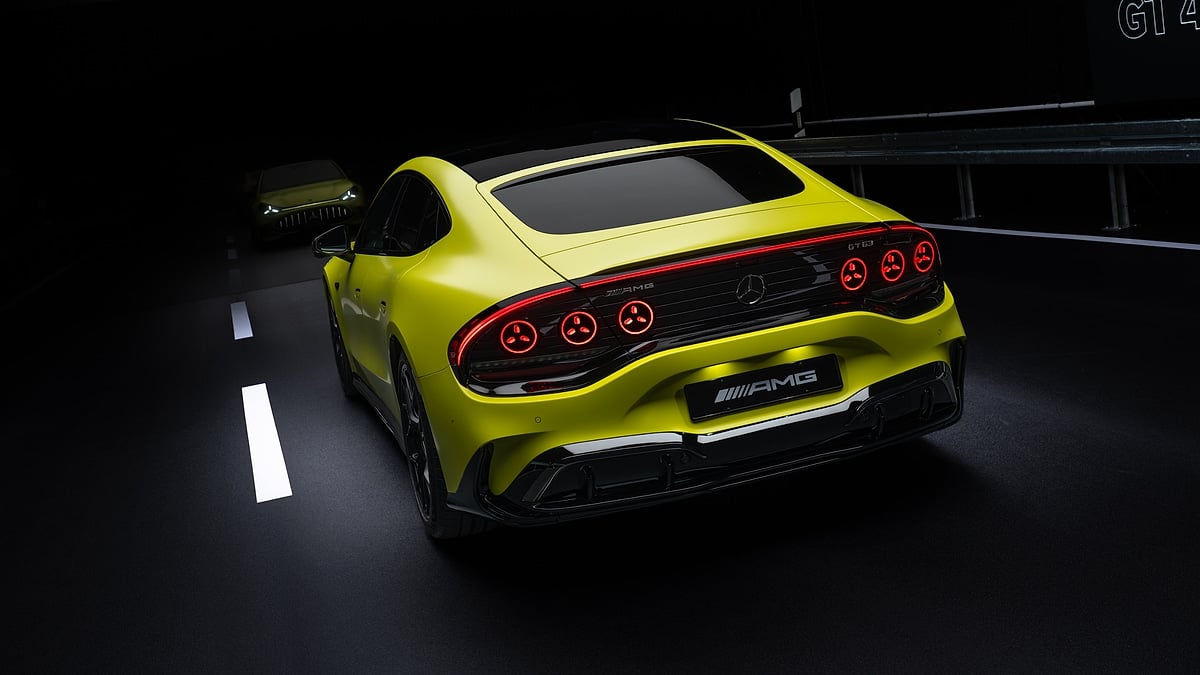
The exterior has taken its own beating. Autoevolution: “I Had To Triple-Check It’s Not Made by Honda.” The BBC reported a “polarised reception.” CarScoops noted that “without the Ferrari badging, it would probably be tough for most everyday folks to tie this car back to the Prancing Horse brand.” Most Ferraris are recognizable even with the badges removed. The Luce’s departure from Ferrari's visual tradition is so complete that it has created a genuine identity crisis. I think that’s brave. I also think bravery doesn’t guarantee beauty.
The Apple Car That Never Was
Apple spent approximately $10 billion on Project Titan between 2014 and 2024. At its peak, 2,000 employees were working on it. The project cycled through leadership changes and partnership negotiations that went nowhere. Apple explored deals with Hyundai and Kia in 2021 that collapsed after Hyundai confirmed the talks publicly. The company also looked at Canoo, LG/Magna, and Toyota.
In April 2021, Apple Car rumors swirled around Lucid Motors. Reports suggested Apple had explored a partnership, and Lucid’s stock moved on the speculation. Lucid’s CEO, Peter Rawlinson, is a former Tesla engineer. But like the Hyundai talks, nothing materialized. In February 2024, Apple cancelled the project.
Ten billion dollars. A decade of work. Nothing shipped.
The Lucid connection hasn’t gone unnoticed. A member of the Lucid Owners Club community, Loc Trang, posted a widely-circulated comparison between the Luce and the Lucid Air. These owners are doing the comparison work that legacy automotive media largely isn’t.
Bobby Goodlatte, a designer and former Facebook product lead, reposted a theory that keeps echoing.
“My theory on the Luce: this is the car Jony wanted to design for Apple. Apple didn’t want to ship it, so he made it for Ferrari.”
LoveFrom was founded in 2019. The Ferrari collaboration began shortly after. Ive spent five years working on a car Apple spent ten years failing to build. What does it say about tech that a car company shipped the product that the world’s most valuable technology company killed? It says Ferrari has more creative courage than a corporation with $200 billion in cash. The Luce might be the last great Ive design.
On Paper It Doesn’t Win. That’s Not The Point.
I should be honest here. The Tesla Model S Plaid costs $109,990, has 1,020 horsepower, hits 60 mph in 1.99 seconds, and manages 368 miles of EPA range. The Lucid Air Sapphire costs $250,500, has 1,234 horsepower, hits 60 in 1.89 seconds, and manages 427 miles of EPA range.
The Ferrari Luce costs $645,000. It’s slower than both. It has less range. On a spreadsheet, it doesn’t win a single category. Not one.
Here’s the comparison that really puts the absurdity in perspective. A Tesla Model 3 Performance costs $54,990, hits 60 mph in 2.9 seconds, manages 309 miles of EPA range, and makes 510 horsepower. The Luce costs more than eleven times as much, is only half a second quicker to 60, and weighs roughly twice as much. You’re buying something else entirely.
But nobody buying a Ferrari is using a spreadsheet. The Luce isn’t competing on performance per dollar. It’s competing on what it feels like to sit in, to touch, to drive. The quad-motor torque vectoring is genuine, not brake-based simulation. The interior is an environment, not an interface. The allocation-only exclusivity (Ferrari delivered 13,640 cars last year, and 81% went to existing owners) creates a different kind of value.
My take: the Luce will sell out before the first delivery. Not because it’s the fastest. Because it’s the only electric car at this price where designers clearly gave a damn about driving.
The sound system is worth mentioning. Ferrari mounted accelerometers to the electric motors to capture their actual mechanical vibrations, then amplified them through the cabin speakers. No fake V12 noise. Where other automakers try to make EVs pretend to be something else, Ferrari lets the electric drivetrain be what it is.
Why This Counts
You are probably not buying a $645,000 Ferrari. I know I’m not. (My editor would like me to confirm this is not an expense account purchase.)
But the design philosophy behind the Luce will filter down. It always does. The same way BMW’s iDrive forced every automaker to rethink infotainment, the Luce’s emphasis on tactile controls and material honesty will influence what your next car feels like. When enough people see that an electric car can have physical buttons and analog gauges and zero interior plastic, the touchscreen-everything approach starts looking like the cost-cutting measure it mostly is.
More broadly, the Luce exposes the creative bankruptcy in legacy EV design. BMW and Mercedes have the engineering talent, the manufacturing scale, and the supplier relationships. What they lack is the willingness to risk making something that doesn’t look like what they’ve made before. Ferrari’s willingness to do exactly that is the difference between an ugly EV and a brave one.
Manzoni put it best:
“Tradition is not the worship of ashes. Tradition is the preservation of fire.”
Legacy automakers are worshipping ashes. Ferrari is tending the fire.
What To Watch Next
If you’re considering any electric vehicle purchase in the next 24 months, use the Luce as a filter. Not the price tag, the philosophy. When you test drive an EV, ask: Does this interior feel designed for driving, or designed for a spec sheet? Are the controls where they need to be? Does the design embrace what the car is, or apologize for it? The gap between BMW’s electric M3 getting memed on Instagram and Ferrari’s Luce selling out before its full reveal is not a price gap. It’s a courage gap.
Ferrari CEO Benedetto Vigna has walked back 2030 EV targets from 40% electric to 20%, citing “non-existent” demand for high-performance EVs. Lamborghini pushed its Lanzador to 2029. Aston Martin delayed its electric plans entirely. Given that Ferrari’s 2025 production run was 81% allocated to existing owners, the Luce looks prescient, not orphaned.
What do you think: does the Ferrari Luce justify the $645K price tag, or is it overhyped? Would you take the BMW iX’s range and tech, or the Audi e-tron’s looks? Have you rejected an EV because of its design? Let me know below.
About The Author
Noah Washington is an automotive journalist based in Atlanta, Georgia, covering sports cars, luxury vehicles, and performance culture. His reporting focuses on explaining the engineering, design philosophy, and real-world ownership experience behind modern vehicles.
Noah has been immersed in the automotive world since his early teens, attending industry events and following the enthusiast communities that shape how cars are built and driven today. His work blends industry insight with enthusiastic storytelling, helping readers understand not just what a car is, but why it matters.
Noah is also a member of the Southeast Automotive Media Association (SAMA), a professional organization for automotive journalists and industry media in the Southeast.
His coverage regularly explores sports cars, luxury vehicles, and performance-driven segments of the automotive industry, including the evolving culture surrounding Formula Drift and enthusiast builds.
Read more of Noah's work on his author profile page.
You can also follow Noah here:
Set Torque News as Preferred Source on Google
Follow us today...