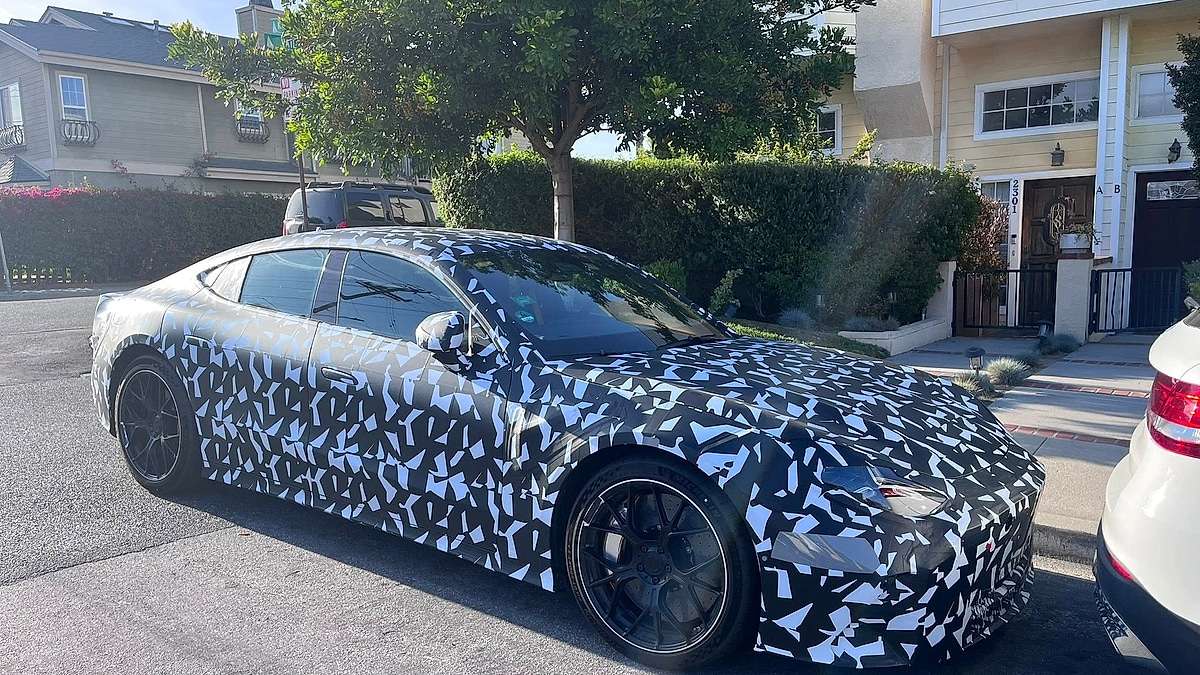

A camouflaged Mercedes-AMG prototype spotted in Los Angeles is interesting not because it confirms a new model, but because of the combination of clues visible on the vehicle. According to the observer who shared the sighting, the car appears to wear AMG-marked hardware and to be fitted with Michelin Pilot Sport S 5 tires, a serious performance tire associated with higher-end AMG applications.
That combination does not identify the prototype with certainty. It does, however, suggest that Mercedes-AMG is testing something more substantial than a generic styling mule, and it arrives at a moment when the brand’s shift toward electrified four-door performance cars is already well underway.
Smart catch.
That correction about the red emergency-style control is important because it keeps the analysis grounded. Visible prototype safety hardware is easy to overinterpret online, especially when readers are already primed to see electrification clues everywhere. But a red stop control inside an early test vehicle does not, by itself, prove a hybrid or fully electric powertrain. The stronger evidence comes from the broader context: the body style, the tire choice, the level of camouflage, and the timing relative to Mercedes-AMG’s publicly stated transition toward more electrified performance models.
The tires tell the real story.
These are almost certainly the Michelin Pilot Sport S 5, co-developed between Michelin and Mercedes-AMG over three years. The development was extensive:
Michelin and Mercedes-AMG developed the Pilot Sport S 5 specifically for serious performance applications, and that matters more than the chemistry details. The key point is not how many compounds were tested, but what the tire signals about the vehicle wearing it. A manufacturer does not typically fit a high-end, track-capable tire like this to a public-road prototype unless chassis behavior, grip balance, and high-speed control are part of the evaluation brief. In other words, the tire choice is meaningful because it suggests performance validation, not because it proves the exact identity of the final production car.
Twenty-five different front compounds were tested. Twenty rear compounds. The final design uses wet-optimized rubber on the inner tread, dry-performance compound in the middle, and track-focused endurance rubber on the outer shoulders.

Currently specified on the AMG GT 63 Coupe and CLE 53. When a manufacturer puts this level of tire on a test mule, they're not testing a styling concept. They're testing a vehicle designed to be driven hard. On the road. And on track.
The Apex Automotor community response was immediate and informed.
Valentino's CLS guess makes sense emotionally, but enthusiasts miss the four-door coupe that started the segment. But Mercedes has been clear: the CLS nameplate is finished. The E-Class absorbed its practical role; the GT 4-Door took its emotional one.
A more disciplined reading is that the sighting fits AMG’s broader product direction without conclusively identifying one exact model. Mercedes-AMG has already signaled that combustion and electrified performance cars will overlap for a period, which means a prototype like this could be a future electric four-door, a transition-stage development car, or a component test vehicle wearing familiar bodywork. The important point is not false certainty about the badge it will eventually wear. The more useful takeaway is that AMG appears to be validating a four-door performance vehicle with hardware serious enough to suggest the brand is trying to preserve dynamic credibility as it moves deeper into electrification.
Here's where it gets interesting.
The AMG.The EA platform uses YASA axial-flux electric motors, technology Mercedes acquired when it bought the British firm in 2021. Each motor produces approximately 480 horsepower and 590 lb-ft of torque while weighing less than 53 pounds.
In a multi-motor setup, total output could exceed 1,000 horsepower. That places the electric GT in direct competition with the Porsche Taycan Turbo GT and the Lotus Emeya. The 800-volt architecture means faster charging and better thermal management under sustained track use.
AMG CEO Michael Schiebe calls it a “dual world” strategy: “We’ve never stopped working on engines. We have this parallel world of technologies, and we’ll have to continue in this dual world for some time.”
Is this prototype alone proof of the electric GT's timeline? No. But the convergence of signals is compelling.
That is also why the tire clue is more helpful than the old CLS nostalgia angle. Mercedes has already closed the CLS chapter, and the more relevant question now is what AMG wants its next four-door flagship to feel like in an era shaped by battery packaging, software calibration, weight management, and electric torque delivery. A sighting like this does not settle output, final naming, or launch timing. What it does do is suggest that AMG still cares about the ingredients that make a performance sedan credible to enthusiasts: grip, chassis intent, and the ability to support serious dynamic work rather than just impressive headline numbers.
The first AMG.EA's production car is scheduled for global rollout in 2026. Europe and the United States get the first allocation. Validation prototypes are almost certainly running public roads right now; that's standard timing for a model launching within 12 months.
The tire specification, the camouflage level, and the LA location (a key test market for Mercedes) all align with a vehicle entering final validation. One prototype sighting is a rumor. A prototype wearing bespoke track tires in a major market is a data point.
Mercedes-AMG has not officially confirmed this specific prototype. The company has, however, been transparent about its electrified future.
Schiebe's interviews and Mercedes' product roadmap both point to 2026 as the AMG.EA launch window. The current GT 4-Door remains on sale for 2026, suggesting a transition year where hybrid and electric variants may overlap.
Mercedes spokespeople previously noted the EQE and EQS as CLS alternatives, but neither carries the AMG performance pedigree this prototype's tires imply.
For prospective AMG buyers, the message is clear: The fairest conclusion is that this Los Angeles sighting adds one more useful clue to Mercedes-AMG’s next chapter without resolving the full picture. The visible details support the idea that AMG is testing a serious four-door performance vehicle during a transition period in which electrified products are becoming central to the brand’s identity. They do not prove final output, final naming, or final timing.

For readers watching this space, the more reliable indicators will be official AMG.EA disclosures, Nürburgring development activity, production-spec tire and brake packages, and future sightings that reveal more of the final proportions. Until then, this prototype is best treated as a meaningful data point, not a definitive reveal.
Image Sources: Mercedes Media Center/Matt Jacobs
About The Author
Noah Washington is an automotive journalist based in Atlanta, Georgia, covering sports cars, luxury vehicles, and performance culture. His reporting focuses on explaining the engineering, design philosophy, and real-world ownership experience behind modern vehicles.
Noah has been immersed in the automotive world since his early teens, attending industry events and following the enthusiast communities that shape how cars are built and driven today. His work blends industry insight with enthusiastic storytelling, helping readers understand not just what a car is, but why it matters.
Noah is also a member of the Southeast Automotive Media Association (SAMA), a professional organization for automotive journalists and industry media in the Southeast.
His coverage regularly explores sports cars, luxury vehicles, and performance-driven segments of the automotive industry, including the evolving culture surrounding Formula Drift and enthusiast builds.
Read more of Noah's work on his author profile page.
You can also follow Noah here:
Set Torque News as Preferred Source on Google
Follow us today...