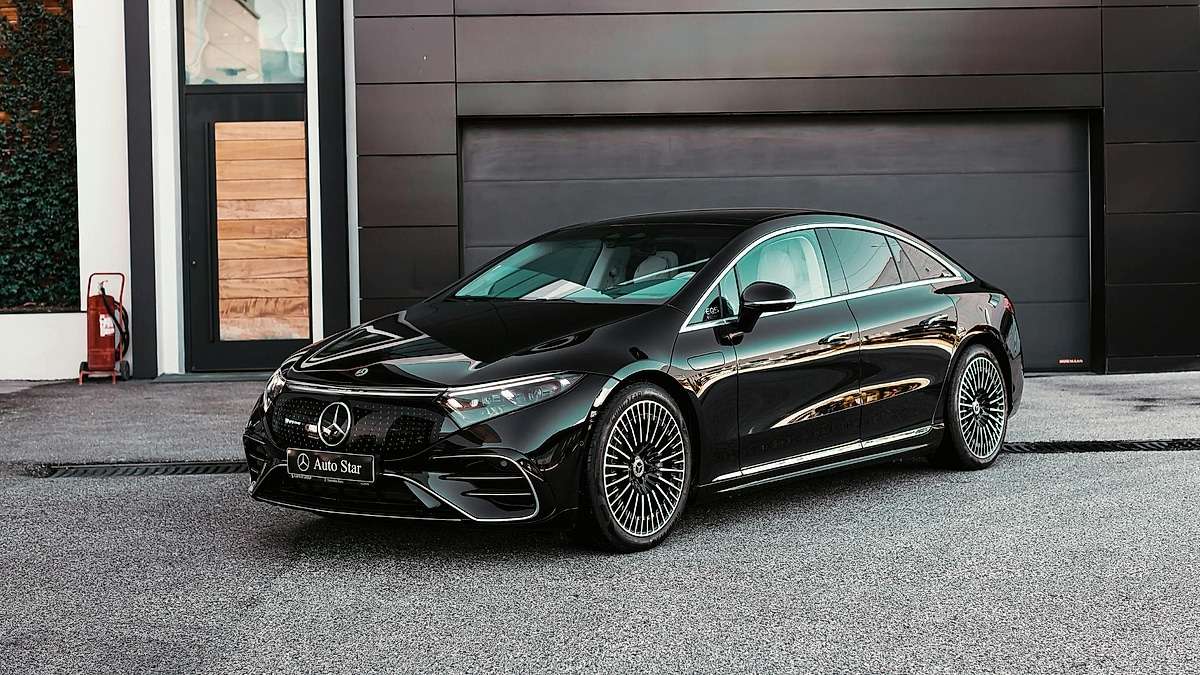

The Mercedes EQS has suffered some of the steepest early depreciation in the luxury market, while the S-Class loses 55.4 percent over five years. Used EV buyers can compare range, charging, battery size, and software directly, and that math punishes the electric flagship.
The Mercedes EQS depreciation story is severe, but it needs clean math. iSeeCars data reported by Motor1 found the EQS lost 48.7 percent of its average new price after one year, equal to about $65,143 on average across the studied vehicles. That is close to half its value in 12 months, and it explains why the EQS appears in conversations about cars that lose half their value in 3 years.

Three-year used examples can approach 60 to 65 percent depreciation depending on trim, mileage, original MSRP, and whether the figure is retail or trade-in. I ran the numbers because the gap between electric and gas luxury resale is too wide to ignore.
The EQS Sheds a Huge Share of Its Value Early
The depreciation data on the EQS is not abstract. A 48.7 percent first-year loss converts to roughly $65,143 in vanished equity in the iSeeCars study, placing the EQS among vehicles that depreciate the most in the first year of ownership. On a simple $120,000 MSRP example, a 47 percent drop would be $56,400, so the dollar math depends on the exact original sticker. The three-year picture is also ugly. Recharged's 2025-2026 depreciation guide says no single official database publishes a universal three-year EQS number, but normal-mileage 2023 EQS 580 examples that stickered around $120,000 to $135,000 can show retail values around $55,000 to $65,000 and trade-in ranges around $47,000 to $55,000. That is how a six-figure electric flagship ends up priced like a loaded mainstream SUV.
Owner anecdotes match the pricing collapse, but they should stay in their lane. Used listings in the $40,000 range for high-MSRP EQS examples are real enough to shape buyer perception, especially when early lessees remember dealers asking over sticker. The turnaround from markup to distress pricing happened in roughly three model years. That does not mean every EQS lost exactly the same percentage. It means the model's public resale story now begins with the discount.
The S-Class Holds Its Value Better Across the Early Window
Mercedes built its brand on the S-Class, and the gas-powered flagship still commands pricing power that the EQS cannot match in the early years. iSeeCars data shows the S-Class depreciates 36.3 percent after three years, retaining a resale value of $76,196. After five years, the S-Class has lost 55.4 percent of its value and still fetches $53,305 on the used market, essentially matching the luxury large car category average of 54.9 percent. The EQS can reach similar or worse depreciation much earlier, depending on trim and transaction type.

That does not make the S-Class cheap to own. iSeeCars' five-year S-Class depreciation estimate is roughly $66,245, which is a large bill even by luxury standards. A used EQS bought after the first big drop can cost less to enter than a comparable S-Class, and the depreciation curve may flatten from there. The catch is the battery and software transparency. Without a verified battery-health report, the EQS savings can evaporate faster than the range meter on a cold morning.
Battery Specs Strip Away the Mystique That Protected S-Class Pricing
Gas luxury buyers purchased status, badge, and intangible ride quality that could not be fully quantified on a spec sheet. EV buyers operate differently. They compare kWh capacity, charging speed, EPA range, mi/kWh efficiency, software support, and screen tech on a spreadsheet. That transparency removes some of the mystery that insulated the S-Class from hard value comparisons for decades. I compared the EQS battery specs against the depreciation curve and found that the specs help explain the pressure on the badge premium.
The U.S. 2026 EQS 450+ Sedan is listed by Mercedes-Benz USA at $99,900 MSRP, with a 118 kWh battery, 390 miles of EPA-estimated range, 9.6 kW AC charging, and 200 kW DC fast charging. That is the relevant U.S. showroom spec for American buyers checking today's EQS 450+. Mercedes also announced a newer EQS range in Europe in April 2026 with a 122 kWh usable battery for the EQS 450+ and 800-volt hardware, but that is not the same specification as the used 2022-2024 U.S. cars driving the depreciation story. Those older cars generally carried smaller usable battery figures and different range ratings. When a buyer can quantify the product directly, the badge premium shrinks.
Used Luxury Shoppers Can Quantify What They Are Actually Buying
The used luxury market has always rewarded opacity. A buyer choosing between a five-year-old S-Class and a three-year-old 7-Series relied on reputation, maintenance horror stories, and test-drive impressions, the same uncertainty behind stories about what to buy instead of problematic used luxury vehicles. The used EV buyer faces a different equation. Range at a given state of health, peak charging speed at a compatible DC station, and real-world mi/kWh in summer and winter can often be checked before the purchase, even if not every dealer provides a perfect battery-health report.
The Math Punishes Buyers Who Bought the Wrong Status Symbol
A $120,000-plus EQS showing up in the $40,000 to $60,000 used range should make any buyer pause. The depreciation is a warning. The early adopter who paid a high transaction price now owns a vehicle whose resale value collapsed faster than many traditional luxury sedans. The buyer who steps in around $55,000 for a three-year-old example may be getting the better deal, but that buyer still needs to watch battery health, warranty timing, tire wear, software support, and the next wave of newer EQS hardware.
I asked the same question every used luxury shopper should ask. What exactly are you paying for? If the answer is measurable range, charging speed, and screen resolution, the EQS competes with a Lucid, a BMW i7, and a used Tesla Model S on a spreadsheet where the three-pointed star carries fewer bonus points. If the answer is intangible prestige and ride isolation, the S-Class still holds that ground, and it holds its early value better while doing it. Luxury EV buyers paid for the future. The depreciation data shows they bought a very expensive lesson in transparency.
About The Author
Noah Washington is an automotive journalist based in Atlanta, Georgia, covering sports cars, luxury vehicles, and performance culture. His reporting focuses on explaining the engineering, design philosophy, and real-world ownership experience behind modern vehicles.
Noah has been immersed in the automotive world since his early teens, attending industry events and following the enthusiast communities that shape how cars are built and driven today. His work blends industry insight with enthusiastic storytelling, helping readers understand not just what a car is, but why it matters.
Noah is also a member of the Southeast Automotive Media Association (SAMA), a professional organization for automotive journalists and industry media in the Southeast.
His coverage regularly explores sports cars, luxury vehicles, and performance-driven segments of the automotive industry, including the evolving culture surrounding Formula Drift and enthusiast builds.
Read more of Noah's work on his author profile page.
You can also follow Noah here:
Set Torque News as Preferred Source on Google
Follow us today...