
For years, luxury automakers promised that software-defined vehicles would make driving smarter, smoother, and more intuitive. In many ways, modern EVs have absolutely delivered on that vision. But as vehicles become increasingly dependent on software systems and sensors, some owners are discovering that advanced technology can occasionally create problems that feel completely unfamiliar compared to traditional gasoline cars.
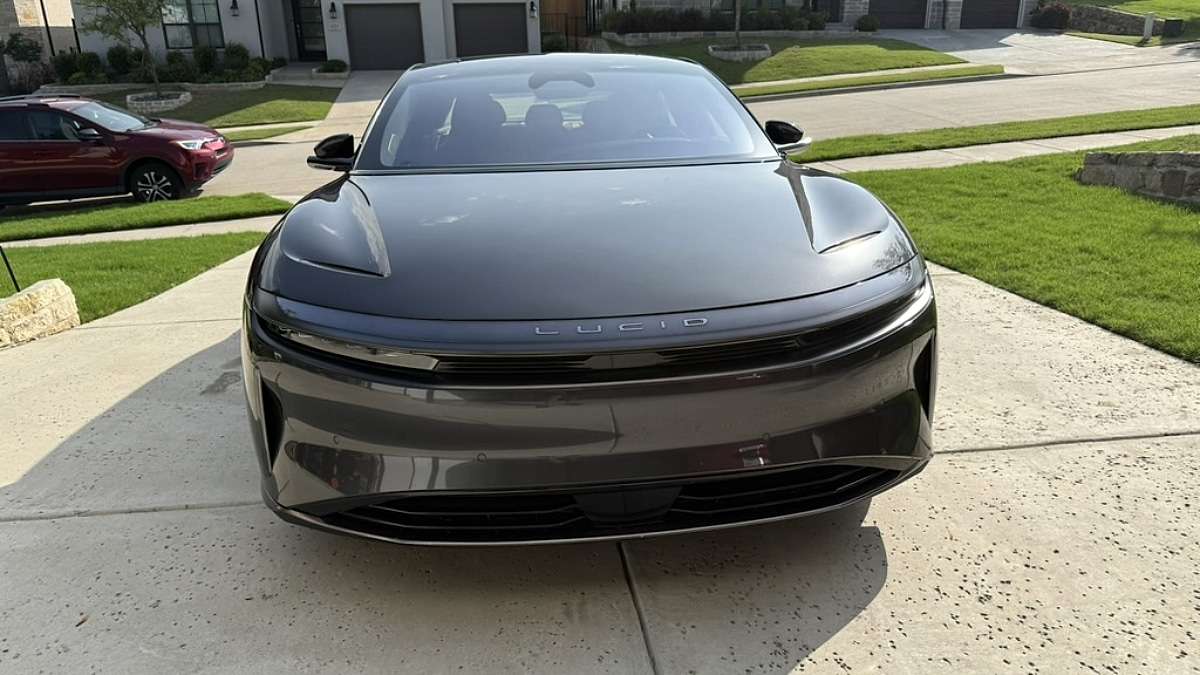
That reality became especially unsettling for one new Lucid owner, whose grocery store trip quickly turned into a stressful experience just days after buying his vehicle. While browsing through the “Lucid Owners Club” group on Facebook, I came across that post from Sagar Shah. Sagar explained that just four days after purchasing a pre-owned 2024 Lucid Air Touring, the luxury EV unexpectedly moved forward multiple times despite him selecting reverse while leaving a grocery store parking lot.
After the issue allegedly caused him to hit a curb and scratch the underside of the car, Lucid support reportedly instructed him to perform a 15-minute “sleep cycle” reset by leaving the vehicle untouched with nothing on the seats.
Here’s how he put it: “I just bought a pre-owned 2024 Lucid Air Touring. On day 4 of ownership, I was at a grocery store, loaded up my groceries, put the car in reverse (rear camera showed up, side mirror tilted down) and the car instead went forward. I panicked, stopped, and put the car in park. This happened 2 more times. I then reset on the car after looking it up online. I tried again and this time it went forward hitting the curb slightly and scratching the bottom of my car.
I called Lucid, waited 20 mins to get a person, and they told me they needed to do a sleep cycle for 15 mins and nothing could be on the seats. I had to take the car seat out, wait outside 15 mins, and now it's functioning okay, but with a scratch at the front.
Do I even keep this car? Has this happened to anyone else? I checked online and people have had it happen to them on Lucid forums. The car was not on an incline. Creep mode was not on either.”

A Grocery Store Parking Lot Became an Ownership Hassle
What makes Sagar’s story especially attention-grabbing is how ordinary the situation was. This was not a track day, a high-speed acceleration run, or some complicated driving scenario involving advanced driver assistance systems. According to his account, this happened during a routine grocery store stop while simply attempting to back out of a parking spot.
That normalcy is part of what makes stories like this resonate so strongly with readers. Most drivers can imagine how quickly panic sets in when a vehicle behaves opposite to the input they expect. Even though Sagar says the issue appears resolved after the sleep-cycle reset, the experience clearly shook his confidence in the car.
The Lucid Air has developed a reputation for being one of the most technologically impressive luxury EVs on the market. In my previous report examining how a Lucid Air road trip proved the sedan’s remarkable real-world efficiency, I explored why many owners continue viewing the vehicle as one of the most advanced luxury EVs currently on the road. But stories like Sagar’s show the other side of the software-heavy luxury EV ownership experience. When something unusual happens, troubleshooting often looks very different from what traditional car owners are used to.
The Strange Reality of “Sleep Cycle” Troubleshooting
One of the most fascinating parts of Sagar’s experience was the solution itself. Lucid support instructed him to let the vehicle sit untouched for 15 minutes with nothing on the seats so the car could perform a “sleep cycle.” For many long-time gasoline vehicle owners, that kind of instruction probably sounds bizarre. But in the modern EV world, software resets and sleep cycles are becoming surprisingly common.
Tesla owners have discussed rebooting screens and resetting software for years. Rivian owners have reported performing hard resets after various system glitches too. Even legacy automakers transitioning into software-defined EVs are increasingly introducing troubleshooting procedures that resemble IT support more than traditional automotive diagnostics.
That doesn't automatically mean something catastrophic is wrong with the vehicle itself, but modern EVs contain enormous amounts of interconnected software systems managing power delivery, infotainment, cameras, sensors, driver assistance functions, and electronic controls. Sometimes those systems can experience temporary glitches or synchronization issues.
There still is a psychological difference between rebooting a smartphone and rebooting a luxury vehicle that costs tens of thousands of dollars. For many buyers, especially those transitioning from traditional combustion vehicles into EVs for the first time, experiences like this can feel unsettling because they challenge decades of driver expectations.

Owners Are Split Between Confidence and Concern
As expected, Sagar’s post quickly generated discussion from other Lucid owners and shoppers. Some commenters defended the brand and suggested this may have been an isolated issue.
Dave Byrne commented: “I have a 2025 LAT and this has never happened. Is the SW up to date? When you reset the car, did you reboot it by holding down the Air symbol on the pilot pad? I drive my 2 kids (7 & 4) in the car every day and to be honest, I feel safer in the Lucid than the Sienna or our SUV.”
Dave’s comment reflects an important reality about online ownership groups. Drivers are far more likely to post when something goes wrong than when everything works perfectly. That can sometimes create the perception that certain vehicles are less reliable than they actually are. At the same time, confidence and trust matter tremendously in luxury vehicle ownership. Buyers spending significant money on premium EVs expect both advanced technology and peace of mind.
Still, not everyone in the comments section felt reassured. Tishawn Fahie wrote: “Wow! I’m glad you’re okay. Every single time I wonder about getting Lucid, these kinds of stories pop up. This is crazy! I’d say exchange it!”
Tishawn’s response highlights a challenge Lucid still faces as a younger automaker trying to establish long-term public trust. Unlike Toyota or Honda, which are companies that spent decades building reputations around reliability and predictability, Lucid is still in the process of convincing mainstream buyers that its vehicles can consistently deliver dependable ownership experiences alongside cutting-edge technology.
Why Software-Defined Cars Feel So Different to Drive
Sagar’s story also arrives during a broader transition happening across the automotive industry. Modern EVs do not simply replace gasoline engines with batteries. They also fundamentally change how vehicles behave and communicate with drivers.
Regenerative braking systems can create unfamiliar deceleration sensations, instant electric torque changes throttle response characteristics, and electronic steering systems continue evolving. Many luxury EVs are also extremely quiet, which alters the sensory feedback drivers have relied on for decades.
I personally think the industry still underestimates how significant this adjustment period can be for some drivers and passengers. We often discuss EVs in terms of charging speed, range, horsepower, and software features, but there is also a genuine human adaptation side to all of this.
In one of my earlier pieces, we discussed how some Lucid Air passengers reported nausea during everyday driving. I explored how one-pedal driving behavior and regenerative braking can affect occupants differently compared to traditional gasoline vehicles. That broader conversation about EV differences is becoming increasingly important as more drivers move from traditional ICE vehicles into software-heavy EV platforms.
Lucid vs Tesla: A Battle of Trust as Much as Technology
Lucid is often compared directly to Tesla because both companies position themselves as technology-first EV manufacturers. But while Tesla spent years normalizing software updates, touchscreen-heavy cabins, and reset-based troubleshooting, Lucid is still much earlier in its ownership journey with mainstream consumers.
Tesla owners have largely become accustomed to the idea that occasional software quirks are part of the ownership experience. Some drivers even joke that their cars receive updates more often than their phones. Lucid buyers, however, are entering the market with extremely high expectations because the Air is positioned as a premium luxury product competing with vehicles from Mercedes-Benz, BMW, Porsche, and Tesla simultaneously.
That creates an interesting challenge for Lucid. On one hand, the company continues earning praise for its engineering, efficiency, ride quality, and interior refinement. Many reviewers still consider the Lucid Air one of the most impressive EV sedans ever built. On the other hand, stories involving software behavior, service experiences, or unusual glitches can spread quickly online because Lucid remains a relatively niche automaker with a smaller owner base. That means every ownership story, positive or negative, tends to attract outsized attention just like this one.
Modern Luxury EVs Are Starting to Behave More Like Consumer Tech
I think stories like Sagar’s are fascinating because they highlight how rapidly the automotive industry is evolving beyond what many drivers grew up understanding as “normal.” A decade ago, if someone told you their luxury sedan needed to sit untouched with empty seats so it could properly reboot itself, most people would have assumed they were describing a laptop instead of a car.
At the same time, I don't think stories like this automatically mean EVs are unreliable or inherently problematic. What I believe they do show is that the industry is still navigating the growing pains that come with turning vehicles into highly software-dependent machines.
For buyers considering EVs from companies like Lucid, Tesla, Rivian, or even legacy automakers transitioning into advanced software platforms, ownership increasingly involves understanding both traditional automotive hardware and modern digital ecosystems. That's a very different ownership experience than what many drivers have historically known.
Important Takeaways
- Software plays a massive role in modern vehicles: Today’s EVs rely heavily on interconnected software systems, which means troubleshooting can sometimes involve resets and sleep cycles instead of purely mechanical repairs.
- Online forums can amplify problems: Drivers are more likely to post when something goes wrong, so ownership groups may not always represent the average ownership experience.
- Luxury expectations remain extremely high: Buyers spending premium-car money expect advanced technology to work consistently and predictably every day.
- EV driving dynamics are still new to many people: Regenerative braking, instant torque delivery, and software-defined controls create a driving experience that some drivers and passengers may need time to adjust to.
- Brand trust takes years to build: Lucid continues earning praise for efficiency, performance, and safety, but long-term reputation ultimately depends on how owners feel after living with the vehicles over time.
Let's Hear What You Have to Say
Have you ever experienced strange software behavior or unexpected glitches in a modern EV?
And do you think software-defined vehicles are making cars better overall, or are they sometimes becoming too complicated for everyday drivers?
I'd love to hear your thoughts in the comments below.
About The Author
Aram Krajekian is a young automotive journalist bringing a fresh and analytical perspective to the evolving automotive landscape by reporting on real-world ownership experiences and providing industry analysis. Based in North Carolina, he covers electric vehicles, trucks, and broader automotive trends with a focus on contributing a balanced evaluation. His reporting cuts through brand bias to provide readers with grounded insight into how vehicles perform for everyday drivers beyond marketing narratives.
Aram can be reached on X and LinkedIn for ongoing automotive coverage.
Image Credits
The “Lucid Owners Club” Facebook group and Lucid’s gallery, respectively.
Set Torque News as Preferred Source on Google
Follow us today...