
If you have been following our coverage of the fourth-generation Coyote V8 delivering record-setting naturally aspirated power in the latest Mustang GT and Dark Horse, you already know this engine has evolved into something much larger than one automaker's platform. It has become the heartbeat of specialty sports cars on two continents, and the Cobra GT Coupe is the most dramatic proof yet.
The automotive world is no stranger to six-figure performance cars. Ferraris, McLarens, Lamborghinis, and limited-production Porsches routinely command prices that would have seemed unthinkable a decade ago. Yet one of the most intriguing new performance cars unveiled this year is not coming from Italy, Germany, or even Detroit. Instead, it is coming from Britain, wearing one of the most legendary names in sports car history, and relying on an engine that millions of enthusiasts instantly recognize from Ford's Mustang. As we have discussed in our analysis of why the Porsche 911 has become a nearly perfect sports car through decades of engineering refinement and racing commitment, the benchmark for an authentic sports car is rarely about raw numbers alone.
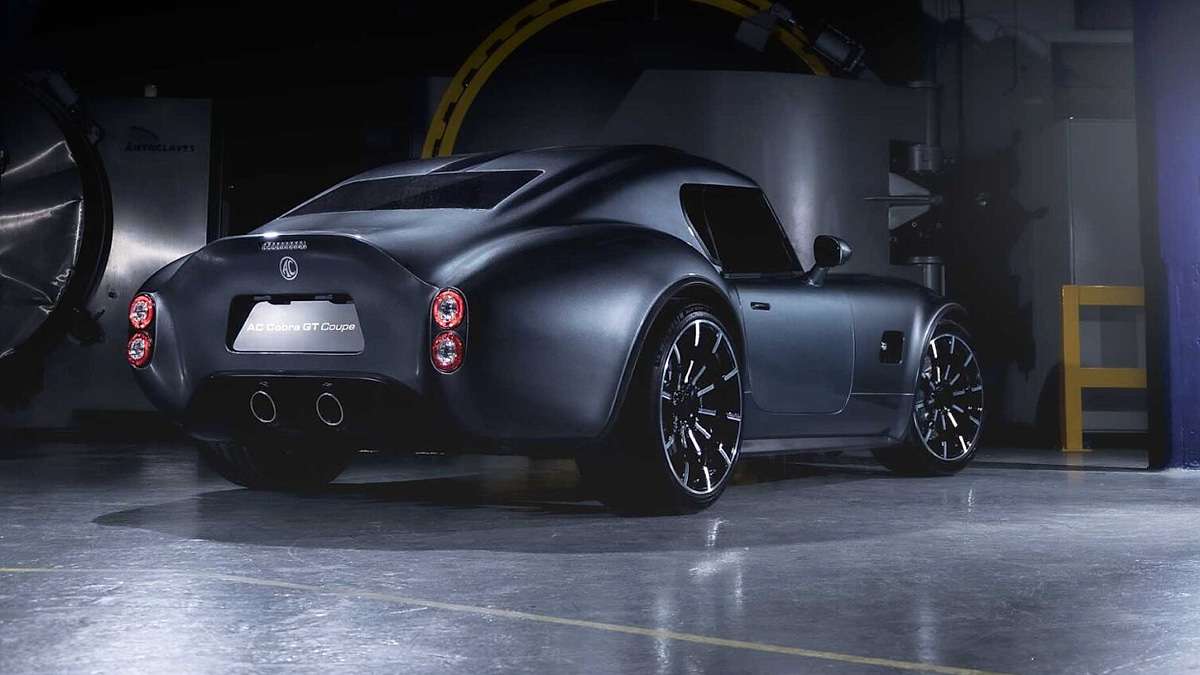
The newly revealed AC Cobra GT Coupe starts at roughly $315,000 and can be equipped with a naturally aspirated Ford 5.0-liter V8 producing around 450 horsepower or a supercharged version making up to 720 horsepower. AC Cars has officially unveiled the production AC Cobra GT Coupe, marking a new era for Britain's oldest active vehicle manufacturer as the automaker celebrates its 125th anniversary. As Autoblog put it, the new GT Coupe is "one of the jewels in the British carmaker's updated range." The result is a machine that blends old-school muscle-car character with modern carbon-fiber engineering.
Why Is Ford Still Powering Legendary Sports Cars Outside Ford?
One of the most surprising aspects of the new Cobra GT Coupe is that its heart comes from Ford. For decades, Ford's V8 engines have powered some of the world's most iconic specialty vehicles. From Shelby creations to low-volume sports cars and continuation models, Ford's small-block V8 architecture has become the default choice for builders looking for reliability, performance, aftermarket support, and global recognition. Our reporting on how spending $10,000 on a Whipple supercharger kit can push the Coyote V8 to 800 reliable horsepower on a street Mustang GT shows just how capable and flexible this platform truly is in the hands of performance builders worldwide.
The Coyote V8 has become especially important because it represents something increasingly rare in today's automotive market: a high-revving naturally aspirated V8 that remains emissions compliant while delivering modern performance. In many ways, Ford's engine has become larger than Ford itself. It is no longer just a Mustang engine. It is one of the last great V8 platforms available to specialty manufacturers seeking authentic performance.
Is This the Worthy Successor to the Shelby Daytona Coupe?
The moment enthusiasts see a fixed-roof Cobra, one comparison becomes unavoidable: the Shelby Daytona Coupe. This is the same conversation our team explored when covering the only remaining 1966 Shelby Cobra 427 Super Snake, which Barrett-Jackson called arguably one of the most iconic American sports cars ever built. The Cobra nameplate carries that kind of weight, and the new GT Coupe walks right into that legacy with every curve of its carbon-fiber body.
Yet AC Cars appears to be taking a different approach. Rather than creating a direct modern interpretation of the Daytona Coupe, AC says the GT Coupe draws inspiration from the lesser-known AC A98 Le Mans racer from the 1960s. The design language reflects that heritage while incorporating modern proportions and aerodynamics. Still, many enthusiasts will inevitably compare the car to Shelby's legendary Daytona. Whether AC intended it or not, the GT Coupe enters territory long occupied by one of the most revered racing cars in American motorsports history.
Why Does It Cost More Than Some Ferraris?
The $315,000 starting price is likely to be one of the most debated aspects of the car. After all, buyers entering this price range can consider everything from exotic Italian sports cars to highly optioned Porsche 911 variants. Our coverage of how Porsche fans are growing frustrated as the brand's cheapest sports cars now climb past $140,000, raising questions about whether the brand has lost its original identity, shows that this pricing conversation extends well beyond Cobra country alone.
The answer lies in production scale. Unlike mass-produced performance cars, the AC Cobra GT Coupe is essentially hand-built. The carbon-fiber body, bespoke chassis, limited production numbers, and specialized engineering all contribute to costs that are spread across a very small number of vehicles. Economies of scale simply do not exist here. Buyers are not paying solely for performance numbers. They are paying for exclusivity, craftsmanship, heritage, and the opportunity to own something few others will ever see in person.
Who Is Actually Buying This Car?
This is perhaps the most interesting question. The typical buyer is unlikely to be cross-shopping a Mustang GT, Chevrolet Corvette, or even a Porsche 911. Instead, the target customer is often someone who already owns several performance vehicles and wants something unique. Collectors, enthusiasts of British sports cars, Cobra aficionados, and individuals seeking analog driving experiences are likely candidates. This is the same buyer profile that chased the Superformance Shelby Cobra continuation models, where the desire to own something with authentic heritage often matters more than any performance specification on paper.
For these buyers, the car's rarity may matter more than outright performance. They already have fast cars. What they are buying is a story.
Is It a Real Cobra or Just a Modern Continuation Car?
This debate may never be fully settled. Unlike many replica manufacturers, AC Cars can legitimately trace its roots back to the original company that built the Ace roadster which ultimately became the Cobra. That historical continuity gives the company a stronger claim than most modern reinterpretations. Our coverage of the 2013 Ford Shelby GT500 Cobra tribute vehicle, where Carroll Shelby himself worked on transforming the GT500 into what his team called the car that represented his ideas about a true Cobra, reminds us just how seriously the Cobra heritage has always been taken by those closest to it.
At the same time, the GT Coupe is unquestionably a modern vehicle. Its dimensions, chassis technology, materials, safety requirements, and engineering philosophy differ dramatically from those of the original Cobra. Perhaps the best answer is that it is both. It is neither a replica nor a direct continuation. Instead, it is AC's attempt to answer a simple question: what would a Cobra look like if its evolution had never stopped?
Why Does a Carbon-Fiber Cobra Weigh More Than 3,500 Pounds?
This may be the issue that sparks the most debate among enthusiasts. The original Cobras became famous partly because they were brutally simple and exceptionally light. The new GT Coupe, despite its carbon-fiber body, weighs roughly 3,500 pounds. At first glance, that seems contradictory. Our deep look at what carbon fiber actually is and why exotic brands like Pagani, Koenigsegg, and Bugatti use it as a gauge of how high-end and serious a car truly is explains why carbon fiber alone cannot always overcome the weight added by modern safety structures, climate systems, and premium interiors.
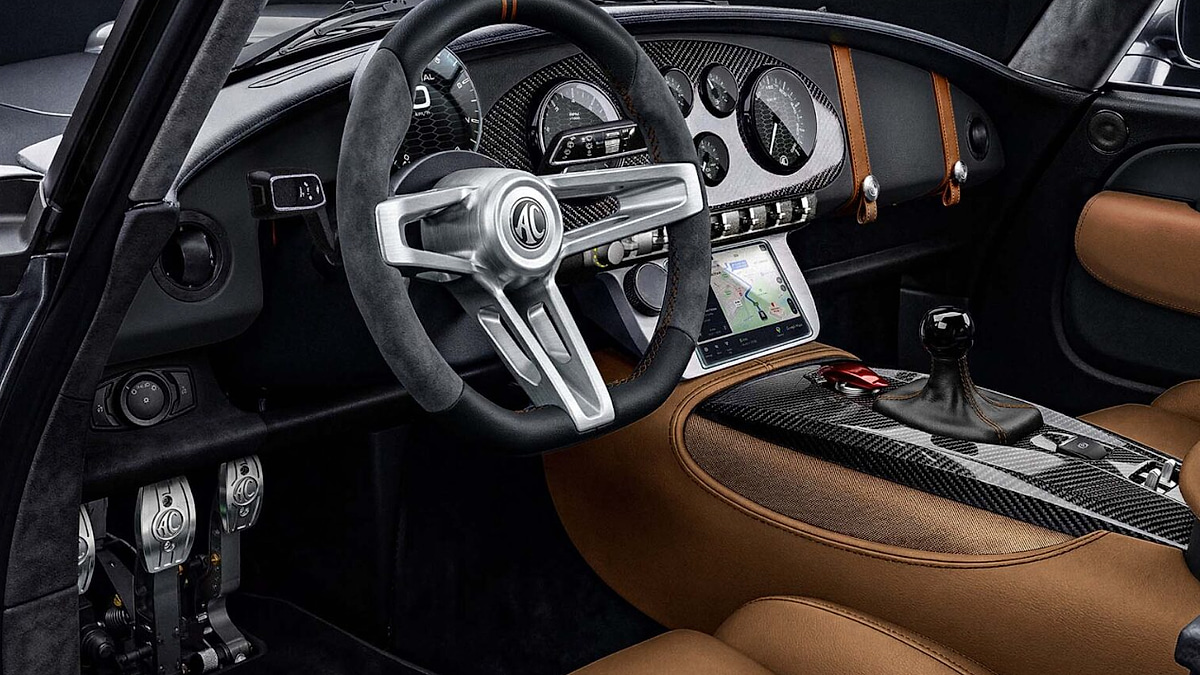
However, modern expectations change everything. Today's buyers demand structural rigidity, crash protection, advanced electronics, climate control, premium interiors, larger brakes, wider tires, and significantly greater refinement. Every one of those improvements adds weight. The result is a car that may be heavier than its ancestors but is also dramatically more capable, comfortable, and usable. Whether that is progress or compromise depends entirely on your perspective.
Is This One of the Last Great V8 Grand Tourers?
Perhaps the biggest question surrounding the Cobra GT Coupe has little to do with the car itself. Around the world, emissions regulations continue to tighten. Manufacturers are investing heavily in electrification and hybridization. Naturally aspirated V8 engines are becoming increasingly rare. Our analysis of how Ford has committed to continuing V8 engines for the foreseeable future, with multiple V8 platforms still active across performance and truck lineups, is a reminder that this powertrain philosophy still has passionate defenders inside major automakers, not just boutique British ones.
That reality gives cars like the Cobra GT Coupe a significance beyond their production numbers. This vehicle represents a philosophy that is slowly disappearing: a front-mounted V8, rear-wheel drive, available manual transmission, and a focus on mechanical engagement rather than digital intervention. For some enthusiasts, that is exactly why the car matters. Not because it is the fastest. Not because it is the most technologically advanced. But because it preserves a driving experience that may soon become extraordinarily rare.
The Bigger Picture
The AC Cobra GT Coupe is not a rational purchase. It was never intended to be. Nobody needs a $315,000 British grand tourer powered by a Ford V8. Yet that may be precisely why it captures attention. In a world increasingly dominated by software, electrification, and automation, the Cobra GT Coupe feels like a celebration of old-school performance values. It combines modern engineering with a powertrain philosophy that enthusiasts have loved for generations. For context, even the 2025 Chevrolet Corvette ZR1, which produces 1,064 horsepower and can hit 60 mph in 2.3 seconds while setting records at Virginia International Raceway, represents how the American performance car tradition is finding ways to survive and thrive in this same rapidly changing environment.
And perhaps that is the most remarkable thing about this car. Its most important component is not the carbon fiber, the chassis, or even the styling. It is the fact that underneath it all beats a Ford V8 that still reminds enthusiasts why they fell in love with performance cars in the first place.
What Do You Think?
Would you spend more than $315,000 on the new AC Cobra GT Coupe, or would you choose a Ferrari, Porsche, or Corvette ZR1 instead?
And do you see the Cobra GT Coupe as a worthy successor to the classic Shelby-era Cobra and Daytona Coupe, or is it simply a modern interpretation wearing a legendary name?
Let us know your thoughts in the comments below.
About The Author
Armen Hareyan is the founder and Editor-in-Chief of Torque News and an automotive journalist with over 15 years of experience writing car reviews and industry news. Now based in the Charlotte region (Indian Land, SC, he founded Torque News in 2010, which since then has been publishing expert news and analysis about the automotive industry. He can be reached at Torque News on X, Linkedin, Facebook, and Youtube. Armen holds three Masters Degrees, including an MBA, and has become one of the known voices in the industry, specializing in the landscape of electric vehicles and real-world stories of actual car owners. Armen focuses on providing readers with transparent, data-backed analysis bridging the gap of complex engineering and car buyer practicality. Armen frequently participates in automotive events throughout the United States, national and local car reveals and personally test-drives new vehicles every week. Armen has also been published as an automotive expert in publications like the Transit Tomorrow, discussing how will autonomous vehicles reshape the supply chain, and emerging technologies in vehicle maintenance.
Images by AC Cars.
Set Torque News as Preferred Source on Google
Follow us today...