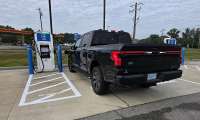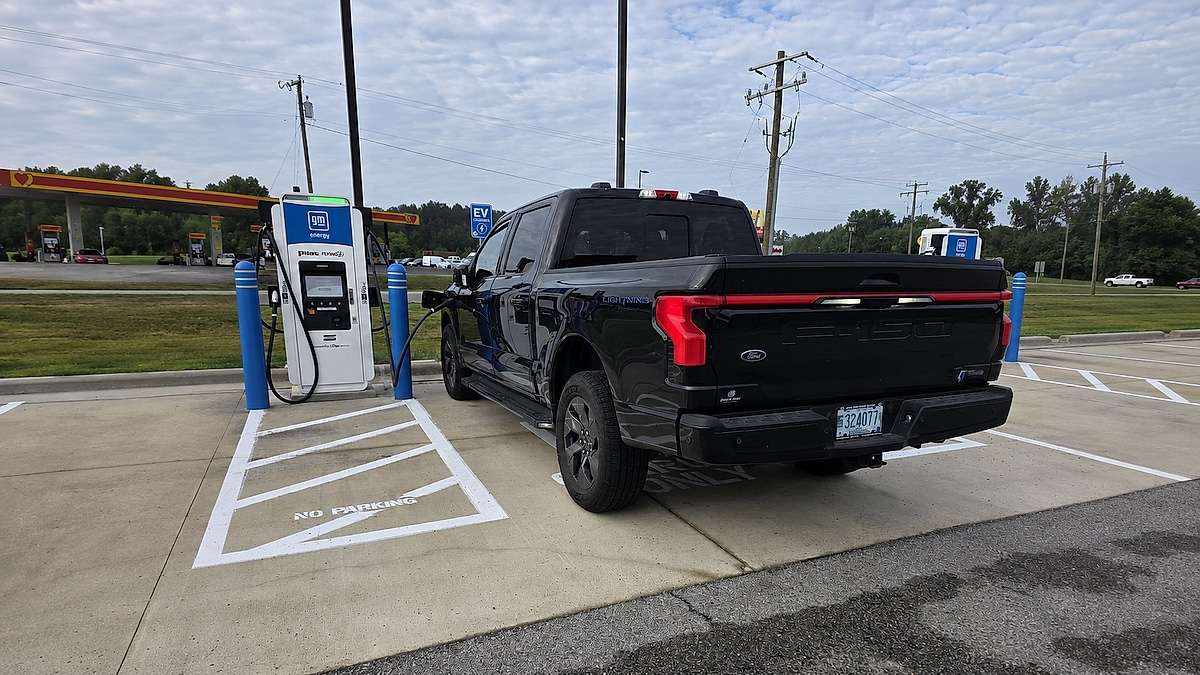

Ray Bisson spent the southbound half of a 1,828-mile road trip waiting for 80 percent.
On the way home, he waited for lunch.
The difference was an hour and a half.
Bisson had owned his Ford F-150 Lightning for a little over a month when he drove from New Hampshire to North Carolina and back. The route included long highway stretches, New York City traffic, speeds ranging from 55 to 70 mph, and a brief maximum of 72. By the time he returned home, the Lightning had averaged 2.2 miles per kWh across the entire trip.
- Charging based on real-world needs rather than fixed percentages can significantly reduce total travel time on long EV trips.
- Efficient trip planning includes aligning charging stops with natural breaks like meals or rest stops.
- Familiarity with charging networks, apps, and vehicle features can improve both convenience and confidence on extended drives.
According to the Facebook post, he learned which Tesla Superchargers would accept his truck. He discovered that Google Maps fit his driving habits better than a paid A Better Routeplanner subscription. He enjoyed BlueCruise through the long interstate sections and found the Lightning surprisingly agreeable in New York traffic.
The largest improvement came from changing one charging habit.
On the trip south, Bisson charged beyond 80 percent at nearly every stop. On the return, he plugged in, used the restroom, bought food, and disconnected when he came back to the truck. The battery received whatever energy fit inside the human battery.
He reached New Hampshire 90 minutes sooner.
Eighty Percent Was Costing Him Time
The 80-percent figure has become embedded in EV road-trip culture.
Automakers publish 10-to-80 or 15-to-80 charging times. Route planners display expected arrival and departure percentages. Owners learn that charging slows near the top of the battery, then begin treating 80 percent as the proper departure point at every station.
It is a useful test standard. It is a poor ritual.
Ford estimates that an extended-range Lightning can charge from 15 to 80 percent in about 38 minutes on sufficiently powerful DC equipment. Charging power declines as the battery fills, particularly near the upper end of the pack. Continuing past 80 percent can be necessary before a long charger gap, though those final kilowatt-hours usually arrive at a slower rate.
Bisson charged for certainty on the southbound trip. Each stop ended with a healthy reserve and more range than the next leg may have required.
The return trip followed a sharper rule: leave when the people and the truck are ready.
If the bathroom visit and food stop took 15 minutes, he charged for 15 minutes. If the next charger required more energy, he stayed longer. The battery percentage became a route requirement rather than a target chosen for its tidy appearance.
An extra ten minutes at one station barely registers during a 900-mile day. Repeat it across several stops, and the total begins to resemble Bisson’s 90-minute gain. The time disappears through a series of small decisions, each one feeling prudent in isolation.
The battery needs enough energy to reach the next dependable charger with a reserve that the driver accepts.
That departure point could be 62 percent on one leg and 84 percent on another.
His 2.2 mi/kWh Average Was Strong
Bisson’s 2.2-mile-per-kWh average deserves attention because the journey was long enough to dilute any unusually favorable stretch.
He covered 1,828 miles, much of it at normal interstate speeds. Divide that distance by 2.2, and the truck used roughly 831 kWh across the round trip.
At that efficiency, a Lightning with approximately 123 to 131 kWh of usable battery energy would have a mathematical full-to-empty range of roughly 271 to 288 miles under similar conditions. Real planning range would be shorter because drivers need a reserve for weather, traffic, charger trouble, construction, and detours.
That lines up closely with the 280-mile figure Bisson says gasoline-truck drivers tend to dismiss.
He does not want to drive 280 uninterrupted miles.
On the return trip, he covered Jersey City to New Hampshire in six hours with one stop of roughly 15 minutes. Bisson said the truck’s battery could outlast his bladder and appetite. For him, the charging stop overlapped with a break he would have taken in any vehicle.
Some drivers can sit behind the wheel for four hours without moving. Families, older travelers, coffee drinkers, dog owners, and anyone buying food on the road usually stop sooner.
For those drivers, the useful question becomes simple: can the truck recover enough energy during a break that was already going to happen?
Bisson’s return trip says it can.
Google Maps Won From the Driver’s Seat
A Better Routeplanner has earned a loyal following because it allows EV drivers to model consumption, weather, charging stops, speed, and expected battery percentages in detail.
Bisson paid for the service and still preferred Google Maps.
His reason was practical. With Android Auto running, he could say, “Hey Google, find a charger within 50 miles on route,” and receive an answer without reaching for his phone. When he tried interacting with the phone, the truck reminded him to watch the road.
That small bit of friction decided which planner he used.
Ford supports Google Maps EV routing through Android Auto on compatible F-150 Lightning models. The system can include charging stops and prepare the battery for DC fast charging as the truck approaches a recognized station.
ABRP still offers useful planning depth before a difficult trip. Google Maps gave Bisson familiar voice controls and quick rerouting while moving through traffic.
The best route planner is the one a driver can use safely when the original plan stops working.
A Tesla Supercharger Is Not Automatically a Ford Charger
Bisson’s first charging lesson could have become expensive if he had discovered it with three percent remaining.
A Tesla logo on a map does not guarantee that an F-150 Lightning can charge there. Ford drivers need a compatible Supercharger, the correct adapter where required, and an activated payment account.
Older Tesla locations and sites unavailable to non-Tesla vehicles may still appear in general map searches. Bisson found that only the Superchargers shown as available to his truck would work.
Every Lightning delivery should cover this before the owner leaves the dealership.
Identify the adapter. Activate the account. Find a compatible Tesla location. Complete one local test session. Learn how firmly the connector needs to seat and how the release mechanism works.
The charging system depends on agreement among the truck, station, adapter, account, payment network, and route planner. Once those pieces are prepared, Supercharger access gives Lightning owners a much stronger road-trip map.
BlueCruise Took Work Out of a Long Day
Bisson praised the Lightning’s behavior through New York City traffic and said BlueCruise became one of the trip’s highlights.
That feature may have contributed more to his satisfaction than a few additional kilowatts at any charging stop.
A 1,828-mile round trip is an endurance exercise. Lane centering, adaptive cruise control, and hands-free operation on eligible divided highways reduce the endless series of small steering and speed corrections that grind away at a driver over a long day.
The driver still has to watch the road and remain ready to take control. BlueCruise handles enough routine work to make the distance feel less punishing.
Bisson’s only comfort complaint was specific: he missed the massaging seat from his other EV.
After nearly 1,900 miles, that sounds like a reasonable request for the next Lightning update.
The Return Trip Was Faster Because He Stopped Filling the Truck
Bisson did not discover a faster charger on the way home.
He changed the question asked at each stop.
The southbound routine focused on reaching 80 percent.
The northbound routine focused on reaching the next charger.
That adjustment saved 90 minutes.
Weather, wind, charger availability, and pricing still influenced the trip. Bisson also noticed that public charging rates had risen since a February drive to Georgia. A failed station could still force an unplanned detour or a longer session elsewhere.
None of those complications required him to remain beside a charging truck after his food was ready and he was prepared to drive.
The more efficient routine was straightforward: arrive with enough empty battery capacity to accept power quickly, select a reliable charger, take care of the people in the cab, and leave with the energy required for the next leg.
Bisson began the trip as a new F-150 Lightning owner, trying to maximize every charging session.
He returned understanding that a full battery and a fast trip are often competing goals.
The truck did not need another ten percent.
He needed to unplug.
Lightning Owners, How Do You Time Your Stops?
On long trips, do you charge to a fixed percentage, follow the route planner’s recommendation, or unplug as soon as you have enough range for the next leg?
Let us know what works best for your road trips and why in the comments.
First image by Ray Bisson
About The Author
Noah Washington is an automotive journalist based in Atlanta, Georgia, covering sports cars, luxury vehicles, and performance culture. His reporting focuses on explaining the engineering, design philosophy, and real-world ownership experience behind modern vehicles.
Noah has been immersed in the automotive world since his early teens, attending industry events and following the enthusiast communities that shape how cars are built and driven today. His work blends industry insight with enthusiastic storytelling, helping readers understand not just what a car is, but why it matters.
Noah is also a member of the Southeast Automotive Media Association (SAMA), a professional organization for automotive journalists and industry media in the Southeast.
His coverage regularly explores sports cars, luxury vehicles, and performance-driven segments of the automotive industry, including the evolving culture surrounding Formula Drift and enthusiast builds.
Read more of Noah's work on his author profile page.
You can also follow Noah here:
Set Torque News as Preferred Source on Google
Follow us today...