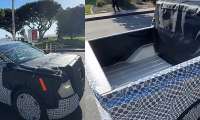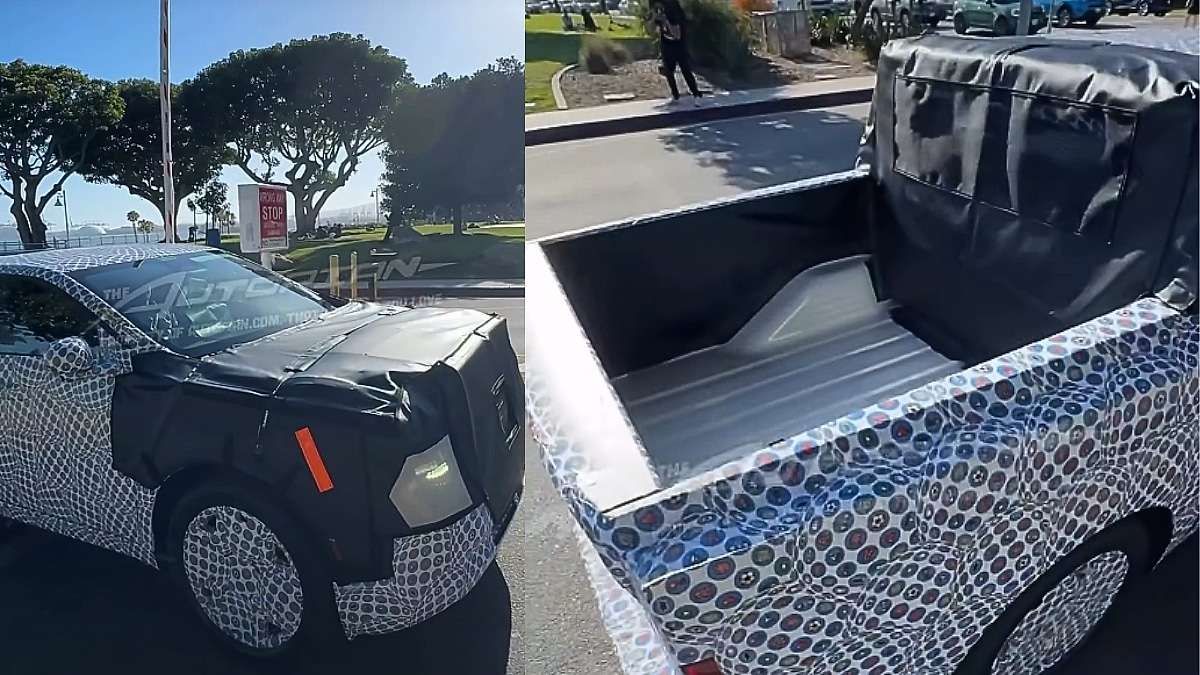

Something remarkable happened on a sun-drenched street in Long Beach, California three days ago, and if you missed it, you missed the most exciting public glimpse yet of what may become the most important affordable electric truck America has ever seen. The Autopian's David Tracy and video manager Griffin tracked down a heavily camouflaged prototype of Ford's upcoming sub-$30,000 electric pickup driving through Long Beach, giving the world its very first real look at the truck Ford CEO Jim Farley has called one of the most audacious projects in the company's history.
The story exploded across automotive social media almost instantly, and if you have been following our ongoing coverage of how Ford's new mid-size EV truck targets $30K pricing and why 2027 may be its biggest risk yet, you already know this sighting was not an accident. And for readers who have been tracking Ford's "Model T moment" and its radical massive bet on affordable EVs as the company pivots toward a stronger future, this is the moment when that bet started to look very, very real.
Here is the question worth keeping in mind as you read: The F-150 Lightning showed America what an electric truck could feel like. Now that Ford has taken everything it learned and started completely from scratch, does a truck this compact have what it takes to win over buyers who never considered an EV pickup before? Think about that, and share your answer in the comments section below.
And it was only this morning that Torque News covered the 8 details Ford's CFO Sherry House revealed about how things are moving forward about Ford's next EV sub-$30,000 truck.
A Little Birdie Was Right
The Autopian posted an Instagram Reel this week with a caption that perfectly captured the electric energy of the moment: "A little birdie told us that Ford's new sub-$30,000 EV truck was gonna be driving around Long Beach today, and that little birdie was right. It's covered in camouflage so the true shape is hard to parse, but look how small it is! What do you think of it?" The post quickly attracted 363 comments and counting, with reactions ranging from genuine excitement to healthy skepticism about the bed size. The sighting was no random encounter. Ford's Electric Vehicle Development Center, the skunkworks operation that designed the truck, sits in the same city, making Long Beach a logical, if revealing, testing ground. The prototype was not hiding. It was practically introducing itself.
For context on how seriously Ford is taking this program, the $30,000 moonshot behind Ford's Universal EV Platform has been described as the Blue Oval's last best hope to topple GM and outrun China's advancing EV industry, and seeing this truck rolling freely on public streets suggests that hope is becoming something far more tangible.
The Camouflage Could Not Hide the Most Important Detail
Despite the camouflage doing its best to disguise the shape, one thing was immediately obvious: this truck is tiny. The prototype drove alongside a full-size electric pickup and looked absolutely dwarfed by it. Even more telling, a Mazda B-Series truck trailing behind appeared almost the same size, and since that Mazda was essentially a rebadged version of the original Ford Ranger, it gives a strong indication of just how compact this EV will be by modern American standards.
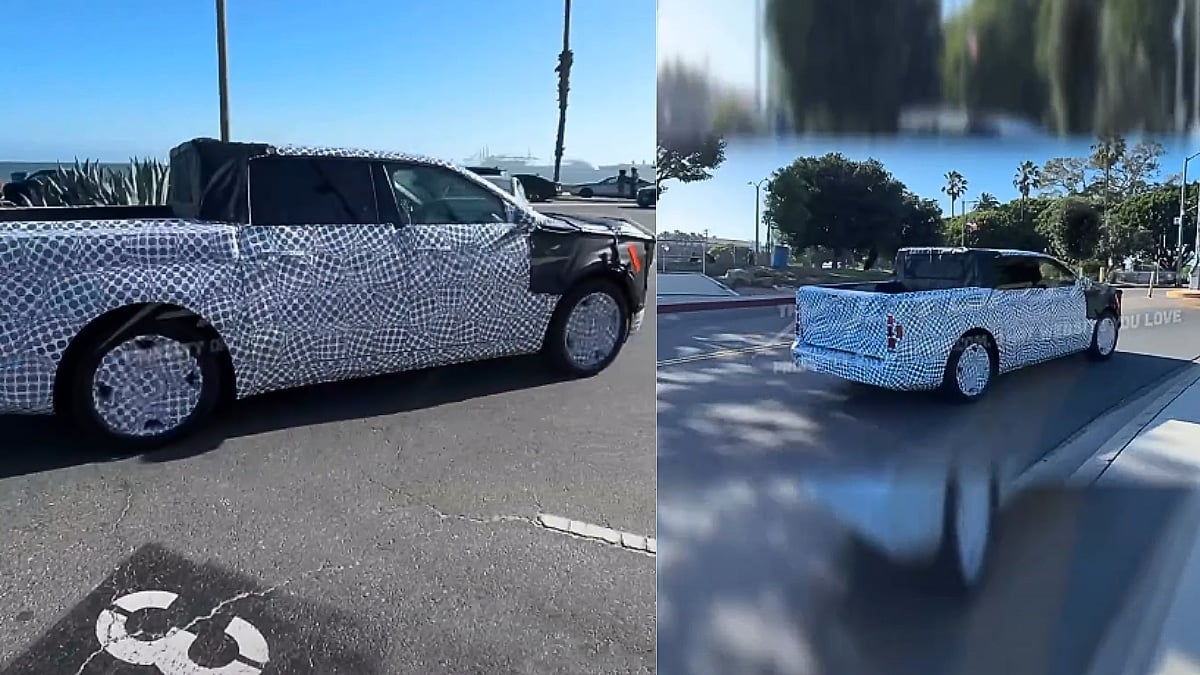
That compactness is not a limitation. It is the strategy. The truck appears to be much smaller than the Ford F-150 and closer in size to the third-generation Ranger from the early 2000s, and even resembles the Maverick in footprint. Anyone who remembers how skeptics once dismissed the Maverick as too small to be a real truck should take note. The 2026 Ford Maverick just drove home with the MotorTrend Truck of the Year award, proving that Americans are ready to embrace smaller, smarter trucks when they deliver real-world value. Ford knows exactly what it is doing with this size.
There Was a QR Code Hidden in the Camo, and It Tells You Everything
Here is where the story gets genuinely fun. A sharp-eyed Autopian reader named Matt noticed that the camouflage wrap covering the prototype was not just decorative. Hidden among soccer balls, teddy bears, sailboats, hearts, painters trays, and bicycles were small QR codes embedded in the pattern. Following the QR code led to a Ford page featuring behind-the-scenes videos, including footage of test engineer Chris Kirkland snow-drifting the EV truck in Michigan's upper peninsula. Ford is not shy about this truck anymore. It is inviting you to look.
That snow-drifting footage also revealed details not visible on the Long Beach prototype, including the truck's exposed wheels and an aerodynamic nose shape that, under the bulky black camo mass seen in California, appears far more slippery and purposeful than the disguise suggested. This is a company that has done its homework, and it wants you to know it. For a deeper look at exactly how Ford is using Formula 1-inspired aerodynamics and race car design principles to streamline development of this truck, our coverage of how Ford is using race car design to build its new $30,000 midsize EV truck explains why the aero strategy alone could make this one of the most efficient pickups ever built.
The F-150 Lightning Was Not a Failure. It Was Ford's Classroom.
This is the part of the story that too many people get wrong, and it deserves to be said plainly. The F-150 Lightning was not a failed product. It was the most important EV education Ford ever received. Ford claims the four-door midsize EV pickup will have more passenger space than a Toyota RAV4, and that is not even including the front trunk or bed, along with a lower cost of ownership than a Tesla Model Y. None of those targets would have been possible without the Lightning showing Ford what buyers actually need, how range anxiety disappears in daily use, and what premium electric truck ownership truly feels like.
The owners who lived with the Lightning proved the concept with their own driving. One Lightning owner who hit 33,000 miles in a single year found it powers his house, hauls server racks, and tackles off-road trails, calling it possibly the best EV truck on the market, which is exactly the kind of real-world validation that gave Ford engineers the confidence to attempt something far more ambitious at half the price.
What LinkedIn and the Comment Section Are Saying
The excitement was not limited to Instagram. Brian Morton, a senior cloud solutions program manager, shared screenshots from the Autopian's video on LinkedIn, sparking an active discussion among professionals curious about where Ford's EV strategy is heading. The comments across both platforms revealed something interesting: the conversation is no longer just about EV enthusiasts. Skeptics, truck traditionalists, and first-time EV considerers are all paying attention to this one.
On The Autopian's post, one commenter captured a sentiment shared by many: "I see this as an EV hybrid maverick. Perfect for driving around town." Another went straight to the practical concern: "I'd rather have 2 doors and a longer bed. Four feet isn't a truck bed." That tension, between the truck buyers who want maximum utility and the commuters who want maximum efficiency in a truck-shaped package, is exactly the market Ford is trying to bridge. The Autopian noted the second row looks fairly large, but that comes at the expense of a shorter bed, which appeared modestly sized but practical enough to fit larger items.
For buyers wondering how this new truck compares with everything else competing for their attention, our side-by-side table comparison of Ford's Universal EV Platform versus the GM Silverado EV and the Tesla Cybertruck lays out the three major U.S. electric pickup approaches in direct, honest terms.
The Technology Under the Camo Is the Real Story
The prototype appeared to have a camera and radar sensors up front, a NACS charging port, and a 48-volt auxiliary architecture, while the traction battery will remain 400-volt class. Those are not small details. The NACS port means every Tesla Supercharger in America is available to this truck's owner on day one, which is a charging network advantage that no affordable EV from any legacy automaker has ever launched with. The prototype's low ride height and roofline, combined with aero wheel covers and what are almost certainly low-rolling-resistance tires, make clear that Ford is chasing maximum efficiency rather than hardcore off-road capability.
That efficiency focus connects directly to the platform-level engineering that makes this truck possible. Ford's new Universal EV Platform promises 4.5-second zero-to-60 acceleration, 15 percent better efficiency than any current pickup, a structural LFP battery, and gigacastings that slash parts by 20 percent, all wrapped in a footprint small enough to park in a standard urban space and light enough to maximize every kilowatt-hour of battery capacity.
Motor1 covered the sighting as well, noting that this is our first look at Ford's upcoming $30,000 electric pickup truck, a vehicle promised to be as fast as a Mustang EcoBoost with more interior space than a Toyota RAV4. That combination of performance, space, and price in a compact truck footprint is something no American automaker has ever successfully delivered, which is precisely why this sighting in Long Beach matters so much beyond the photos themselves.
For the broader industry picture, Ford CEO Jim Farley has confirmed they will have an affordable EV to compete with the Tesla Model Y and Model 3, saying there is nothing else like it on the market today, and that ambition now has a face, even if that face is still covered in soccer balls and teddy bear camouflage.
Why This Sighting Changes the Narrative
Until now, Ford's $30,000 electric truck existed in the realm of press releases, executive promises, and investor presentations. The Long Beach sighting changes that. A real truck, on real streets, in the real world, is a fundamentally different kind of proof than anything that comes out of a conference room. And the fact that it showed up in Southern California, thousands of miles from where Ford said prototypes were being tested in Michigan, suggests the program has more momentum and wider reach than anyone on the outside fully understood.
Our in-depth coverage of Ford's $30,000 gamble inside the Universal EV Platform explains how unicasting technology replaces 146 individual structural parts with just two massive aluminum castings, reducing assembly time by 15 percent and eliminating thousands of fasteners, and this truck driving openly through Long Beach suggests that manufacturing revolution is no longer theoretical. It is being tested, refined, and driven in the California sunshine.
Your Turn
Now that Ford's next sub-$30,000 electric truck has been spotted in the wild for the very first time, the conversation gets real.
Does a truck this compact, this aerodynamic, and this focused on efficiency change your mind about whether an electric pickup could fit your life, even if you have always considered yourself a truck person first?
And if Ford really delivers this vehicle at or near $30,000 with a spacious four-door cabin, a NACS charging port, and 4.5-second acceleration, would you choose it over a Ford Maverick Hybrid, a gas-powered Ranger, or an EV from a competing brand?
Let us know your thoughts in the comments section below. This is exactly the kind of story where your perspective matters, and the more voices in the room, the better the conversation gets.
Return tomorrow, or check our Torque News Home Page for more interesting automotive news articles.
Images are screenshots from The Autopian's Instagram video, shown above.
About The Author
Armen Hareyan is the founder and Editor-in-Chief of Torque News and an automotive journalist with over 15 years of experience writing car reviews and industry news. Now based in the Charlotte region (Indian Land, SC, he founded Torque News in 2010, which since then has been publishing expert news and analysis about the automotive industry. He can be reached at Torque News on X, Linkedin, Facebook, and Youtube. Armen holds three Masters Degrees, including an MBA, and has become one of the known voices in the industry, specializing in the landscape of electric vehicles and real-world stories of actual car owners. Armen focuses on providing readers with transparent, data-backed analysis bridging the gap of complex engineering and car buyer practicality. Armen frequently participates in automotive events throughout the United States, national and local car reveals and personally test-drives new vehicles every week. Armen has also been published as an automotive expert in publications like the Transit Tomorrow, discussing how will autonomous vehicles reshape the supply chain, and emerging technologies in vehicle maintenance.
Set Torque News as Preferred Source on Google
Follow us today...