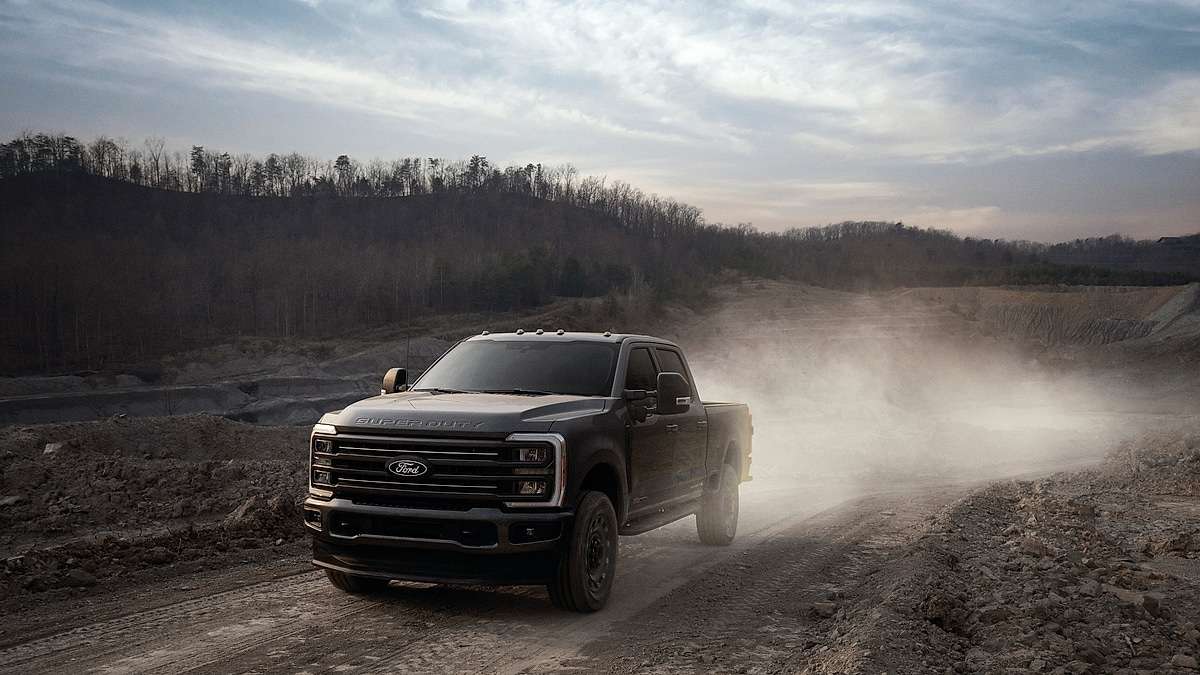

After a frustrating and difficult year, Ford has climbed out of its quality issues and is now receiving high marks for building better vehicles. After more than 150 recalls in 2025, setting an industry record, Ford is now the No. 1 Mainstream Brand in J.D. Power Initial Quality Study. Thomas King, president of OEM solutions at JD Power, said Ford not only ranked “highest among mass market brands,” but also “the Ford F-150, Ford Mustang and Ford Super Duty ranked highest in their respective segments.” It is the second year in a row that those three vehicles won their segments. The F-Series of trucks continues to be the top-selling vehicles in the U.S. for the 49th year in a row.
“According to the JD Power 2026 U.S. Initial Quality Study (IQS), overall new-vehicle quality, as measured by the total number of problems per 100 vehicles (PP100) experienced in the first 90 days of ownership, has improved sharply this year, with fewer problems cited across nine of 10 categories evaluated. Infotainment is the exception, where connectivity issues continue to strain customer experience with new-vehicle quality. A lower PP100 score indicates higher vehicle quality.”
Among mass market brands, Ford ranks highest with a score of 152 PP100. Nissan (156 PP100) ranks second and Buick (162 PP100) ranks third.
Ford’s Quality Improvement is Remarkable
The company surpassed the industry’s traditional mass market leaders in IQS, climbing from No. 15 in 2023 to No. 1 among mainstream brands in the annual survey of new buyers.
“This is a proud day for everyone at Ford, and the result of years of intensive work across our company,” said Jim Farley, Ford president and CEO. “Many doubted that an American company with a huge American workforce could compete with the world’s best on quality, let alone reach the top. But we put our heads down and worked together every day to deliver for our customers. Today, Ford is not only the most American automaker but also the gold standard for new vehicle quality.”
CEO Farley also praised the company’s partners on social media.
“To our manufacturing and engineering teams across the U.S., Canada and Mexico – thank you. @Ford ranks number one among mass market brands in the 2026 @JDPower U.S. Initial Quality Study because of your skill, ingenuity and commitment to quality. Proud of what we've accomplished together.”
"Quality Comes First" has always been our top priority at @Ford, which is why today is such a proud moment for our team. Ford has been named the number one mainstream brand in the J.D. Power 2026 U.S. Initial Quality Study. Many doubted that an American brand could truly deliver industry leading quality but they underestimated the grit, pride, and expertise that define Ford. Thank you to everyone across the company for your hard work and dedication in making this achievement possible.”
The Ford Escape, Ford Explorer, Ford Expedition and Ford Maverick also landed among the top three in their segments. That means seven of Ford’s 10 models tested placed in the top three in their segments, the highest percentage of any other automaker.
Ford also ranks second overall among corporations and third overall among brands. Ford improved by 41 fewer problems per 100 vehicles compared with last year, the largest year-over-year improvement among mainstream brands. The momentum extends to Lincoln, which climbs to No. 6 from No. 8 among premium brands.
Where Ford Improved the Most
Ford improved in nearly every vehicle category measured by JD Power. Driven by software improvements, infotainment quality saw the largest leap forward, performing 11 points better than the industry average, while powertrain reliability also improved significantly.
According to J.D. Power, infotainment issues are still the number one quality complaint for all the automakers.
“The only category experiencing an increase in reported problems this year is infotainment, with a total of 44.4 PP100 in the mass market segment and 38.3 PP100 in the premium segment. Within the infotainment category, problems with Android Auto and Apple CarPlay connectivity account for an increase of 1.4 PP100 in reported problems, the largest single contributor to the year-over-year decline in infotainment quality.”
I know that Ford has really cracked down on some of the suppliers responsible for many of the connectivity issues. Ford had multiple recalls for the modules that control the touchscreen and also the module that controls the infotainment connectivity. The Accessory Protocol Interface Module (APIM) is the "brain" behind Ford's SYNC systems. The APIM manages Bluetooth phone connections, media, voice commands, and navigation. If the touchscreen goes black, freezes, or you lose phone connectivity, the APIM is typically the part that needs to be replaced or reprogrammed. Ford found that many of the faulty APIMs had poor soldering, that allowed the vehicles to lose connectivity.
The APIM is just one example of a faulty part that caused huge headaches for Ford customers. Earlier, Ford started threatening suppliers that companies with too many defects would be banned from bidding on future projects. The recalls cost both Ford and the suppliers hundreds of millions of dollars.
Ford Started Addressing Potential Problems Earlier
In 2023, Ford created a unified industrial system. This meant Vehicle Engineering, Manufacturing, Supply Chain and Quality teams worked side by side under one organization, led by Chief Operating Officer Kumar Galhotra.
“Bringing them together allows us to look at the entire ecosystem of a vehicle – from the intricacies of software development to the deepest tier of the supply chain to the plant floor — as one continuous, collaborative flow,” Galhotra said. “We rallied the whole company around a clear vision: Quality Comes First. That means hard-wiring rigorous processes deep into the way we work, building a culture of relentless problem-solving and recognizing our teams when they prevent issues from reaching customers.”
Ford teams went directly onto supplier plant floors to address potential problems alongside their counterparts.
“It’s easy to celebrate heroes fixing problems,” said Liz Door, Ford chief supply chain officer. “What we really want is to celebrate zero defects.”
Now, Ford checks suppliers earlier in the development process for rigorous design validation that helps ensure long-term performance. Ford says the effort drove a 30% reduction in launch issues year over year.
“Leaders spend so much more time on the plant floor now. It’s about supporting and collaborating with our operators and learning from them,” said Bryce Currie, Ford chief manufacturing officer. “We’re averaging over eight ideas per project from operators, and we are investing to support them, like adding AI vision systems to help identify anomalies.”
Closing the Software Gap
Finally, with vehicles becoming highly digital, Ford overhauled its software quality assurance from the ground up to make modern technology as reliable as the physical hardware. Today, before code ever reaches a vehicle, it is stress-tested through hundreds of thousands of automated scenarios designed to simulate unpredictable, real-world use. The result: Ford catches and eliminates software bugs far earlier in development, for a better customer experience.
Ford Says It Will Continue Fighting for Improvement.
“Are we proud? You bet. Satisfied? Not even close,” Galhotra said. “This is a milestone, not a finish line. We will celebrate this moment today, but tomorrow we are back at it: chasing perfection, driving continuous improvement and getting better every single day.”
What the J.D. Power Initial Quality Study Covers
According to J.D. Power, “The U.S. Initial Quality Study, now in its 40th year, is based this year on responses from 78,514 purchasers and lessees of new 2026 model-year vehicles who were surveyed after 90 days of ownership. The IQS additionally incorporates repair visit data based on hundreds of thousands of real-world events reported to franchised new-vehicle dealers.”
The results are based on a battery of 227 questions plus relevant repair data, all of which cover 10 vehicle categories. The questions concern infotainment; features, controls and displays; exterior; driving assistance; interior; seats; powertrain; driving experience and climate. The results are designed to help manufacturers identify problems and improve their vehicles. The data was collected from June 2025 through May 2026.
Image by Ford
About the Author
Mary Conway is a professional automotive journalist and has decades of experience specializing in automotive news analysis. She covered the Detroit Three for more than twenty years for the ABC affiliate, in Detroit. Her affection for the Motor City comes naturally. Her father ran a gas station while Mary was growing up, in Wisconsin. Follow Mary at @MaryConwayMedia on X and on Facebook, and send her car news tips for future stories. Mary Conway is an esteemed automotive and business reporter who was inducted into the Michigan Journalism Hall of Fame in 2019. Mary is a member of the Automotive Press Association, Rocky Mountain Automotive Press, Society of Professional Journalists, and NATAS.
Set Torque News as Preferred Source on Google
Follow us today...