
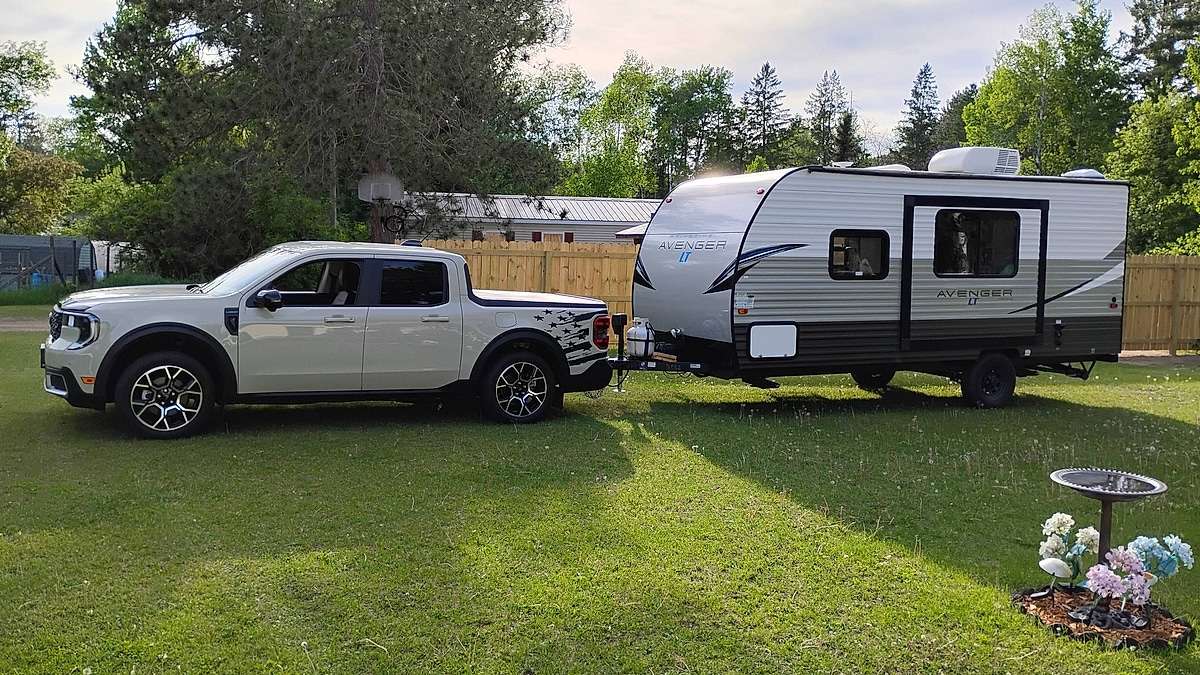

Tony Barbee’s 2025 Ford Maverick Lariat Hybrid AWD did the thing small-truck owners keep arguing about.
It pulled a single-axle camper on 55-mph roads, with the 4K Tow Package doing its work, tow mode selected, and the truck holding the pace he wanted. The camper weighed 3,014 pounds dry. Barbee added about 450 pounds of cargo to the RV, including fresh water, put another 200 pounds in the Maverick’s bed, and had two adults in the cab.
Ford finally gave the hybrid Maverick what owners asked for from the beginning: all-wheel drive and the 4K Tow Package in the same truck. On paper, that turns the little hybrid into a 4,000-pound tow vehicle. In the driveway, with a camper sitting behind it and the tongue load already near the limit, the math gets less cheerful.
Ford Finally Built The Hybrid Maverick Owners Wanted, But The Ratings Still Demand Respect
Barbee’s post has the right instinct. He is not bragging about abusing a compact unibody pickup. He is trying to give other owners a real setup to study. That is rare enough to respect.
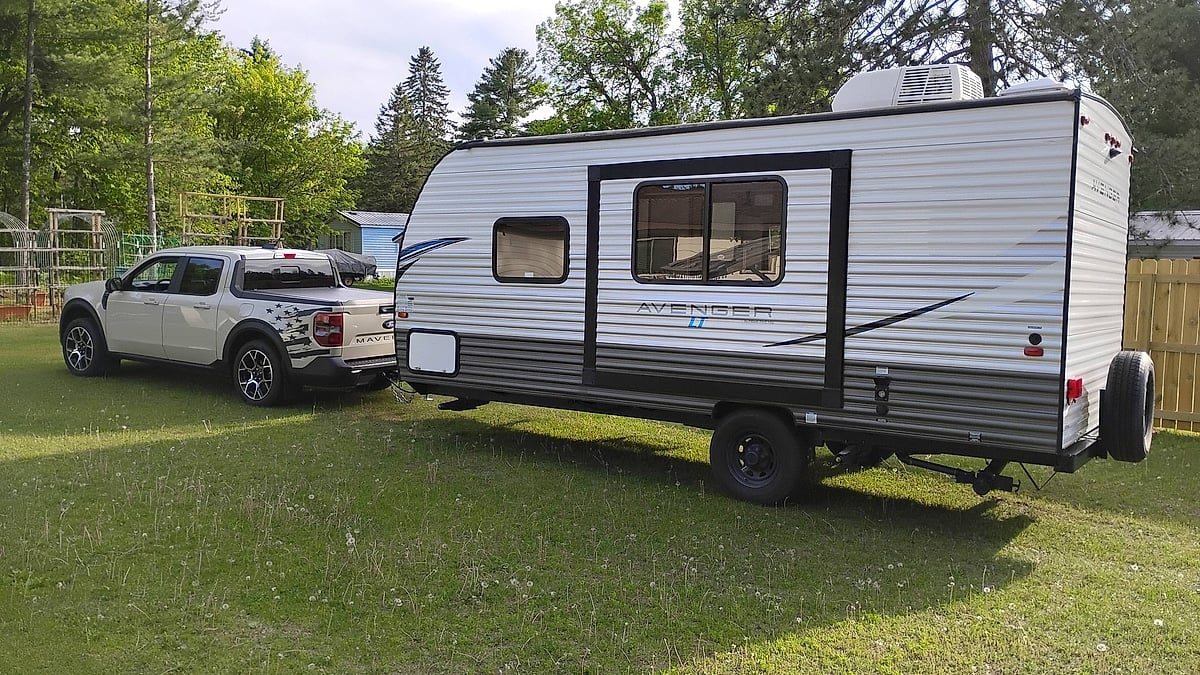
The trailer appears to match the Prime Time Avenger LT 17FQS numbers almost perfectly: 3,014 pounds dry and 355 pounds hitch weight. Loaded with his reported 450 pounds, the trailer could be sitting around 3,464 pounds before any dealer-installed options or gear he forgot to count.
Four Maverick: Towing Facts Every Hybrid AWD Owner Should Know Before Hitching A Camper Up
- The Maverick’s wheelbase is 121.1 inches, which is shorter than many midsize pickups. That helps maneuverability around town but also means trailer balance and tongue weight become more noticeable when towing near the truck’s limits.
- Ford rates the Maverick Hybrid AWD with the 4K Tow Package at an 8,315-pound Gross Combined Weight Rating (GCWR), meaning the truck, passengers, cargo, trailer, and trailer cargo all have to fit within that total number.
- The 2025 Maverick Hybrid uses a 2.5-liter Atkinson-cycle four-cylinder paired with an electric motor for a combined 191 horsepower, giving owners a powertrain designed primarily around efficiency rather than traditional truck towing performance.
- Despite its compact footprint, the Maverick’s bed can carry standard 4-by-8-foot sheets of plywood when positioned correctly, one reason many owners use it as both a daily driver and a weekend tow vehicle instead of stepping up to a larger pickup.
That keeps it under the Maverick’s 4,000-pound tow rating. It also puts the combination close enough to the ceiling that every small number starts acting like a large one. The tongue weight is the part that makes me sit up.

Ford rates the Maverick’s hitch at 400 pounds of max tongue load. Barbee says the RV already had a 355-pound tongue weight. A weight-distributing anti-sway hitch he considered using would add about 90 pounds. Hitch hardware does not vanish because it has a helpful name. That weight still lives on the truck side of the equation.
Add 90 pounds to 355, and you are already past 400 before the first cooler, tool bag, propane refill, battery change, or campsite impulse purchase enters the picture.
Why A 355-Pound Tongue Weight Can Matter More Than A 4,000-Pound Tow Rating
That does not mean the truck instantly folds in half. It means the advertised 4,000-pound number is not the whole conversation. With small tow vehicles, tongue weight usually runs out before courage does.
Barbee later said he changed his plan after reading more about weight-distribution hitches and the Maverick’s unibody construction. He decided to order a sway bar kit instead. I think that was the more cautious move.
A weight-distribution hitch can be a beautiful tool on the right vehicle and trailer. It can also be the wrong answer when someone uses it to make an overloaded setup look level. Level is not the same thing as legal, balanced, or kind to the structure. The Maverick does not have a traditional body-on-frame truck chassis. That changes the way I look at spring bars, leverage, and aggressive hitch setup.
The comment section went exactly where it always goes.
One person warned him not to overdo the weight-distribution hitch because of the unibody frame. Another said the camper was too big and too heavy. Someone else said they tow similar weight at 70 mph without drama. A few people pushed anti-sway equipment hard. Barbee, to his credit, kept sorting through the noise instead of doubling down.
That is how you stay alive towing.
The best towing conversations never start with “Can it pull it?” A golf cart can pull a camper across a flat yard. The real questions are uglier. Can it stop cleanly? Can it handle a crosswind? Can it stay within tongue weight, payload, rear axle load, tire capacity, GCWR, and frontal-area guidance at the same time? Can it do all that after three hours of heat, trucks passing, pavement heaves, and a driver who is getting tired?
The Most Important Towing Question Has Nothing To Do With The Tow Rating
The Maverick’s frontal-area limit deserves more attention here. Ford says the 4K Tow Package raises the Maverick’s maximum trailer frontal area to 40 square feet. Many small campers shove more air than their weight suggests. A trailer roughly 7 feet 4 inches wide and nearly 10 feet tall has the kind of face that can make a 55-mph road feel easy and a 70-mph interstate feel like punishment.
That detail may explain why Barbee’s maiden voyage went well.
No freeway. Mostly 55-mph roads. Short trip. Tow mode. Low selected. Sensible pace. That is the right way to introduce a light truck to a camper.
I would be much more interested in the next test. Same trailer, scaled weight, full water, actual tongue measurement, 62 to 65 mph, a windy day, and a few miles with semis passing. That would tell us more than a backyard photo or a short local pull.
The First Highway Trip Will Reveal More Than The Maiden Voyage Ever Could
The Maverick deserves credit here. A 2025 Lariat Hybrid AWD with 4K Tow is a clever little truck. It gives buyers the hybrid mileage they wanted with the towing package they used to have to give up. For someone pulling a small boat, utility trailer, teardrop, light pop-up, motorcycle trailer, or carefully chosen small camper, it can make a lot of sense.
A tall travel trailer close to 3,500 pounds loaded asks more from it.
Barbee’s setup looks possible. It does not look casual.
That distinction is where half the internet gets towing wrong.
The other quiet detail is payload. Ford advertises up to 1,500 pounds, but each truck’s door sticker decides the real number. A Lariat with options may have less usable payload than a stripped XL. Tongue weight counts. Bed cargo counts. People count. Hitch hardware counts.
Payload Is Where Many Maverick Towing Setups Quietly Run Out Of Room
After Barbee adds two adults, 200 pounds in the bed, the camper tongue weight, and any sway-control hardware, the Maverick’s remaining margin could shrink quickly.
This is why I would send this truck and trailer to a CAT scale before a long haul.
One pass with the truck alone. One pass with the trailer attached. Ideally one more with the final camping load, full water if that is how the family travels, and the exact hitch setup. The scale ticket will kill the guessing. It will show front axle, rear axle, trailer axle, gross combined weight, and whether the Maverick is carrying the load the way the driver thinks it is.
No forum argument can beat a scale ticket.
I also like that Barbee added mirror extensions. Small detail, big confidence boost. A compact pickup with a full-height camper behind it needs better rearward visibility than the factory mirrors can usually provide. The rubber-strap fit sounded clumsy, but the instinct was right. Seeing around the trailer lowers stress and gives the driver more time to react.
The same goes for speed. A Maverick towing near the upper half of its rating should live in the right lane and be proud of it. Sixty mph with a calm trailer beats 70 mph with a white-knuckle steering wheel every single time. Anyone mocking that has never had trailer sway introduce itself at highway speed.
The Difference Between A Successful Tow And A Comfortable Tow Is Usually Margin
Barbee’s report should help Maverick owners, but only if they read the whole thing. What stands out is how quickly the conversation shifts from the advertised 4,000-pound tow rating to the details that actually determine whether a setup works.
The truck appears capable of handling this size trailer, but the outcome depends on the same factors that matter with any tow vehicle: tongue weight, payload, trailer balance, speed, and how carefully the combination is set up.
That is still good news.
It just comes with homework.
For this exact kind of camper, I would do four things before calling it road-trip ready. Weigh the loaded tongue with the fresh tank set up the way it will actually travel. Confirm the truck’s payload sticker. Install a properly matched sway-control solution without using hitch hardware as permission to exceed Ford’s ratings. Then run the combination across a public scale.
After that, take the first freeway run before the big trip. Pick a calm day. Leave the family at home. Try 60 to 65 mph. Let semis pass. Watch temperatures. Feel the steering. Brake hard in a safe place. If the trailer starts writing checks the Maverick does not want to cash, you will know before the vacation is on the line.
I like Barbee’s honesty because he gave owners the useful version of the story: the truck pulled it, the setup sat reasonably, mirror extensions helped, and the hitch decision needed more thought.
That is real towing.
The Maverick Hybrid AWD has grown into a better small truck for people who actually use trucks. Just do not let the 4K badge talk louder than the scale.
If you tow with a Ford Maverick, I’d love to hear your real-world numbers. What trailer are you pulling, what does it actually weigh loaded, what tongue weight are you seeing on the scale, and how does the truck behave once you get above 60 mph? Have you used sway control, a weight-distribution hitch, or neither?
Share your setup and experience in the comments. The most useful towing advice usually comes from owners willing to post the numbers.
Images by Tony Barbee from Facebook.
About The Author
Noah Washington is an automotive journalist based in Atlanta, Georgia, covering sports cars, luxury vehicles, and performance culture. His reporting focuses on explaining the engineering, design philosophy, and real-world ownership experience behind modern vehicles.
Noah has been immersed in the automotive world since his early teens, attending industry events and following the enthusiast communities that shape how cars are built and driven today. His work blends industry insight with enthusiastic storytelling, helping readers understand not just what a car is, but why it matters.
Noah is also a member of the Southeast Automotive Media Association (SAMA), a professional organization for automotive journalists and industry media in the Southeast.
His coverage regularly explores sports cars, luxury vehicles, and performance-driven segments of the automotive industry, including the evolving culture surrounding Formula Drift and enthusiast builds.
Read more of Noah's work on his author profile page.
You can also follow Noah here:
Set Torque News as Preferred Source on Google
Follow us today...



Comments
I towed a 16' Airstream…
Permalink
I towed a 16' Airstream Basecamp from Sacramento to 5500' elevation in the Sierras. It worked great, and I was super impressed with how well it worked. My Maverick is the gas-only AWD with 4K towing. It was a 240-mile round trip. I concur, I would not want to tow this package across the US. Love my Maverick, but it was a little small.
That Sacramento to 5,500…
Permalink
In reply to I towed a 16' Airstream… by Brent (not verified)
That Sacramento to 5,500 feet example is exactly why these real owner reports matter. The Maverick can do more than a lot of people assume, especially with the 4K package, but there is a big difference between a smart regional tow and pretending it is a full-size truck.
Very good article. Towing at…
Permalink
Very good article. Towing at max weights is doable on flat ground. In the mountains or at high altitude, a totally different story. The Maverick would tow a lot safer with a pop-up or light fiberglass camper. I tow a similar trailer with a 2016 V6 Colorado with a 7000# tow rating. Two many white-nuckle towing experiences.
That is the distinction that…
Permalink
In reply to Very good article. Towing at… by Wes Smith (not verified)
That is the distinction that gets lost in a lot of tow-rating debates. Flat ground and moderate speed can make a marginal setup feel perfectly fine.
Frontal area wind load will…
Permalink
Frontal area wind load will push that setup over its tow rating.
That is the part I wish more…
Permalink
In reply to Frontal area wind load will… by Jeff Sharp (not verified)
That is the part I wish more people looked at before they focused only on trailer weight.
With limited tongue weight…
Permalink
With limited tongue weight capacity, I would have gone to a dual axle trailer. It reduces sway, porpoise like undulations and or case of blow outs and emergency braking is a safer alternative.
A dual-axle trailer can…
Permalink
In reply to With limited tongue weight… by Stephen (not verified)
A dual-axle trailer can bring real stability advantages, especially with tracking, braking, and tire-failure margin. The challenge with the Maverick is that the trailer still has to fit inside the truck’s tongue weight, payload, GCWR, hitch, and frontal-area limits at the same time.
Thank you so much for this…
Permalink
Thank you so much for this article! I just purchased a 2026 Maverick Lariat AWD Hybrid with a tonneau bed cover and plan to buy a small trailer to tow. I now realize I need to give consideration to several factors beyond loaded weight and tongue weight. I would love recommendations for a trailer that includes a bathroom. I'm considering the Rockwood GeoPro G15LE with an unloaded weight of 2,329 lb and a tongue weight of 320, but now I'm concerned that the shape will create significant "wind load." How does a cautious buyer calculate these factors prior to purchase?
Congratulations on the 2026…
Permalink
In reply to Thank you so much for this… by Noelle (not verified)
Congratulations on the 2026 Maverick. That sounds like a great small-truck setup, especially with the AWD hybrid and Lariat trim.
For the trailer, you are asking the right question. Loaded weight and tongue weight are only the first two numbers. A tall camper can ask a lot from a compact truck because it pushes air even when the scale number looks acceptable.
For a cautious buyer, I would look at five things before purchase:
Your Maverick’s actual payload sticker on the driver's door jamb.
The trailer’s loaded weight, not dry weight.
Real loaded tongue weight after propane, battery, water, food, gear, and hitch hardware.
Frontal area: approximate trailer width multiplied by the exposed height.
Whether the trailer has electric brakes and whether your truck is properly set up to use them.
Why no mention of trailer…
Permalink
Why no mention of trailer brakes or fuel mileage. I tow with a Toyota Highlander Hybrid with no problem to 70 mph but one of the most important things is to have Electric trailer brakes because of the trailer/ car weight ratio.
You are right to bring up…
Permalink
In reply to Why no mention of trailer… by Auburn Packwood (not verified)
You are right to bring up trailer brakes. Once a trailer gets close to the tow vehicle’s weight, electric brakes should be treated as basic equipment, not an optional comfort item.