
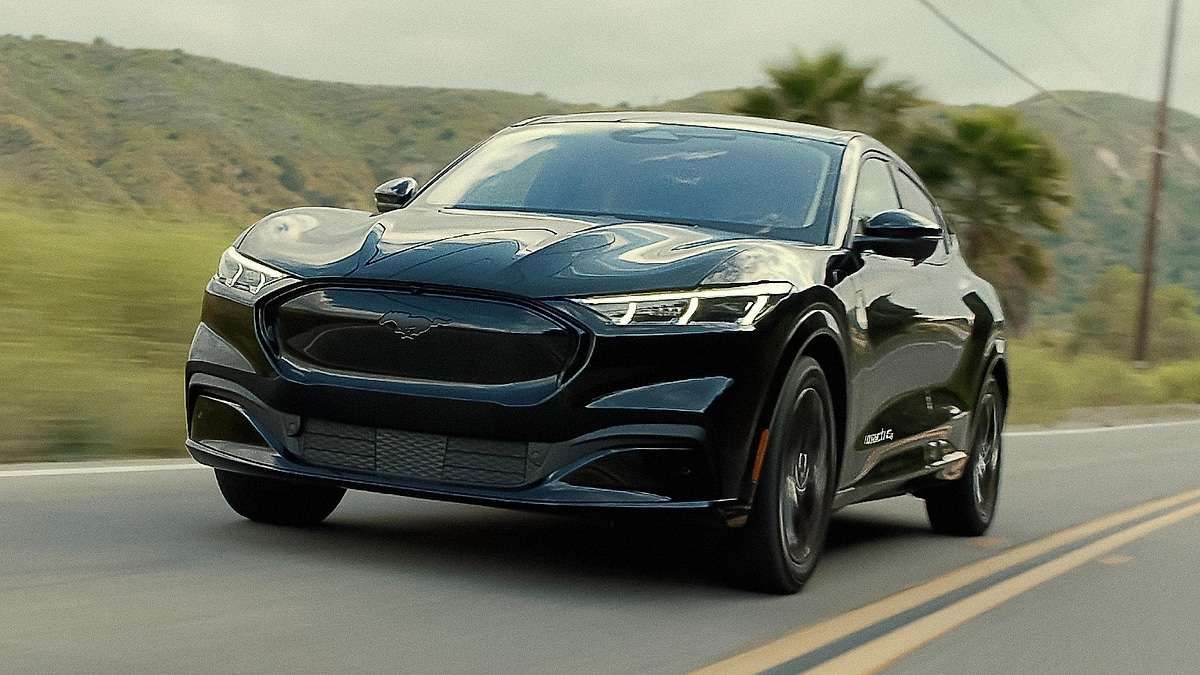

Vickie Hahn Wyeth’s Mustang Mach-E did the thing people argue about online.
It went from Arkansas to Canada and back. Six days. More than 2,000 miles. A wedding deadline on the northbound leg. A looser return trip on the way home. Enough charging stops to turn theory into habit and habit into a conclusion.
Her conclusion was not dramatic. That is why I trust it.
Traveling by EV took longer than traveling by a gas car. She would still do it with a leisurely pace. She would not plan more than about 400 miles per day in the Mach-E right now.
A 400-mile day sounds conservative until you put real travel around it. Hotel checkouts. Border timing. Wedding schedules. Weather. Bathroom stops. Food that is somewhere other than the charging-site hot case. Chargers that sit deeper in town instead of directly on the exit ramp. A station that works, but adds a 14-minute round trip before the car even starts charging. A route planner that technically succeeds while quietly eating the afternoon.
That is the difference between an EV trip that works and an EV trip that feels easy.
The Mach-E Made The Trip, But The Clock Kept The Receipt
Wyeth did not describe a disaster. She said there was no shortage of chargers. The problem was placement.
Gas stations have spent a century learning how to catch drivers at highway speed. They live on exits. They fight for sightlines. They put signs high enough to be seen before the decision point. They stack fuel, bathrooms, windshield squeegees, snacks, coffee, and fast food into one familiar pause.
EV charging has improved quickly, but many stops still feel like they were placed by a map instead of by a tired driver.
A charger can be nearby and still cost time. It may be behind a big-box store, inside a shopping center, near the back of a hotel lot, tucked beside a dealership, or placed far enough into town that the detour becomes part of the charging session. That does not show up cleanly in the car’s range estimate. It shows up at 8:40 p.m. when everyone wants to be done.
Wyeth’s comment about Love’s truck stops was honest too. EV advice often tells drivers to eat while charging. Sensible. Efficient. Easy to say from a desk. On a 2,000-mile trip, the available food starts to matter. If every convenient charging stop turns into the same truck-stop meal, some travelers will choose a second stop for better food. That adds time. Time can become money. Fall far enough behind and an extra hotel night enters the calculation.
That is the part people miss when they reduce EV travel to cents per kWh.
A 320-Mile Rating Does Not Create 320-Mile Road-Trip Legs
Ford lists some 2025 Mach-E configurations at up to 320 miles of EPA-estimated range. That is useful information. It does not mean a driver should plan every highway leg around 320 miles.
Real trips use buffers.
Drivers often leave home at 100% because that is the one charge of the day that can happen while everyone sleeps. Once the trip starts, the road-trip pattern changes. Most drivers DC fast charge to around 80% because charging slows near the top of the battery. The first leg can be the longest. The next legs usually shrink.
That is one reason a commenter made a smart point: starting from home at 100% may give a Mach-E owner the full advertised confidence window, but public DC fast charging often turns the practical next leg into something closer to an 80% battery decision.
Then the route adds its own taxes.
Wind. Rain. Cold. Speed. Elevation. Cargo. Tire pressure. Detours. A charger that sits on the wrong side of town. A station with one stall down. A line at a busy site. A food stop that does not match the charging stop.
The Mach-E can absolutely road trip. Wyeth proved that. The day still needs room around the car.
Road-Trip Truths From This Mach-E Owner’s Drive
- Charger availability is no longer the only issue; charger placement can add real time to a travel day.
- Charging during meals works best when the charging stop has food people actually want.
- A 400-mile daily target may feel more realistic than chasing gas-car mileage on a fixed schedule.
The Money Savings Were Smaller Than The Time Cost
One commenter asked the obvious question: how much did the Mach-E save compared with a gas vehicle?
Wyeth guessed about $60 over the entire trip, while admitting it was hard to know precisely. Other owners in the thread gave mixed answers. Some said road trips cost them more than gas. Some save money by staying at hotels with free charging. One hybrid owner said his gas-electric car is cheaper on long trips.
That mix of answers feels right.
EVs usually win hard at home. Charge overnight at residential rates and the math looks great. Public DC fast charging changes the equation. Prices vary. Networks vary. Canada versus the U.S. can vary. Hotel charging can swing the trip back in your favor. A free Level 2 charger overnight can erase an entire paid stop. A pricey DC station can make the fuel savings look thin.
Wyeth’s experience points to the better question.
How much is the time worth?
If a six-day trip saves $60 but adds enough friction to risk another hotel night, the savings are fragile. If the same trip is leisurely and the stops become part of the vacation, the math feels different. The car did not change. The schedule did.
That is why EV road-trip satisfaction is deeply personal. Some people like the forced breaks. Some families travel better with a pause every couple of hours. Other drivers were raised by the “bathroom, gas, snacks, go” school of interstate discipline. Those drivers will feel every charging detour in their bones.
The Mach-E’s Charging Speed Shapes The Whole Trip
The Mustang Mach-E is a good EV, but it is not one of the fastest-charging road-trip machines on the market.
That matters after the second or third DC stop.
A single fast-charge stop usually feels fine. Stretch legs. Use the bathroom. Check messages. Grab a drink. By the time the humans are ready, the car may be close enough. Several stops in one day expose every weakness: charger placement, activation, taper, stall reliability, payment weirdness, and whether the route planner chose a stop that makes sense for a human being.
A commenter said one DC fast-charge experience makes for a great trip, while multiple stops can weigh on you. That is one of the cleanest ways to explain the Mach-E road-trip experience.
The car is easy to love locally. It is still enjoyable across distance. The rhythm changes when the day depends on repeated public charging.
Mach-E owners know the car’s strengths. It is quiet. Comfortable. Quick enough. Practical. Familiar inside in the way Ford buyers appreciate. The charging curve simply asks for more patience than a few newer EVs with larger packs, faster peak rates, or stronger sustained charging.
That does not make the Mach-E a bad road-trip car. It makes route planning more important.
The Charging Stop Has To Replace The Gas Stop, Not Just The Pump
One of the best comments in the thread had nothing to do with battery chemistry.
Someone asked what EV drivers do to clean their windshields, because he still ends up going to a gas station.
That sounds small. It is not.
Gas stations solve a bundle of road-trip chores. Fuel. Bathroom. Trash. Coffee. Windshield. Air. Snacks. Ice. Lottery tickets if that is your vice. A quick glance at the tires. A familiar parking layout. EV stations often solve only energy. Sometimes they solve energy in a lonely corner of a retail lot with no squeegee, no trash can, no canopy, and no reason to stand there except obligation.
That is not enough for mass-market road travel.
A charging network does not become mature when it has enough dots on a map. It matures when the stop feels complete. Put chargers at travel centers, real convenience stores, restaurants, grocery stores, and hotels with good lighting and easy highway access. Add canopies where weather demands them. Add trash cans and windshield cleaning. Make the stalls pull-through when towing routes matter. Put the chargers where the driver already wants to stop.
The Mach-E owner’s frustration was not exotic. It was practical.
The stop needs to work as a stop.
Why 400 Miles A Day Is A Smart Rule, Not A Defeat
Wyeth’s 400-mile daily limit may sound like giving up to people who pride themselves on 700-mile gas-car days.
I see it as a sane planning number for this vehicle and this kind of trip.
At 400 miles, a Mach-E driver can leave home or a hotel with a strong charge, make one serious charging stop, possibly add a second shorter stop if conditions require it, and still have enough day left for food, delays, weather, and human tolerance. Push to 600 or 700 miles, and the trip becomes less forgiving. Every charger detour matters. Every slow stall matters. Every meal choice matters. Every wrong turn feels personal.
Long EV trips reward margin.
This is where some experienced Tesla and long-range EV owners will object. They will say they have done 1,000-mile days. They will say planning gets easier. They will say new EV travelers charge too high, stop too early, and use the wrong stations. Some of that is true. Experience helps. Better software helps. Tesla access helps. Faster vehicles help. Knowing the good stops helps.
None of that erases Wyeth’s point.
A normal owner on a real family trip with a real deadline came back with a number that felt right for her life. That is valuable. It is more useful than a hero run by someone who treats charging stops like a game.
The Wedding Deadline Changed Everything
The northbound leg had a wedding waiting at the end of it. That changes the emotional math.
A charger delay on a casual vacation becomes a story. A charger delay before a wedding becomes stress. You start padding the schedule. You charge earlier than you might need to. You stop at safer percentages. You choose reliability over elegance. You watch the clock while the car adds miles. You think about clothes, arrival time, check-in, weather, and whether the route planner is about to embarrass you.
On the way home, Wyeth had more freedom to notice how much time the trip really required.
That split is important. EV road trips can feel perfectly reasonable when the schedule is soft. Add a hard arrival time and the driver becomes more sensitive to every inefficiency. The same stop that feels relaxing on vacation feels expensive before an event.
That is why “just enjoy the break” is not always a serious answer.
Sometimes the destination owns the day.
Hybrids Still Have A Role For Families Like This
Several commenters said they use a Prius, RAV4 Hybrid, Maverick Hybrid, F-150, or another gas vehicle for long-distance travel. That is not anti-EV heresy. That is household fleet logic.
A Mach-E can be the perfect daily driver and still lose the garage vote for a 2,000-mile schedule. Home charging, low operating cost, quiet driving, instant torque, and reduced maintenance make it excellent for ordinary life. A hybrid can make more sense when a family needs long legs, fast stops, flexible food, easy windshield cleaning, and no charger planning.
That does not mean the EV failed.
It means the family owns more than one tool.
The mistake is asking one car to be perfect for every use case. Some owners will road-trip the Mach-E happily. Some will rent a gas car twice a year. Some will keep a hybrid for big trips. Some will wait until charging is better located. All of those choices can be rational.
Wyeth’s post gives permission to say the quiet part: loving an EV does not require pretending every trip is better in one.
Infrastructure Needs To Move From “Available” To “Convenient”
The biggest lesson from this trip is that charger count alone is not enough.
Drivers need chargers where travel already happens. Exits. Travel plazas. Hotels. Restaurants. Grocery centers. Border corridors. Rural routes with real spacing. Sites that do not require a scavenger hunt. Stalls that work. Food that does not feel like punishment after the third stop. Clear signs from the road. Enough plugs to handle weekend traffic. Easy payment.
Ford’s BlueOval Charge Network and Tesla Supercharger access have improved the picture for Mach-E owners. That helps. More options reduce panic. Plug & Charge helps when it works. Adapters help when the right Superchargers are available. The map today is better than it was when the Mach-E launched.
Wyeth’s trip shows the remaining gap.
The next phase of EV infrastructure has to care about minutes before and after charging. The time spent exiting, navigating into town, finding the stall, activating, waiting, choosing food, returning to the highway, and rebuilding the day’s rhythm. Those minutes decide whether a trip feels smooth.
A charger can be fast and still be inconvenient.
The Mach-E Owner’s Report Is Useful Because It Is Balanced
This was not a rant from someone stranded at a broken charger.
The owner said chargers existed. The trip succeeded. The car made it to Canada and back. She still came home with a clear limit for future planning.
That is useful.
EV adoption needs fewer fantasy arguments and more reports like this. The Mach-E is a strong daily EV. It can handle long trips. It may add enough time and planning friction that some owners choose a different vehicle for hard-schedule travel. Public charging can save some money, but not always enough to outweigh extra hours. Chargers at truck stops help, but drivers need variety. Infrastructure has improved, and placement still lags behind the gas-station model.
Every sentence can be true at once.
If I owned a Mach-E and had to be at a wedding 1,000 miles away, I would plan the way Wyeth did: carefully, conservatively, with backup chargers and realistic daily mileage. If I were wandering with no hard clock, I would be more relaxed. That is the actual EV road-trip decision. The question is rarely whether the car can make it. The question is whether the day still feels like yours.
For this owner, 400 miles became the line.
That may be the most honest Mustang Mach-E road-trip advice I have read in a while.
How Far Would You Plan In A Mach-E?
If you road-trip a Mustang Mach-E, what is your comfortable daily limit: 300, 400, 500, or more than 600 miles? Include your battery size, typical charging networks, average stop time, whether you use Tesla Superchargers, and whether your answer changes when you have to arrive at a fixed time.
About The Author
Noah Washington is an automotive journalist based in Atlanta, Georgia, covering sports cars, luxury vehicles, and performance culture. His reporting focuses on explaining the engineering, design philosophy, and real-world ownership experience behind modern vehicles.
Noah has been immersed in the automotive world since his early teens, attending industry events and following the enthusiast communities that shape how cars are built and driven today. His work blends industry insight with enthusiastic storytelling, helping readers understand not just what a car is, but why it matters.
Noah is also a member of the Southeast Automotive Media Association (SAMA), a professional organization for automotive journalists and industry media in the Southeast.
His coverage regularly explores sports cars, luxury vehicles, and performance-driven segments of the automotive industry, including the evolving culture surrounding Formula Drift and enthusiast builds.
Read more of Noah's work on his author profile page.
You can also follow Noah here:
Set Torque News as Preferred Source on Google
Follow us today...







Comments
I've taken similar trips in…
Permalink
I've taken similar trips in the same vehicle, from the Portland Metro area to Western Montana, to the OR/Cal border, to Vancouver BC, and camping in rural OR/WA. The first thing to note is the Mach-E is among the slowest fast charging EVs available (175kW/hr) so there are better options for more frequent or longer ranged road trippers like the Ionic 5 with is 800kW architecture. My car is the standard 250 mile ranged car. I think your example driver is being too conservative in their usage if they have the larger battery but it's accurate for my car.
The first 450 miles (of a 250 mile ranged car) travelled are the same as a gas car: there is one stop for food/restroom that lasts about a half an hour. It can take a little bit of researching to find a fast charger near food options. The car starts at 100% charge, but because charging is slow before hitting 20% charge and after receiving 80% charge, the sweet spot is taking the battery down to 20% and charging up to 80% (the last 20% can take the same time as the first 60%). Afterwards, stops occur every three hours. My practical daily limit is about 550 miles on two stops (220 miles, 175, 175) with one extra stop than I would do in an ICE car and then charge overnight at the hotel. Add about 50 miles to each leg for the larger batter Mach-E. You can always draw down the battery below 20% before the hotel because it'll charge to full overnight which explains the fuzzy distance math.
Backup is always a 120/240v convertible trickle charger and I've never had to use it, even through Eastern Washington and Idaho. The cost at the public charger system is about $70 for 400 miles or about the same costs as my prior Saab would do at $3.50/gal. In my most recent long trip, I prefer my EV to ICE. It's extremely quiet, more comfortable, easier to make trips with more tech (e.g. self-driving, safety aides, 15" map screen, wifi radio). On most occasions it's worth the extra time.
For ICE car road trips, my practice is to leave at 3:00am and stop for gas and breakfast before my family wakes up and to travel at least 800 miles (or up to 16 hours on the road as the only driver) the first day and sometimes the same distance the second. The EV won't do that without several more hours in transit and probably a relief driver. I left the EV at home travelling to intermountain West National Parks 3 years ago because the location of the Parks is not near chargers and the Parks system was not EV friendly. The distance was possible, but I wouldn't be able to take the meandering route to State and National Parks and Monuments. I left the EV at home mineral picking in South Eastern Oregon because the unelectrified location was 150 miles from the nearest town and outside of the EV's round-trip range. I rent a car for those infrequent trips now and come out ahead on wear/tear/maintenance.
Charging from home at $.09/kW, it costs me $14 for 500 miles real world costs, taken from my pre- and post-EV electrical bills to subtract out the effect of my solar panel. 99% of my charging is at home so it's saving me about $.70 per mile at $3.50/gal. I would not buy an EV without guaranteed nighttime access to at least a 240v charger. I have paid $84 dollar in maintenance at the dealer in 3.5 years/35K miles for wipers, new air filter, and rotate the tires. Once the extended warranty ends, I'll perform that maintenance myself.
The Mach-E can absolutely do…
Permalink
In reply to I've taken similar trips in… by Matt Song (not verified)
The Mach-E can absolutely do long trips, but the day has to be planned around its charging curve.
Great article everyone’s…
Permalink
Great article everyone’s mileage may vary pun intended. I took delivery of my Rivian R1T in Richmond, Virginia, and drove it all the way back to Houston. For that specific route, every stop I made it was time to eat and it was located near better restaurants that I would’ve chosen myself as opposed to a gas station. Any other stops I had to make to charge I was ready for a restroom break. Each time I stopped I needed all the time it took to charge the truck before I could be ready to leave. So it really depends on the route and what’s along it. I prefer chargers being by better restaurants so I’m not always just eating fast food on long trips. I have changed my mind set from waiting to eat or “holding it” to just stopping when I needed and making charging a part of it. So far for long road trips and the routes I take it’s efficient. The trouble starts when I do a ton of inner city driving as sometimes that can get annoying.
When charging stops line up…
Permalink
In reply to Great article everyone’s… by Mav (not verified)
When charging stops line up with food, bathrooms, and a real break, it stops feeling like waiting on the truck. It just becomes part of the trip. That Richmond-to-Houston route sounds like the version of EV travel that automakers and charging networks should be trying to build everywhere: reliable chargers placed where people already want to stop.
Looks like someone figured…
Permalink
Looks like someone figured out how to write content with a genai tool...
We need to stop sugar…
Permalink
We need to stop sugar coating it. Fast charging is crazy expensive. Only do it if you have to. You will not save any money vs a fuel efficient ICE or hybrid.
Plan your route around free level 2 charging at the hotel if you can. That's the only way the people in the article could have saved 60 bucks over 2000 miles.
The mach e gets about 93 eMPG on highways, depending on the exact model and let's compare that to say a 30 mpg car, and say you fast charge at .45 a kwh which would be on the low end of the national average . That works out to
Cost per gallon of gas break even = (cost per kwh x 33.7 x mpg of ICE car) ÷ empg if EV
(.45 x 33.7 x 30) ÷ 93 = 4.89
4.89 per gallon. That's your break even. If gas costs less than that, then your EV is more expensive than a 30mpg ICE/hybrid.
Like I said. Don't fast charge unless you absolutely have to.
That math is solid and…
Permalink
In reply to We need to stop sugar… by Dave (not verified)
That math is solid and people need to see it laid out like that.
Very good article, with…
Permalink
Very good article, with honest real world information.
Thank you, that's the only…
Permalink
In reply to Very good article, with… by Shelby Church (not verified)
Thank you, that's the only goal. Real world numbers over press release numbers, every time.
The $60 savings mentioned…
Permalink
The $60 savings mentioned doesn't take into account that a 2,000 mile trip in a ice vehicle would require roughly half of a $120 oil change.
That's a fair point.
Permalink
In reply to The $60 savings mentioned… by David (not verified)
That's a fair point.
The problem is not the car,…
Permalink
The problem is not the car, its the charging network. Why can't more gas stations have chargers. Accessability means pairing with food and bathroom stops and that means you are not wasting tine looking for chargers. I also took MME from Canada to Gulf Coast and had no issues. I take time on long trips as i dont want to be a fatigued driver. Some people will never do this.