
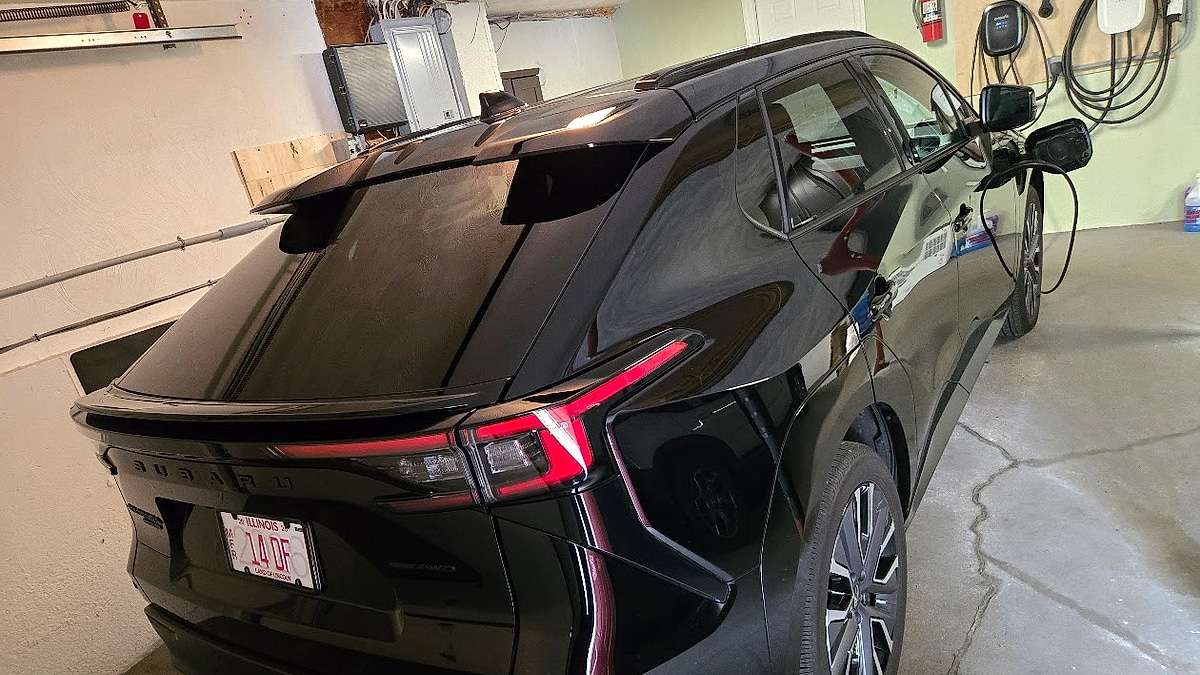

During our recent testing, we had a chance to back-to-back test two green Subaru vehicles, which have virtually identical passenger space and are more alike than different. We decided to conduct a close analysis of the two vehicles' cost of ownership to determine whether the Solterra battery-electric vehicle or the Crosstrek Hybrid has an advantage. This is a hot topic, now that gas prices are a bit higher than the inflation-adjusted norm. The outcome busts the myth that EVs have advantages in the long-term cost of ownership.
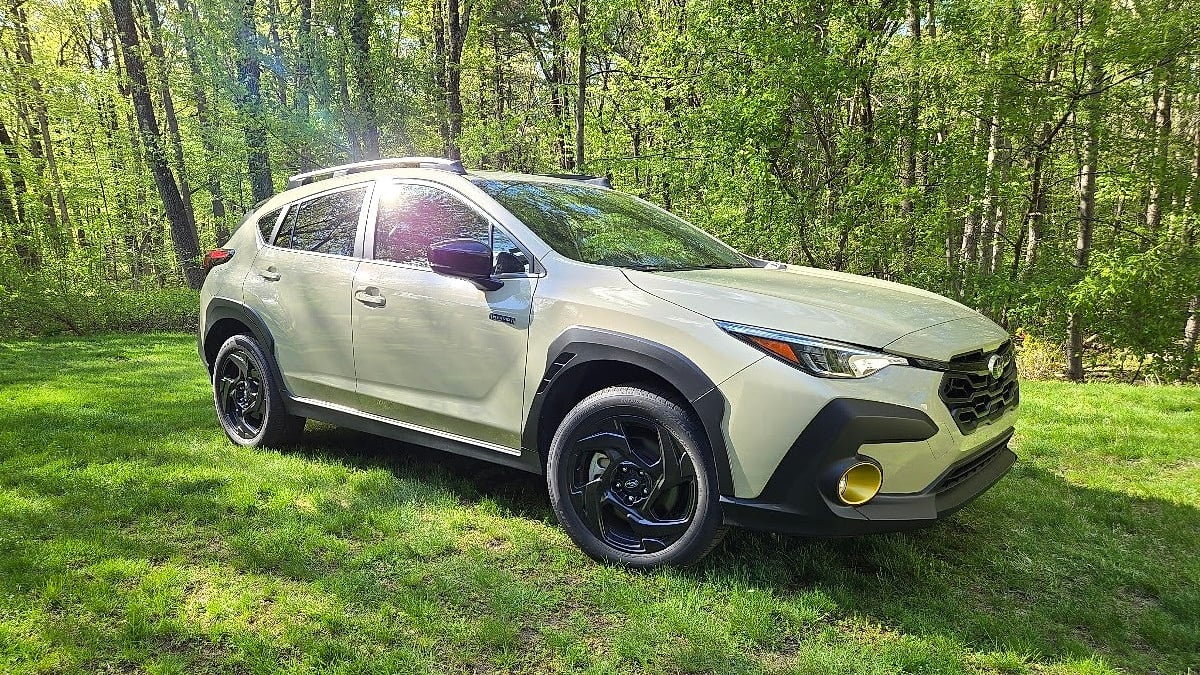
Why Solterra vs. Crossstrek Hybrid?
It may come as a surprise to our readers that the Crosstrek has about three more cubic feet of passenger space than the Solterra. The Solterra is larger outside, but the Crosstrek is bigger inside. Not only is the Crosstrek larger in total passenger volume, but it also has more headroom, more front seat legroom, and more rear seat legroom. When driven, our right knee was always in contact with the Solterra’s hard plastic center console. Oddly enough, the “smaller” hybrid is actually bigger when you drive it. Now, the Solterra does have the edge on cargo volume, so we consider this matchup fair.
What Trims Will We Compare?
The Solterra we tested was a Limited, so instead of the Sport Hybrid Crosstrek we tested, we’ll use the higher-cost Limited Hybrid's price in our comparison to make the matchup as fair as possible.
Purchase Costs and Depreciation - Hybrid Advantage $6,430 On Day 1: $9,370 In Year 5
We will use Subaru’s official prices in our comparison, but of course, discounting will also play a role in the out-the-door price of any vehicle you buy, so shop around. We chose colors of these two vehicles without added paint charges for our comparison. Here are the prices of the 2026 Solterra Limited and Crosstrek Hybrid Limited, including Subaru’s Destination and Delivery charge:
2026 Solterra Limited $42,845
2026 Crosstrek Limited $36,415
Hybrid Advantage $6,430
On the very first day of our comparison, the hybrid starts out with a $6,430 price advantage over the battery-electric vehicle (BEV). This number is amazingly close to the average price disadvantage that EVs have over “gas-powered vehicles.” In April, Cox Automotive analyzed the price difference between the two and found that the “EV price premium over ICE+ vehicles widened modestly in April to approximately $6,214.” So, our example seems to represent the norm when comparing two similar vehicles, one EV and one of another powertrain type.
Depreciation is the real killer for EVs. In March, iSeeCars analyzed the 5-year depreciation for all types of vehicles. EVs have the worst depreciation as a group. The study found that EVs have an average 5-year depreciation of 57% of value. Hybrids, by contrast, have the best value retention of all powertrain types, and the Subaru Crosstrek Hybrid was specifically listed in the iSeeCars report. Its 5-year depreciation is 33.1%. So let’s now calculate how much each vehicle will cost its owner in terms of purchase price less depreciation in five years. Since we don't have the exact number for Solterra EV, let us lean its way generously and say that instead of the average of 57.2%, we’ll use 50% to boost its value up a smidge:
2026 Crosstrek Hybrid Limited 5-year projected depreciation $12,053
2026 Solterra Limited 5-year projected depreciation $21,423
After five years, the hybrid in our example has a dramatically lower cost of depreciation, giving it a $9,370 ownership cost advantage. So far, the hybrid in our example is dramatically more affordable than the EV, which costs its owner almost $2K more per year to own.
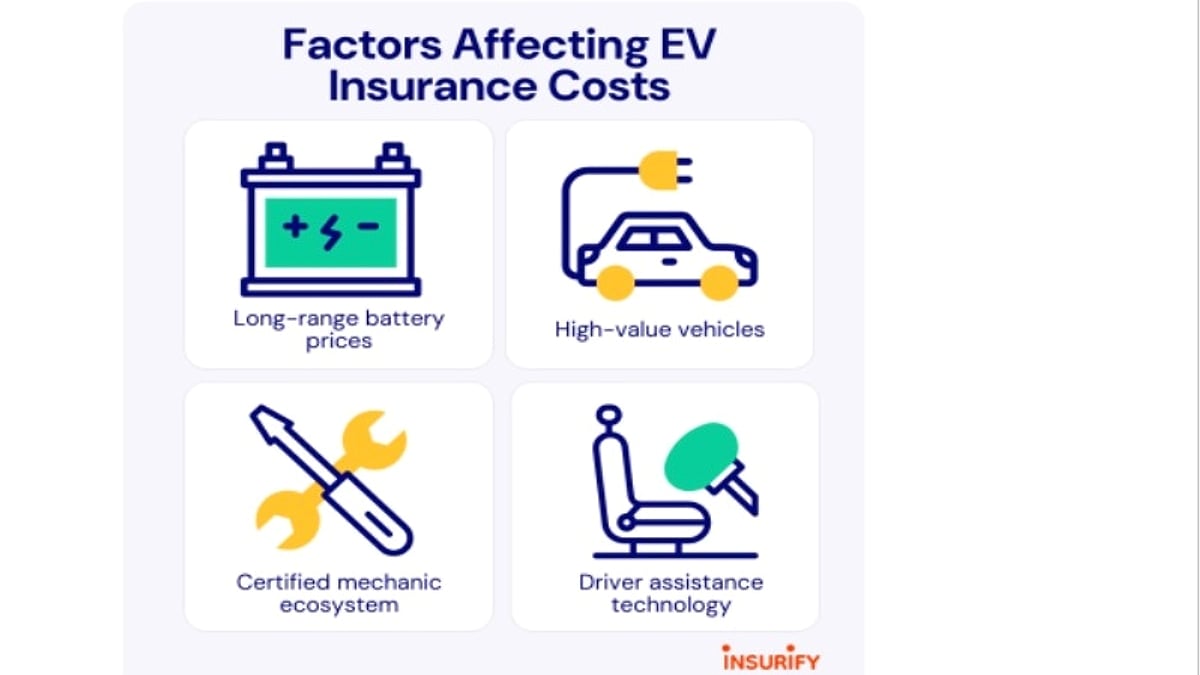
Insurance Costs - EV vs. Hybrid - Hybrid Advantage is $527 Per Year
A recent analysis by Insurify showed that EVs have dramatically higher insurance costs than other powertrain types. We reached out to Insurify and asked for the average insurance cost for each of these two specific vehicles. Insurify was kind enough to give us the data.
2026 Subaru Crosstrek Hybrid Limited Annual Insurance Cost Average $2,193
2026 Subaru Solterra EV Limited Annual Insurance Cost Average $2,720
Based on Insurify's data, the EV in our comparison will cost its owner $527 more to insure each year of ownership (on average). However, insurance costs vary widely by state and by driver. We suggest asking your insurance agent to compare the costs of the exact models you are considering when shopping for a new vehicle.
Energy Cost Comparison and Contrast EV vs. Hybrid - How You Charge Matters Most
As with insurance, what you pay for electricity depends entirely on your local area. The variation is extreme. We turned to FuelEconomy.Gov for the national averages. According to this source, the EV energy advantage for a vehicle driven 15,000 miles each year is $1,250 in favor of the EV. That is a very important cost difference. However, does this average use an at-home electricity price or a public one? That question is extremely important for shoppers.
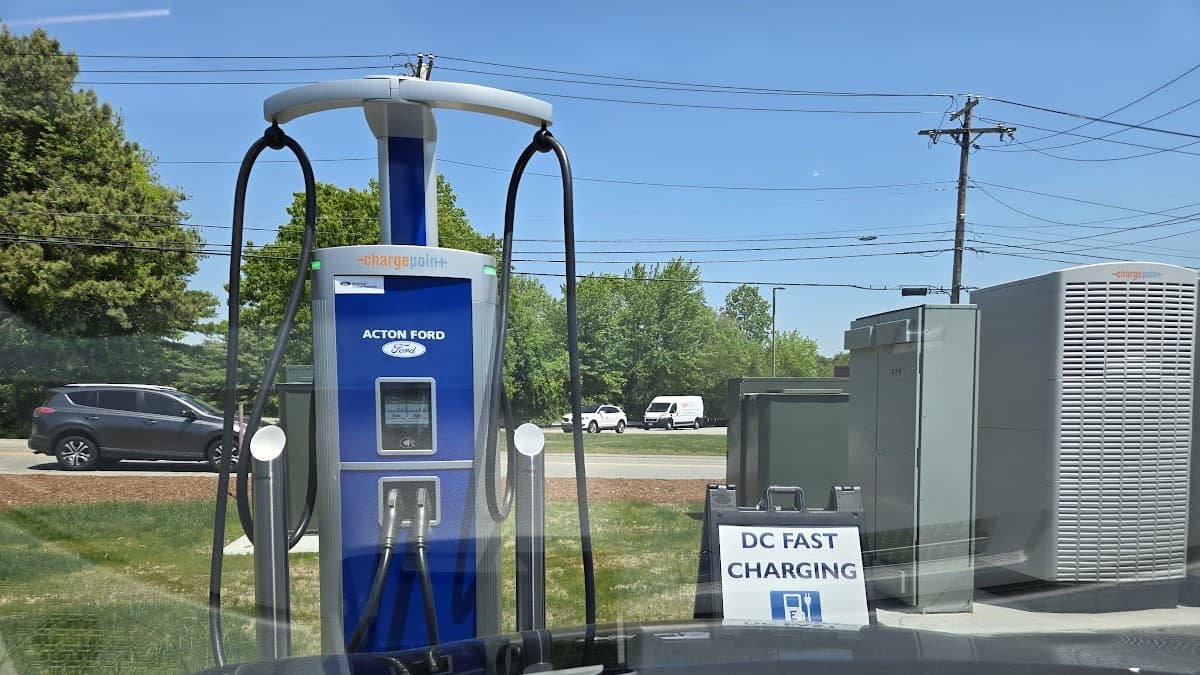
I own a home in Metro West Boston and have two Level 2 EV chargers installed in the garage. My home charging rate from Eversource using the lowest available energy cost is $0.33/kWh. With the Solterra having a 74.7kWh battery and an EPA-estimated range of 278 miles, my energy cost per mile in the Solterra is nine cents per mile when charging at home. If I charge in public at the closet DC charger, the price is $0.58/kWh, making the cost per mile fifteen cents.
The Crosstrek Hybrid has an EPA-estimated 36 MPG. The last gas I purchased was this past Sunday, and I paid $3.99/gallon. Let’s use today's Massachusetts average, as supplied by AAA. That price is $4.37. The math at the higher average fuel cost works out to eleven cents per mile. You can calculate your own cost per mile for energy, but in the Northeast, the Crosstrek Hybrid and Solterra EV have no meaningful difference in energy cost. The Solterra has the edge if I charge at home, and the Crosstrek Hybrid is less expensive for energy if I were to use public DC charging for the EV. Both vehicles are quite reasonable to energize, with the Solterra being the highest in cost per mile for those who don’t have a home charger.
As you can see, the EV is not the lowest cost for energy when charged in public using DC charging. Our take is that if you can charge at home, you will save money on energy with an EV. If you cannot, a hybrid will have the lower cost of energy in areas that have average gasoline prices. You will need to do your own math here.
Maintenance Costs EV vs. Hybrid
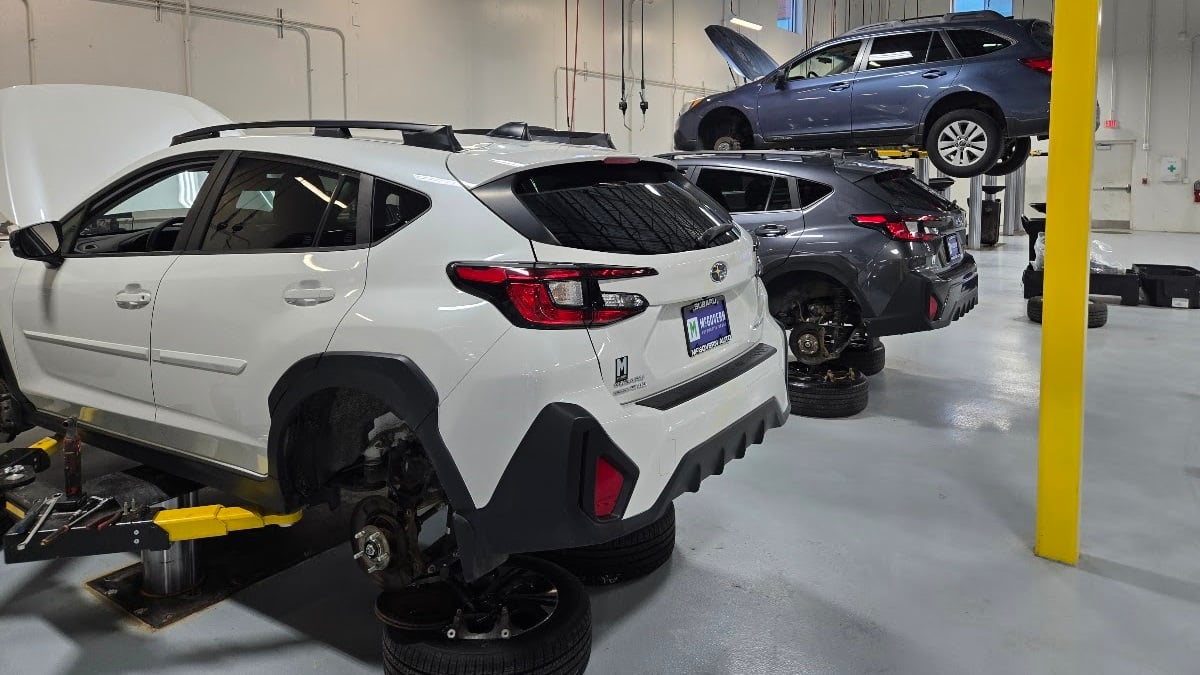
It’s difficult to calculate the exact maintenance cost for each of these vehicles over their lifetimes, but we can make some predictions and give the EV every advantage as we go along. The Solterra Limited has 20-inch OEM tires from either Yokohama ($992/set) or Bridgestone ($1,224/set). The 18-inch OEM Falken tire on the Crosstrek Hybrid has a cost of $849/set. We used prices from Tire Rack. So, the tire replacement cost for the Hybrid is lower. You can expect to pay about $50 to $300 per set less when you need tires for the Crosstrek vs. the Solterra. EVs are notorious for needing tires faster than other powertrain types, but let’s just assume that only one set every 3 years will be needed for each.
Both vehicles require tire rotations, 12-volt battery replacements, brake fluid service, wiper blade replacement, washing, and cabin air filter replacements, so there is no need to calculate these costs. Both have regenerative braking, and we can expect long brake pad and rotor life from each. No advantage or disadvantage for either.
The Crosstrek will need an oil change two times each year. Let’s budget $80 for each. Every 5 years, that will add $800 to the Crosstrek Hybrid's cost of ownership. Let’s also add $500 for a spark plug change for the Crosstrek every five years. Plus $300 for a rear differential fluid change. Thus, the annualized added maintenance cost for the hybrid will be $320. After factoring in the added cost of the EV's tires, let’s call the annual added cost of maintenance for the hybrid about $300.
Like the Solterra, the Crosstrek hybrid has no starter, no alternator, no serpentine belt, no timing belt, so those troublesome items will not be repair or replacement concerns. The dual-motor, planetary-gearset transmission in the Crosstrek Hybrid is maintenance-free and has proven reliable in Toyota vehicles that have used it for decades. Feel free to add any other costs you can think of for the Subaru Hybrid model.
Hybrid Wins the Cost of Ownership Matchup
The one distinct advantage we find for the EV is maintenance. The Solterra EV should cost about $300 less for maintenance each year. Energy depends mainly on two factors: Your local cost for fuel, and whether you charge at home or in public. Using the national averages for energy, the Solterra has a $1,250 advantage per 15,000 miles of use.
Here is a per-year breakdown of the first five years’ advantages and disadvantages:
Hybrid Depreciation Advantage $1,874
Hybrid Insurance Advantage $ 527
EV Energy Advantage - (High Miles and National Averages) $1250
EV Maintenance Advantage $300
Final Outcome - Hybrid Costs $851 Per Year Less To Own
Overall, where and how you add energy to these vehicles will be the biggest x-factor in their ownership costs. In Metro Boston, the Hybrid wins easily because we have average gas prices and high electricity costs, even when we charge at home. Charging in public is the real savings killer for the EV. One thing our analysis shows is that even when we give the EV the benefit of the doubt at every step, the hybrid costs much less to own than the EV. Which is not a headline you often find published.
Help us find the inevitable math error in our story. If an error is found, we’ll correct it. Tell us in the comments below what your personal energy costs would do to change this outcome.
John Goreham is a 14-year veteran of Torque News. An accomplished writer and a long-time expert in vehicle testing, Goreham also serves as the Vice President of the New England Motor Press Association and has a growing social media presence. He’s also a 10-year staff writer and community moderator for Car Talk. Goreham holds a B.S. in Mechanical Engineering and an undergraduate Certificate in Marketing. In addition to vehicle and tire content, he offers deep dives into market trends and opinion pieces. You can follow John Goreham on X and TikTok, and connect with him on LinkedIn.
Insurance graphic courtesy of Insurify. Images by John Goreham.
Set Torque News as Preferred Source on Google
Follow us today...






Comments
So from doing Uber with…
Permalink
So from doing Uber with eletric in Portland and denver.
It's interesting it's 30 cents a kwh
Charging 100 miles is right around 10 bucks. So I split that
50 miles is 5 bucks. Gas here is 5.00 a gallon on average. So my logic is I'm getting 50 miles to the price of a gallon. Meaning the eletric car gets basically 50 miles a gallon the same as most hybrid. Just interesting it's different everyware. This is public charging by the way
Your article doesnt seem to…
Permalink
Your article doesnt seem to take into consideration the rebates offered on the EV. Right now Subaru has $6,000 in rebates for the EV lineup, not to mention available rebates provided by the state you live in for EV purchases. In Massachusetts, for example, depending on your income there is $3,500 - $6,000 available. In Maine it is currently as much as $8,000. These are instant rebates applied at time of purchase, not a tax credit.
Battery powered cars are…
Permalink
Battery powered cars are largely a novelty item. The toyota hybrid is vastly superior.
The math issue is that the…
Permalink
The math issue is that the crosstrek comparison just isn't accurate. The measurements for the crosstrek to be "bigger" are less than an inch for each category. And whe. Actually sitting in both, the solterra feels noticeably roomier.
As far as vehicle class and feature expectation, the solterra has to be compared to the forester or OB when comparing the same trims. Because the forester and OB come with considerably more feature comforts than the crosstrek. Comforts that the solterra also come with. So to actually compare apples to apples you have to take features into account. Or at the very least you have to compare a higher trim crosstrek to a lower trim solterra. Further dividing the math.
Also don't forget about rode quality, trim quality, etc. furthering that the crosstrek is the wrong comparison
Emmett, I want to thank you…
Permalink
In reply to The math issue is that the… by Emmett (not verified)
Emmett, I want to thank you for your comment about the size matchup. First off, you are very right in one key way - any matchup is imperfect. There is almost no direct comparison, so we do our best to make them meaningful. I'm a former Forester owner and lifelong fan of the model. I considered it for this comparison very carefully, but opted for Crosstrek for two reasons. First, Forester is bigger than Solterra in ALL ways. It has much more passenger volume than Solterra, as opposed to the Crosstrek, which has more but is closer to Solterra. It also has more cargo volume than Solterra. In addition, I have not yet driven the 2026 Forester Hybrid. In fact, I've never seen one in person. I had the Crosstrek Hybrid for a week. Finally, the Solterra does not "feel" bigger to me when I am inside it. As I mentioned in the story, my right knee was in contact with the center console of the Solterra at every moment. The Crosstrek felt more comfortable, and I appreciated the greater head and legroom of the Crosstrek, as I am six feet tall. I embedded a link to the driving impressions part at the end of the story. I hope you will take the chance to check it out. Please take my comment as adding to the chat, not saying you are wrong. I really do appreciate your input.
Your analysis did not…
Permalink
Your analysis did not include the cost of the level 2 charger and its installation costs probably in excess of $2000 CND. Another cost that favours the hybrid.
Thanks, Bill! You are spot…
Permalink
In reply to Your analysis did not… by Bill (not verified)
Thanks, Bill! You are spot on. At my home in Metro Boston, the panel upgrade needed for the L2 charger was about $1,100, and the charger wiring itself was about $600. The two chargers I have mounted have a retail value of over $700 total. This was the lesser expense. At a prior home, I paid over $6,000 to enable L2 charging, mostly due to a very old service and panel.
My beef is with the…
Permalink
My beef is with the depreciation calculation. How does one figure that one car has more depreciation than another? That is not explained, and seems TOTALLY arbitrary! 51% vs 30%??? Come ON!! That's BS. I've been driving my Chevy Bolt 5 years, NO battery degradation, no real maintenance except tires. Your entire premise comes down to so-called depreciation. Baloney.
The depression thing is…
Permalink
In reply to My beef is with the… by Rob Vernon (not verified)
The depression thing is worse than even this. The expected lifespan of an ICE car is no more than about 250k miles. An EV can probably go double. So, not only is depreciation not accurate, when the ICE car is junked, the EV can still be driven again for as long as the original ICE car. So, to be fair, you really should double the purchase price of the ICE car, because you'll have to buy 2.
Depreciation really is only a factor on new cars. Do the math again on a car newly off lease, so second owner. Then do it again for the 3rd owner. Only the initial owner comes out behind. But then again, he got a quieter, smoother, more performant (in the city at least) car... So did he really lose?
The depreciation cost refers…
Permalink
In reply to My beef is with the… by Rob Vernon (not verified)
The depreciation cost refers only to the resale value. EVs do lose resale value very quickly, largely because EV technology is advancing rapidly. 5 years can see dramatic improvements in battery life etc.
If you intend to drive a car until it falls apart, then only worry about the cost to operate and the initial purchase price.
Hi Rob. Thanks for asking…
Permalink
In reply to My beef is with the… by Rob Vernon (not verified)
Hi Rob. Thanks for asking for clarity on depreciation. I think I can help, and it starts with checking out the links in that section, which will lead to you more details on the sources. The original source is a publicly available study published by iSeeCars.com (March 24, 2026). iSeeCars is a metro-Boston-based company that works with national car dealers who sell new and used vehicles. They are like Cars.com and CarGurus.com in the services they provide. The source used price data from thousands of data points to arrive at the averages by powertrain for depreciation. However, for the Subaru hybrid, we didn't need to use an average of its vehicle type because there was 2021 Crosstrek Hybrid data available specific to that model. So we used that value. If we'd opted to use the average for hybrids, it would not have made any meaningful change to the outcome, because the Crosstrek Hybrid had a depreciation of 33.1%, and the average for hybrids was 35%. The steep depreciation of EVs is a mixed blessing. One positive of steep EV depreciation is that it enables low-cost used EV purchases. We have covered positive EV angle that many times here at TN. Thanks for the chance to expand the discussion.
In Kansas City, I pay $0.04…
Permalink
In Kansas City, I pay $0.04/kWh during overnight off-peak hours. Even during peak hours, it's $0.27/kWh.
Gas is around $3.85 here today.
Where you live is going to swing the cost of ownership considerably. I'd be paying $2k more a year in gas if I drove a comparable gas vehicle.
Matt, great added comment…
Permalink
In reply to In Kansas City, I pay $0.04… by Matt (not verified)
Matt, great added comment. If electricity is just $0.04/kWh, and you can charge at home, an EV is a slam dunk. Just for comparison, just the delivery part of a Metro Boston electric bill is over $0.18/kWh, not including the actual electricity usage part of the bill. It's astounding that KC can offer such a great price. Clearly, other rate payers are helping to enable that reduced cost.
Owning an EV is about more…
Permalink
Owning an EV is about more than just money. It is a step toward carbon reduction. Yes, evs have higher CO2 emissions during production, but that is offset by lower - far lower - operating emissions. Zero for solar and hydro, 40%lower even for coal powered electricity. It's about care. I stopped buying Subaru when they declared love is what makes a Subaru, but if you love the planet you will go electric and ride your bike.
Thank you John Fisher for…
Permalink
In reply to Owning an EV is about more… by John Fischer (not verified)
Thank you John Fisher for your comment about the many reasons to own a green vehicle. Yes, owning an EV is definitely about reducing CO2 emissions. Many hybrid owners would say that they also had that in mind when they purchased a vehicle capable of traveling without any emissions for many scenarios, and for reducing the total lifetime CO2 produced by owning a hybrid. I am not following your point about the Subaru Love campaign, but I can say it was a massive success for the brand. Like "Zoom Zoom" and "Built Ford Tough" were for the Mazda and Ford brands. Thanks for adding this important point about how green cars help the environment.
I think you used 74.7kWh and…
Permalink
I think you used 74.7kWh and 278 mile range (and electricity price) to calculate EV cost per mile. So the cost is calculated for 3.7 miles/kWh. We are averaging 5.5 miles/kWh in our Solterra, albeit under relatively ideal spring conditions so far.
Your home charging rate is…
Permalink
In reply to I think you used 74.7kWh and… by KG (not verified)
Your home charging rate is rather high!
In Pasadena, CA right now, off-peak hours are $0.11/kWh, and gas is $6.50/gallon.
With incentives, the Trailseeker (close kin to Solterra) was about the same price as an Outback or Forester Hybrid, and it also goes 0-60 in 3.9 seconds... so there's the added fun factor. Plus I am finally free of pollution guilt every time I want to go on a road trip.
Perhaps the long term maintenance cost will not quite line up, but there are many more subjective factors that matter to folks like me.
Great points, David. Yes, we…
Permalink
In reply to Your home charging rate is… by David Robbins (not verified)
Great points, David. Yes, we EV drivers here in Metro Boston, served by Eversource, may one day also enjoy non-EV owner ratepayer-subsidized lower evening charging rates. However, we have yet to even receive smart meters. The performance of EVs is outstanding, that is true. Do you often accelerate from a standstill to 60 MPH as fast as possible? Here in our area, it is illegal, and the fine is hefty. The offense is called "Exhibition of speed," or simply, "Driving to endanger." It's one of the few violations that can actually get your car towed and result in a court appearance. We do have some on-ramps where the speed limit is 55 MPH nearby, but it is hard to stop before the quick rush up to traffic speeds. So we go from 20 MPH to 55 MPH, and sometimes even faster. The Crosstrek Hybrid did very well in that scenario, but the Solterra was more thrilling. Cheers,
Great comment, KG. You do…
Permalink
In reply to I think you used 74.7kWh and… by KG (not verified)
Great comment, KG. You do make a great point. Energy per mile for EVs and range definitely vary from season to season and driver to driver. It sounds like you are a very efficient driver. With your good habits, you would surely also have a higher than average mileage if you drive a hybrid vehicle.