
A new study from the research team at iSeeCars has just thrown sand in the gears of shoppers looking to EVs as a solution to high fuel prices. It turns out that electric vehicles depreciate so dramatically that owners lose tens of thousands of dollars compared to fuel-sipping hybrids. “Electric vehicles consistently cost more than the equivalent gasoline or hybrid model,” said iSeeCars Executive Analyst Karl Brauer. “That high upfront cost comes back to haunt electric cars on the used market, where buyers aren’t willing to pay the premium.”
The iSeeCars study looked at the depreciation of five-year-old vehicles. Depreciation is the loss in value as a vehicle ages. It’s steepest in the first two years, and then it slowly moderates. The research team analyzed over 950,000 5-year-old used cars sold from March 2025 to February 2026. What the team uncovered was that electric vehicles don't just depreciate a bit more than other green vehicles, such as hybrids; it’s a night-and-day difference.
The average depreciation for a vehicle with an EV powertrain was found to be 57.2%. That means if you purchased an electric vehicle for $40,000, by year five, its value would have dropped to just $19,200. By contrast, the average depreciation for vehicles equipped with a hybrid powertrain was just 35.4%. Which means that a hybrid purchased for $40,000 would have a value after year five of $25,840. The difference between these two examples is $6,640, or about $1,328 per year, or $111 per month, in favor of hybrids.
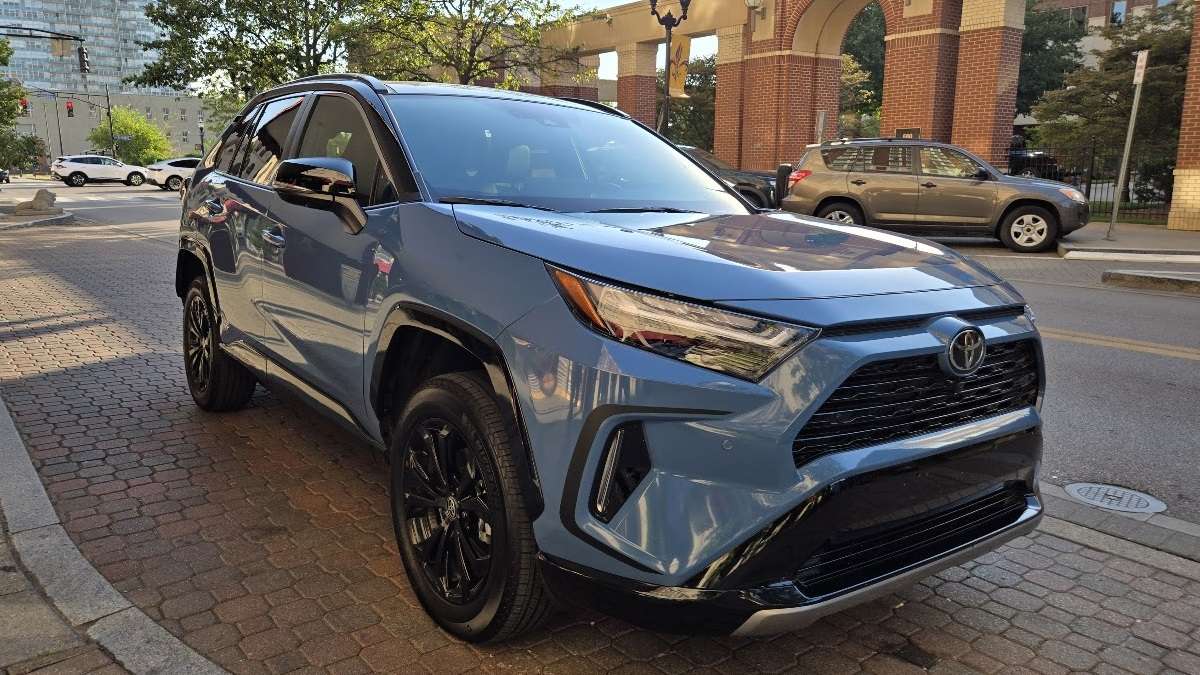
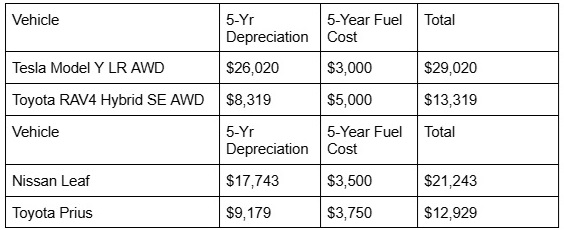
Now let’s take two real-world examples. We’ll select the two top-selling, five-passenger green crossovers in America, the Tesla Model Y and the Toyota RAV4 Hybrid. The data showed a loss of value of $26,020 for the all-electric Tesla Model Y, and a loss of just $8,319 for the RAV4 Hybrid. The difference is a staggering $17,701 in favor of the hybrid.
The Tesla Model Y AWD LR has an EPA-Estimated annual energy cost of $600. The Toyota RAV4 AWD SE has an annual energy cost of $1,000. So, the Model Y is ahead by $400 per year. An owner would save $2,000 in energy costs over five years with the Model Y compared to the RAV4 Hybrid. However, factoring in the depreciation difference, the Toyota RAV4 Hybrid owner comes out ahead by a shocking $15,701.
How about a second, more affordable vehicle pairing example, such as the all-electric Nissan Leaf vs. the hybrid Toyota Prius? You can check out the details in our chart below, but the result is that the Prius has a lower cost over five years by $12,929.
The difference in depreciation between hybrid powertrain-equipped vehicles and battery-electric vehicles is so vast that comparing the best EV, the Tesla Model 3, at 54%, to the average of all hybrids at 35.4% still makes EVs look terrible.
Which EVs lose the most value over their first five years of ownership? They are:
1) Nissan Leaf 63.1%
2) Volkswagen ID.4 62.1%
3) Tesla Model S 62.0%
4) Tesla Model X 61.2%
5) Mustang Mach-E 60.8%
One conclusion of the iSeeCars study is:
Toyota is the most prominent brand for retained value, holding 10 of the top 25 spots.
This is no accident if you consider that every top-selling Toyota model is either offered only as a hybrid or has multiple hybrid trim options.
As it turns out, some trucks also have great value retention. Which trucks have the very best retained value? The Toyota Tacoma and Toyota Tundra, both of which are now offered in hybrid trims.
The idea that EVs automatically save you money is starting to crack. Yes, they’re a smidge cheaper to run, but not by as much as you might think. When depreciation is factored in, hybrids come out way ahead every time, making them the better economic choice for drivers trying to go green without overspending.
Were you surprised by just how badly the math works out for EVs compared to hybrids? Tell us your thoughts in the comments below.
John Goreham is a 14-year veteran of Torque News. An accomplished writer and a long-time expert in vehicle testing, Goreham also serves as the Vice President of the New England Motor Press Association and has a growing social media presence. He’s also a 10-year staff writer and community moderator for Car Talk. Goreham holds a B.S. in Mechanical Engineering and an undergraduate Certificate in Marketing. In addition to vehicle and tire content, he offers deep dives into market trends and opinion pieces. You can follow John Goreham on X and TikTok, and connect with him on LinkedIn.
Set Torque News as Preferred Source on Google
Follow us today...