
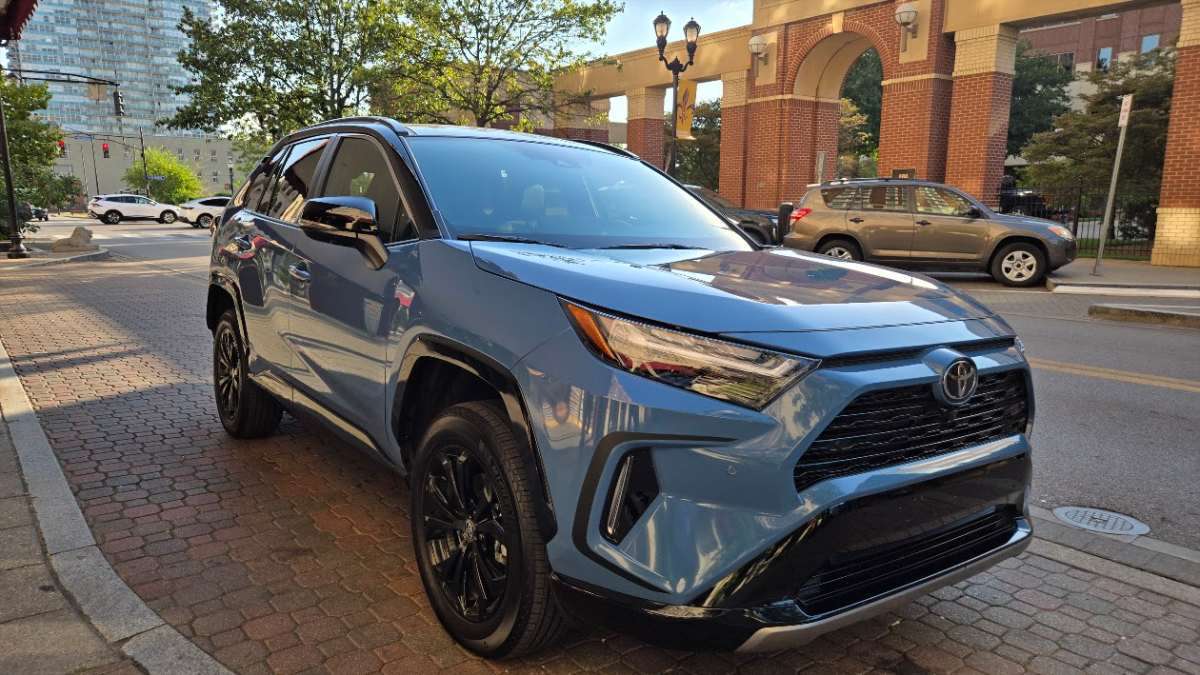

This past week, I took a break from banging out automotive content to learn a bit more about automotive manufacturing. I visited Toyota's TMMK Kentucky plant, which is about to switch production from the current fifth-generation 2025 RAV4 to the all-new (sort of) sixth-generation 2026, which represents a new generation. I met everyone from co-op students on internships to the plant President during the visit, and got to see with my own eyes the line that is about to start building the new RAV4. I have some embargoed content from that trip I can’t yet share, but I can tell you that I think Toyota must be cuckoo to swap the RAV4 now. Here’s why.
When you visit a Toyota plant on a media, influencer, and investor tour, you often end up driving the vehicles that the plant builds. I’m sure this is no surprise to readers. The timing of my trip was a bit odd. The plant is about to start building the new RAV4, which will transition to a 100% electrified powertrain selection and be segmented into three distinct flavors: Core, Sport, and Rugged. The first drive event for the all-new RAV4 is about to take place. I literally just missed the new one! However, I did get to drive one of the last 2025 RAV4 XSE Hybrid AWD models that will ever be produced. And it blew me away.
I test and review about 60 new vehicles each year, and I am no stranger to the RAV4 segment. I’ve driven virtually all of the competition, including the Honda CR-V (Hybrid) and Nissan Rogue, relatively recently. What struck me when I drove the outgoing 2025 RAV4 Hybrid XSE was that I consider it the best in class. So why mess with success?
Well, Toyota is all about not messing with success, normally. But the RAV4 we have now (2025) is a design that was put together about ten years ago, and it has been on sale for over six and a half years. You’d think it would be a fossil that stuck out in its class, but the exact opposite is true. Let me give you some examples of what I mean.
Name another 40 MPG crossover of the RAV4’s size and price that is equipped with all-wheel drive and a spare tire. There isn’t one. Name another all-wheel drive plug-in hybrid crossover of any type that has averaged about 2,000 units per month for many years. There isn’t one. Just RAV4. Name another crossover in the RAV4’s segment that has sold over 350,000 units year to date. None are really even close. The RAV4 is ahead of CR-V by 20% in deliveries this year, and the RAV4’s 2025 deliveries are greater than the Nissan Rogue’s and Hyundai Tucson’s combined. The RAV4 also has one of the shortest days-on-lot number of any best-seller in the country. By nearly all measures, the RAV4 is kicking and taking. So why replace it?
One reason would be safety. Believe it or not, the RAV4 we have in 2025 is the same generation as the 2019 model that was rated a Top Safety Pick+ by IIHS. However, the tests have gotten harder, and some of the new test scores for the 2025 RAV4 are not perfect. I am confident that Toyota will update the structure to enable top scores on the updated (higher-speed) safety tests.
Another reason to update the RAV4 is to update its styling. I love the current RAV4’s look, but my wife looked at it and passed. She instead opted for a 2024 Toyota Venza Hybrid, which has a sleeker, more modern look. Toyota still earned a sale, but the Venza is now discontinued in America. The new RAV4 will have three looks, and those who don’t like “Rugged” may find they do like one of the other two styles.
In conclusion, it is wise for a conservative company to make changes, even if the model is selling well now. The idea is to stay ahead of the pack, and that means updates must come. Normally, I tell my readers to run out and buy the leftover new vehicles that overlap the new generation when models are updated, but the truth is, Toyota will likely have virtually none. Toyota has been selling the RAV4 off the back of the delivery truck since, well, 2019. If you do find one, and it's discounted, buy it. Based on my four hours of drive time in one, I can tell you with high confidence that it is the benchmark for the segment. At least for a few more weeks, until Gen-6 arrives.
John Goreham is the Vice President of the New England Motor Press Association and an expert vehicle tester. John completed an engineering program with a focus on electric vehicles, followed by two decades of work in high-tech, biopharma, and the automotive supply chain before becoming a news contributor. He is a member of the Society of Automotive Engineers (SAE int). In addition to his eleven years of work at Torque News, John has published thousands of articles and reviews at American news outlets. He is known for offering unfiltered opinions on vehicle topics. You can connect with John on LinkedIn and follow his work on his personal X channel or on our X channel. Please note that stories carrying John's by-line are never AI-generated, but he does employ grammar and punctuation software when proofreading and he also uses image generation tools.
Set Torque News as Preferred Source on Google
Follow us today...






Comments
I understood that the Venza…
Permalink
I understood that the Venza model line has been moved to the Toyoto CROWN line for 2026 along with the current Camry.
I don't know if there other vehicles that also have been moved.
Thanks for commenting,…
Permalink
In reply to I understood that the Venza… by Charles Kuebler (not verified)
Thanks for commenting, Charles. Yes, Toyota does see the Crown as filling the need that the Venza once satisfied in the U.S. The Venza is a different vehicle, though, and it continues in other markets as the Harrier. Cheers,