
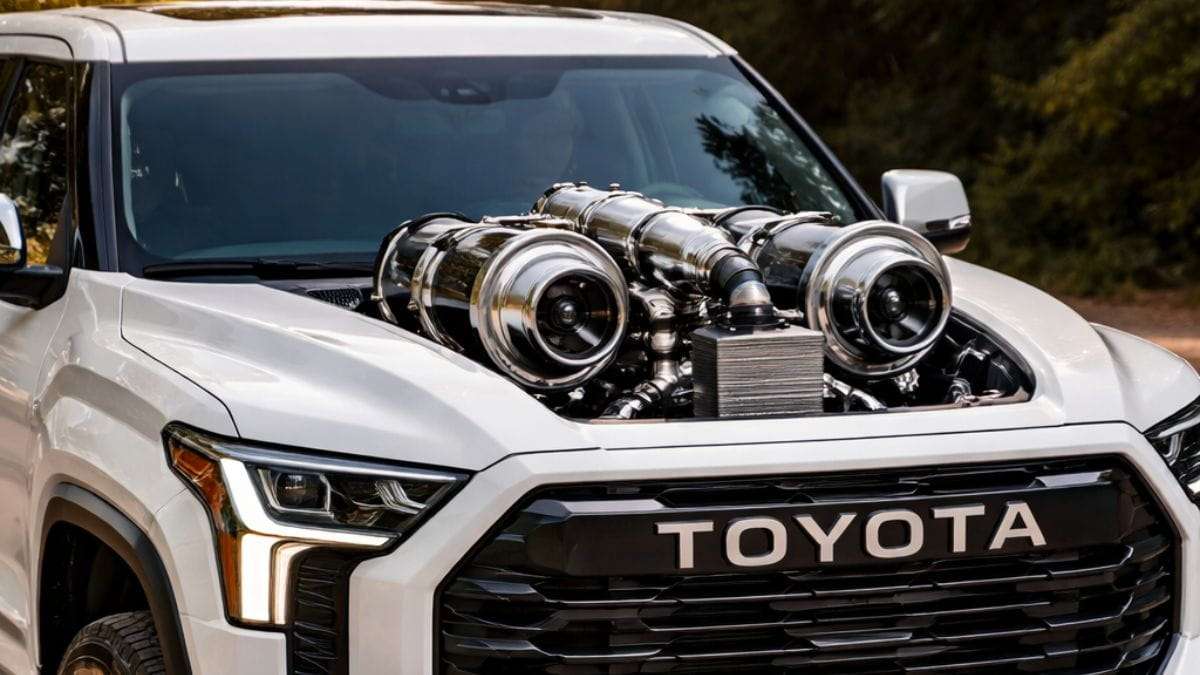

Modern trucks don’t usually fail loudly anymore. No bang. No smoke. No dramatic roadside breakdown. Instead, they fail politely, with a dashboard message that sounds more like a suggestion than a command.
That’s exactly what happened to Bob Swika, a 2023 Toyota Tundra Limited i-Force Max owner, when his truck displayed a “Reduced Engine Power, Visit Dealer” warning at just 12,000 miles. What followed was an $8,000 turbo replacement - covered under warranty - but also a revealing look at how ownership, reliability, and manufacturer response intersect in today’s turbocharged pickup trucks.
If you own a new Toyota Tundra, are considering buying one, or are simply trying to understand whether modern turbo V6 trucks are as dependable as their reputations suggest, this story deserves your attention.
“Just got the ‘Reduced Engine Power, Visit Dealer’ message. I was close to the dealer so I stopped by. The code is showing something with the turbo. They gave me a loaner truck and said they’d let me know what it is as soon as possible. It’s a 2023 Toyota Tundra Limited iForcemax with 12,000 miles.”
Bob shared that message in the 2023 to 2026 Toyota Tundra Owners Facebook group. Calm. Informative. No panic. Those are often the posts that deserve the most attention.
When the Truck Decides Something Is Wrong
Reduced engine power messages exist to prevent damage, but they also highlight how much authority modern trucks now have. Bob did the right thing immediately. He did not push it. He did not ignore it. He went straight to the dealer.
That choice likely prevented a small issue from becoming something much worse.
Soon after, Bob posted an update that changed the tone of the discussion.
“I was told there was an issue with one of the turbos. Need a new turbo and all supporting parts such as gaskets. Parts were ordered today and will hopefully be in and installed tomorrow. Glad this is under warranty the parts total is almost $8,000.”

Eight thousand dollars is the hidden number behind modern efficiency.
The Waste Gate Detail That Matters
Bob later explained what failed.
“I brought the truck on Thursday afternoon when I got the message. The turbo and turbo sub assembly and gaskets and clamps were ordered the same day and delivered Friday morning. I got the truck back yesterday late afternoon. I am honestly really surprised at how fast they were able to get my truck back to me. They listed the cause of failure as the waste gate getting stuck.”
This detail matters because it aligns with broader scrutiny of the platform. Toyota has already expanded oversight, which is explained in this in depth Torque News report on Toyota expanding the recall of the 3.4 liter twin turbo V6 after more vehicles were found to be potentially affected.
Toyota՛s Handling Was Surprisingly Pleasant
This part deserves credit. Bob received a loaner. Parts were ordered immediately. The truck was repaired quickly. Toyota handled the situation in a professional and surprisingly pleasant way.
That experience contrasts sharply with other owner stories. One example is described in a Torque News report about a 2024 Toyota Tundra owner whose truck broke down at 21,500 miles and spent 21 weeks in service.
When Things Go Much Worse
Not every case ends smoothly. Some are deeply unsettling. Torque News documented a 2025 Toyota Tundra TRD Pro with less than 19,000 miles that already suffered a blown main bearing, a story that still raises questions.
At the same time, millions of owners continue driving trouble free trucks, which is why this discussion remains polarized. That tension is explored in a Torque News analysis of millions of miles driven on Toyota Tundra drivetrains alongside growing disillusionment with turbocharged reliability.
Toyota Support Can Change the Outcome
Some owners report major repairs paired with solid manufacturer support. One example is a 2023 Toyota Tundra owner who needed a new engine at 24,000 miles and praised Toyota for loaners and smooth handling.
Others remain unsure how to feel, like the owner in this Torque News story about a 44,000 mile engine shutdown warning that left a Tundra owner speechless.
And then there are cases that feel almost unreal, such as a brand new 2025 Toyota Tundra TRD Pro Hybrid that encountered trouble just 400 miles into a road trip.
The Opposite View, Are We Overreacting
It is fair to challenge the concern. Social media amplifies unusual occurrences. Thousands of trouble free trucks never generate posts. One early turbo failure does.
From that perspective, Bob’s experience shows the system working. Early detection. Fast repair. Strong support.
Long-Term Heat Management and Turbo Longevity in the 3.4L Twin-Turbo Tundra
One issue that doesn’t get enough direct attention in the Toyota Tundra turbo debate is heat management over long ownership periods, especially for owners who tow, idle frequently, or drive in hot climates. Turbochargers live and die by temperature control, and the 3.4-liter twin-turbo V6 packs a lot of thermal stress into a relatively tight engine bay compared to the old naturally aspirated V8. On paper, Toyota engineered robust cooling systems, oil pathways, and intercoolers. But real-world ownership is revealing that sustained heat cycles, not peak horsepower runs, may be where long-term risks accumulate. This matters because many Tundra buyers aren’t weekend drivers. They’re contractors, tower operators, and families who expect the truck to rack up miles without drama.
What’s especially relevant is that turbo heat issues often don’t fail loudly at first. Instead, they show up as oil breakdown, carbon buildup, sensor errors, reduced boost, or limp-mode warnings long before a catastrophic failure. Several owner stories across Torque News point to warning messages, shutdown alerts, and extended dealer visits that don’t always end with a clear explanation. From an ownership perspective, that uncertainty erodes trust faster than a single broken part. Toyota handled individual cases well by approving repairs, engine replacements, and loaner vehicles, but the broader concern remains: how will these turbo systems look at 150,000 or 250,000 miles when heat exposure compounds year after year?
This also ties directly into maintenance behavior, which turbo engines are far less forgiving about than older Tundra V8s. Oil change intervals, oil quality, cooldown habits after towing, and even software updates can meaningfully affect turbo lifespan. Many longtime Toyota truck owners are still adjusting to this reality. They bought a Tundra expecting old-school durability, but they’re now driving a truck that behaves more like a modern performance engine under load. That mismatch between expectations and mechanical reality may be one of the quiet reasons why frustration around the turbo Tundra feels louder than the actual failure rate alone would suggest.
A Simple Moral Worth Remembering
Listen early. Act calmly. Respect warning signs. Being attentive is not fear driven. It is responsible.
Modern trucks are smarter, faster, and more efficient, but also more complex. Reliability today is no longer just about how long parts last. It’s about how quickly problems are detected and how well manufacturers respond when something goes wrong.
In Bob’s case, Toyota did things right. That doesn’t erase broader concerns, but it does show what ownership can look like when the system works.
Now let me ask you:
Have you ever experienced a reduced engine power or engine shutdown warning, and how did you react in that moment?
And after reading these real owner stories, has your confidence in turbocharged trucks changed at all?
Share your experience in the comments․ I read them, and so do other owners trying to decide what comes next.
Armen Hareyan is the founder and Editor-in-Chief of Torque News. He founded TorqueNews.com in 2010, which since then has been publishing expert news and analysis about the automotive industry. He can be reached at Torque News Twitter, Linkedin, and Youtube. He has more than a decade of expertise in the automotive industry with a special interest in Tesla and electric vehicles.
Set Torque News as Preferred Source on Google
Follow us today...



Comments
Turbos are fun and all, but…
Permalink
Turbos are fun and all, but reliability comes with supercharging, not turbocharging. Every auto enthusiast knows that.
Insurance??? Isn’t that a…
Permalink
Insurance??? Isn’t that a recall or a warranty?
I always wanted a Tundra and…
Permalink
I always wanted a Tundra and yes mine is a 2019 with the 5.7 V-8. Being a truck owner I have had numerous trucks. Chevy,Ford even one Dodge. My aim was to eventually own a Toyota Tundra after reading stories of anywhere from 600,000 miles to a million miles on these trucks. So as I got older after turning wrenches on trucks I finally broke down and bought my 2019. I love it. Most dependable truck I’ve ever owned. My Ford was the most up until I bought the Tundra. In my experience the pressures on a V-6 turbo charged engine are not feasible. If it were a diesel I could see it. My message to Toyota would be go back to the drawing board and put the V-8 back in the truck. I don’t care about gas mileage I care about dependability. Work on better fuel efficiency rather than beating up on a 6 cylinder engine to be a work horse. I feel the alternative is the big three are going to take front stage in the pickup market. Americans want dependable hard working trucks. Ford is already ahead of the market. Unless of course you want to make sedans and suvs. Short of that you’re killing your truck market because I know dozens of people that will never buy into the idea of a V-6 that is an actual work truck.