
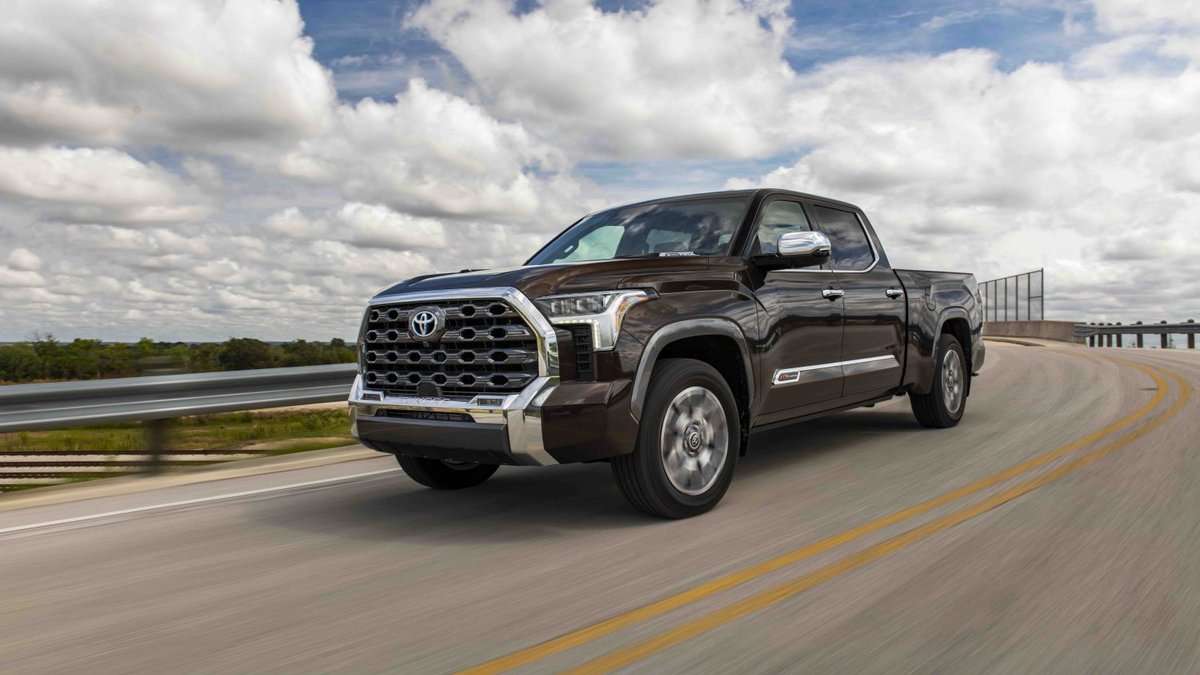

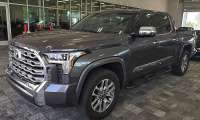
A 2024 Toyota Tundra Limited owner says his truck has spent nearly one-fifth of its life in the service department after suffering a major engine failure at just over 21,500 miles. Despite two separate engine rebuilds and an active interim engine recall, he says Toyota refused to authorize a full engine replacement, leaving him conflicted about a truck he otherwise loves.
The breakdown occurred on August 4, 2025, when the truck had just over 21,000 miles on the odometer. The failure happened six hours from the owner’s home, two states away, forcing him to rely on the nearest Toyota dealership for repairs. That dealership opted to rebuild the engine rather than replace it, a process that ultimately took more than 14 weeks, largely due to parts delays.
“Here's an update to my breakdown experience.
You can check my profile for my previous post.
TL; DR - Engine was rebuilt (took 15 weeks - mostly waiting for parts). A week later, the engine is leaking. Toyota denied a full engine replacement (even though I have the interim engine recall notice). The engine has to be rebuilt again, and the truck is still in the shop. Total time in the shop now is 21 weeks and counting.
I have a 2024 Limited with a 10/23 build date.
It broke down at 21,5XX miles on August 4th, 2025.
The dealership closest to where I broke down rebuilt the engine.
I picked up the truck on November 14, 2025.
In total, they had my truck for 14 weeks and 4 days.
A week after my engine was rebuilt, I noticed an oil spot in the driveway and took the truck to my local dealership on December 3, 2025. My local dealership did not do the repair since my breakdown happened 6 hours away from home - 2 states away.
My local service department inspected the work done, and the service rep said my engine was leaking everything from everywhere. They said it looked like the tech that did the rebuild didn't know what they were doing, and the work was done inadequately. My local service department quoted the original service department that did the rebuild $7750 to fix their work.
Advertising
The service department that did the rebuild decided not to pay my local dealership to fix it - even though I voiced my concerns with their work and requested they let my local service department handle the job. They decided to transport my truck back to them (6 hours, 2 states away) and swap my truck out for a rental. Then they would do the repairs themselves. It took a week and a half for my truck to be transported.
Since my truck has the interim engine recall notice, the service rep said they would talk to Toyota about just replacing my engine instead of trying to rebuild it again. Toyota denied their request and told them to rebuild it.
My truck is still in the shop.
The amount of time my truck has been out of commission this time has been 6 weeks and counting.
The total time my truck has been in the shop so far is 20 weeks, 4 days.
I got the truck right at the end of December 2023. I've had it for about 107 weeks, and it's been in the shop for 21 of those weeks. Almost 20% of the time I've had it.
I'm currently consulting with a lemon law lawyer to see how much Toyota offers to buy the truck back for, and then I'll decide if I want to go through with it or not.
Again, this has just been my experience. I'm sure (and hope) many others have had completely different experiences. I'm sure many of you would have handled things differently.
I'm just conflicted because I absolutely love my truck, but this whole experience (that's still ongoing) has really taken a toll on my enthusiasm for it.”
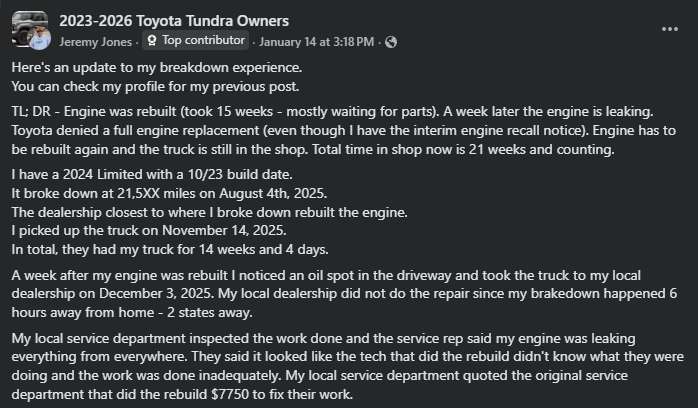
The owner finally got his truck back on November 14, 2025. Less than a week later, he noticed oil spots forming in his driveway. Concerned, he brought the truck to his local Toyota dealership on December 3 for inspection. That dealership did not perform the original repair and quickly identified extensive oil leaks, describing the engine as “leaking everything from everywhere.” According to the service department, the rebuild appeared to have been done improperly.
Toyota Tundra: Twin Turbo & Fuel Economy
- The Tundra’s twin-turbo V6 replaces the previous V8, improving torque delivery for towing while changing the truck’s character with more turbo-related sound and response behavior.
- Suspension tuning leans toward stability under load, delivering confident highway manners when hauling but a firmer ride when the bed is empty.
- Cabin design focuses on practical usability, with a wide center console, large storage spaces, and controls sized for work use rather than a purely minimalist layout.
- Fuel economy improves versus older generations, but the truck’s size and gearing still make efficiency highly dependent on speed, payload, and towing demand.
The local dealership quoted the original repair facility $7,750 to correct the issues. Rather than approve the work, the original dealership chose to transport the truck back to their facility and redo the repairs themselves. The owner requested that his local dealer handle the work instead, but that request was denied. Transporting the Tundra back took an additional week and a half, during which time the owner was placed in a rental vehicle.
Because the truck carries an interim engine recall notice, the service department again requested authorization from Toyota to perform a full engine replacement instead of another rebuild. Toyota denied that request and instructed the dealership to rebuild the engine a second time.
As of the owner’s latest update, the truck remains in the shop. The second repair attempt has added more than six additional weeks of downtime. In total, the truck has now spent 21 weeks in service.
The owner purchased the Tundra at the end of December 2023 and has owned it for roughly 107 weeks. With 21 of those weeks spent in the shop, he calculates that nearly 20 percent of his ownership period has been without the vehicle. He is now consulting with a lemon law attorney to determine whether a manufacturer buyback is possible and what compensation Toyota might offer.
What makes the situation particularly difficult for him is that he still enjoys the truck when it is working. He describes himself as conflicted, saying he absolutely loves the vehicle but that the prolonged repair process, repeated rebuilds, and refusal to approve a full engine replacement have taken a serious toll on his enthusiasm.
Other Tundra owners responding to his story shared similar experiences. Some reported multiple rebuilds due to oil leaks, while others stated that their trucks received complete long block replacements under recall guidance. Several expressed confusion as to why Toyota would approve repeated rebuilds rather than installing a fully assembled replacement engine.
While Toyota has not publicly commented on individual cases, the story highlights a growing frustration among some late-model Tundra owners. The issue is not only the mechanical failure itself, but the length of repairs, inconsistency between dealerships, and corporate reluctance to authorize complete engine replacements even when repeat failures occur.
For this owner, the decision now comes down to whether to walk away through lemon law or continue trying to salvage a relationship with a truck he still wants to love. As he put it, the experience is still ongoing, and while he hopes others have had better luck, his own situation has reshaped what ownership looks like far sooner than he ever expected.
Image Sources: Toyota Media Center
Noah Washington is an automotive journalist based in Atlanta, Georgia. He enjoys covering the latest news in the automotive industry and conducting reviews on the latest cars. He has been in the automotive industry since 15 years old and has been featured in prominent automotive news sites. You can reach him on X and LinkedIn for tips and to follow his automotive coverage.
Set Torque News as Preferred Source on Google
Follow us today...




Comments
Toyota vehicles are total…
Permalink
Toyota vehicles are total junk , you couldn't give a Japanese vehicle. I use to have a shop, I made more money working on that junk. I would never buy a Toyota, pure junk.
You Are Not Alone With The…
Permalink
You Are Not Alone With The V6 Twin Turbo Engine Problems On 2024 Tundra's.....This Should Be Settled With Toyota Corporate...To Trade The Truck In....You May Love That Truck...But It Will Not...Ever Respect You On The Road Due To The Factory Flaws...I Am Shocked That A Dealership Rebuilt That Engine...Guess No More Remanufactured Or New Units...Call Your Lawyer And Settle This ASAP....
Lemon law and classaction…
Permalink
Lemon law and classaction.
You can also file small claims court for any car rental, loss wages, and other expenses. In California the maximum damage is $12,500. Including emotional distress and punitive damage.
Is this another way of…
Permalink
Is this another way of defamation for toyota ? I see bmw falling apart and no review editor would report that ? Was this report a biased report from rivals . I call this bulls
Tough story. Mine is worse!…
Permalink
Tough story. Mine is worse! We owned a Dodge Ram, Eco Diesel. Had 41k miles, just serviced. Truck burned down to the ground while I was driving it! 2017 truck. We maintained all service records. We had Mopar 100k Bumper to Bumper Warranty. Dodge laughed basical. Declined our coverage! We had to rely on our insurance to recover some of the loss. Fast forward, we owned a Jeep, 4XE. Hybrid battery failed. Killed the grand cherokee jeep with 51 k miles. Dealership would not take it in on trade...unless...we bought a bran new jeep! That car too had the Mopar 100 k Warranty. We bought the new grand cherokee, 20 miles on the OD and we sold it with 79 miles on the OD. You can bash Toyota, but Stillantis is WAY worse! We will never, ever own any Stillantis, Dodge, Jeep product.
And what about the owners…
Permalink
And what about the owners time and hardship involved in all this. He deserves compensation. My time is worth as much as some stupid service writers wages or corporate CEO calling the shots. I see lawsuits which Toyota deserves. Never been much of a Toyota guy anyway. Harder to work on than most other cars and trucks
Buddy would be better off…
Permalink
Buddy would be better off shopping for a 2021 or older Tundra. The V6 twin turbo is a nightmare.
Your truck has 21,500 Mi on…
Permalink
Your truck has 21,500 Mi on it and it spent almost all of its life in the shop and you say that you love it still? This is why Toyota has no incentive to change. Because fools tolerate being abused. You deserve what you get.
This is why I won’t buy a…
Permalink
This is why I won’t buy a Toyota. The company won’t stand behind their product or the customers. They’re unreliable.
My first Tundra was a 2002. …
Permalink
My first Tundra was a 2002. It was a great truck so I didn't think twice about buying a 2022 1794 TRD Tundra. (In the my mind I heard my dad saying NEVER to buy a first year model) well he was right! I got more compliments on the look and color of the truck than any vehicle I owned. Then all of the recalls and glitches arose. Severe engine hesitation was still there after a new engine. Then the bed liner started peeling off the composite bed. After 4 years of frustration I'd had enough. My dream truck that turned into a nightmare. As I didn't want to go back to monthly payments my dealer worked with me and put me into a 2026 4-Runner for the Tundra. TMC had better wake up. They have tarnished their reputation. Let's see if R&D learned from their mistakes. Only time will tell.
Why wouldn't they just…
Permalink
Why wouldn't they just submit the leak repair through the warranty claims process? It's under the 3/36k. Let Toyota charge back the original dealership for their workmanship and let the local dealer handle the repairs. This sounds like the local dealer wanted customer pay pricing instead and never submitted the repair recommendations to Toyota.
Toyota use to care about its…
Permalink
Toyota use to care about its loyal customers.got greedy like American truck companies. That's why you don't buy new motor than the reliable v8. Looks good on paper.not proven in real world driving. For what you paid for you should get better
service
Hope this helps you and other
Toyota USA has continued to…
Permalink
Toyota USA has continued to go down hill in quality and customer service for the last decade. I purchased a '16 Tacoma and it had problems from the start. Toyota USA deleted all of my service records for fear I was going to seek lemon law action. While that was not the case, their deception and absolutely underhanded tactics resulted in me selling our family Toyotas and never buying another Toyota again. I'm not surprised to see that they're continuing to fail in reliability and customer service. I feel like I jumped ship just before it sank. Toyota is not what it used to be.