

I have watched countless capable 4x4 trucks slide into total losses because their drivers mistook traction for invincibility. Here is the survival secret you need before the next storm.
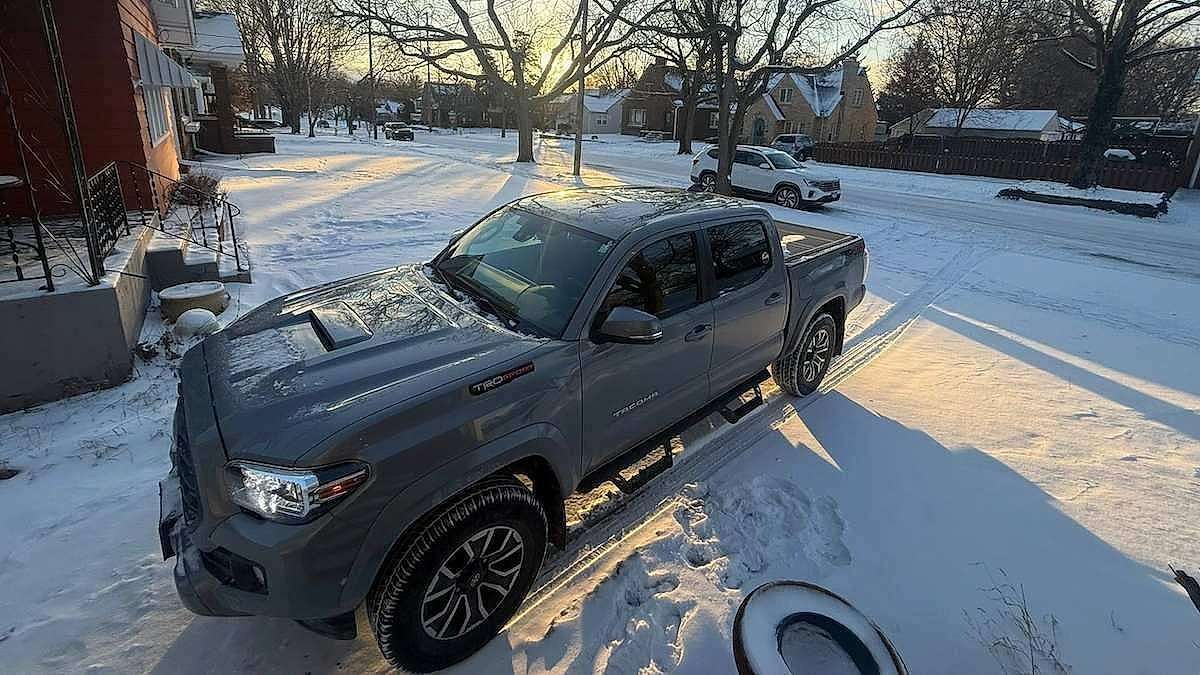
I’ve spent my entire life driving in the snow, and every time the first Colorado snow hits, I see the same heartbreak: a pristine Toyota Tacoma sitting in a ditch because the owner mistook "Go Power" for "Stop Power." It is a scene that plays out from the Eisenhower Tunnel to the neighborhood streets of Parker, where I’ve watched capable rigs slide helplessly into curbs while their drivers look on in shock. There is a sinking feeling when you realize your $50,000 investment is now a wrecked sled headed straight for a tow truck.
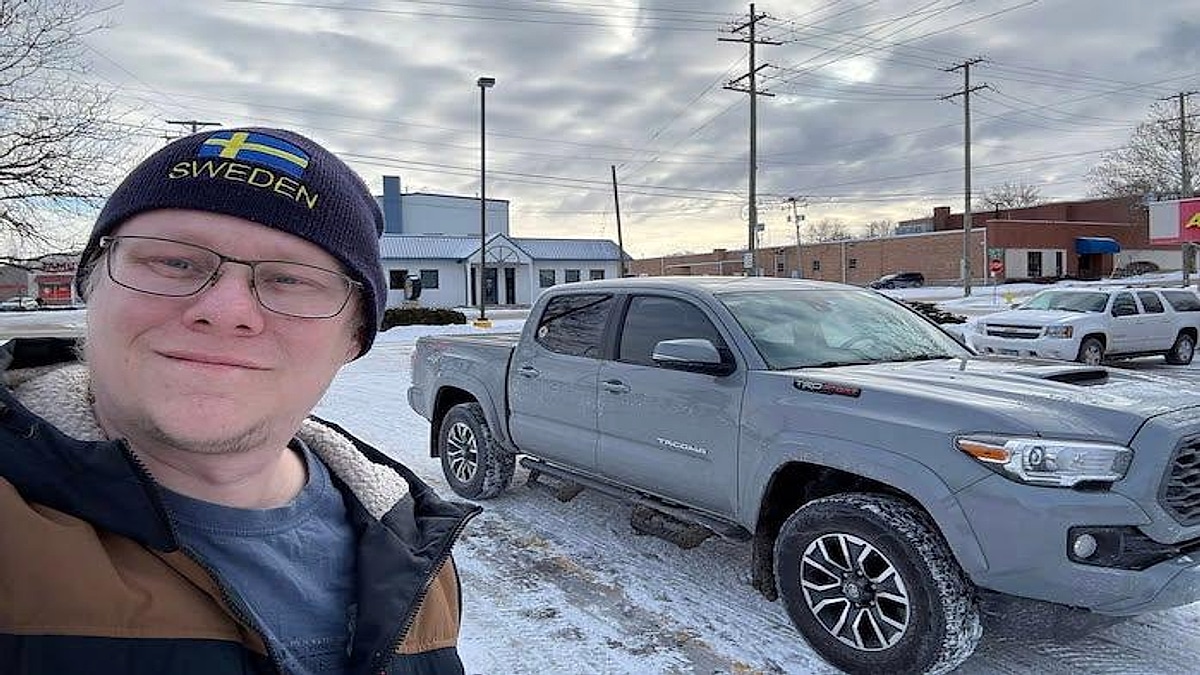
Over at the Taco Nation Facebook group, owner Brent Erickson Jr. from Illinois issued a plea to the community that every driver needs to hear: “To all my Taco drivers out there, remember even if we have 4x4s, still drive responsibly! 4x4 doesn’t mean 4-wheel stop. Our vehicles are too adorable to be totaled out or damaged!”
Here’s the industry secret nobody tells you at the dealership: 4x4 helps you get moving, but it does absolutely nothing to help you stop on black ice. In fact, that extra weight might even work against you. Over my 30 years of experience, I’ve seen countless drivers treated to a harsh lesson in physics. When you engage Four Wheel Drive, you essentially double your traction for acceleration, while your braking system remains identical to that of every other vehicle on the road.
Whether you drive a TRD Pro or a base Corolla, you still only have four contact patches with the pavement, and if those tires can’t grip, you aren’t stopping.
The "Why" Behind the Winter Drama
Why does this happen specifically to the Tacoma? As a reporter who has analyzed hundreds of owner experiences, I can tell you the "Taco" has a unique vulnerability in the snow. As a mid-size pickup, it exhibits a significant front-heavy weight bias. Without several hundred pounds of sandbags in the bed, the rear wheels have very little downward pressure. When you hit the brakes on a snowy descent, the weight shifts even further forward, often causing the rear end to lose its "anchor" and begin a dangerous fishtail.
Many owners believe their sophisticated Crawl Control or Multi Terrain Select systems are a safety net for highway driving. They aren't. Those tools are designed for low speed technical off-roading, not for navigating a slushy I-70 at 60 mph. Relying on tech instead of physics is a recipe for a totaled truck.
Brent's Not the Only One Concerned
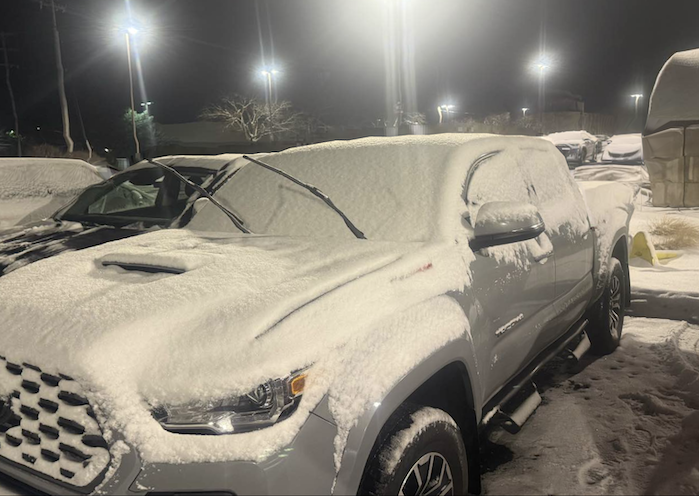
Community sentiment on Reddit echoes this "survivor tip" mentality, underscoring that even the best 4x4 system is secondary to tire choice and driver awareness.
One user on Reddit noted the severity of the situation, stating, "4x4 will obviously help to get moving, but I couldn't tell you how many times I've seen 4x4 trucks at the side of the ride stuck in a ditch after a snowstorm while I was cruising along fine in my Corolla."
Another owner highlighted the vulnerability of the design, mentioning, "A Tacoma is fine in snow, but fundamentally it's a pickup truck which is poorly weighted for snow handling. Throwing some sandbags in the back can offset that though," found in this Reddit thread.
My Recommendations
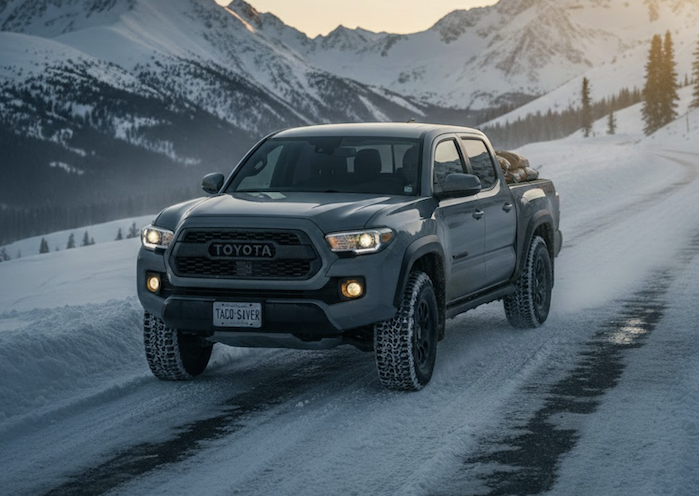
If you want to keep your Tacoma "adorable," as Brent said, and out of the body shop this winter, follow these steps I’ve curated from years of testing:
1. The 300-Pound Rule: Go to your local hardware store and buy six 50 pound bags of tube sand. Place them directly over or slightly behind the rear axle. This changes the center of gravity and gives your rear tires a fighting chance to grip during braking.
2. Ditch the "All Seasons": I don't care what the dealership told you. Factory "All Season" tires are actually "Three Season" tires. In temperatures below 45°F, the rubber compound in standard tires hardens like a hockey puck. Dedicated winter tires, such as the Blizzak DM-V2, remain soft and "bite" into the ice.
3. Engine Braking is Your Friend: Instead of slamming the brake pedal and triggering ABS (which can increase stopping distance on loose snow), use your transmission to downshift. This uses the engine's compression to slow all four wheels evenly, preventing a lockup.
4. The "Texture" Test: Early in your drive, when it is safe and no one is behind you, give the brakes a firm tap at low speed. This tells you exactly how much "bite" you actually have before you find out the hard way at a red light.
Here's a tip you may not know: The colder the temperature, the better grip and traction you'll have. As temperatures warm up, you need to be even more cautious.
Key Takeaways for My Readers
- 4x4 is for Momentum, Not Management: It helps you get out of the driveway, but it won't help you navigate a corner on ice.
- Weight Matters: An empty truck bed is a liability in a blizzard.
- Tires Over Tech: No amount of computer logic can override a lack of mechanical grip.
- Adorable isn't Invincible: The Tacoma is rugged, but its frame and body panels are expensive to repair. Protect your investment by respecting the limits of physics.
4x4 Is Not a Magic Braking Shield
Driving a Tacoma in winter should be empowering, not nerve-wracking. By understanding that your 4x4 system is a tool for propulsion rather than a magical braking shield, you can avoid the common pitfalls that lead to insurance claims and heartache. Take the time to prep your truck with the right tires and proper ballast, and remember that being the "coolest" truck on the road doesn't mean much if you're upside down in a snowbank.
It's Your Turn: Have you ever had a "close call" where your 4x4 gave you a false sense of security in the snow? What is your go-to winter setup for your Tacoma? Leave a comment in the red "Add new comment" link below.
About The Author
Denis Flierl is a 14-year Senior Reporter at Torque News and a member of the Rocky Mountain Automotive Press (RMAP) with 30+ years of industry experience. Based in Parker, Colorado, Denis leverages the Rockies' high-altitude terrain as a rigorous testing ground to provide "boots-on-the-ground" analysis for readers across the Rocky Mountain region, California EV corridors, the Northeast, Texas truck markets, and Midwest agricultural zones. A former professional test driver and consultant for Ford, GM, Ram, Toyota, and Tesla, he delivers data-backed insights on reliability and market shifts. Denis cuts through the noise to provide national audiences with the real-world reporting today’s landscape demands. Connect with Denis: Find him on LinkedIn, X @DenisFlierl, @WorldsCoolestRides, Facebook, and Instagram.
Photo credit: Denis Flierl via Brent Erickson Jr.
Set Torque News as Preferred Source on Google
Follow us today...


Comments
Hi. I've have found that…
Permalink
Hi. I've have found that the BF GOODRICH all terrain. TA tires worked best for me in the winter and during rainy weather. And usually keep the extra weight in the bed all year.
I recently bought a 2017…
Permalink
I recently bought a 2017 Taco TRD Sport. I already noticed the stopping problem with it after we got some light snow here in Lansing Michigan. I've been driving on snow ever since I was 15, I'm 70 now and this is my first 4x4. The same with taking off from a traffic light. Thanks for the advice on putting weight in the bed. I've had several two wheel drive trucks over the years and always added weight in the back for traction and I'll be doing it with my taco from now on.
And in other surprising news…
Permalink
And in other surprising news, water is wet and the earth is more or less a sphere which orbits the sun once per 365.25 rotations.
I appreciate you laying out…
Permalink
I appreciate you laying out the common sense winter driving wisdom. I am CA coastal transported to the PNW and learned to drive on Mtn/Winter conditions from an East Coast skier once my son took up competitive skiing at Mt Hood.
When the E Coaster learned to drive there weren't fancy tire compounds. Distance between you and the other car or turn are key. Momentum is your friend, acceleration and braking are your enemies. Slow and subtle movements both help you maintain contact and control.
The sandbags or weight in the bed are definitely key for trucks in winter driving conditions. So many observed fishtails due to unbalanced weight distribution.
And I second 4WD is for go and there is no 4WD or AWD stop.
I don't drive a Taco, but have a Subie with all weather tires. All weather or snow tires help but are no substitute for safe driving.
I wish state DOT would push articles likes they or put out their own public service announcements to educate people on winter driving techniques.