
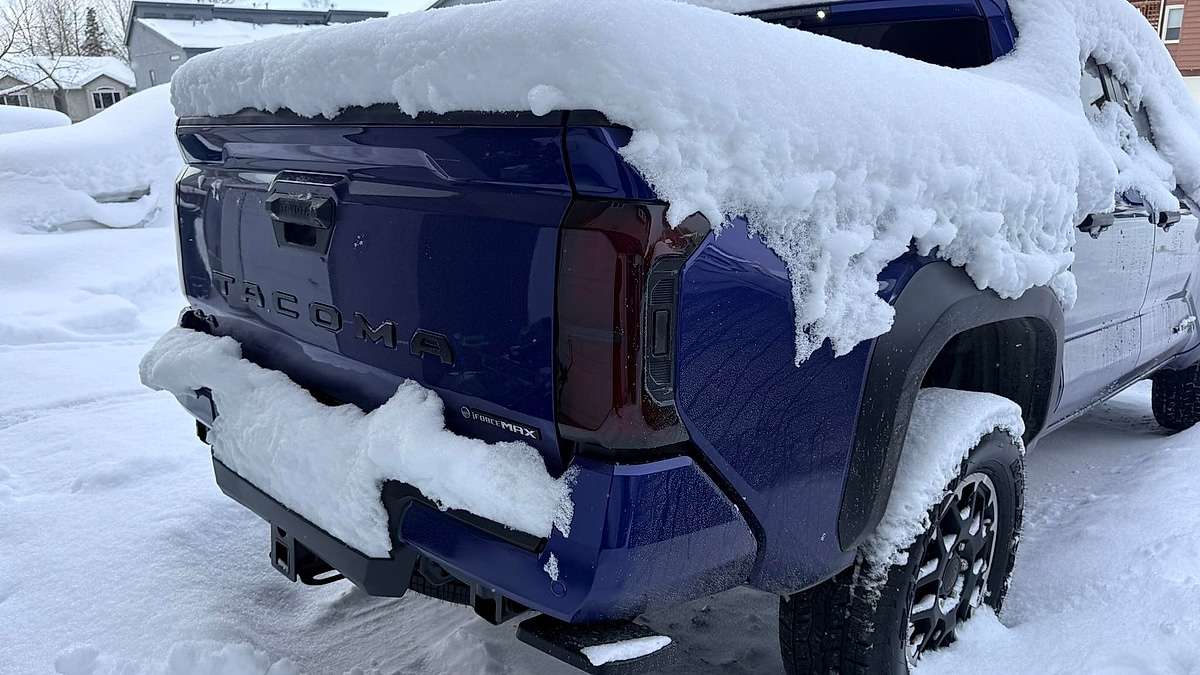

Abby San-Pridgen, a new owner of a 4th-generation Toyota Tacoma, found her truck's tailgate completely inoperable after several days of freezing temperatures. Despite attempting both power and manual releases, the tailgate remained "frozen Shut," rendering the truck's primary utility feature useless.
This experience shows a recurring design oversight in modern pickup trucks, particularly when integrated with aftermarket or factory tonneau covers. What should be a robust, all-weather workhorse becomes a frustrating impediment, forcing Tacoma owners into workarounds for a problem that should have been engineered out of existence. The expectation of reliability in diverse climates, a hallmark of the Toyota brand, is directly challenged by such basic failures.
The 4th Generation Toyota Tacoma's tailgate design, especially when paired with a tonneau cover, is demonstrably inadequate for cold-weather operation, forcing owners into impractical solutions for a fundamental utility feature.
"My Tacoma has been sitting for days with freezing temperatures. Now that it’s warming up, I wanted to load up. I cannot get my tailgate to open. It’s frozen Shut. I tried power and manual. Nothing works. It’s such an inconvenience. Does anyone experience the same issue?"
San-Pridgen's frustration is palpable, and it's a sentiment echoed by countless truck owners who expect their vehicles to perform reliably in all conditions.
Toyota Tacoma: Cold-Weather Tailgate Concerns
- The 4th Generation Toyota Tacoma, introduced for the 2024 model year, features a redesigned chassis and powertrain, including a standard 2.4-liter turbocharged i-Force engine. Its tailgate is equipped with both power and manual release mechanisms, designed for versatile cargo access. The tailgate freezes shut in temperatures below freezing, particularly when a tonneau cover is installed. This suggests a design flaw in the sealing or clearance between the tailgate and the cover, allowing ice to bind the components.
- The problem is not unique to Toyota but is exacerbated in designs where the tailgate's top edge or latch mechanism becomes an ice trap when combined with a tonneau cover. This can render the bed inaccessible without manual intervention or thawing.
- Solutions employed by owners, such as using a snow brush to break ice or running the truck through a car wash, show the absence of an effective factory-engineered solution. This points to a need for revised tonneau cover designs or improved tailgate sealing for cold climates.
The fact that neither the power nor the manual release could overcome the ice buildup points to a significant design vulnerability. This is about basic functionality failing under conditions that many parts of the country experience annually.
The discussion that followed San-Pridgen's post quickly zeroed in on the likely culprit. Dare Doerfler, another owner, offered a solution born of a similar experience: "If you have a tonneau cover, it's probably frozen to it on the top lip. Happens to me quite frequently. I use the non-brush end of my snowbrush to separate the two....just a thought." This is a concession that a modern pickup truck requires a household item to function after a cold snap.
San-Pridgen confirmed Doerfler's suspicion, stating, "I figured it’ll be the tonneau cover. I had to run it through a quick wash just to get it working again. This is probably the one thing I hate about this truck." The solution, a car wash, is both absurd and telling. It reveals a design that fails to account for the most basic interaction between common accessories and environmental conditions. Toyota sells these trucks with tonneau covers, either factory-installed or as dealer options, yet the integration appears to be an afterthought in cold climates.
This is where the engineering decisions become questionable. A tailgate is a critical access point. If its operation is compromised by ice forming between it and a tonneau cover, then either the cover's design, the tailgate's sealing, or the release mechanism's robustness is fundamentally flawed. Owners resort to car washes or snow brushes to operate a basic feature.
The 4th Generation Toyota Tacoma's susceptibility to frozen tailgates, particularly when fitted with a tonneau cover, is an unacceptable lapse in design and validation. Toyota markets the Tacoma as a rugged, capable truck, yet its functionality is compromised by common winter conditions and a popular accessory. This is a failure to deliver on the fundamental promise of a pickup truck that should work reliably, regardless of the weather. Owners should not be forced to choose between cargo security and tailgate access, nor should they need to visit a car wash to thaw a basic mechanical function.
This experience shows a recurring design oversight in modern pickup trucks, which include the Tacoma, particularly when integrated with aftermarket or factory tonneau covers. What should be a robust, all-weather workhorse becomes a frustrating impediment, forcing owners into workarounds for a problem that should have been engineered out of existence. The expectation of reliability in diverse climates, a hallmark of the Toyota brand, is directly challenged by such basic failures.
This persistent issue reveals a broader trend where, despite advancements in powertrain and infotainment, fundamental usability in challenging conditions remains an Achilles' heel for many new truck models. Indeed, industry analysts, including those at J.D. Power, have noted a slight but consistent uptick in "design-related" customer complaints for new trucks in their initial quality surveys released this past week, often citing features like tonneau covers and tailgate mechanisms as common pain points, suggesting manufacturers are still struggling to balance innovation with robust, all-weather functionality.
This pattern indicates that while engineering prowess is evident, real-world owner experiences in varied climates are sometimes overlooked in the rush to market, directly impacting brand perception for reliability.
Image Sources: Toyota Media Center
About The Author
Noah Washington is an automotive journalist based in Atlanta, Georgia, covering sports cars, luxury vehicles, and performance culture. His reporting focuses on explaining the engineering, design philosophy, and real-world ownership experience behind modern vehicles.
Noah has been immersed in the automotive world since his early teens, attending industry events and following the enthusiast communities that shape how cars are built and driven today. His work blends industry insight with enthusiastic storytelling, helping readers understand not just what a car is, but why it matters.
Noah is also a member of the Southeast Automotive Media Association (SAMA), a professional organization for automotive journalists and industry media in the Southeast.
His coverage regularly explores sports cars, luxury vehicles, and performance-driven segments of the automotive industry, including the evolving culture surrounding Formula Drift and enthusiast builds.
Read more of Noah's work on his author profile page.
You can also follow Noah here:
Set Torque News as Preferred Source on Google
Follow us today...



Comments
When you are in sub zero…
Permalink
When you are in sub zero temperatures after a snow and ice storm its to be expected if you have a cover on your truck.
It happened to me and I have a manual release for my tail gate.
Unfortunately you can't beat mother nature