

Key Points
- The Coverage Gap: State minimum liability limits (often $25,000) are no longer sufficient to cover modern trucks like the 2025 Tundra, which often exceed $60,000 in value.
- The Subrogation Strategy: Experts recommend filing through your own insurance first; your carrier will pay for repairs immediately and then pursue the underinsured driver to recover the costs.
- Recovering Lost Value: Beyond physical repairs, owners of new vehicles should file a Diminished Value Claim to recoup the thousands of dollars in resale value lost due to an accident appearing on the vehicle's history.
When you buy a new truck, especially something like a Toyota Tundra, you expect the normal responsibilities that come with ownership. Oil changes. Insurance payments. Maybe the occasional tire replacement. Yet, what most owners do not expect is walking outside in the morning, ready for work, and finding their nearly new truck damaged while it sat parked overnight.
That is exactly what happened to Jordan Taylor, who shared his experience last night in the 2023 to 2026 Toyota Tundra Owners community. Within hours, his post began drawing attention. By the time this article was written, it had already received more than 629 responses, which tells you something important right away.
Situations like this are more common than people think, and they raise questions that many drivers do not consider until the moment they face them.
“I Woke Up and Walked Out to See This”
Jordan described the moment in a way many vehicle owners can instantly imagine.
He wrote:
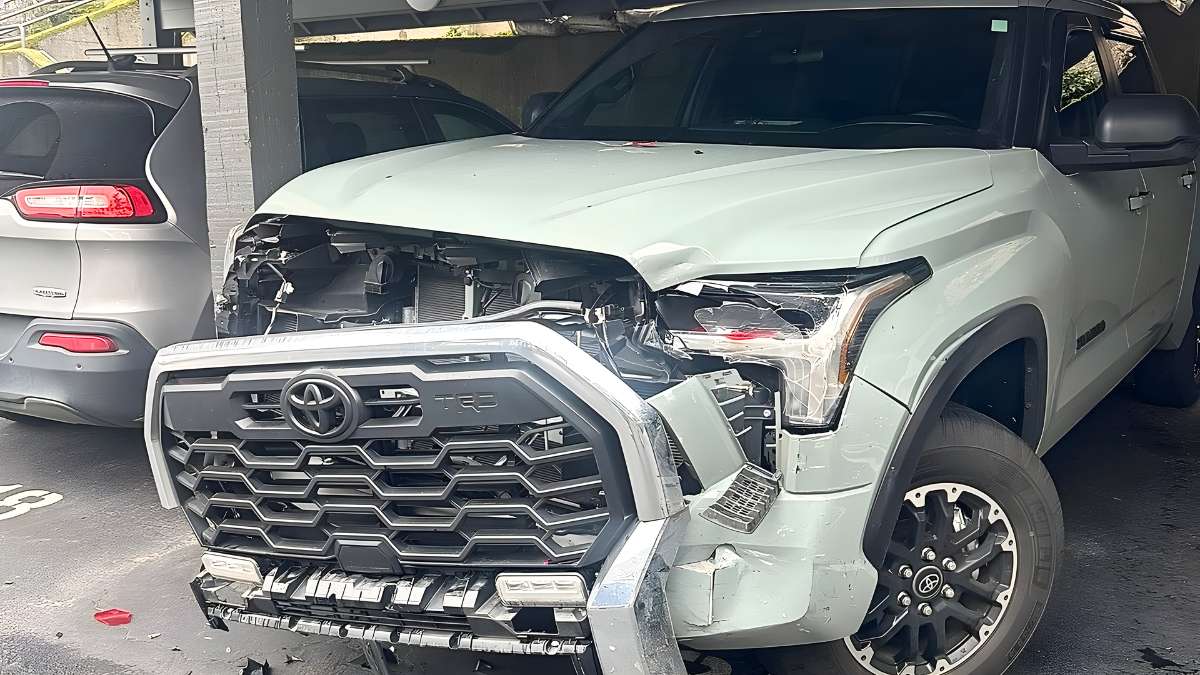
“How many have gone through this situation or similar and how was the outcome. My 2025 TRD Tundra off road, which only has 10k miles on it, was hit while it was parked. Woke up to go to work and walked out to see this.”
He included photos showing the front of his 2025 Toyota Tundra TRD Off Road with the grille severely damaged and partially detached.
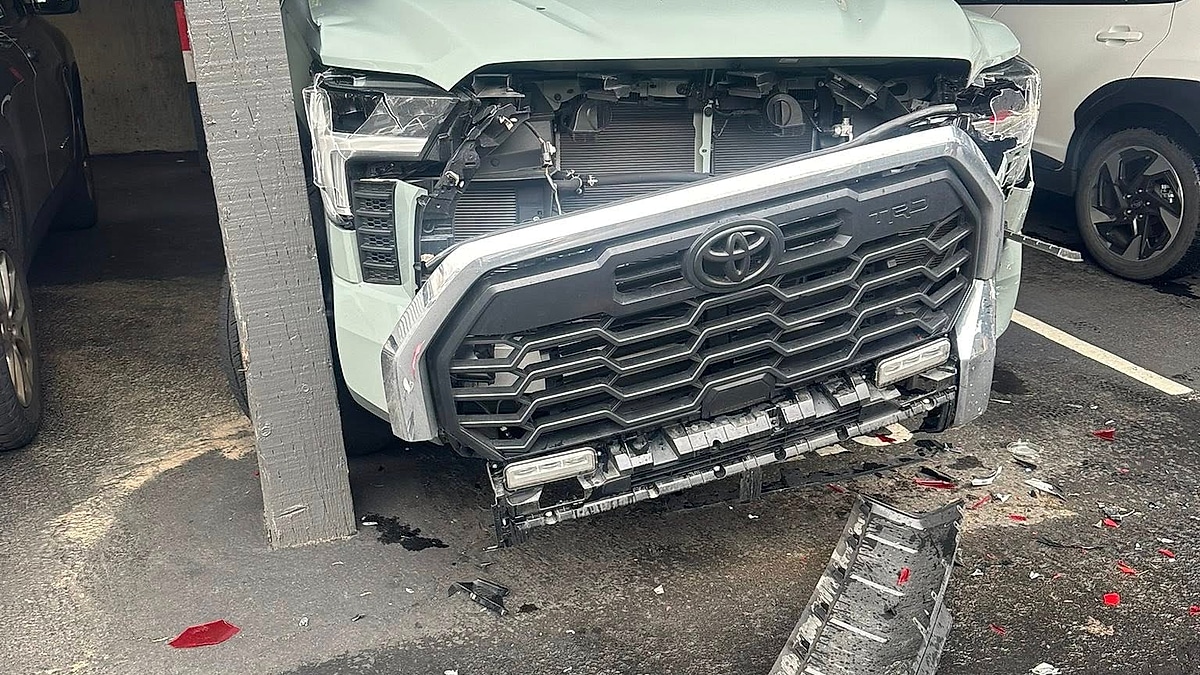
The truck had only about 10,000 miles, meaning it was still very much a new vehicle.
There was one detail that immediately changed the tone of the story.
“The lady stayed and police came so only positive.”
Anyone who has covered automotive stories long enough knows that hit and run cases happen regularly. Drivers return to find damaged vehicles and no information about who caused it. In that sense, Jordan’s case had one positive element from the start.
But the situation quickly became more complicated.
Jordan added an update that sparked a lot of discussion among truck owners.
“The lady's insurance only covers up to 25k so they are saying they have to use my insurance if it’s totaled or damage costing more then her limit etc. This is insane. We live in a world where someone destroys your truck you have to pay for it.”
That comment struck a nerve across the community.
Because this is where many drivers discover an uncomfortable reality about insurance coverage.
The $25,000 Insurance Limit Problem
In several states across the United States, the minimum liability insurance requirement can be surprisingly low.
According to data published by the Insurance Information Institute, some states still allow property damage coverage limits around $25,000.
Years ago that amount could cover the repair or replacement of many vehicles.
Today, with modern trucks like the 2025 Toyota Tundra often priced well above $60,000, that limit can quickly become insufficient.
In practical terms, this means the at fault driver’s insurance may pay up to the policy limit. After that, the remaining cost may need to be covered through other means such as the victim’s own insurance policy.
It can feel confusing at first, especially when you are the one who did nothing wrong.
That is where the conversation in the Tundra community became interesting.
Many owners began sharing real world advice.
Essential Roadmap For Protecting Your $60K Truck Investment
If you are hit by a driver with insufficient insurance, follow these steps to ensure you aren't left holding a $30,000+ repair bill:
- Activate Your Underinsured Motorist (UIM) Coverage: Immediately notify your insurer to trigger your UIM property damage clause. This covers the "gap" between the at-fault driver’s limit (e.g., $25k) and your truck’s actual value.
- Leverage Subrogation: File the claim through your own collision policy. Your insurer will pay for the repairs immediately and then use their legal team to "subrogate," pursuing the at-fault driver’s assets or bank accounts to recoup the costs and your deductible.
- Demand a Diminished Value Appraisal: Even a perfectly repaired Tundra is worth less because of its accident history. Hire an independent appraiser to document this "inherent diminished value" and file a third-party claim against the at-fault driver's insurance for this specific loss.
- Mandate OEM-Only Repairs: For a vehicle under 25,000 miles, insist on Original Equipment Manufacturer (OEM) parts. Using aftermarket components can jeopardize your factory warranty and further lower your resale value.
- Request a Total Loss Threshold Review: If repair estimates reach 70-75% of the truck's market value, push for a "Total Loss" designation. Modern ADAS (Advanced Driver Assistance Systems) and frame complexities often make high-mileage repairs less reliable than a full replacement.
Why Many Owners Say Use Your Own Insurance First
One of the first responses came from Daniel Diaz, who offered guidance based on his experience.
“Best thing to do in a situation like this is put it through your own insurance. They’ll go after the other people’s insurance and then their bank accounts or properties. Your insurance rate won’t go up if the accident was not your fault. Mine had less damage and it was totaled.”
That approach reflects how insurance subrogation works.
When you file through your own insurer, they pay the claim and then pursue reimbursement from the at fault party or their insurer.
This can sometimes move faster than negotiating directly with the other driver’s insurance company.
Another commenter, Derrek Holland, reinforced that idea.
“Call your insurance company. They represent you and their job is to make you whole. They will fix properly or total it and normally quicker than the other.”
This is a key distinction many drivers miss.
The other driver’s insurance company is primarily focused on minimizing the payout. Your insurer is contractually responsible for protecting your interests.
That difference alone can change how smoothly a claim proceeds.
Could the Truck Be Declared a Total Loss?
Some owners also raised another possibility.
Modern trucks are complex machines. Even damage that appears cosmetic can hide structural issues.
Catch Crab suggested asking for a detailed inspection.
“Ask for a full mechanical teardown and frame analysis printout. Toyota has really strict guidelines on repairs if the frame has damage.”
That point matters because manufacturers like Toyota have strict standards for frame repair. If the structure of a truck is compromised, insurers may decide it is safer and more economical to declare it a total loss.
In many states, vehicles approaching 75 percent of their value in repair costs can be classified as totaled.
This is why another commenter, Mark Steven Young, emphasized reviewing the insurance valuation carefully.
“Make sure you look at the entire market evaluation to ensure it’s accurate. They were missing a ton of features on mine and after some back and forth I got an additional $8,000.”
Market valuation disputes happen frequently after total loss claims. Optional equipment, trim packages, and condition adjustments can significantly change the payout.
The Often Overlooked Diminished Value Claim
Another topic that appeared in the conversation was something many drivers have never heard about.
Diminished value.
John Barron explained how it worked in his case.
“Just happened to my 2026 Tundra. 1,400 miles and $7,000 in damage. The person who hit me insurance covered it. Also I filed a diminished value claim so they had to send me a check for what value the truck lost with the accident on the Carfax.”
Even after repairs, a vehicle with an accident history may be worth less on the resale market. That lost value can sometimes be claimed from the at fault driver’s insurance.
Policies vary by state, but it is a conversation worth having if your vehicle suffers major damage.
Situations like Jordan’s also remind many truck buyers how important the initial purchase price can be. Some owners intentionally choose lower trim trucks so they are not financially stretched if something unexpected happens later. One buyer recently explained how he purchased a 2025 Toyota Tundra SR Double Cab 4x4 for under $40,000 and felt the base model offered everything he needed without a heavy payment burden.
While understanding that you are owed for lost resale value is the first step, actually getting a check from an insurance company is a different battle. To help you navigate the common 'lowball' tactics adjusters use, here is a professional breakdown of how to fight for your claim's true value.
One More Important Detail Many Owners Mentioned
Another response brought up a detail that can affect long term reliability and warranty coverage.
Mike Jarvis advised:
“Make sure the body shop is a Toyota shop and make sure they only use OEM parts. A lady ran into me too and they tried using aftermarket parts.”
This advice touches on a broader issue that often surfaces with modern vehicles.
Repairs done outside manufacturer guidelines can sometimes affect warranty claims later. Many dealerships recommend factory parts and certified repair procedures for that reason.
Another reason some owners prefer dealership level repairs involves long term warranty coverage. One Tundra owner recently shared how he traded his older V8 truck for a new hybrid powered model after discovering a dealer backed lifetime powertrain warranty that changed his entire perspective on ownership. If you want to understand how warranties can influence major truck decisions, take a look at this story about why a 2026 Toyota Tundra buyer traded a so called bulletproof V8 for a V6 hybrid after learning about a dealer backed lifetime warranty.
It is similar to issues seen in other vehicles, such as a case discussed by a repair professional involving a Honda Accord, where instrument cluster repairs ended up costing more after being handled outside dealership channels. In that case the technician explained that dealership repair options could have been less expensive and more compatible with the vehicle’s systems.
The lesson is simple.
Where a vehicle is repaired can matter almost as much as how it is repaired.
The Bigger Lesson in Jordan’s Story
Stories like this resonate because they remind us how quickly life can change.
One morning you are heading to work. The next you are dealing with insurance adjusters, repair estimates, and questions about liability limits.
Yet there is another angle worth reflecting on.
The driver who hit the truck stayed at the scene and cooperated with police.
That choice matters.
Accidents happen in life. What defines people afterward is often how they respond. Taking responsibility, staying present, and cooperating can prevent a difficult moment from becoming something much worse.
In a world where unchecked behavior can create bigger problems, accountability still carries real value.
Jordan’s experience also highlights something practical for every driver.
Review your insurance coverage before you ever need it.
Understanding liability limits, uninsured motorist coverage, and collision protection can make the difference between a stressful situation and a manageable one. Because once the damage happens, the policy you chose months or years earlier is the one that determines what happens next.
There is another financial angle many truck owners think about after an accident like this. Even if a vehicle is repaired properly, market value can change quickly. One Tundra owner recently said his 2025 truck lost nearly $30,000 in just nine months according to a dealership valuation, raising bigger questions about how trucks are priced and traded today.
What Has Been Your Experience?
Now I would like to hear from you.
Have you ever walked outside and found your vehicle damaged while it was parked? How did the insurance process play out for you? And if you drive a Toyota Tundra or another truck, have you ever filed a diminished value claim after an accident and did it make a difference in your final payout?
Share your experience in the comments below. Your story might help another driver navigate an unexpected situation more confidently.
Images by Jordan Taylor from his public post, referenced above.
About The Author
Armen Hareyan is the founder and Editor-in-Chief of Torque News and an automotive journalist with over 15 years of experience writing car reviews and industry news. Now based in the Charlotte region (Indian Land, SC, he founded Torque News in 2010, which since then has been publishing expert news and analysis about the automotive industry. He can be reached at Torque News on X, Linkedin, and Youtube. Armen holds three Masters Degrees, including an MBA, and has become one of the known voices in the industry, specializing in the landscape of electric vehicles and real-world stories of actual car owners. Armen focuses on providing readers with transparent, data-backed analysis bridging the gap of complex engineering and car buyer practicality. Armen frequently participates in automotive events throughout the United States, national and local car reveals and personally test-drives new vehicles every week. Armen has also been published as an automotive expert in publications like the Transit Tomorrow, discussing how will autonomous vehicles reshape the supply chain, and emerging technologies in vehicle maintenance.
Set Torque News as Preferred Source on Google
Follow us today...



Comments
In the covered wagon days,…
Permalink
In the covered wagon days, the 80 Corolla with its city bus bumper would not fold up like nothing like today's crash worthiness in Corolla. Same here. The old Hilux with its metal bumpers would rarely look like that, period even after battle.
Always get underinsured…
Permalink
Always get underinsured driver on you policy it very inexpensive.
That’s why I carry enough…
Permalink
That’s why I carry enough uninsured/under insured to cover everything in the event that happens.
You must have uninsured and…
Permalink
You must have uninsured and underinsured coverage on your policy. And get a dash cam if you don't have one. Garmin makes a good one.
Yes, yes and yes. I'm not a…
Permalink
In reply to You must have uninsured and… by Geno Watson (not verified)
Yes, yes and yes. I'm not a fan of the Garmin brand. I have been using Rexing dash cams for the last 6 years. At the bare minimum get a front and rear camera system. Honestly 4K doesn't really do much except use up excessive amounts of storage.
Is it easy to Bluetooth the…
Permalink
In reply to Yes, yes and yes. I'm not a… by Sean Sherburn (not verified)
Is it easy to Bluetooth the video from the Rexing to your phone at the scene while you are waiting on the police to arrive?
A 50k+ repair on a 60k truck…
Permalink
A 50k+ repair on a 60k truck? There’s an industry term for that… total loss.