
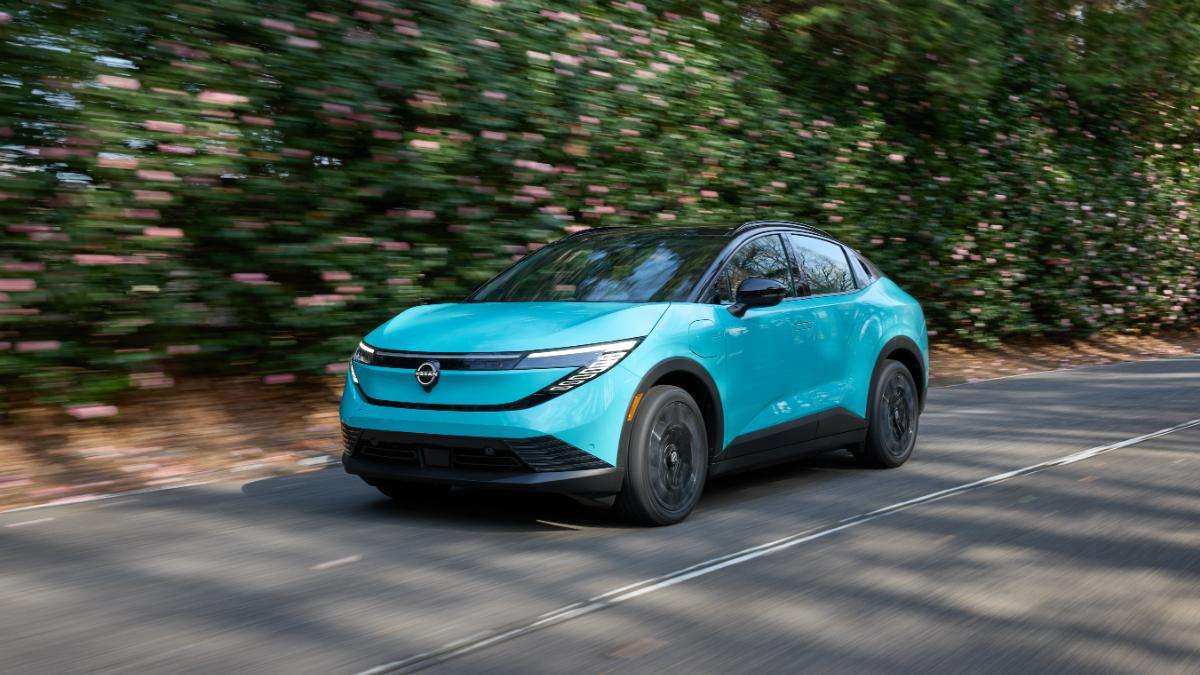

The often-cited benefits of electric vehicles typically revolve around environmental impact, lower running costs, or instant torque. Yet, for many drivers, the transition to an EV appears to offer a far more profound, and perhaps unexpected, advantage: a dramatic reduction in driving-related stress and road rage. This phenomenon, reported by numerous new EV owners, suggests that the quiet, smooth operation of electric powertrains might be recalibrating the very psychology of daily commuting.
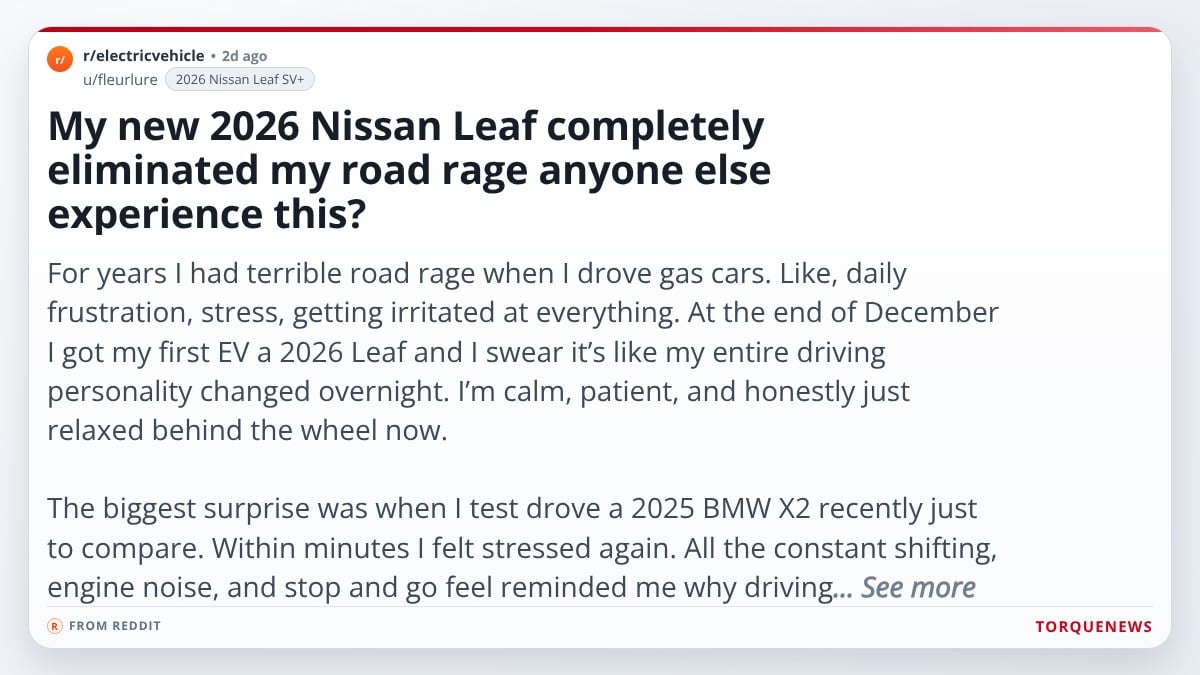
One such driver, posting under the handle "fleurlure" on the r/electricvehicles subreddit, recently shared their experience, stating:
"For years, I had terrible road rage when I drove gas cars. Like, daily frustration, stress, getting irritated at everything. At the end of December, I got my first EV, a 2026 Leaf, and I swear it’s like my entire driving personality changed overnight. I’m calm, patient, and honestly just relaxed behind the wheel now.
The biggest surprise was when I test-drove a 2025 BMW X2 recently, just to compare. Within minutes, I felt stressed again. All the constant shifting, engine noise, and stop-and-go feel reminded me of why driving used to wear me out mentally. I actually hated it and couldn’t wait to get back into my Leaf.
Has this happened to anyone else after switching to an EV? Did it change your mood or stress levels while driving?"
This sentiment resonates deeply within the EV community. The constant drone of an internal combustion engine, the subtle vibrations, and the mechanical lurch of gear changes are all subconscious stressors that accumulate over time. An EV, like the Nissan Leaf, by contrast, offers a serene cabin environment, a smooth, linear power delivery, and often, a simpler, more intuitive driving experience. It’s a fundamental shift from the mechanical symphony of an ICE vehicle to the near-silent glide of an electric one, and it clearly impacts driver temperament.
2026 Nissan Leaf SV+: A Deeper Look at Nissan's EV Evolution
- The 2026 Nissan Leaf SV+ represents the latest iteration of Nissan's pioneering mass-market electric vehicle, offering an enhanced battery and improved range over base models. This trim level typically includes a larger battery pack, providing a more competitive driving range suitable for longer commutes.
- Equipped with a 62 kWh battery, the SV+ model delivers an estimated EPA range of around 226 miles, a significant improvement over the standard Leaf's 40 kWh battery and 149-mile range. Its electric motor produces 214 horsepower and 250 lb-ft of torque, allowing for swift acceleration off the line.
- Nissan has consistently focused on affordability and practicality with the Leaf, making it an accessible entry point into EV ownership for many consumers. The 2026 model continues this tradition, balancing modern EV technology with a user-friendly package.
- The Leaf's e-Pedal system, which allows for one-pedal driving, contributes to a smoother and more intuitive driving experience, further reducing driver fatigue. This feature enables drivers to accelerate, decelerate, and stop using only the accelerator pedal, enhancing regenerative braking efficiency.
Commenter "Jabes" echoed this, stating: "I didn't really have any road rage, but I'm very happy to glide to my destination now. I do find myself not liking the rattle, shake, and roar of ICE-engined cars now. And I was a petrolhead with various fast german cars in my younger years..." This shows a critical point: even those without overt road rage find the EV experience superior. The rejection of traditional "petrolhead" sensations for quiet serenity suggests a maturation of driver preferences, prioritizing comfort and calm over the visceral, often aggressive, engagement of a performance ICE car. The industry's continued focus on engine noise as a performance metric now seems increasingly anachronistic.
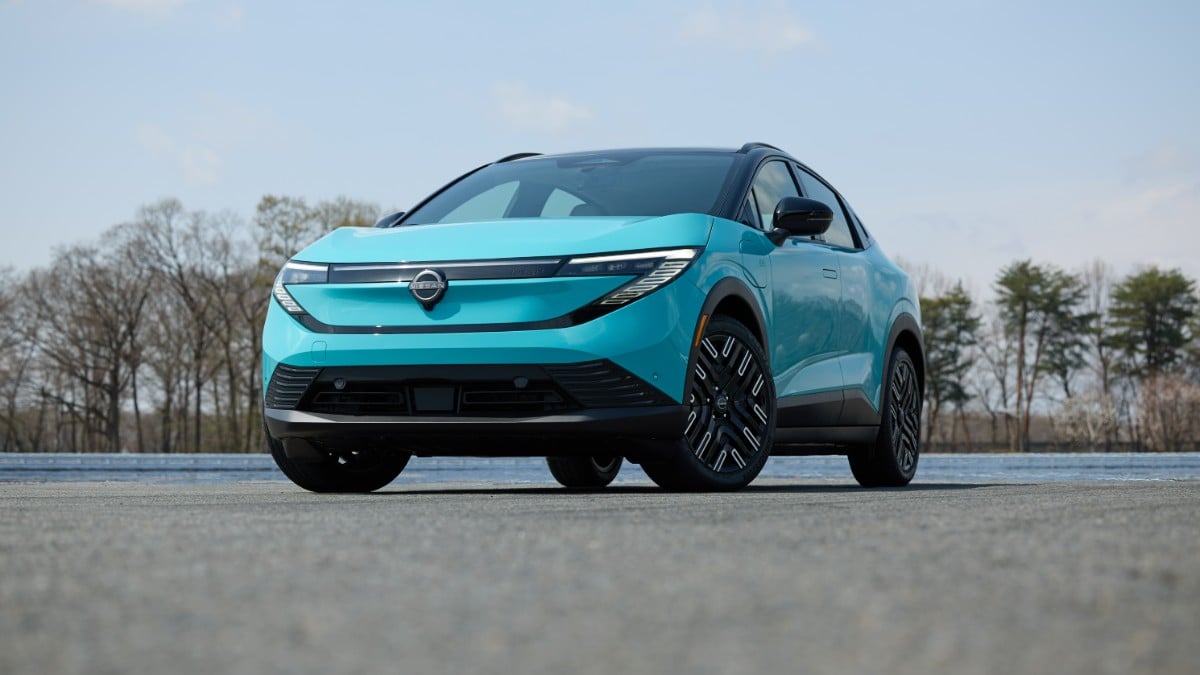
The quiet operation of an EV like the Leaf also seems to temper aggressive driving behaviors. "Ok-Mathematician8461" noted: "My EV (like many) is supercar fast - but I drive everywhere in a sedate and calm manner that I never did with ICE. I use the power for overtaking or a spirited drive on a deserted road, but my day-to-day driving just chilled out. I attribute this to not hearing the engine rev (and knowing I could take the flake with the noisy exhaust with a simple squeeze of the accelerator)." This is a fascinating psychological effect. The absence of aural feedback, the lack of a screaming engine note, appears to disconnect the driver from the primal urge for speed, even when the capability is readily available. It's a testament to how much sensory input influences our driving style.
However, not everyone finds this calming effect universal. "Jasped" offered a dissenting view: "lol no. I have mellowed out as I’ve gotten older, but I still get annoyed at a lot of drivers on the road and their unpredictable nature. Also, why do you have to be in the left-most lane on the highway going 5 under the speed limit with no one in the middle lanes???" This perspective is crucial, reminding us that vehicle type is not a panacea for all driving frustrations. While the EV might remove some internal stressors, the external environment – the unpredictable, often infuriating behavior of other drivers – remains a constant variable. No amount of electric serenity can fully insulate a driver from the realities of shared roadways.
The power of modern EVs can also be a double-edged sword, as "Electrik_Truk" pointed out: "Same, I've mellowed, but having a 550 hp truck that goes 0-60 in 3.5 seconds gets me in trouble sometimes. Literally the opposite effect of my old gas vehicles, which were slow by almost every metric. I loved my CRZ and Ranger, but if I was in road rage mode, pretty much anything smoked me lol. Now in the back of my head, I know I can be a real ass if I want... But for me, it's having a family in the vehicle that stops me from being an idiot these days, not the car." This comment reveals the immense performance potential of many EVs. While the quiet might promote calm, the sheer, effortless acceleration can tempt even the most sedate driver. It suggests that while the car might not provoke rage, its capabilities can certainly enable aggressive driving if the driver's internal discipline isn't strong.
This leads to a nuanced understanding of the EV's psychological impact. "FailsTheTuringTest" elaborated: "Our household has two EVs. When I drive our main car, the Volvo XC40, it’s very difficult for me not to drive…spiritedly? It’s just so effortlessly quick and smooth, it brings out my inner hooligan, and I do get impatient behind slower drivers in it. 400 hp will do that to you, I guess. On the other hand, our second, less-used car is a second-gen Leaf, and I tend to drive that car like a grandma. It feels more like a regular hatchback, although one with a lot of low-end torque if you need it. So I’m still quick off the line, but it just doesn’t inspire that go-go-go mentality in me." This distinction between different EV models is vital. A high-performance EV, even a quiet one, can still encourage aggressive driving due to its raw capability, much like a potent ICE sports car. The more sedate nature of a vehicle like the Leaf, despite its instant torque, seems to align better with a calmer driving style.
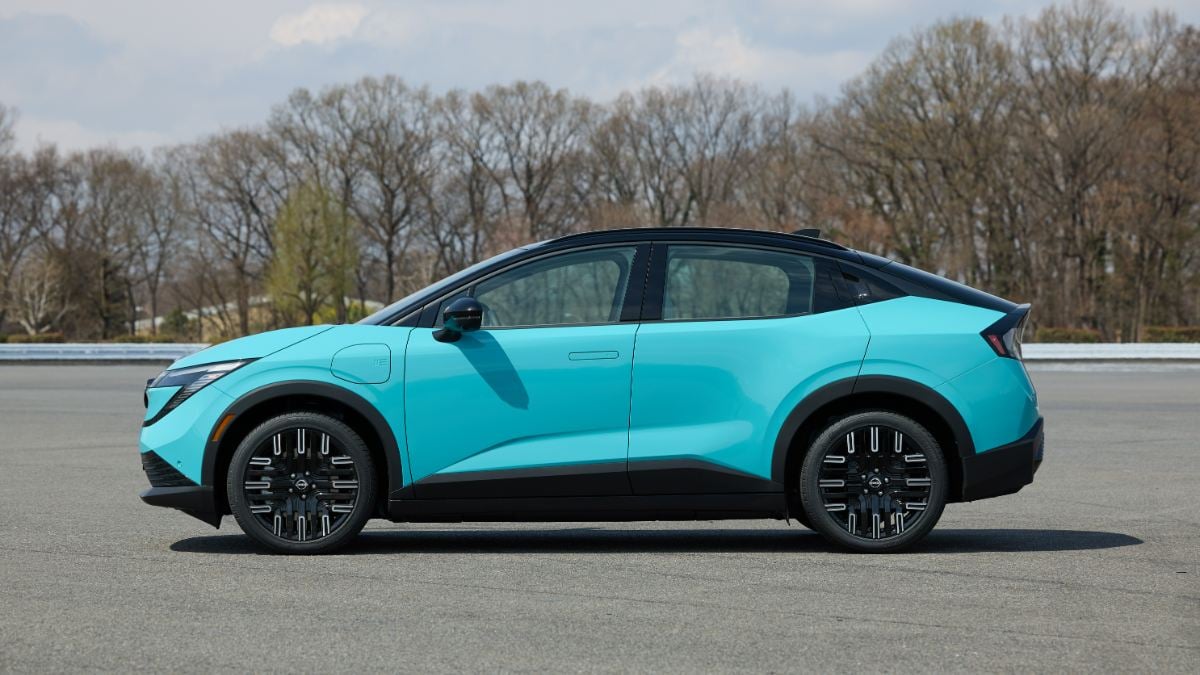
The core argument that EVs inherently reduce road rage is compelling, particularly when considering the sensory overload often associated with traditional vehicles. The constant mechanical noise, vibrations, and the need to manage gears all contribute to a heightened state of alert that can easily tip into frustration. EVs strip away much of this, creating a more tranquil environment that allows drivers to focus on the road without the constant internal combustion soundtrack.
The shift to electric propulsion appears to offer a significant, albeit often overlooked, benefit: a more peaceful and less stressful driving experience. While external factors and individual temperament will always play a role, the inherent characteristics of EVs, their quietness, smoothness, and effortless power delivery, are undeniably conducive to a calmer commute. This psychological advantage, far from being a mere byproduct, could become a key selling point for a new generation of drivers seeking sanctuary from the daily grind of traffic.
Image Sources: Nissan Media Center
Noah Washington is an automotive journalist based in Atlanta, Georgia. He enjoys covering the latest news in the automotive industry and conducting reviews on the latest cars. He has been in the automotive industry since 15 years old and has been featured in prominent automotive news sites. You can reach him on X and LinkedIn for tips and to follow his automotive coverage.
Set Torque News as Preferred Source on Google
Follow us today...






Comments
ou should really rethink the…
Permalink
You should really rethink the claims you're making here. ICE vehicles don't cause YOUR road rage. That's in your head....