
Let’s be honest, Nissan deserves more credit than it gets. Back in 2011, under the bold leadership of CEO Carlos Ghosn, they didn’t just talk about the future, they built it. I still remember attending one of their local LEAF launch events. It felt like stepping into a mini-Epcot center, buzzing with optimism and possibility.
Sure, the first LEAF wasn’t perfect. With just 73 miles of EPA-estimated range, it left a lot to be desired in real-world use. Despite the limitations, for its bet, Nissan received major awards like the 2011 European Car of the Year, World Car of the Year 2011, and Japan Car of the Year 2011-2012.
Now, 15 years later, the 2026 LEAF is evolved, but still seems to be chasing the high-water mark set by Tesla. I can only imagine where we would be today if Nissan had pushed the throttle forward and followed-on with a full line on EVs in the 2010’s.
Many social media posts are giving the 2025 LEAF a positive reception. Here’s a recent post on Reddit by tyfe with tons of comments:
“Actually looks really good, I’m surprised Nissan made something decent. This should sell well.”
JGRACEFAN95 responded with:
Advertising
“This could be the win that Nissan needs to keep going. I’m seeing a lot of the new Armadas and Kicks and this I bet will steal a lot of model Y sales.”
On another long Reddit thread, Razzburry_Pie posted:
“Highlights: 75 kWh battery (now with active thermal management, lol), 303 miles range, 215 hp...Has two charging ports…that can take 150 kW and do 10% to 85% in 35 minutes. Infotainment screens are fully Google-integrated. It's a good-looking small crossover now, the angular awkwardness is gone.”
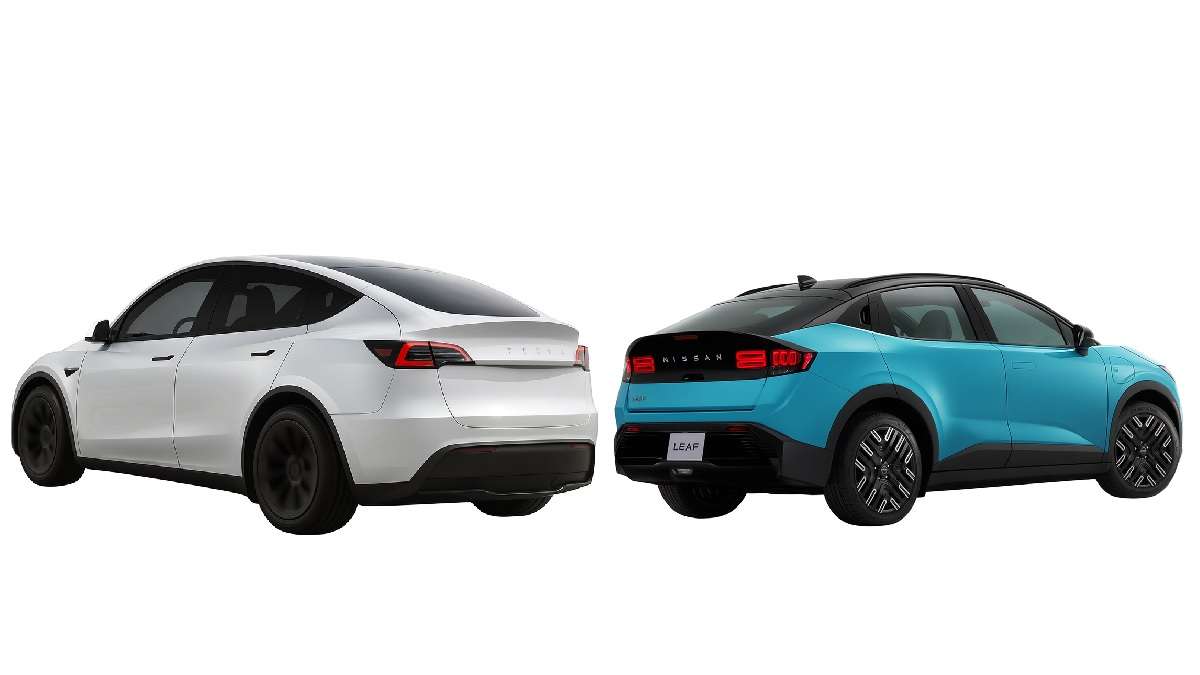
When I first saw the new 2026 Nissan LEAF, it looked familiar, almost exactly like something I’d seen before. It isn’t just a new LEAF, it’s a compact Tesla Model Y in disguise. Maybe it’s an intentional, smart design move.
Tesla didn’t just energize the electric vehicle category, it created a design language, a kind of EV shorthand we all now recognize as “the future.” It’s all about the minimalist interior, the smooth front end, and the glass roof. This raises a tough question: are brands like Nissan playing catch-up or giving people what they clearly want? It feels a little like watching a band cover a hit song, and wondering if the magic is in the new interpretation or the original tune. Either way, the LEAF’s transformation says a lot about where the EV market is headed, and who’s setting the tone.
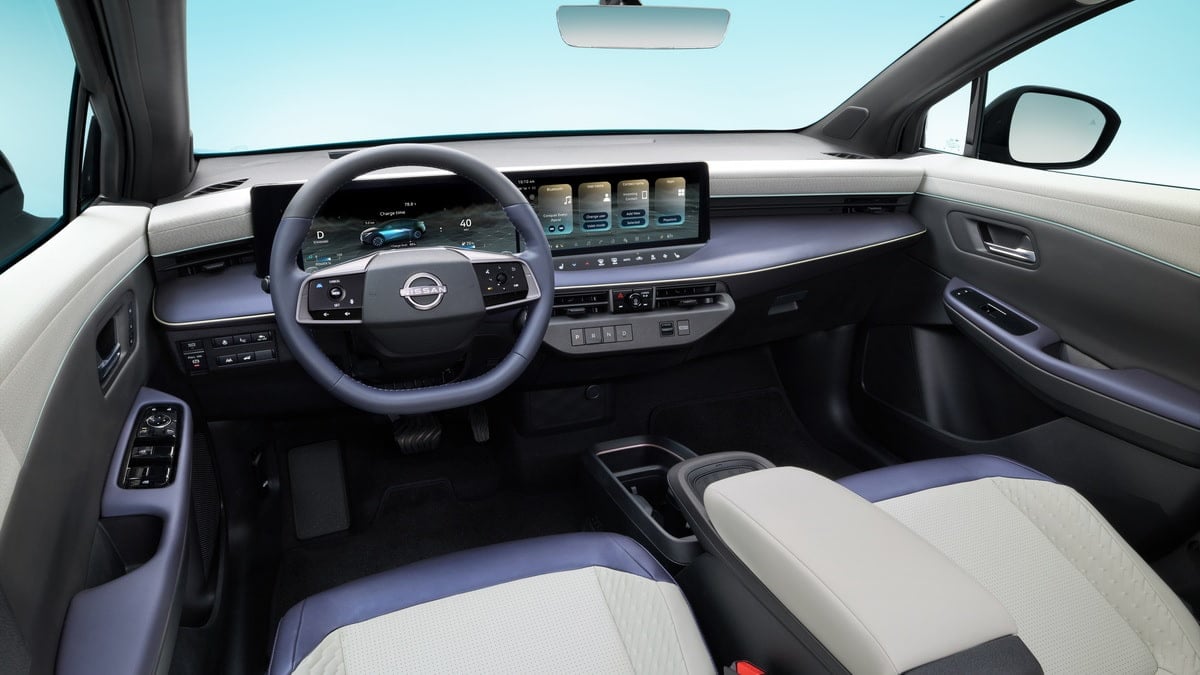
This latest iteration sees the LEAF transformed from a hatchback to a crossover SUV. Its new shape gives it a lower drag coefficient, but now resembles a Tesla Model Y, only smaller. In addition to its original J1772 charge port, it now has an added Tesla-style (NACS) port which gives it access to the Tesla Supercharger network. The top trim level offers 303 miles of range. Its minimalist and spacious interior along with a panoramic roof also suggests Tesla.
Nissan finally budged and moved on from the dying CHAdeMO charge port. For years, owning a LEAF meant living with a second-class charging experience and hunting for the elusive CHAdeMO stations, and hoping that they actually worked.
With the 2026 LEAF adding a Tesla-style NACS port, everything changes. Suddenly, it’s easier to charge. Nissan didn’t just update a port, they admitted something big. They admitted that the EV landscape has shifted, and the Tesla Supercharger network won. Now, LEAF owners can pull into a Supercharger station and plug in like everyone else, no adapters, no second-class citizen vibes. I can’t help but wonder what this means for the brands that are still holding out.
Please Drop Your Thoughts in the Comments Below
Were you around when the original Nissan LEAF launched? What do you remember about those early EV days?
What do you think would’ve happened if Nissan had followed through with a full EV lineup back in the early 2010s?
Chris Johnston is the author of SAE’s comprehensive book on electric vehicles, "The Arrival of The Electric Car." His coverage on Torque News focuses on electric vehicles. Chris has decades of product management experience in telematics, mobile computing, and wireless communications. Chris has a B.S. in electrical engineering from Purdue University and an MBA. He lives in Seattle. When not working, Chris enjoys restoring classic wooden boats, open water swimming, cycling and flying (as a private pilot). You can connect with Chris on LinkedIn and follow his work on X at ChrisJohnstonEV.
Image sources: AI, Nissan press kit
Set Torque News as Preferred Source on Google
Follow us today...