
Is the 2026 Tundra’s twin-turbo 'ticking time bomb' finally making the Nissan Titan the safer bet?"
I’ve spent 30 years in the automotive trenches, and if there’s one thing I know, it’s that a truck’s reputation is earned in the dirt, not the showroom. For years, the Toyota Tundra was the undisputed king of the "million-mile" club, while the Nissan Titan PRO-4X stood as the rugged, V8-powered alternative that refused to quit.
But as we roll into the 2026 model year, something has shifted, and not for the better.
In my research into Tundra reliability, I recently found Mark Cisco, a die-hard Titan owner who was ready to jump ship to Toyota. He told the Toyota Tundra Owners Facebook group, “I joined this group thinking my next truck would be a 2026 Toyota Tundra. But after reading these comments about the Tundra problems, I’m not so sure now. I have a 2015 Nissan Titan PRO-4X.” Source: Technical Discussion via Toyota Tundra Owners Community
From My View: Why the “Bulletproof” Toyota Badge is Rusting in 2026
Mark’s hesitation is well-founded, as outside experts have noted that the 3.4L twin-turbo V6 in the current-generation Tundra has been "hugely flawed" due to persistent machining debris that Toyota's initial recalls failed to fully resolve. Toyota ADMITS the Tundra has Engine Problems.
I have personally observed this crisis deepen, previously reporting that even the supposedly "fixed" replacement engines are failing, proving that the short-block remedy is simply not enough to restore long-term owner confidence.
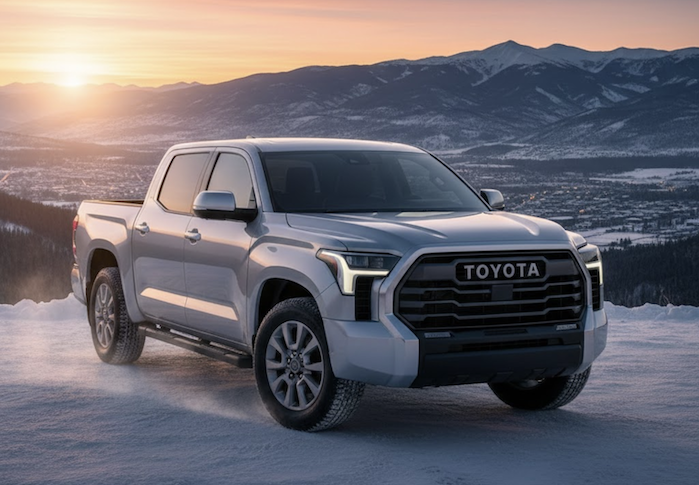
My Take: The $65,000 "Learning Curve"
Mark isn’t alone. I’m seeing a massive wave of "reliability refugees" fleeing the Tundra’s transition to a twin-turbo V6. From catastrophic main bearing failures to the dreaded "limp mode" in cold climates, the "bulletproof" Toyota badge is facing its greatest crisis since the frame-rust era. As a third-generation Colorado native who has seen how the thin air of the Rockies punishes forced-induction engines, I have to ask: Is Toyota trading its soul for MPG, and are you about to pay the $65,000 price for their "learning curve"?
The reality is that even vehicles produced well after the initial recalls are failing, with reports indicating that metal debris from the manufacturing process continues to contaminate oil passages and accelerate bearing wear. Toyota Tundra & Lexus Engine Recall | Lemon Law Experts.
I’ve highlighted the severity of this "machining debris" scandal before, exposing how some 2024 and 2025 owners are seeing their engines seize with as little as 2,000 miles on the odometer.
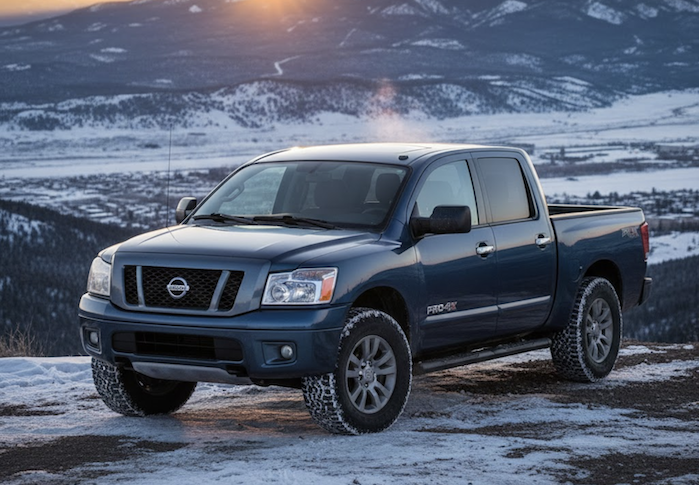
The Industry Secret: Machining Debris or Design Flaw?
The "Industry Secret" vibe here is that Toyota's "Machining Debris" explanation might just be the tip of the iceberg. While the company points to "swarf" (metal chips) left in the block, many veteran mechanics I talk to suspect a deeper controversy about the main bearing design. In the sub-zero winters of Parker, Colorado, "cold-start" bearing wear on these high-strung V6s is becoming a terrifying reality. When you combine tight tolerances with debris and high-altitude stress, you get a "ticking time bomb."
Independent teardowns are fueling this skepticism, with specialists noting that because "the main bearings and rod bearings share an oiling circuit, they should be equally damaged if leftover machining debris were the main cause," yet findings often show rod bearings remaining clean while main bearings are destroyed. Total BS: Engine Teardown Specialist Says Toyota's Explanation Doesn't Make Sense.
My own technical dives have raised similar red flags, specifically questioning why replacement long blocks, the supposed fix, are reportedly failing at the same alarming rates as the originals.
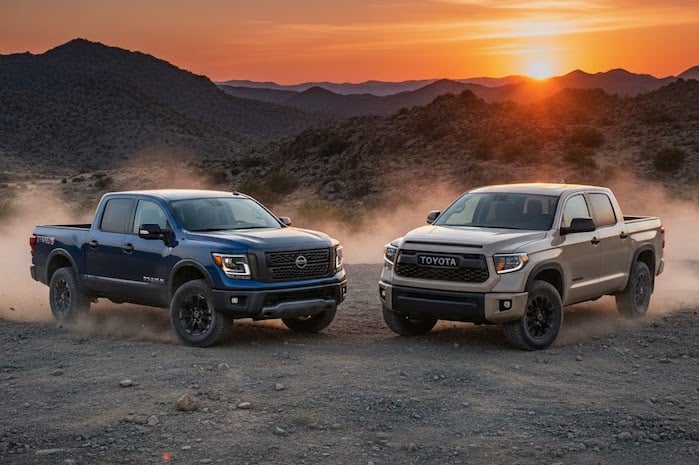
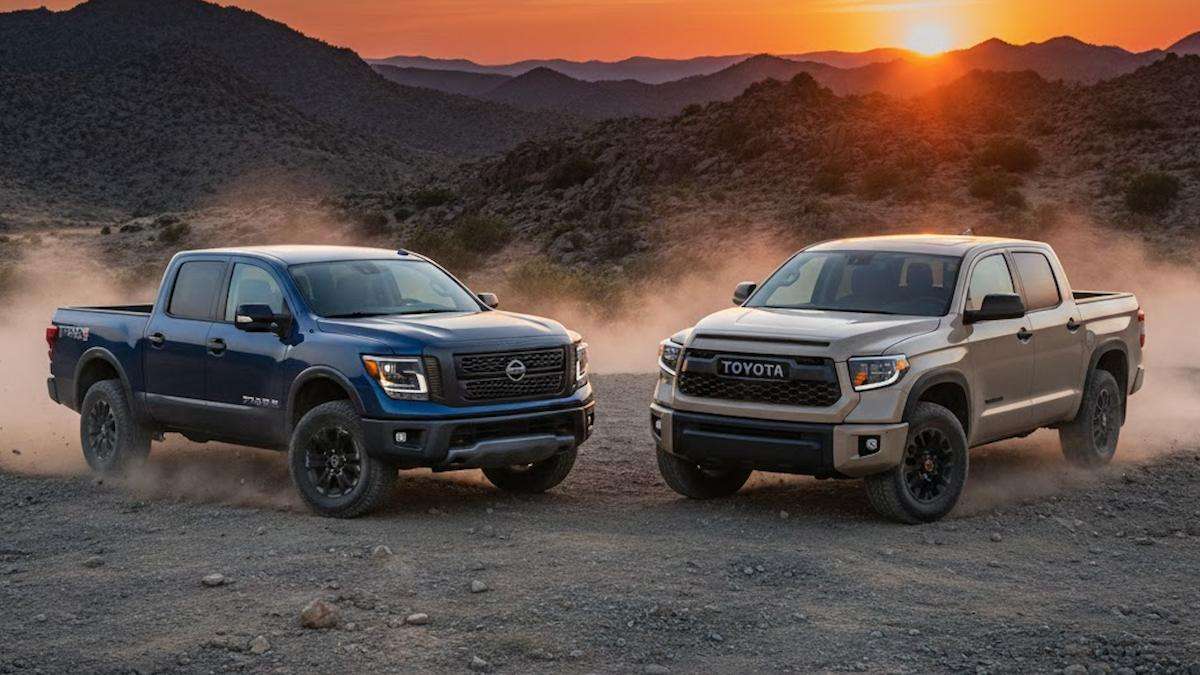
The Final Face-Off: 2024 Nissan Titan vs. 2026 Toyota Tundra
As a reporter who has watched the V8 era slowly fade into the sunset, comparing the final-run 2024 Nissan Titan to the 2026 Toyota Tundra isn't just a spec-sheet battle; it’s a clash of philosophies. On one side, you have the "Old Guard" Titan, a truck that offers a 5-year/100,000-mile bumper-to-bumper warranty, nearly double what Toyota currently provides. On the other hand, the 2026 Tundra is a high-tech gamble that trades the legendary V8 rumble for the complex "whistle" of twin turbos.
The Real-World Cost of Efficiency
We need to talk about what this means for your wallet. In my decades of covering auto news, the "Toyota Tax" that extra few thousand dollars you pay for the peace of mind is only worth it if the truck actually starts every morning. Right now, that 2026 Tundra is asking you to trust a sophisticated, twin-turbocharged, intercooled V6 that is under immense internal pressure. It’s a marvel of engineering for fuel economy, but engineering for the "EPA" is not the same as engineering for the "End User."
Contrast this with the Nissan Titan. While it’s true that Nissan is sunsetting the model, that 5.6L Endurance V8 is a known quantity. It doesn't have turbos to fail, it doesn't have a complex hybrid battery system to manage in 2026, and, most importantly, it isn't currently the subject of a multi-billion-dollar engine replacement campaign. When I talk to readers who tow heavy trailers through the Eisenhower Tunnel, they tell me they’d rather have the "thirsty" V8 that finishes the climb than the "efficient" V6 that ends up on a flatbed.
Community Technical Feedback
Community sentiment has shifted from loyal to let-down. One user on Reddit shared a harrowing experience with their brand-new truck, stating, "The vehicle has 2000km on it... suddenly the truck lost all power and my engine shut off... dealership said the engine got 'too cold' which caused the throttle body to stick," which you can follow in this 2026 Tundra failure discussion.
Another owner expressed total loss of faith, saying, "Toyota's continued excuses and lack of transparency have broken my faith in anything with this engine and eroded my trust in the brand," as noted in this Reddit thread about 2026 engines.
Key Takeaways for 2026 Buyers
- The V8 Advantage: The Nissan Titan's 5.6L V8 remains a "reliable veteran" compared to the Tundra's unproven twin-turbo V6.
- The 2,000-Mile Risk: Engines are seizing at shockingly low mileages, making a new purchase a significant financial gamble.
- Towing Matters: Trust a reporter who lives in the environment where these trucks are tested most, the Colorado Rockies.
- The "Swarf" Issue: Machining debris is still a factor in 2026, despite Toyota's multiple attempts to "wash" the problem away.
In The End
Toyota is at a crossroads, and for buyers like Mark Cisco, the path to a 2026 Tundra is blocked by mechanical landmines. Until Toyota can prove that the V35A engine can handle the long haul without "ticking," the aging but honest Nissan Titan might just be the smarter place to park your hard-earned money.
What Would You Do? Would you take the gamble on Toyota's tech or stick with the proven V8 power of the Titan? Let me know your thoughts and leave a comment in the red “Add new comment” link below.
Denis Flierl is a 14-year Senior Reporter at Torque News and a member of the Rocky Mountain Automotive Press (RMAP) with 30+ years of industry experience. Based in Parker, Colorado, Denis leverages the Rockies' high-altitude terrain as a rigorous testing ground to provide "boots-on-the-ground" analysis for readers across the Rocky Mountain region, California EV corridors, the Northeast, Texas truck markets, and Midwest agricultural zones.
A former professional test driver and consultant for Ford, GM, Ram, Toyota, and Tesla, he delivers data-backed insights on reliability and market shifts. Denis cuts through the noise to provide national audiences with the real-world reporting today’s landscape demands.
Connect with Denis: Find him on LinkedIn, X @DenisFlierl, @WorldsCoolestRides, Facebook, and Instagram.
Photo credit: Denis Flierl via Nissan, Toyota
Set Torque News as Preferred Source on Google
Follow us today...