

What you have here is one of the most useful counterweights to the internet’s usual EV discourse, which tends to fixate on early failures while ignoring what happens when a car is actually worked hard for years. This Hyundai Ioniq 5 story, backed up by scanner screenshots and real mileage, lands squarely in the category that matters most: evidence gathered the slow, unglamorous way, one ride at a time.
A 2022 Ioniq 5 SEL AWD with 273,310 miles is not a garage queen, nor a carefully curated long-term test. This is a rideshare car running five or six days a week, often from morning until midnight. That alone reframes every number shown on the diagnostic screens. Operating time north of 117 hours, cumulative energy discharge nearing 600 kWh, and a battery that has lived almost its entire life cycling rather than sitting all tell the same story. This car has been used as transportation, not a technology demo.
“22 Ioniq 5 SEL AWD, 273310 miles, at 271,0003 water pumps replaced, one went out the other week,$3400, at 249,000 replaced cooling fan and radiator, as it wobbled and destroyed $2900. No brakes yet.
I am not a tech, I am a Rideshare driver and d the car is still working 5 or 6 days a week from 9 am till midnight.
Here are pictures for you tech geniuses, from a scanner at 100% charge. The battery's state of health went up after repairs. How long will it stay up? I don’t know.”
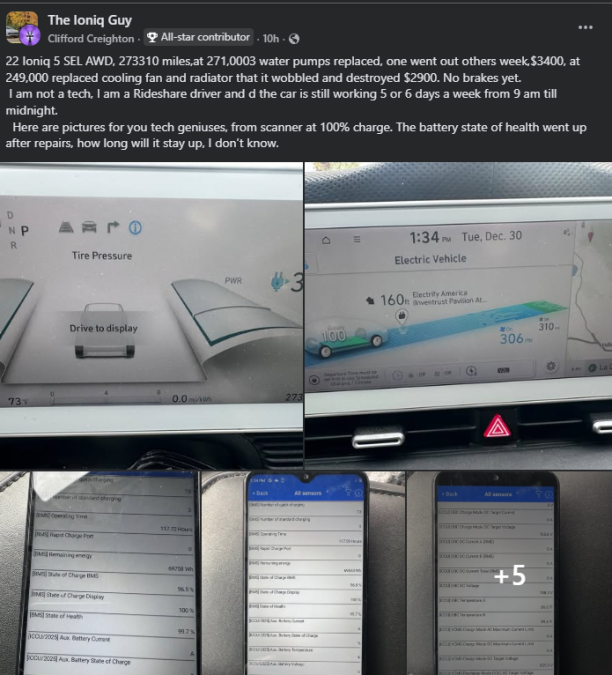
The traction battery data is the headline. Despite more than a quarter-million miles, the reported state of health sits around 99.7 percent, with commenters correctly noting that the effective usable capacity still translates to roughly 94 percent real-world SOH, which is exceptional by any standard. At this mileage, that equates to only a handful of miles lost from EPA range. For a high-regen, urban-heavy-duty cycle like rideshare work, that loss is functionally irrelevant. The battery is not just surviving, it is aging gracefully.
Hyundai Ioniq 5: Charging Speed and Long-Distance Usability
- The Ioniq 5’s long wheelbase and flat floor enable a spacious cabin relative to its exterior footprint, improving rear legroom and overall passenger comfort.
- Ride tuning favors compliance, allowing the suspension to absorb rough pavement effectively while maintaining composure at highway speeds.
- Interior controls mix physical buttons with touchscreen interfaces, reducing dependence on menus for climate and audio adjustments.
- Charging performance is a defining usability feature, with fast DC charging capability helping offset real-world range limitations on longer trips.
What has failed is equally important. Three water pumps by 271,000 miles, followed by a cooling fan and radiator assembly after wobble-induced damage, add up to about $6,300 in repairs. That is real money, and it deserves to be acknowledged plainly. But context matters. Those costs arrived after hundreds of thousands of miles of commercial use, and they are tied almost entirely to thermal management hardware rather than the battery itself. The high-voltage system, inverter, and pack remain intact and healthy.
The absence of brake replacement is another quiet but telling detail. Regenerative braking is not an abstract benefit here. It is measurable savings realized over hundreds of thousands of stop-and-go miles. The same applies to drivetrain wear. There are no transmissions, torque converters, or timing chains lurking in the maintenance log. The car keeps moving because there is simply less to wear out in daily operation.
Equally notable is what did not happen. No ICCU failures for the Ioniq 5. Only two 12-volt battery replacements across nearly nonstop operation. That lines up with an underappreciated EV reality: cars that are driven constantly tend to treat their auxiliary systems better than cars that sit. Heat cycles, charging regularity, and continuous DC-to-DC operation are often kinder than long idle periods.
The scanner screenshots themselves reinforce this story. Isolation resistance remains high. Cell voltage spread appears well controlled. Maximum cell voltage sits at a reasonable 4.1 volts. Coolant temperatures are stable. These are not the numbers of a battery being held together by software optimism. They reflect a pack operating within its design envelope, even deep into its service life.
There is a philosophical tension running through the comments, particularly the idea that the owner has “spent what the car is worth” in repairs. That framing misses the point. For a rideshare driver, the vehicle is not an asset to be flipped. It is a tool that converts uptime into income. Measured that way, the Ioniq 5 has already paid for itself several times over, even after accounting for cooling system repairs.
The broader takeaway is not that the Ioniq 5 is perfect, nor that every EV will age this way. It is that high-mileage reality looks very different from early-failure anecdotes. Batteries do not appear to be the ticking time bombs they are often portrayed as. Instead, ancillary systems like pumps, fans, and cooling hardware emerge as the long-term wear items, much like alternators and water pumps once were in combustion cars.
If there is a quiet lesson here, it is that EV longevity is less about avoiding miles and more about managing heat and usage patterns. This car has lived a hard life, but a consistent one. And at 273,000 miles, the most expensive and anxiety-inducing component of all still looks ready to keep going. That is not a promise of one million miles, but it is strong evidence that the conversation around EV durability is overdue for recalibration.
Image Sources: Hyundai Media Center
Noah Washington is an automotive journalist based in Atlanta, Georgia. He enjoys covering the latest news in the automotive industry and conducting reviews on the latest cars. He has been in the automotive industry since 15 years old and has been featured in prominent automotive news sites. You can reach him on X and LinkedIn for tips and to follow his automotive coverage.
Set Torque News as Preferred Source on Google
Follow us today...







Comments
The miles don't matter, the…
Permalink
The miles don't matter, the battery age does, since the car is from 2022, you have until 2027 to have no problem
My 2014 Prius C and V, still…
Permalink
In reply to The miles don't matter, the… by Paul (not verified)
My 2014 Prius C and V, still going with no real change in mileage etc. NiMH batteries in both vehicles. My 2025 Hyundai Tucson Ultimate PHEV has Lithium ion and consistently gives me the 53km range expected an up to 57km sometimes. It's just a year old so time will tell, however warranty is 8 years on the traction battery and components. Both Prius have never had front brakes done and the V had rear brakes done at 150000km, the C still no brakes needed although mileage is just 120000km. Other maintenance just regular oil changes and required servicing, one software recall and the 12 volt AGM battery replaced at 10 years. Very low cost of ownership.
Wow... You really suck at…
Permalink
Wow... You really suck at math.
117 hours is just shy of 5 days.
273,000 miles divided by 120 hours means that the driver averaged 2277 miles per hour.
Are you an idiot? That's nearly 3 times the speed of sound.
600kWh. Again, are you dense? On my EV, 670kWh is 2400 miles.
You're off by 2 orders of magnitude in both stats.
You should go back to highschool.
Yes, it is good to see that…
Permalink
Yes, it is good to see that high frequent use is doing well with many EVs.
As early preliminary data suggested, time not milage is the bigger concern for most EV drive (main) batteries.
In this aspect, a vehicle with a higher usable range can tolerate a larger battery degradation over time and still be usable before needing replacement.
Starting with a vehicle that has near 100 or even less initial range, greatly reduces the usability as the battery degrades 10%, 20%, or more. But, if you start with a 400 mile range, even a 50% degradation factor is still a very usable range!
EVs are not for everyone, or every application. But, longer range batteries, and more common charging locations are helping to make EVs meet the needs of more people.