
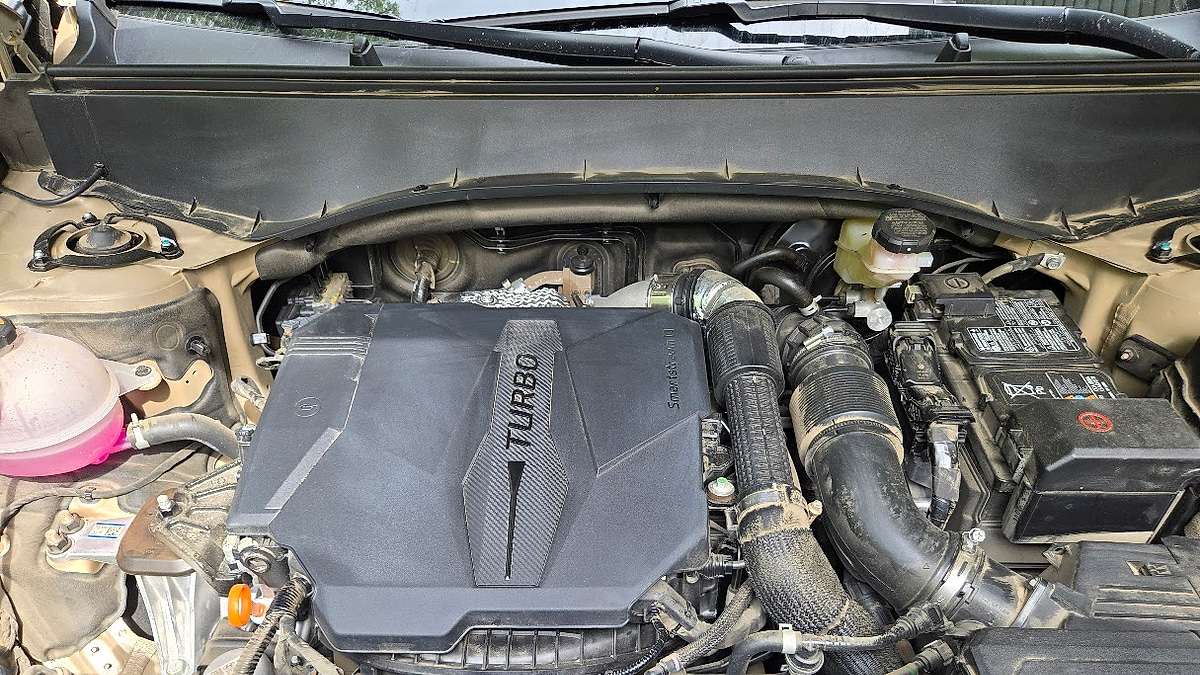

There was a time when if you told me that I’d sing the praises of an automaker moving from a V6 and into a smallish turbocharged four-cylinder engine, I’d have laughed at you. Leave it to Kia to finally turn my thinking around 180 degrees on this after 15 years of vehicle testing. If you’re a die-hard V6 fan, like I was until this past Tuesday, maybe this story will benefit you. There is a twist at the end.
Why a Turbocharged 4 is Better Than a V6 With No Turbo
Hold your horses if you want to burst forth with a handful of valid reasons why a V6 without a turbo (normally-aspirated is the term for that, BTW) is a gazillion times better than any silly four-pot. I know there are advantages to a V6. But hear me out, please.
Torque. That’s pretty much where I’m headed. Pound feet or foot pounds, depending on how you swing. Either way, it's the torque you feel when you drive like an adult. Unless you are redlining your huge, full-sized, three-row, seventeen-foot-long family thruster, horsepower doesn’t matter one iota. All those fancy horsepower numbers we see on spec sheets are “peak” horsepower. In normal driving, you use less than a third of that power, and you are often using almost none. As in lawnmower levels of power.
Peak horsepower requires a lot of piston slaps. Torque requires few. It’s the pull or push you feel when you use the accelerator. That satisfying oomph, if you will. And a turbocharged 2.5-liter four-cylinder can give you that great feeling way better than a normally aspirated V6. Now, a turbocharged six is the cat's meow, but nobody’s giving you that choice here. At some point, price becomes a limiting factor.
High-compression engines can develop great torque at low RPM. The turbocharger is the path to that happy place. It helps the engine to create a bushel of pound-feet of torque in the rev range where you, me, and everyone but your seventeen-year-old operate big vehicles in public. Drive normally, even with gusto, but not like a crazy person, and high torque at low RPM is where it’s at.
You normally drive around with your engine spinning contentedly between 1,200 RPM and about 3,500 RPM. If you casually go for more, the vehicle is simply going to shift and drop the revs back down. You can pin the throttle and go full Mad Max at every light and tap into the peak horsepower for about a second, but you won’t for many reasons. Tickets. Accidents. Gas mileage in the low single digits. And frankly, fatigue. You need to be a high school junior to enjoy a big SUV that way for more than ten seconds.
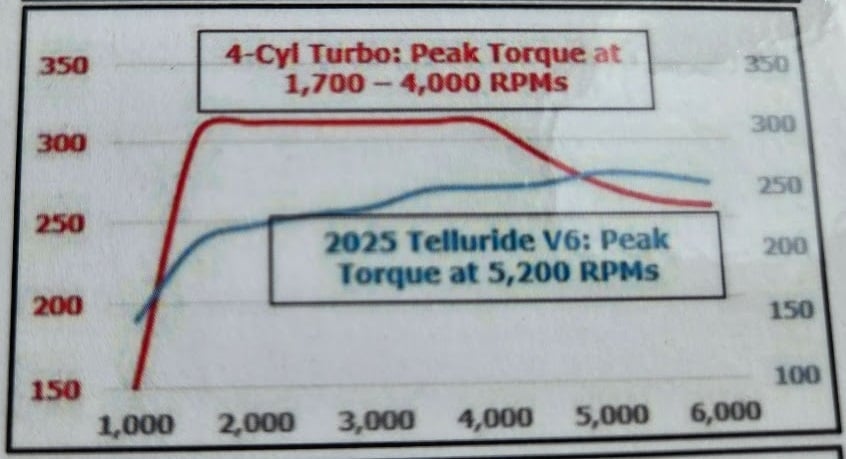
So let’s look at the torque curve of Kia’s very own V6 engine and its newly minted 2.5-liter, four-cylinder turbocharged mill. As you can see, the turbo offers you a whopping 300 pound-feet at just off idle. And it holds the peak torque way past where the vehicle is going to shift. In essence, you get the full torque capability of the engine all the time you are driving. It’s like an EV in a good way. Constant, generous thrust. By contrast, the V6 never offers you that much torque, and it’s delivered to you in such a way that when you first set off, you have about 50% less torque than the four-cylinder gives you. And you can really feel that if you back-to-back vehicles with the different engines. The long and short of it is that the turbo is more satisfying.
Money Saved In Three Forms
There are added benefits to the four-cylinder turbo. First, it costs less to produce. It’s smaller and has fewer parts overall, even with the turbo thrown into the mix. Second, since there are fewer spark plugs and fewer parts in general, it should save a few bucks in maintenance. Finally, a small turbo driven maturely is usually about five to ten percent more efficient than a V6, so it can save you some money on gas. Long-term, that can add up.
About Premium Fuel
We should stop here and address one outdated myth about turbocharged engines and fuel. No, turbochargers don’t require Premium fuel. There is zero correlation. You know which daily-driver vehicles need it? The ones where spec-page numbers are more important than real-world use. That’s the end of the story. The Telluride, like most turbocharged vehicles works just fine on regular and would derive zero benefits for having been “designed” to use Premium. If you stumble upon a vehicle that requires Premium when shopping, find another model.
Truth About V6 Engines
V6 engines in the category of the Telluride have two main advantages. First, they tend to be a bit less noisy. It’s subjective, and it’s hard to know how much is active sound canceling (Honda Pilot) and how much is just noise insulation. But, based on our extensive testing time, V6 engines are quieter than turbo fours in most cases.
Six-cylinder engines are also “smoother.” They benefit from some cylinder firing balances that an inline four can’t replicate. Boxer (horizontally-opposed fours) are actually worse in the real world. Inline sixes are the best, and V6 engines second. Don’t get me started on three-cylinder engines. They are a mess.
Two Alternatives Better Than a Turbo Four
If you think I have a weird turbo four fetish, no, it’s not that. I am just spitting truth here. Here is some more truth: Kia offers a turbocharged hybrid four-cylinder engine that is even better than the standard turbo four. Better torque, dramatically better fuel economy, lower cost of ownership, and hybrids can be much simpler and more reliable than a traditional engine. Who wouldn’t take a hybrid with 339 hp at idle over one with 311?. Throw in the fact that the hybrid gets 33 MPG and the turbo four gets 19 MPG, and it’s easy to make the case that hybrids are the best powerplants sold right now. Except one other intriguing option.
Kia makes an all-electric three-row SUV called the EV9. What would you think if I told you it has up to 526 pound-feet of torque before it even turns a wheel, is literally silent, and is more than likely lower in cost to energize than the hybrid? If you can charge at home and live without a spare tire, EVs are an option worthy of consideration.
Let’s face it, the glory days of the old-school V6 have come and gone. Stop ogling the peak horsepower numbers like they have any correlation with real-world driving enjoyment. It’s time to admit that V6 engines are no longer the smoothest, quietest engine options. Turbos, hybrids, and all-electric powertrains are the present, and the last two are duking it out to decide which is the future.
John Goreham is a 14-year veteran of Torque News. An accomplished writer and a long-time expert in vehicle testing, Goreham also serves as the Vice President of the New England Motor Press Association and has a growing social media presence. He’s also a 10-year staff writer and community moderator for Car Talk. Goreham holds a B.S. in Mechanical Engineering and an undergraduate Certificate in Marketing. In addition to vehicle and tire content, he offers deep dives into market trends and opinion pieces. You can follow John Goreham on X and TikTok, and connect with him on LinkedIn.
Set Torque News as Preferred Source on Google
Follow us today...







Comments
You ARE a Mechanical…
Permalink
You ARE a Mechanical Engineer, John! What in the bleep are RPMs??? Is it not the R for RevolutionSSS???
Good point. I write the way…
Permalink
In reply to You ARE a Mechanical… by Gilbert (not verified)
Good point. I write the way folks are most likely to understand the sentence. Don't get me fired up about heads-up display. I'll think over what you are correctly saying here. Thanks
Still looking for where the…
Permalink
In reply to You ARE a Mechanical… by Gilbert (not verified)
Still looking for where the V6 is 50pct of the 4's torque
Thanks, Rcase, I may have…
Permalink
In reply to Still looking for where the… by Rcase (not verified)
Thanks, Rcase, I may have been unclear when I said 50% less. Look to the left of the curve shown in the story. Torque at low RPMs. The 4-cylinder has 300 hp, and the 6-cylinder has 200. What would be a better way to describe the difference? I may be explaining this poorly: 50% of 200 is 100. And if you add 100 to 200, the sum is 300.
Thanks for the article John…
Permalink
Thanks for the article John.
Disappointed you did not mention issues of turbos related to;
* High mileage lifespan and durability vs a normally aspirated engine.
* Smooth torque/power delivery of turbos across the power band.
These are not diesel engines John so they suffer dramatically on the two aforementioned issues, even vs a na engine. This has been noted by reviewers of the Telly's already in test drives and turbo designs have always had much shorter lives than na engines. I would have thought this would be referenced in your discussion?
Wow, just terrible advice in…
Permalink
Wow, just terrible advice in this article. Squeezing as much power as possible out of an engine kills its reliability. I'd rather spend a few dollars more on gas than own something that won't last.
Kias and Hyundais barely…
Permalink
Kias and Hyundais barely last the life of their warranties. Disposable vehicles with touchy drivetrains. Cheap materials everywhere. Hidden manufacturing shortcuts lead to reliability problems.
Get real. All three of my…
Permalink
Get real. All three of my vehicles still V8s though one has twin turbos. (Though points on the torque from turbos. My twin turbo V8 is easier to accelerate quickly in while one of the others without turbos is quicker, it takes much effort and throttle to match the twin turbo.) A four cylinder? I think not.
The turbo is where your…
Permalink
The turbo is where your killing an engine it pushes to high of compression and to much heat for all that amounts to nothing when the engine is worn out at 70,000 miles and is burning oil. If your going to push a turbo wich I am not a fan of turbos use a v6. But I can get the same horsepower gain and torque gain out of a N/A four cylinder car as you can with a turbo 4 cylinder car. You guys just aren't building the engine right. Car manufacturers today are going with 4 cylinder turbo engines because its cheaper and they get more money out of service on the cars that's the bottom line. When you come right diwn to it car manufacturers are not doing people any favors there just making the cars cheaper and now there just useless disposal cars there trash made to day to sound good. I have owned v6 and 4 cylinder cars all my life and if you build a 4 cylinder engine the right way you don't need a turbo because I have done it and got better hp and torque numbers from N/A engine with out all that turbo bull crap
Very thoughtful comment,…
Permalink
In reply to The turbo is where your… by Robert N Brookhart (not verified)
Very thoughtful comment, Robert. Can you give us an example of a three-row SUV with a non-turbo four cylinder with 300 lb-ft of torque at 1400 RPM? Any brand, and any price point? I'd like to noodle this more.