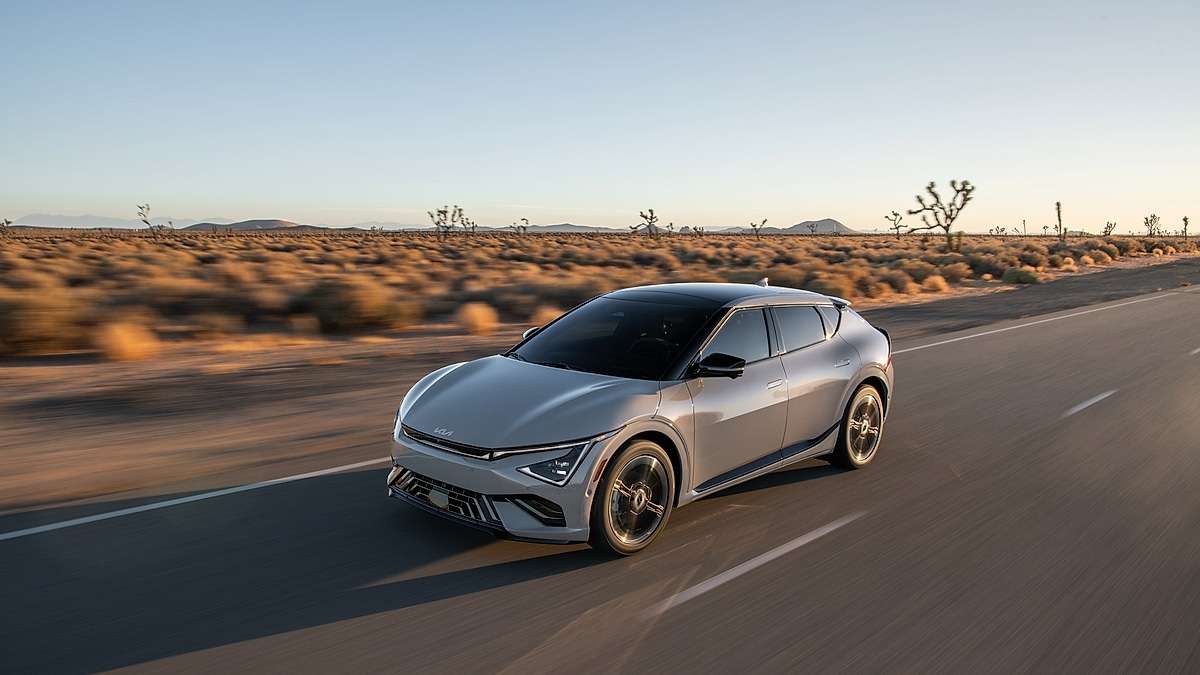

The modern camping argument usually starts with batteries and ends with generators. Somewhere in the middle, somebody insists an EV belongs nowhere near the woods. Andy Spinks spent six nights in the North Georgia mountains quietly testing that assumption.
The machine that justified the trip was already there.
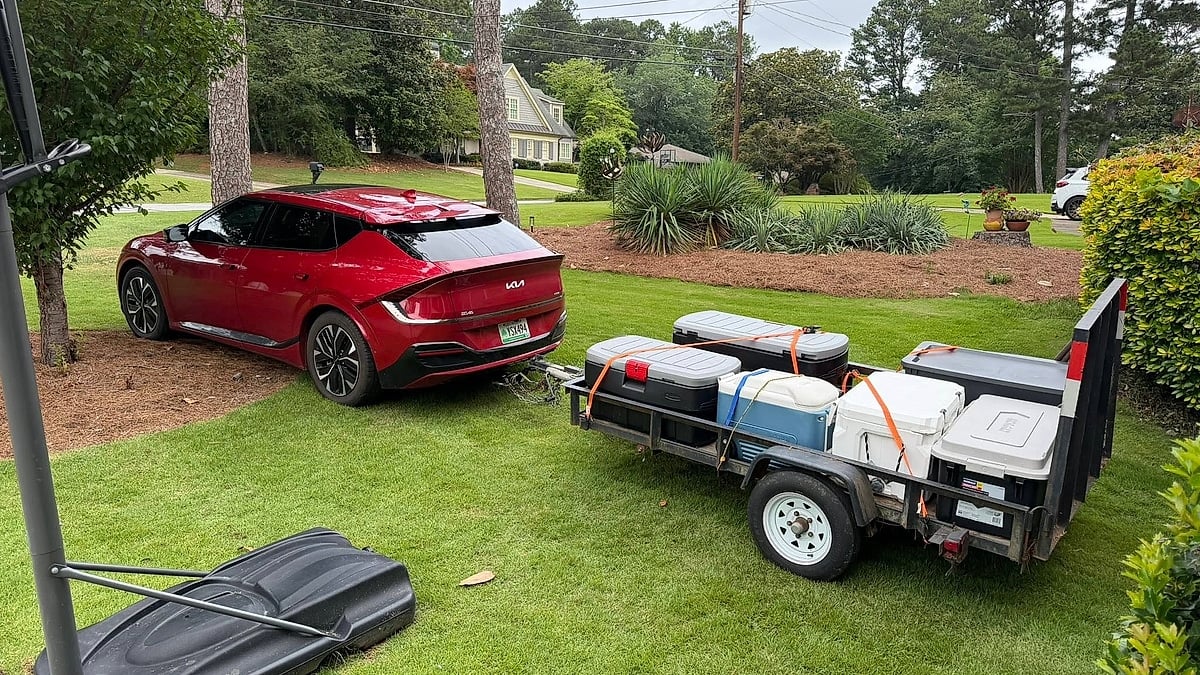
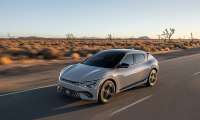
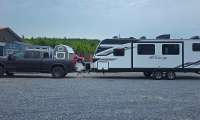
His 2023 Kia EV6 GT-Line RWD carried him from Atlanta into the North Georgia mountains, pulled a trailer over highway and muddy forest-service roads, then supplied electricity for six nights of camping. According to Facebook, his loads included a four-foot LED shop light, a tent fan, phones, tool batteries, a Makita chainsaw battery, his CPAP machine, and equipment for a friend’s CPAP.
- The 2023 Kia EV6 GT-Line RWD is EPA-rated for up to 310 miles of range and uses a 77.4-kWh battery pack, making it one of the longest-range non-Tesla EVs sold in the U.S. at the time.
- Kia's Vehicle-to-Load (V2L) system can supply up to 1.9 kW of AC power, enough to run camping equipment, charge power tools, operate medical devices, or even serve as emergency backup power during an outage.
- Built on Hyundai Motor Group's 800-volt E-GMP platform, the EV6 can charge from 10% to 80% in about 18 minutes at a compatible DC fast charger under ideal conditions.
Why The EV6's V2L System Matters More Than Its Range In The Woods
Vehicle-to-load power is usually demonstrated with a blender, television, or coffee maker. A CPAP user sees a different kind of freedom. The EV6 can turn a remote campsite into a place where nighttime medical equipment has stable AC power, without a gasoline generator droning beside the tent.
Spinks arrived at camp with 77 percent battery and left six nights later with a little under 30 percent.
The car spent almost half its pack keeping camp alive.
The Drive Up Was The Easy Part To Measure
The first screenshot covers 82.64 miles from Atlanta to Ellijay. The trip took 1 hour and 41 minutes at an average of 52 mph. Kia’s log reports 30.66 kWh used, including 28.92 kWh for the drivetrain, 0.95 kWh for climate control, and 0.79 kWh for accessories. It also reports 3.67 kWh regenerated.
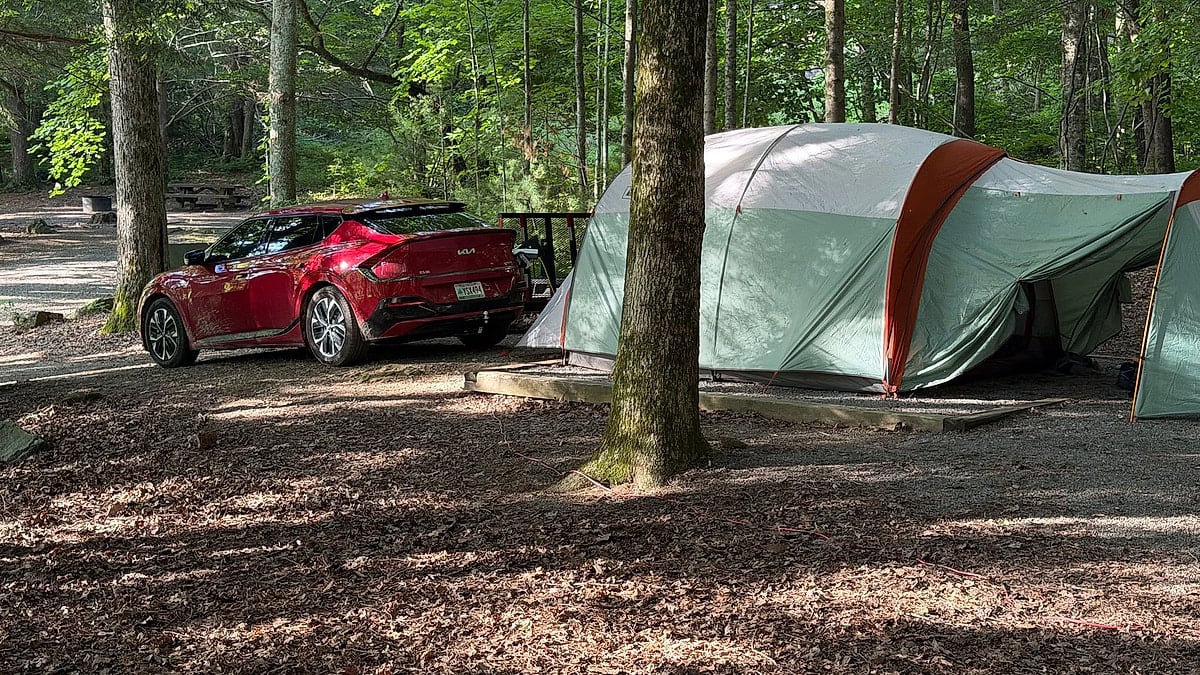
If the regenerated energy is subtracted from the displayed use, the net draw lands near 27 kWh, or roughly 3.1 miles per kWh. Using the 30.66-kWh figure directly gives 2.70 miles per kWh. Kia’s app does not explain the accounting clearly enough to declare either figure definitive.
In East Ellijay, Spinks added 31.2911 kWh in 26 minutes and paid $16.56, about 52.9 cents per kWh. He charged to 95 percent, bought ten bundles of firewood, and began the climb.
The route rose from roughly 1,350 feet to a campsite around 3,150 feet, touching elevations near 3,600 feet. Ten miles were muddy Forest Service roads.
He arrived with 77 percent.
The screenshot claims something wildly different.
Kia’s App Claims A 130-Mile-Per-kWh Climb
The mountain-leg screen reports 27.34 miles, 2 hours and 10 minutes, a 16-mph average, and 0.21 kWh of energy used.
That equals 130 miles per kWh while towing uphill through mud.
The battery’s fall from 95 to 77 percent offers the credible guide. Eighteen percent of the EV6’s 77.4-kWh nameplate capacity equals roughly 13.9 kWh before battery buffers and display rounding. That puts the climb near two miles per kWh, a plausible result for slow, steep towing.
The screenshot exposes a weakness in owner telemetry. A polished app can display a precise number that is physically impossible. Trip logs can miss sessions, lose communication, or mishandle vehicle sleep states.
Owners should cross-check the app against state of charge, odometer, charging receipts, and the terrain they just drove.
Precision without plausibility is decoration.
Six Nights Used About 36 kWh
A 47-percentage-point drop against a 77.4-kWh pack represents about 36.4 kWh. Actual AC energy delivered to devices would be lower because the inverter, vehicle electronics, battery buffers, and conversion losses consume energy too.
Spread across six days and nights, that decline averages roughly 6.1 kWh per day, or about 250 watts continuously.
The listed equipment rarely demanded 250 watts at every moment. The 42-watt shop light, fans, phones, CPAP equipment, and battery chargers cycled. Spinks suspects a faulty jump pack remained plugged in all day twice without reaching full charge. The EV6 itself also has to stay awake enough to provide AC power.
One defective device can sit quietly and drain for hours.
Kia allows the driver to set a minimum battery level for V2L. When the pack reaches that threshold, the vehicle cuts external power and preserves driving range. In a remote campsite, that keeps a forgotten appliance from spending the energy needed to reach pavement.
Anybody relying on CPAP equipment should still carry a dedicated backup battery and verify its runtime before leaving home. A damaged cable, tripped outlet, or badly estimated camp load should not create a single-point failure.
The Mountain Gave Some Energy Back
The return began with 21.75 miles from camp to East Ellijay. The app reports 6.1 kWh regenerated during that segment. The route took 1 hour and 41 minutes at an average of 17 mph.
Spinks arrived at the charger with 23 percent. He added 39.2395 kWh in 37 minutes for $20.64, about 52.6 cents per kWh. Combined with the outbound stop, public charging totaled 70.53 kWh and $37.20.
The final drive to Atlanta covered 82.02 miles at an average of 59 mph. Kia’s log reports 36.98 kWh used and 11.59 kWh regenerated.
Climbing demands a large energy deposit. Descending refunds part of it. Regeneration cannot repay air drag, tire resistance, and conversion losses, though 6.1 kWh recovered on the slow descent remains useful energy.
The Missing Trailer Weight Deserves A Scale
Kia rates the U.S.-market 2023 EV6 at 2,300 pounds with trailer brakes. Spinks did not provide the trailer’s empty weight, loaded weight, tongue weight, brake setup, or hitch rating.
That data needs to come before anyone copies the trip.
Ten bundles of firewood, camping equipment, food, tools, and the trailer itself can consume a 2,300-pound allowance quickly. Forest roads add articulation, uneven loading, mud, grades, and limited ground clearance. A vehicle completing the route does not certify that the combination remained within every rating.
I would weigh the loaded trailer and measure tongue weight before the next trip. The door-jamb payload label, hitch limits, tire ratings, and owner’s manual should all agree with the actual numbers.
The EV Became Part Of The Campsite
The EV6 stopped being transportation after it reached the mountain. It became the camp’s electrical system.
People who need CPAP equipment, communications gear, lighting, powered-device charging, or work equipment gain options that a normal vehicle cannot provide without a separate generator and fuel.
Silence carries practical value. The EV6 supplies power without exhaust, hot fuel cans, pull cords, or an engine idling beside sleeping people.
The owner paid 52 to 53 cents per kWh at the two public charging stops, so this was never a bargain-energy demonstration. The value came from capability and access.
Spinks used roughly half a battery over six nights, drove down the mountain, charged once, and returned to Atlanta. He learned which devices drank more than expected and found a trip log that could not survive basic arithmetic.
Next time, he wants a margarita machine.
Bring it.
Put the faulty jump pack in the trash first.
EV6 Owners, What Have You Powered Off-Grid?
Owners using V2L for camping should share the nights, battery percentage, essential equipment, trailer weight, and any appliance that consumed far more energy than expected.
Two images by Andy Spinks
About The Author
Noah Washington is an automotive journalist based in Atlanta, Georgia, covering sports cars, luxury vehicles, and performance culture. His reporting focuses on explaining the engineering, design philosophy, and real-world ownership experience behind modern vehicles.
Noah has been immersed in the automotive world since his early teens, attending industry events and following the enthusiast communities that shape how cars are built and driven today. His work blends industry insight with enthusiastic storytelling, helping readers understand not just what a car is, but why it matters.
Noah is also a member of the Southeast Automotive Media Association (SAMA), a professional organization for automotive journalists and industry media in the Southeast.
His coverage regularly explores sports cars, luxury vehicles, and performance-driven segments of the automotive industry, including the evolving culture surrounding Formula Drift and enthusiast builds.
Read more of Noah's work on his author profile page.
You can also follow Noah here:
Set Torque News as Preferred Source on Google
Follow us today...