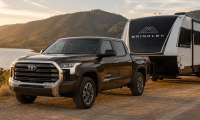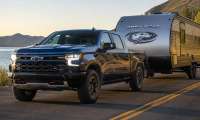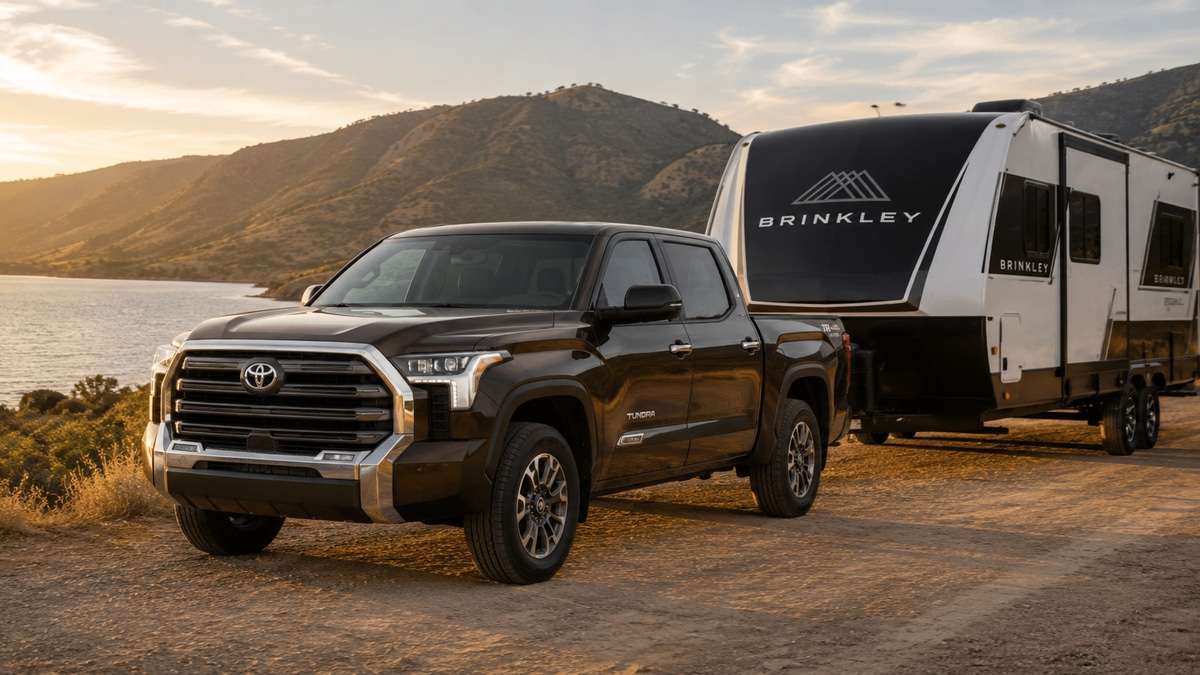

An 11,400-pound tow rating makes a 7,700-pound Brinkley Model I 235 look like an easy match for a 2026 Toyota Tundra SR5. The trailer would sit 3,700 pounds below the advertised maximum, and the planned trips are short runs across flat Florida.
Brian Fleming is trying to determine whether that apparent cushion survives the number printed on his truck’s door sticker. His CrewMax short-bed Tundra allows 1,400 pounds for occupants and cargo, and that becomes the tighter limit once the trailer is attached.
Brinkley recommends keeping approximately 12% to 15% of a conventional travel trailer’s loaded weight on the hitch. Even at the bottom of that range, a 7,700-pound Model I 235 would place approximately 924 pounds on the Tundra.
Fleming expects two adults and a dog to add 380 pounds, with another 40 pounds of gear carried in the truck. That leaves 980 pounds of the door-sticker allowance before the trailer is connected.
Subtract the estimated 924-pound tongue load, and only 56 pounds remains before the Equal-i-zer hitch hardware or any additional truck cargo is counted. Raise the tongue weight to 13%, still within Brinkley’s recommended range, and the simple payload calculation is already 21 pounds over before the hitch is added.
That calculation is not a final scale verdict. The trailer’s actual tongue weight is still unknown, and a properly adjusted weight-distribution hitch will change how the load is divided among the truck and trailer axles. It does reveal the problem with judging this pairing by its 11,400-pound tow rating. This Tundra may run out of usable payload thousands of pounds before it runs out of advertised towing capacity.
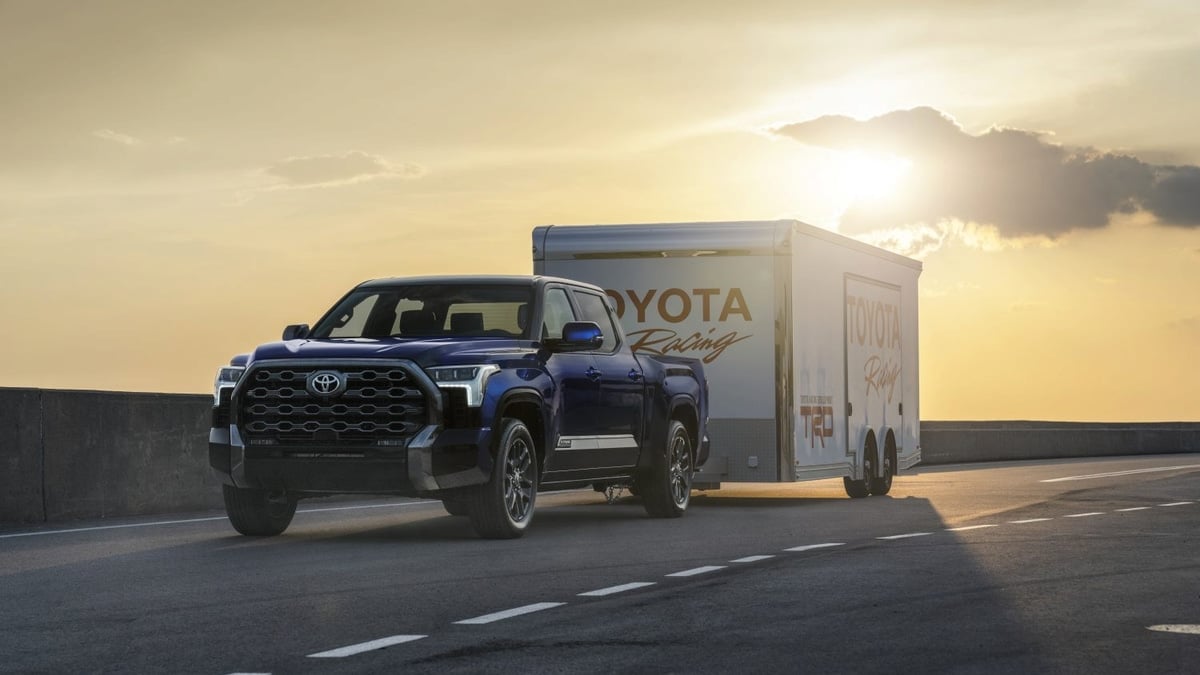
That is the problem in Brian Fleming’s plan to tow a 2027 Brinkley Model I 235 with a 2026 Toyota Tundra SR5 CrewMax. The trailer sits comfortably below the truck’s maximum tow rating, but the stated payload is almost consumed at Brinkley’s minimum recommended tongue percentage. Fleming later confirmed on Facebook that the truck’s door label lists 1,400 pounds for occupants and cargo.
This calculation is a conservative pre-purchase screen rather than a final scale verdict. A properly adjusted weight-distribution hitch changes how the load is divided among the truck’s axles and the trailer axles. The exact trailer, hitch adjustment, and loaded axle weights remain unknown.
It still shows why the 11,400-pound number cannot settle this purchase.
The Truck Numbers Conflict by 320 Pounds
Fleming listed these figures for the Tundra:
- GVWR: 6,990 pounds
- Curb weight: 5,270 pounds
- Payload: 1,400 pounds
- GCWR: 17,250 pounds
- Maximum trailer weight: 11,400 pounds
- Front GAWR: 4,080 pounds
- Rear GAWR: 3,860 pounds
The first three figures cannot all describe the same as-built truck.
Subtracting the listed 5,270-pound curb weight from the 6,990-pound GVWR produces 1,720 pounds of theoretical payload, not 1,400.
Conversely, a 1,400-pound door-sticker payload and a 6,990-pound GVWR imply that the truck weighed approximately 5,590 pounds when its factory occupant-and-cargo allowance was established.
That creates a 320-pound discrepancy.
The likely explanation is that 5,270 pounds is a generic or base curb weight, while the door sticker reflects the individual truck after factory options. Dealer-installed accessories or later modifications can reduce the available margin further.
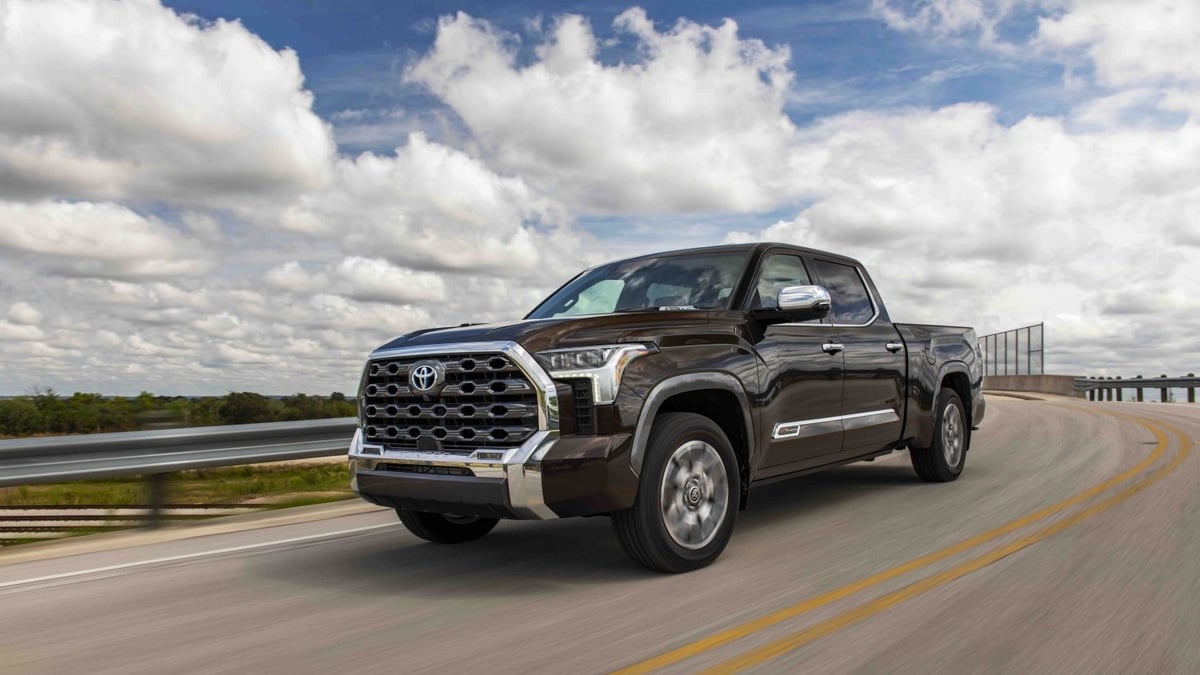
The yellow door label is the stronger planning number because it belongs to the specific truck. A full-fuel scale ticket with the planned passengers and truck gear would settle the remaining uncertainty.
That 320 pounds changes the entire conclusion. A genuine 1,720-pound payload would provide substantially more room. The confirmed 1,400-pound door sticker makes the combination marginal before the trailer has even been purchased.
The 610-Pound Hitch Figure Is a Dry Specification
Brinkley’s official 2027 Model I 235 flyer lists:
- UVW: 6,987 pounds
- GVWR: 8,495 pounds
- Published hitch weight: 610 pounds
- Exterior length: 26 feet, 11 inches
- Overall height: 11 feet, 4 inches
- Fresh-water capacity: 55 gallons
- Tandem 4,400-pound axles
- Load Range E tires
The published 610-pound hitch weight equals only 8.7% of the trailer’s unloaded weight.
If the trailer remained at 610 pounds of tongue weight after being loaded to 7,700 pounds, its tongue percentage would fall to 7.9%. That would sit well below Brinkley’s own 12% to 15% conventional-trailer guidance.
The dry hitch figure therefore cannot be used as the expected road-ready tongue load. Batteries, propane, water, food, tools and camping equipment can all change the measurement. Equal-i-zer recommends selecting and setting up its hitch from actual loaded trailer and tongue weights rather than dry specifications.
Here is the payload screen using Fleming’s planned 7,700-pound trailer weight:
At a 12 percent loaded tongue-weight ratio, the trailer would place approximately 924 pounds on the Toyota’s hitch. After adding 380 pounds for the occupants and dog, along with 40 pounds of gear carried in the truck, only 56 pounds of payload capacity would remain.
Increasing the tongue-weight ratio to 13 percent raises the estimated tongue weight to 1,001 pounds. At that point, the truck would exceed its payload rating by approximately 21 pounds.
At 14 percent, the estimated tongue weight rises to 1,078 pounds, placing the Toyota approximately 98 pounds over its payload rating. A 15 percent tongue-weight ratio would put approximately 1,155 pounds on the hitch and leave the truck about 175 pounds over its rated payload capacity.
Those margins do not yet include the physical weight of the hitch assembly.
At the trailer’s full 8,495-pound GVWR, even a 12% tongue load would be approximately 1,019 pounds. That would put the simple payload budget about 39 pounds over before the hitch hardware is added.
The Equal-i-zer Hitch Can Redistribute Load, but It Cannot Raise the Ratings
A weight-distribution hitch applies leverage through its spring bars. That restores some load to the truck’s front axle and transfers some of the hitch effect toward the trailer axles.
It can improve steering response, braking balance, ride posture and stability when correctly sized and adjusted.
Equal-i-zer is equally clear about its limit: the hitch does not increase payload, GVWR, axle ratings, tire capacity, receiver capacity or the manufacturer’s maximum towing limit. Tongue weight and hitch equipment still have to be included when checking the truck’s capacity.
That is why the 56-pound result should be treated as an early warning rather than a final legal weight.
The final answer comes from actual front axle, rear axle and total truck weights with the hitch engaged. The weight-distribution system may change the truck’s measured axle loads, but it cannot turn a 1,400-pound door label into a 1,600-pound label.
Fleming’s plan to purchase a tongue scale is one of the strongest parts of his setup. The trailer should be loaded with its batteries, propane, normal camping equipment, food and expected water before the tongue is measured.
The Propane and Battery Weight Should Not Be Subtracted Twice
The plan includes an estimated 170 pounds for propane and batteries.
Those items belong in the trailer’s loaded weight. Their position, likely near the front of the trailer, may also raise the tongue weight more than cargo stored near or behind the axles.
Once the trailer is treated as weighing 7,700 pounds and its tongue is estimated as a percentage of that loaded weight, the 170 pounds should not also be subtracted in full from the truck’s payload. Doing that would count the same mass twice.
The cleaner process is:
- Load the propane, batteries, water and camping cargo into the trailer.
- Weigh the complete trailer.
- Measure its actual tongue weight.
- Add the hitch hardware, people and truck cargo.
- Weigh the complete combination with the weight-distribution hitch adjusted.
Equal-i-zer specifically warns that batteries, propane, water and cargo can change tongue weight substantially, which is why a loaded measurement is more useful than the brochure’s 610-pound figure.
A 7,700-Pound Target Allows Only 713 Pounds Above Dry Weight
The planned 7,700-pound travel weight is only 713 pounds above Brinkley’s published 6,987-pound UVW.
After the estimated 170 pounds of propane and batteries, approximately 543 pounds remains for:
- Food and drinks
- Clothing
- Bedding
- Kitchen equipment
- Chairs and outdoor equipment
- Hoses and electrical equipment
- Tools and spare parts
- Pet supplies
- Water
The Model I 235 carries up to 55 gallons of fresh water. A full tank would weigh approximately 459 pounds, leaving about 84 pounds of the planned 713-pound loading allowance after the estimated propane and battery weight.
The family may travel with little fresh water, and the tank’s location will influence tongue weight. The example shows how quickly a “partially loaded” trailer can approach the 7,700-pound target.
Factory options can also change the individual trailer’s empty weight. Brinkley’s 2027 flyer says its specifications are subject to change, so the federal weight label on the purchased unit should replace every brochure estimate.
Timbrens Can Change the Tundra’s Stance, but Not Its Door Sticker
Timbrens may reduce rear suspension sag and improve the truck’s loaded stance. That can be useful once the combination has been proven to remain within every rating.
They cannot create additional GVWR.
Timbren states that helper springs can increase the suspension spring capacity, but the truck must remain within the GVWR established by the manufacturer.
A level-looking Tundra can still exceed:
- GVWR
- Rear GAWR
- Tire ratings
- Receiver ratings
- Door-sticker payload
Helper springs also do not perform the same job as a weight-distribution hitch. They support the rear suspension, while a properly adjusted WDH uses leverage to restore front-axle load and distribute the hitch effect.
The correct order is to verify the weights, adjust the Equal-i-zer hitch, and then decide whether rear-suspension support improves the ride. Using Timbrens first can hide visible squat without answering the weight question.
The 3,860-Pound Rear Axle Could Be the Next Limit
The truck’s rear GAWR is listed at 3,860 pounds.
Without an unloaded rear-axle scale weight, there is no reliable way to calculate how much rear-axle capacity remains. The trailer tongue acts behind the rear axle, so the rear axle initially receives more load than the tongue weight alone while some weight is removed from the front axle.
The Equal-i-zer hitch should return part of that load toward the front and trailer axles. Its adjustment determines how much.
A truck can remain under its 6,990-pound GVWR and still exceed rear GAWR, a tire rating or the receiver’s maximum tongue limit. It can also remain below the 11,400-pound tow rating while exceeding GVWR.
The next essential photographs are the receiver label and the certification label. The scale ticket then has to show front axle, rear axle, trailer axle, and combined weights with the trailer loaded for travel.
The CAT Scale Debate Has a Straight Answer
Some commenters argued over whether a CAT scale is sufficiently accurate for a pickup and travel trailer.
That debate distracts from the information missing here.
CAT’s own instructions place the truck’s front axle on platform one, the rear axle on platform two and the trailer axles on platform three. The result provides axle-group weights and total gross weight, although it cannot provide individual wheel or corner weights.
That is precisely the data needed to compare the Tundra with its front GAWR, rear GAWR, GVWR and GCWR.
The best sequence would be:
- Truck only: Full fuel, both adults, dog and normal truck gear.
- Loaded combination with the WDH engaged: This shows the road-ready front, rear, trailer and combined weights.
- Loaded combination with the spring bars safely relaxed: This shows what the hitch is transferring.
- Tongue measurement: Weigh the loaded trailer’s tongue independently and confirm that it falls within the trailer manufacturer’s guidance.
The truck-only weigh can be completed before the Brinkley is purchased. It will reveal the Tundra’s actual front, rear and total weight and show how much of the 1,400-pound door allowance remains with the family aboard.
Flat Florida Trips Reduce Grade Exposure, Not Weight
Two-hour trips across flat Florida are easier on a tow vehicle than repeated mountain climbs and descents. They reduce exposure to prolonged thermal loading and long downhill braking.
The route does not change the Tundra’s payload, GVWR, GAWR, receiver or tire ratings.
The Brinkley is also 26 feet, 11 inches long and 11 feet, 4 inches tall. That creates a substantial side profile for crosswinds and the pressure wave from passing trucks, even on level roads.
The 2027 trailer’s equipment list includes anti-lock brakes with anti-sway and dynamic brake boost, all useful features. They do not add capacity to the Tundra.
Short travel distance also provides little relief during a sudden lane change, wet emergency stop or strong crosswind. The combination needs adequate weight distribution and axle margin every mile it is moving.
Is This Tundra and Brinkley Pairing Workable?
At a true 1,400-pound door-sticker payload, this combination is too close for approval from brochure estimates.
At the planned 7,700-pound trailer weight:
- The tow rating has 3,700 pounds of apparent room.
- GCWR is unlikely to be the first limit.
- Brinkley’s 12% tongue-weight floor leaves only 56 pounds in the simple payload budget before hitch hardware.
- A 13% tongue load exceeds that budget before the hitch is counted.
- Rear-axle, tire, and receiver margins remain unknown.
- Timbrens cannot increase any of those ratings.
The pairing may produce legal scale numbers after the exact trailer is loaded and the Equal-i-zer hitch is correctly adjusted. The available loading window would still be narrow, and a few hundred pounds of additional water, bed cargo or camping equipment could change the result.
Before purchasing the Brinkley, the truck should be weighed full of fuel with the planned occupants and gear. The actual trailer should then have its as-built weight label, loaded tongue estimate and receiver requirements documented. A dealer willing to measure the tongue of a similarly equipped Model I 235 would provide more useful information than another discussion about the 11,400-pound tow rating.
A three-quarter-ton truck would create substantially more payload and rear-axle reserve. The Tundra can remain an option only if the individual labels and loaded scale ticket prove that every limit is respected.
Would you tow this 7,700-pound Brinkley with a Tundra carrying a 1,400-pound payload sticker, or is an estimated 56 pounds of remaining margin too close? If you tow a similar combination, share your loaded trailer weight, measured tongue weight, and CAT scale axle numbers in the comments. Those figures could show whether this pairing has usable capacity or only looks comfortable under the advertised tow rating.
About The Author
Noah Washington is an automotive journalist based in Atlanta, Georgia, covering sports cars, luxury vehicles, and performance culture. His reporting focuses on explaining the engineering, design philosophy, and real-world ownership experience behind modern vehicles.
Noah has been immersed in the automotive world since his early teens, attending industry events and following the enthusiast communities that shape how cars are built and driven today. His work blends industry insight with enthusiastic storytelling, helping readers understand not just what a car is, but why it matters.
Noah is also a member of the Southeast Automotive Media Association (SAMA), a professional organization for automotive journalists and industry media in the Southeast.
His coverage regularly explores sports cars, luxury vehicles, and performance-driven segments of the automotive industry, including the evolving culture surrounding Formula Drift and enthusiast builds.
Read more of Noah's work on his author profile page.
You can also follow Noah here:
Set Torque News as Preferred Source on Google
Follow us today...