

Truck power hides deadly towing danger. A Georgia owner learned this the hard way on the highway.
His brand-new 2025 Toyota Tundra had the torque, but it couldn't stop the terrifying white-knuckle trailer sway.
Modern half-ton trucks possess enough twin-turbocharged torque to mask a dangerous setup right until the first crosswind hits.
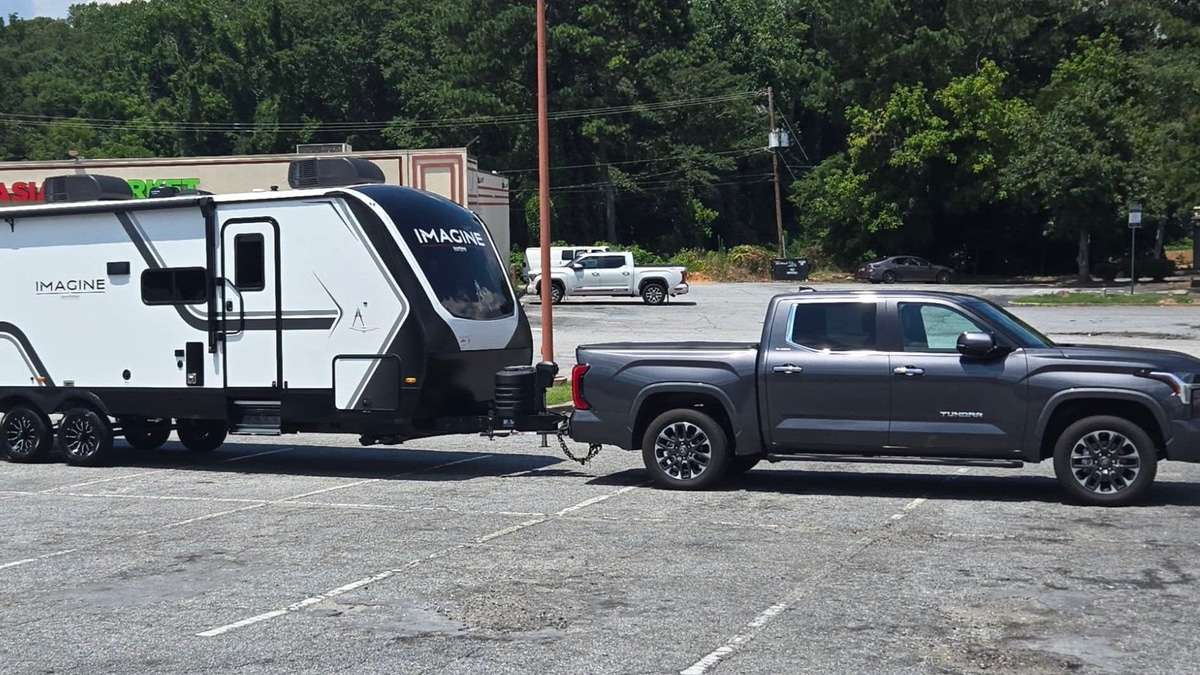
When Georgia truck owner Stephen Matthews hitched his 2025 Toyota Tundra to a massive Grand Design Imagine travel trailer, the power was flawless, but the highway stability wasn't.
Despite running a high-end mechanical equalizer weight-distribution hitch, destructive trailer sway began slipping past the truck’s factory safety systems. Matthews took to the 2023-2027 Toyota Tundra Owners Facebook community forum to share a reality check that every half-ton truck owner needs to hear.
"My 2025 Tundra pulled my large Imagine travel trailer nicely; I just need to get the hitch dialed in," Matthews reported. "Using an equalizer, and there is still a little bit of sway. It's not bad, though. Has anyone used the Lippert Curt electronic anti-sway?"
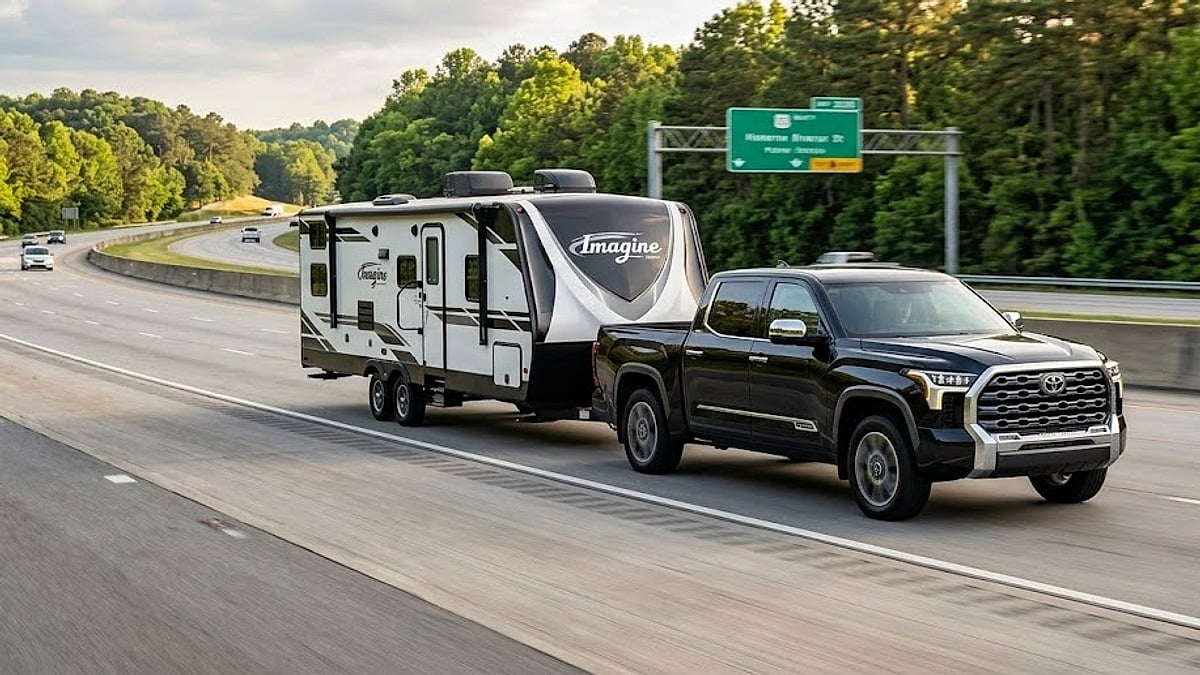
This owner's dilemma exposes a massive, hidden engineering gap between modern half-ton truck marketing and real-world towing dynamics. As a veteran automotive journalist with over three decades of evaluating trucks under heavy loads, I constantly see this specific failure mode catch consumers off guard.
The Illusion of Half-Ton Twin-Turbo Power
The modern i-FORCE Max twin-turbo V6 platform makes towing feel effortless from a dead stop. With up to 583 lb-ft of torque on tap, the 2025 Tundra accelerates a heavy travel trailer with the confidence of an old-school diesel heavy-duty truck.
However, pulling power has absolutely nothing to do with dynamic highway stability. The physical weight of the tow vehicle relative to the trailer remains the golden law of towing safety.
Grand Design Imagine travel trailers are notorious for having a massive "sail area" profile. These trailers stand tall, catch immense crosswinds, and act like a giant lever on the lightweight chassis of a half-ton tow vehicle.
When a semi-truck passes at 75 mph, it pushes a wall of air that physically shoves the rear of the trailer. This creates a lateral pivot moment at the hitch ball, forcing the Tundra's rear axle to step out slightly before the driver can even react.
The Tundra's coil-spring rear suspension provides an incredibly smooth unladen ride, but it lacks the lateral stiffness found in leaf-sprung heavy-duty platforms. This subtle lateral deflection compounds the geometric leverage the trailer holds over the truck's rear footprint.
Why Mechanical Equalizer Hitches Hit a Hard Engineering Wall
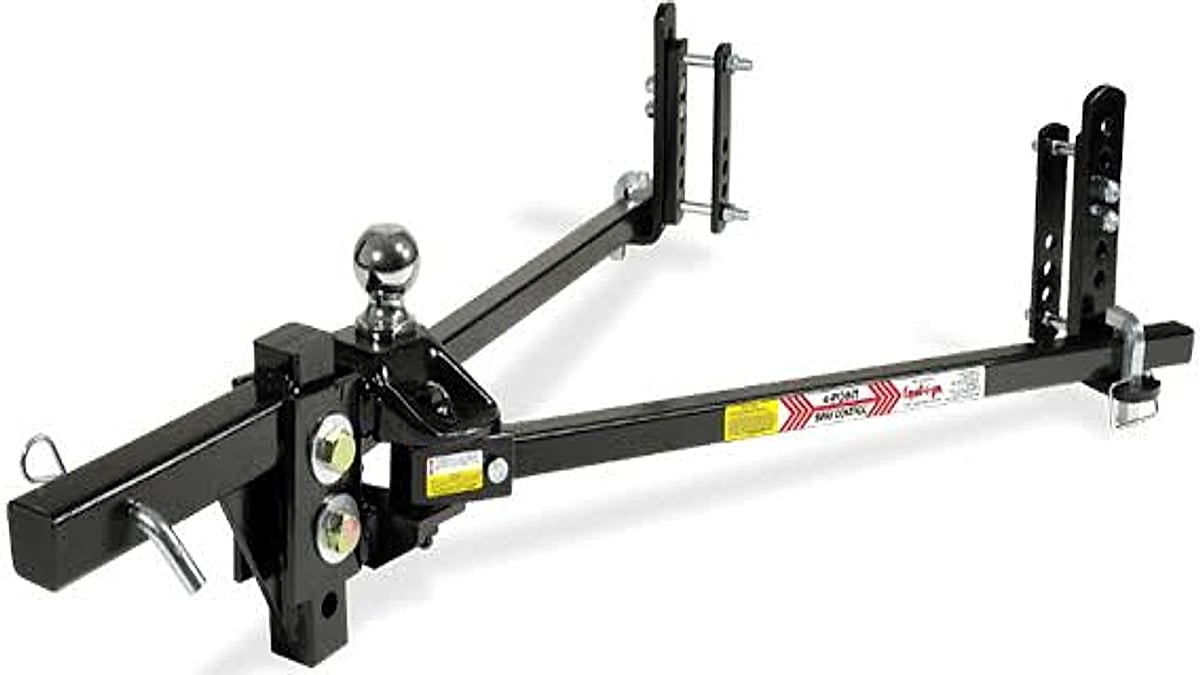
For decades, the standard go-to solution has been the mechanical 4-point friction weight-distribution hitch. These systems use steel-on-steel friction at the hitch head and trailer frame brackets to resist lateral movement.
While excellent for leveling a sagging truck, standard friction hitches hit an absolute engineering wall when it comes to high-profile campers. The underlying physics of passive friction simply cannot match the sudden forces generated by modern highway speeds.
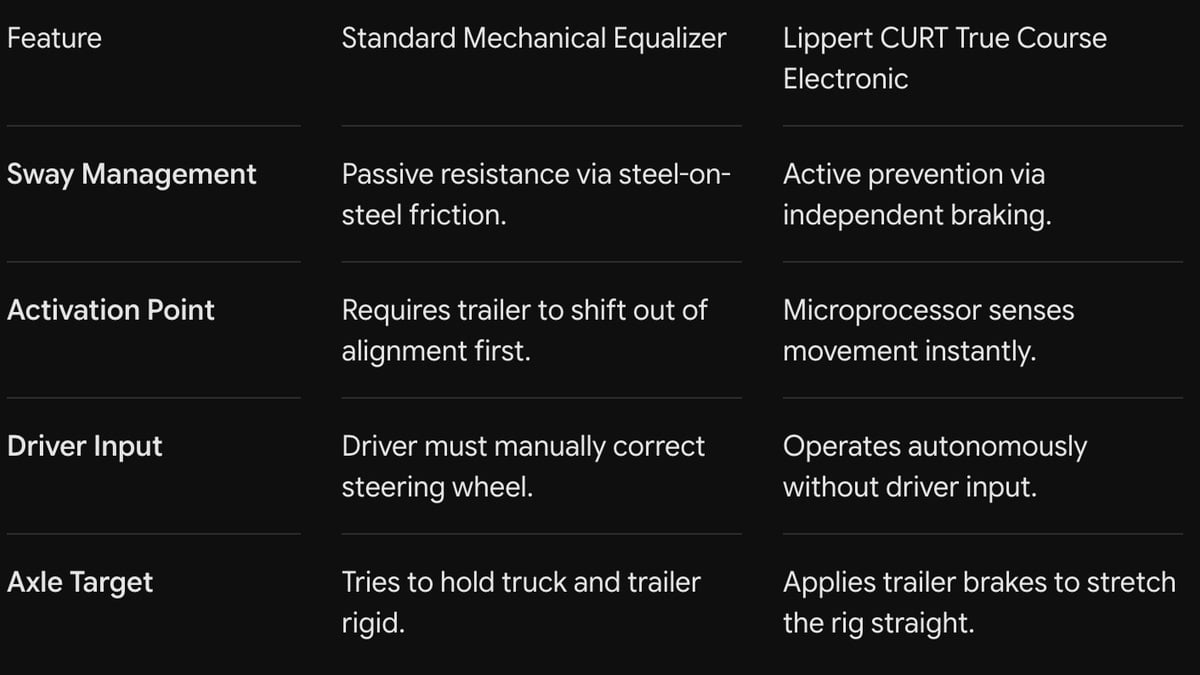
Friction-based sway control is entirely passive. It requires the trailer to physically move out of alignment before the steel-on-steel friction begins resisting the force.
If the tongue weight isn't perfectly optimized down to the exact pound, or if the hitch head angle is off by a single washer, the friction bars simply slide right through the brackets. The Tundra owner is left correcting the steering wheel manually, resulting in exhausting, white-knuckle highway driving over long distances.
Furthermore, as mechanical components wear down, the static friction coefficient drops significantly. This degradation means a hitch that performed adequately during its first year can slowly lose its ability to damp high-amplitude sway events.
The Electronic Revolution: Lippert CURT True Course
Faced with persistent highway sway that passive steel bars couldn't cure, Matthews asked the community about a highly specific upgrade: the Lippert CURT True Course electronic anti-sway system. This technology marks a radical shift from passive mechanical friction to active computer intervention.
Instead of waiting for the truck driver to react, the CURT True Course Advanced Trailer Sway Control System module is mounted directly to the trailer frame and wires into the existing electric brake lines. It continuously scans for the precise signature of aerodynamic trailer oscillation.
Inside the module, an advanced internal gyroscope and microprocessor constantly measure lateral G-forces and yaw rates. The moment a crosswind or semi-truck force initiates an unnatural side-to-side oscillation, the computer steps in.
It completely bypasses the truck's in-cab brake controller. It pulses the trailer’s electric brakes independently on opposite sides, instantly pulling the trailer back into perfect alignment before the driver even feels the steering wheel twitch.
This targeted braking application creates an immediate tension force along the vehicle combination’s centerline. Stretching the rig back into a straight line dampens the sway's kinetic energy before it can propagate to the tow vehicle.
For a complete breakdown of how these mechanical and digital defensive tools work together out on the road, check out Lippert's operational comparison on How to Install & Use a Trailer Sway Control Kit.
Real-World Next Steps for Tundra Owners
If you are towing a large travel trailer like a Grand Design Imagine with a 2022–2026 Toyota Tundra, you cannot rely entirely on your truck's factory stability control. The truck's internal Trailer Sway Control system only activates after the sway becomes severe enough to threaten the truck’s own traction control.
Before dropping hundreds of dollars on electronic modules, ensure your mechanical setup is flawlessly dialed in. Take your fully loaded rig to a certified CAT scale and verify that your tongue weight sits securely between 10% and 15% of the total trailer weight.
If your scale numbers are perfect and your friction hitch is tight, yet you still experience the highway float described by Matthews, it is time to look at electronic augmentation. Adding a frame-mounted electronic brake actuator gives a light half-ton truck the technological teeth it needs to dominate the highway safely.
Tell Us What You Think: Have you battled highway sway while towing a large travel trailer with a half-ton truck? Do you trust old-school mechanical friction hitches, or is it time to upgrade to computer-controlled electronic anti-sway tech?
It’s Your Turn: Click the red "Add new comment" link below to share your real-world towing setup, your experience with Grand Design campers, and what you would do to fix this owner's highway sway dilemma.
There’s More Coming Tomorrow… Also check out my Torque News Home Page for more of my informative Toyota Tundra news articles.
About The Author
Denis Flierl is a 14-year Senior Reporter at Torque News and a member of the Rocky Mountain Automotive Press (RMAP) with 30+ years of industry experience. Explore his full investigative reporting archives and technical guides at DenisFlierl.com.
Based in Parker, Colorado, Denis leverages the Rockies' high-altitude terrain as a rigorous testing ground to provide "boots-on-the-ground" analysis for readers across the Rocky Mountain region, California EV corridors, the Northeast, Texas truck markets, and Midwest agricultural zones.
A former professional test driver and consultant for Ford, GM, Ram, Toyota, and Tesla, he delivers data-backed insights on reliability and market shifts. Denis cuts through the noise to provide national audiences with the real-world reporting today’s landscape demands.
Connect with Denis: Find him on LinkedIn, X @DenisFlierl, @WorldsCoolestRides, Facebook, and Instagram.
Photo credit: Denis Flierl via Stephen Matthews
Set Torque News as Preferred Source on Google
Follow us today...







Comments
I personally had 3 tundras…
Permalink
I personally had 3 tundras over the years. Pulling trailers that were the size of the author.
I finally got smart and bought a 7.3 gas F250 with the 10 speed transmission.
It was a world of difference and I realized the tundra frame was too light for the job. Plus the tundra has too low carrying capacity adding to the problem.
The article doesn't mention…
Permalink
The article doesn't mention how long of a trailer he was pulling. My first camper was a bumper pull on a half ton but I moved up to a 5th wheel 3/4 ton or one ton and that's all I've had for the last 30 years, all for safety reasons. I see people pulling large trailers all the time with half tonners, even with 1/4 ton pickups and it freaks me out a bit. Pulling on I70 west of Denver through the mountains is an accident waiting to happen.
I fought trailer sway for 2…
Permalink
I fought trailer sway for 2 years with an 8500 lb 28 ft trailer towed by a diesel Ford Excursion. Anti sway hitch did help immensely, but only after all 4 of the cheap soft factory trailer tires blew out on me, to be replaced by a new style of tire in the 225 75 15 size. These new tires are f rated and look like a semi truck steer tire. They were non existent until a few years ago but a set of these solved the sway problem 100%. Even when semi trucks pass, the trailer doesn't budge. Best part is the tires are just over $120 each so not too expensive.