

Toyota’s pickup lineup asks a loyal owner to change brands at the exact moment the work gets heavier. The Tundra is powerful enough to tempt owners into jobs normally assigned to larger trucks, yet Toyota’s current U.S. pickup range consists of the Tacoma and the Tundra. There is no factory 3/4-ton or 1-ton Toyota pickup above them as of this writing.
“I know imma get grief,” Jim Doran began in the Towing with Tundras Facebook group. Then he put the demand bluntly: “I would literally camp outside a Toyota dealership to buy a heavy-duty Toyota truck.”
Doran said he traded a 2022 Tundra while he was in line for an engine replacement, moved into a 2024 Ram 2500 with the 6.4-liter Hemi, and found the Ram merely adequate. It “towed OK,” he said, but the vinyl-lined work-truck interior left him cold. Then he “went nuts and splurged” on a 2026 Ford F-350 XLT.
“Oh my is this truck amazing,” Doran wrote.
“I haven’t loved a truck like this since my Toyota’s back in the day.”
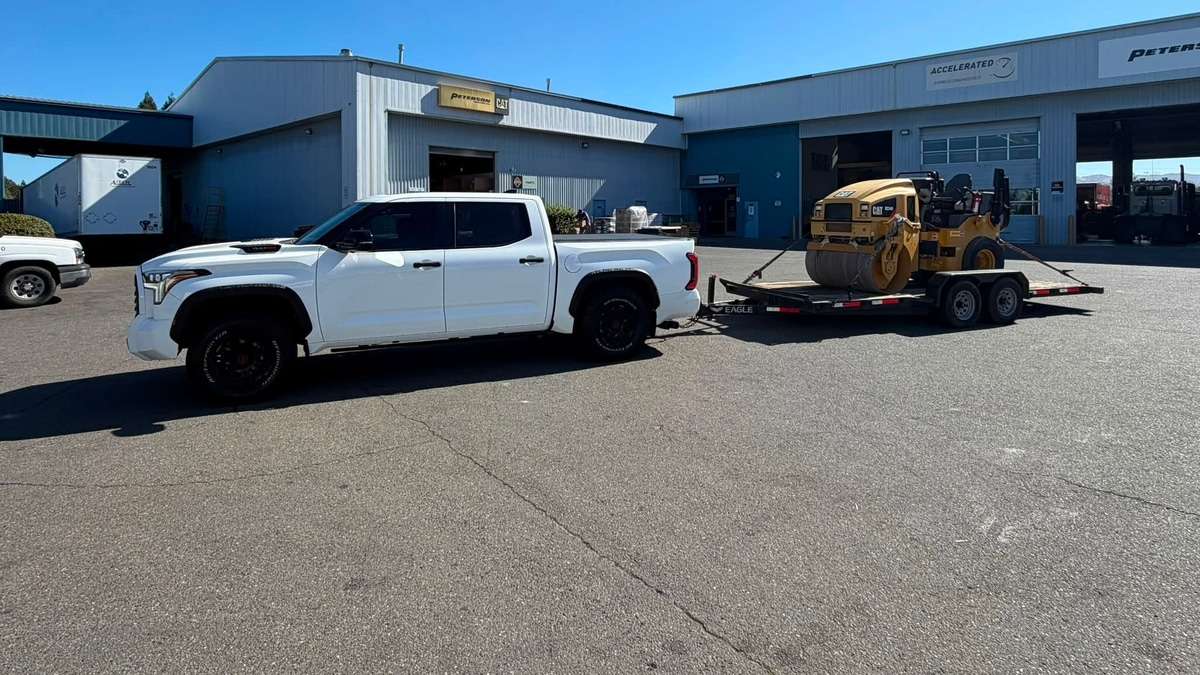
In the 2023-2027 Toyota Tundra Owners Facebook group, James Allan Betz posted a photograph of a white third-generation Tundra hitched to a tandem-axle equipment trailer carrying a yellow road roller. He said people at Cat called him crazy for towing the 8,000-pound machine 200 miles. His response was pure Toyota folklore: “Toyotas have toppled regimes in the Middle East and Africa, surely this one can tow a roller 200 miles home!”
Then Betz added the fact in parentheses that changes the whole photograph: “My 5 Ram 5500 were all busy working today.”
Betz describes the Tundra that filled in. Doran describes the Toyota that did not exist. Together, their posts expose the same gap: The Tundra can perform serious towing, while Toyota offers no upward path for owners who need greater payload, axle capacity, braking reserve, and repeated-duty margin.
An 8,000-Pound Roller Is More Than an 8,000-Pound Tow
If the roller’s stated weight is accurate, the loaded trailer weighed more than 8,000 pounds. The trailer, chains, binders, spare equipment, and anything else aboard all count. Some of that combined load also presses down on the truck through the hitch, consuming payload alongside the driver, passengers, tools, and bed cargo.
The engine can win the first 100 feet. The brakes, axle ratings, tires, payload, and trailer setup decide the next 200 miles.
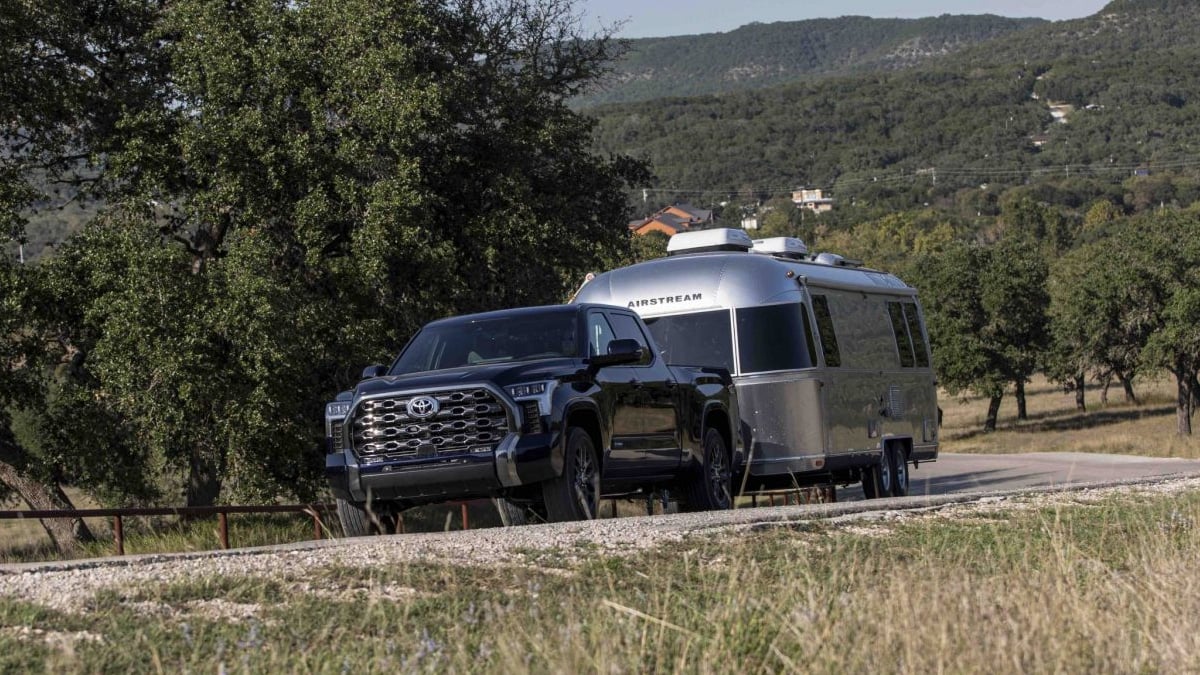
Toyota’s 2023 Tundra brochure did not give every truck the same 12,000-pound rating. Depending on configuration, maximum trailer ratings ranged from 8,300 to 12,000 pounds, while maximum payload ranged from 1,485 to 1,940 pounds.
The 12,000-pound ceiling belonged to an SR5 4x2 Double Cab with the 6.5-foot bed. Many CrewMax 4x4 versions were rated near 11,000 pounds, and payload changed substantially with trim, drivetrain, bed length, and powertrain. Toyota also told owners to account for occupants, cargo, added equipment, and the truck’s actual curb weight before towing.
The photograph cannot reveal Betz’s exact trim, drivetrain, payload sticker, axle ratings, hitch rating, or loaded trailer weight. It shows the truck and trailer parked in an industrial lot. A scale ticket, tongue weight, trailer-brake condition, controller setting, tire loading, route, grade, speed, and weather remain unknown.
The door sticker outranks the photograph. A scale ticket outranks the comments.
Without either in the post, Betz’s account remains one owner’s report about one trip, rather than a universal verdict on what every Tundra can safely tow.
The comments quickly became a roll call of 8,500-, 11,000-, and even larger towing claims. Most did not include the truck configuration, payload label, loaded trailer weight, tongue weight, or axle numbers. They demonstrate owner confidence more clearly than they establish available capacity.
I recently examined a former Tundra owner whose camper carried an 8,495-pound GVWR, yet the loaded combination pushed his truck about 400 pounds over its GVWR once real tongue weight, passengers, and travel cargo were counted. The brochure looked comfortable. The scale ticket changed the ownership decision.
Another Tundra owner reported moving nearly 20,000 pounds for 11 miles. The truck pulled it, but the owner’s description of stopping exposed the class mismatch long before engine power did.
Toyota’s current gas Tundra produces 479 pound-feet of torque, while the i-FORCE MAX hybrid reaches 583 pound-feet, and the company advertises up to 12,000 pounds of towing. Those figures help explain why serious weight can feel surprisingly manageable from the driver’s seat. The truck’s remaining payload, axle load, braking reserve, stability, cooling, and duty cycle still govern the margin.
The Five Ram 5500s Explain What the Tundra Was Doing There
Betz’s parenthetical keeps the story in proportion. His work fleet includes five Ram 5500s, and all five were occupied. The Tundra covered a job when the trucks normally used for heavier work were unavailable.
That is a meaningful endorsement of the Toyota. It also separates a truck that can complete one demanding task from a truck designed to own that task every day.
Commercial work rewards reserve. Axle capacity, braking, tire ratings, cooling, hitch options, payload, serviceability, and repeated heat cycles matter because the same truck may have to pull again tomorrow, and again the day after that.
Betz’s Tundra may have handled the reported trip well. His five Ram 5500s reveal what his operation normally assigns to the hard jobs.
Betz later said his two 2023 Tundras and a 2023 Sequoia had each passed 50,000 miles without a problem. That belongs in the story because it directly counterbalances Doran’s experience. It remains three vehicles in one owner’s fleet, just as Doran’s engine-replacement account remains one owner’s report.
Doran’s 2022 Tundra sits within the model-year range of Toyota recall 24V-381, which covered about 98,600 certain 2022 and 2023 Tundras. Toyota said machining debris left in some engines could lead to knocking, rough running, failure to start, or loss of motive power. The remedy called for a free engine-assembly replacement.
Doran’s post does not include a VIN or repair order, so the recall cannot be confirmed as the reason his engine was being replaced.
I previously examined the second ownership problem created by a major engine repair: The recall can be completed correctly, while the owner still faces questions about trade value, vehicle-history records, and long-term confidence.
Doran’s decision shows how quickly that uncertainty can become a sale for another brand.
The F-350 Gave Doran Something the Tundra Could Not
Doran did not provide trailer weights, route conditions, or the exact configurations of his Ram and Ford, so his comments cannot serve as a controlled test. His ownership path still delivers a clear result.
The Ram 2500 towed adequately. The F-350 made him excited about trucks again.
My read is that Doran was responding to reserve as much as acceleration. A heavy-duty truck can feel calmer because it carries more capacity in its chassis, axles, brakes, tires, hitch structure, and thermal systems. That reserve becomes valuable with a heavy trailer, a loaded bed, a steep route, or a job repeated often enough to turn heat and wear into operating costs.
Ford’s 2026 maximum-payload tables, which assume minimum equipment, show why the F-350 belongs in another category. Depending on engine, wheelbase, tires, and single- or dual-rear-wheel configuration, 4x4 Crew Cab F-350 ratings range from roughly 3,700 pounds to more than 6,700 pounds.
The current Tundra’s advertised maximum is 1,850 pounds. Doran’s exact XLT door sticker could be much lower than Ford’s chart maximum, but many F-350 configurations provide a far larger payload envelope.
That is the step Toyota does not offer. A Tundra buyer who outgrows the half-ton has to leave the brand for a heavier pickup.
A Real Toyota HD Would Need More Than the Old 5.7
Doran suggested putting the old 5.7-liter V8 into a 3/4-ton Toyota, then developing a new engine or diesel for a 1-ton. The nostalgia is understandable. Toyota’s 2021 Tundra used the 5.7-liter V8, while the current generation moved to twin-turbo V6 and hybrid powertrains.
Bringing back the V8 would answer one question and leave the harder truck unanswered.
A credible Toyota HD program would require substantially more axle, brake, wheel, tire, cooling, frame, transmission, transfer case, hitch, GVWR, and GCWR capacity.
To compete for serious fleet and vocational buyers, Toyota would also need the ecosystem surrounding the truck: chassis-cab and upfit support, body-builder guidance, parts availability, commercial service, and dealers prepared for owners whose trucks earn money every day.
Toyota could enter with gasoline power. Ford lists a 6.8-liter gasoline V8 as standard on the 2026 F-350 XLT, the trim Doran said he bought, although his particular engine was not specified.
A gasoline Toyota HD could be credible. The chassis and ratings would have to be credible first.
The posts establish that at least one eager buyer exists. They cannot tell Toyota how many heavy-duty trucks it could sell or whether the volume would justify a new program.
The strongest counterargument in the comment thread was the investment itself, and it deserves respect. An HD program is a new truck business, far beyond a suspension package. Toyota can rationally stay out even while that decision sends some loyal buyers elsewhere.
Several commenters also invoked the Nissan Titan XD as the cautionary precedent. Nissan marketed that truck as a bridge between traditional half-ton and full heavy-duty pickups. That is exactly the kind of compromise Toyota should avoid.
Doran is asking for a clear class step with true HD working margin, rather than an expensive truck parked between categories.
The customer leakage is visible. Doran bought a Ram and then a Ford because Toyota had no step-up truck. Betz owns five Ram 5500s because his work extends beyond the Tundra’s class.
Toyota should enter this segment only if it is prepared to design around payload, braking, axle margin, cooling, and repeated duty from the first weld. A heavier spring package, a larger advertised tow number, and an HD badge would leave the central problem intact.
Betz’s account explains why owners believe the Tundra can punch above its class. His five Ram 5500s explain why a capable half-ton still leaves room for a heavy-duty truck.
Toyota loyalty usually comes with a next vehicle waiting in the lineup. For Doran, the next truck wore a Ford badge.
Would you buy a Toyota 3/4-ton or 1-ton if its first engine were gasoline-only, and what minimum payload and trailer ratings would make you leave Ford, GM, or Ram?
Tundra owners towing near the limit, what truck configuration and CAT-scale axle weights did you record with the trailer loaded for travel?
Tell us in the comments.
One photo by James Allan Betz
About The Author
Noah Washington is an automotive journalist based in Atlanta, Georgia, covering sports cars, luxury vehicles, and performance culture. His reporting focuses on explaining the engineering, design philosophy, and real-world ownership experience behind modern vehicles.
Noah has been immersed in the automotive world since his early teens, attending industry events and following the enthusiast communities that shape how cars are built and driven today. His work blends industry insight with enthusiastic storytelling, helping readers understand not just what a car is, but why it matters.
Noah is also a member of the Southeast Automotive Media Association (SAMA), a professional organization for automotive journalists and industry media in the Southeast.
His coverage regularly explores sports cars, luxury vehicles, and performance-driven segments of the automotive industry, including the evolving culture surrounding Formula Drift and enthusiast builds.
Read more of Noah's work on his author profile page.
You can also follow Noah here:
Set Torque News as Preferred Source on Google
Follow us today...




Comments
I guess these guys never…
Permalink
I guess these guys never heard of a Hino. Wow, they're is a heavy duty Toyota class 7 to be exact. Who would have thought?
“ The engine can win the…
Permalink
“ The engine can win the first 100 feet. The brakes, axle ratings, tires, payload, and trailer setup decide the next 200 miles.” Almost right. The two most important factors are axle loading and transmission torque rating. Tow too heavy and it’s a race to see if your rear axle bearings fail or your automatic transmission overheats and fails. The biggest single factor is semi floating vs the much stronger full floating rear axle. 1/2 tons run semi floating. 3/4 and up (generally, some manufacturers make the pointless heavy half/light 3/4 tons) run full floating rear axles. Semi floating: the axle transmits torque and carries weight (load). In full floating the axle only transmits torque. It handle none of the weight.
My 2023 tacoma has a tow…
Permalink
My 2023 tacoma has a tow rating of 6900lbs. Toyota needs to make 3/4 and 1ton pickups for sale in the u.s.