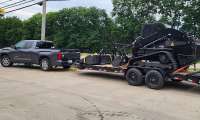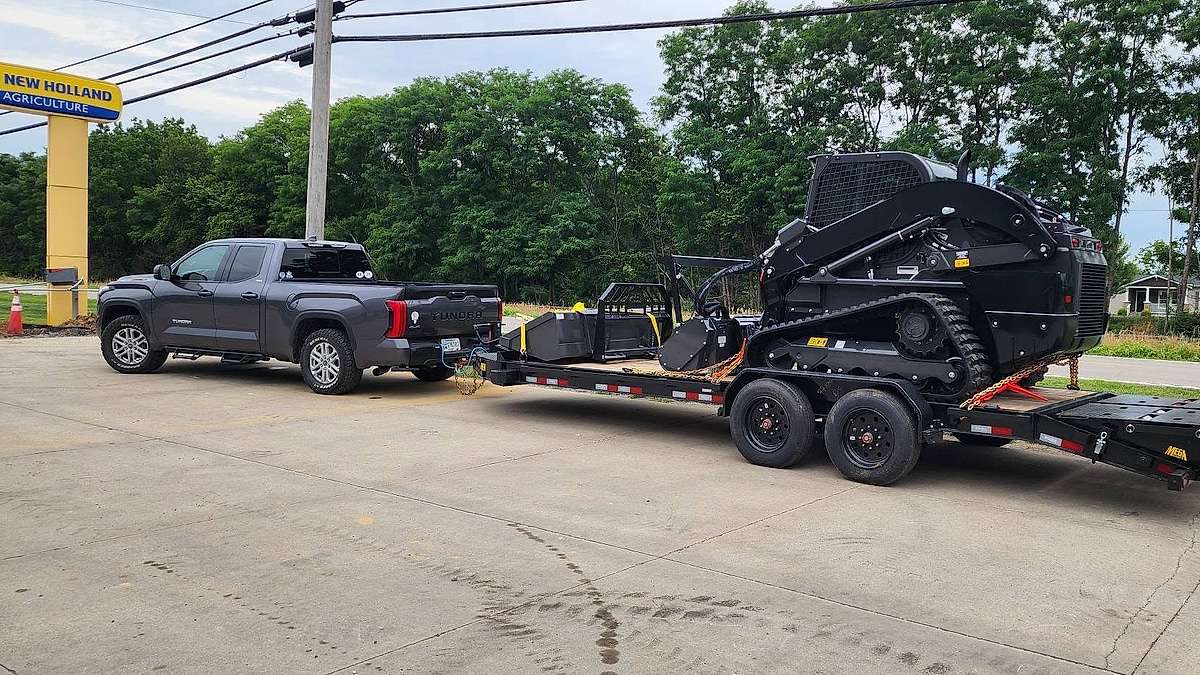

The photograph explains why people get themselves into trouble with modern trucks.
The Toyota Tundra sits there looking composed. No cartoon squat. No bumper dragging the pavement. No front end pointed toward low orbit. Behind it sits a 22-foot heavy-duty equipment trailer, a black tracked skid steer, and enough attachment weight to make the whole combination land somewhere between 17,500 pounds and just under 20,000 pounds by the owner’s estimate.
The truck moved it.
That is the dangerous part.
Kevin Harris posted the picture in a 2023-2027 Toyota Tundra owners group with the line every truck owner understands: should you pull it? No. Can you pull it? Absolutely.
- The estimated combined weight exceeded the Tundra’s maximum tow rating by thousands of pounds, highlighting how easily modern trucks can mask dangerous overload situations
- Proper trailer loading over the axles helped maintain stability and reduced visible squat, but did not reduce the total stress on the truck’s braking and structural systems
- The biggest limitation wasn’t pulling power but stopping ability, reinforcing that braking capacity, not engine strength, is often the true safety boundary in heavy towing scenarios
He did not dress it up as a recommendation. He said he had no other vehicle available when the equipment came in, lived about 11 miles from the store, stayed on rural roads where the highest speed limit was 45 mph, and never even reached that speed. He also said he had a 3500 4x4 dually Crew Cab coming the next day, which would become the truck for this work.
That context matters.
So does the weight.
The Tundra Passed The Easy Test
The easy test was motion.
A current Tundra has plenty of engine. Toyota’s twin-turbo V6 and 10-speed automatic give the truck the kind of low-rpm pull older half-tons could only fake with noise. The truck can tug hard before it feels dramatic. A short rural pull at low speed with the weight placed carefully over the trailer axles may feel almost reasonable from the driver’s seat.
That is how the trap works.
A modern half-ton can move loads that would have looked ridiculous behind earlier pickups. Power is no longer the first limit. Turbo torque has made half-ton trucks feel stronger than their ratings in ordinary moments. The Tundra can get the load rolling. The transmission can find a gear. The frame can take the initial pull. The rear suspension may look civilized if the trailer is loaded well.
The photograph shows a truck that still has its dignity.
A scale ticket would show the argument more clearly.
Toyota’s maximum published tow number for the current Tundra is 12,000 pounds in the right configuration. Many trims tow less. The owner’s load estimate was thousands of pounds beyond that figure. Even using the low end of his numbers, the trailer and cargo were around 17,500 pounds. That is roughly 5,500 pounds above Toyota’s best-case advertised ceiling. At just under 20,000 pounds, the gap grows to nearly 8,000.
That is not shaving a rating.
That is stepping into another class of truck.
The Picture Looks Calm Because The Load Is Placed Well
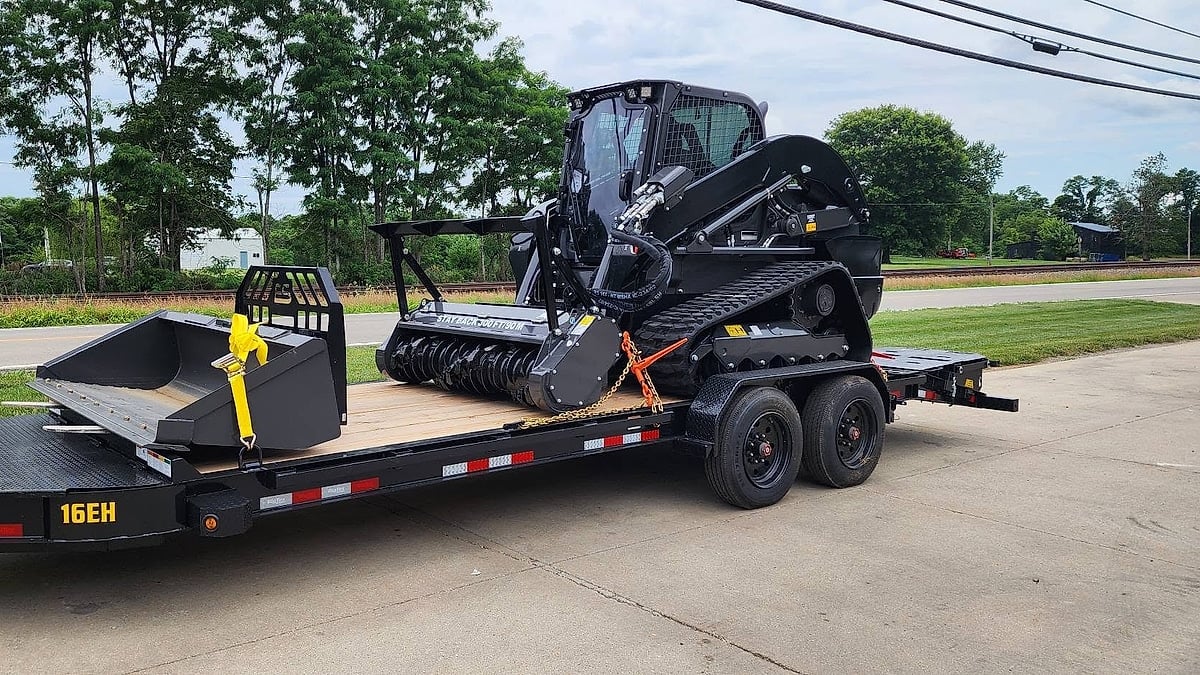
One commenter noticed the truck was not squatting. Another praised the way the trailer was loaded. The owner replied that the weight was over the axles.
That was the right instinct.
The skid steer sits over the tandem axles, keeping the trailer from dumping its full mass onto the Tundra’s hitch. Poorly loaded equipment trailers can ruin a tow vehicle before they ever leave the lot. Too much tongue weight crushes the rear axle and lifts weight from the steering tires. Too little tongue weight can make the trailer hunt, wag, and shove the truck around.
This load appears to have been placed with some thought.
Good loading does not cancel gross weight.
Even if the tongue weight was managed carefully, the total trailer weight still had to be pulled, controlled, and stopped. The receiver, frame, brakes, cooling system, tires, axles, transmission, and legal ratings did not change because the trailer looked level.
A clean stance can be a lie.
That is why “it didn’t squat” is useful only as a first glance. The real questions are uglier: what was the loaded trailer weight on a scale, what was the tongue weight, what did the rear axle carry, what was the combined weight, and how much stopping margin remained?
The Tundra photo answers none of those.
The owner’s comment about braking answers enough.
Stopping Was The Honest Part
Harris said the truck pulled fine, tracked straight, and got up to speed slowly but without trouble.
Then he talked about stopping.
That was “a whole other story,” in his words. He could feel the weight behind him and had to give himself plenty of time and space.
That line is the article.
The internet loves a pull. Truck culture loves proving what a machine can drag from one place to another. Engines get worshipped because power feels heroic. Brakes get treated like paperwork until the road ahead fills with brake lights.
A 20,000-pound load does not care how confident the driver felt during acceleration. It cares about kinetic energy. It cares about brake heat. It cares about the trailer brakes, controller settings, tire grip, pavement condition, and the one driver who pulls out without looking.
At 35 or 40 mph on quiet rural roads, Harris could manage the run by leaving room and staying patient. That does not convert the combination into a safe highway rig. Speed changes everything. Grade changes everything. Rain changes everything. A panic stop changes everything.
This is where a heavy-duty truck earns its money.
A 3500 dually does not merely bring more engine. It brings more axle, more tire, more brake, more frame, more receiver capacity, more cooling, more stability, and a greater appetite for ugly work. The dually is not glamorous compared with a new Tundra in a driveway. Hook it to a 20,000-pound equipment load, and the romance ends quickly.
The right truck is the one that makes the emergency less interesting.
Short Distance Changes Risk, But It Does Not Change Ratings
Harris’ clarification should be taken seriously.
This was not a 600-mile interstate haul. It was not a mountain descent. It was not a business model. It was one rural 11-mile move, on roads below 45 mph, in light traffic, by an owner who says he knew the setup was beyond what should be done regularly.
That makes the story different from some fool blasting down the interstate at 75 mph with an excavator and a prayer.
It does not make the combination within the rating.
Both truths can stand.
The owner reduced exposure by keeping the speed low, choosing a short route, and apparently loading the trailer carefully. He also accepted the mechanical and safety risk that Toyota’s ratings do not support. The fact that he made it home without drama should not become permission for another owner to copy the stunt across town during rush hour.
Truck forums often split into two useless camps. One side treats every overweight move like attempted murder. The other side treats ratings like suggestions written by nervous lawyers.
Reality sits between them.
Ratings include heat, braking, acceleration, durability, stability, hitch limits, axle loads, tire capacity, and repeatability. They are designed for more than whether the truck can tug a load across a parking lot. At the same time, real life occasionally puts people in imperfect situations where experience, speed, route choice, trailer brakes, and loading discipline separate a bad idea from a disaster.
Harris seemed to know the difference.
The problem comes when the next reader only remembers the picture.
The Engine Is The Least Interesting Survivor
Some commenters joked about the new Tundra’s V6. Others brought up the old 5.7-liter V8. A few treated the photo like proof that Toyota’s newer turbo engine can do anything a truck owner asks.
That misses the point.
This was never a clean engine test.
A powertrain surviving one overloaded low-speed pull says less than people want it to say. The engine had enough torque. The transmission got through the trip. Good. That should be expected of a modern pickup over 11 miles if the driver is gentle.
The fragile part of this story is the margin.
How much brake remained? How much tongue weight landed on the receiver? How much did the rear axle carry? How hot did the transmission get? What happened to the tires? Did the trailer brakes do most of the stopping? Could the truck have controlled a sway event? Would the same combination behave on a downhill grade at 60 mph?
Those questions do not fit neatly under a photo.
They decide whether the move was merely bold or genuinely foolish.
What The Owner Did Right
The owner admitted several things.
- He admitted upfront that the Tundra should not be used this way.
- He kept the route short.
- He stayed below the posted rural-road speeds.
- He loaded the machine onto the trailer axles.
- He paid attention to braking.
- He had the correct class of truck arriving for future work.
That combination of self-awareness and restraint is why the story has value. It shows the difference between an emergency one-off and a person confusing capacity with capability.
The Tundra did a job above its pay grade.
The owner appears to understand that the promotion was temporary.
The Takeaway For Other Tundra Owners
A Tundra can feel stronger than its rating.
Do not let that feeling write the plan.
The published tow rating, payload label, receiver rating, axle ratings, tire ratings, trailer-brake condition, and tongue weight all need to agree before a heavy tow becomes routine. A skid steer or equipment trailer should go across a scale before the owner guesses. Attachments add weight fast. Tongue weight can move dramatically depending on where the machine sits. Trailer brakes need testing before the truck reaches the road.
For a load approaching 20,000 pounds, the right answer is a heavy-duty truck or commercial transport.
The Tundra can move in the right low-speed rural circumstance.
That is not the same as owning the job.
Harris’ photo will make some owners grin. It made me look straight at the brakes.
The truck had the muscle to pull the load.
The driver had the sense to know he should not make a habit of it.
Tundra Owners, What Is The Heaviest Thing You Have Moved?
Share the actual trailer weight, tongue weight, distance, speed, truck trim, brake-controller setup, and whether the load was a one-time emergency or something you tow regularly.
Comment down below.
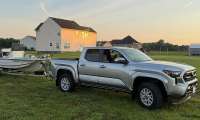
Two images by Kevin Harris
About The Author
Noah Washington is an automotive journalist based in Atlanta, Georgia, covering sports cars, luxury vehicles, and performance culture. His reporting focuses on explaining the engineering, design philosophy, and real-world ownership experience behind modern vehicles.
Noah has been immersed in the automotive world since his early teens, attending industry events and following the enthusiast communities that shape how cars are built and driven today. His work blends industry insight with enthusiastic storytelling, helping readers understand not just what a car is, but why it matters.
Noah is also a member of the Southeast Automotive Media Association (SAMA), a professional organization for automotive journalists and industry media in the Southeast.
His coverage regularly explores sports cars, luxury vehicles, and performance-driven segments of the automotive industry, including the evolving culture surrounding Formula Drift and enthusiast builds.
Read more of Noah's work on his author profile page.
You can also follow Noah here:
Set Torque News as Preferred Source on Google
Follow us today...