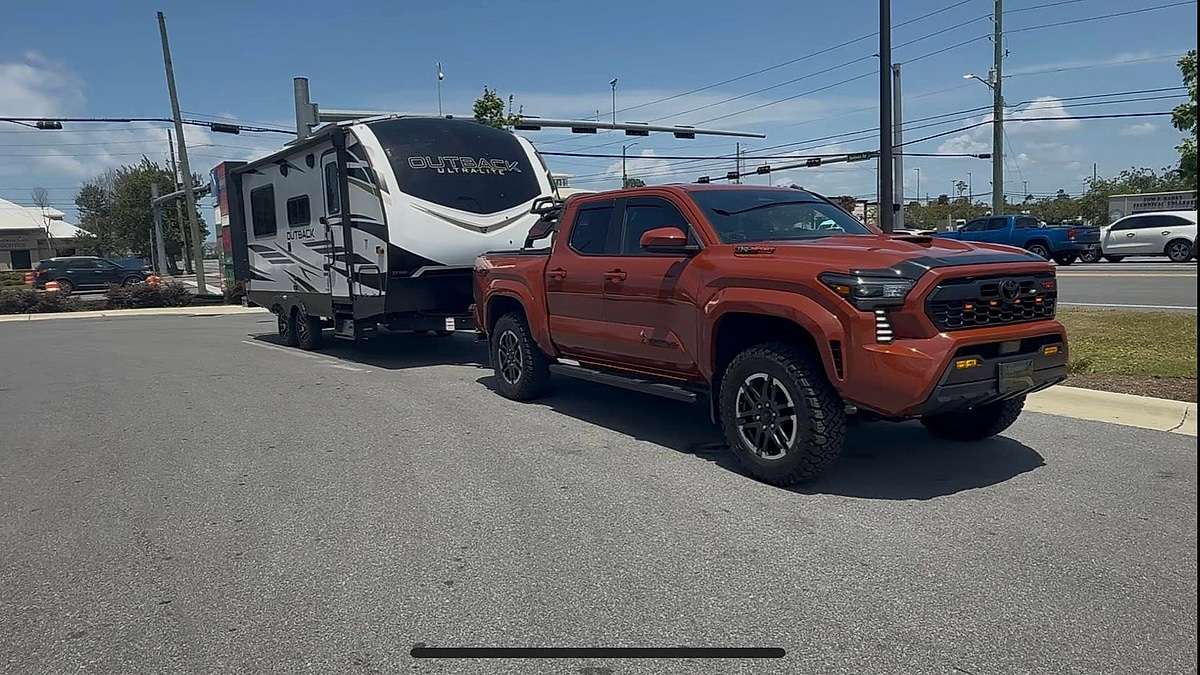

The photograph looks like a brochure shot for midsize-truck confidence.
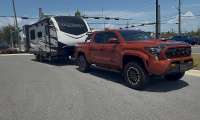
A fourth-generation Toyota Tacoma sits level in front of a tandem-axle Keystone Outback travel trailer. The trailer appears settled over its axles, the truck’s nose has not climbed toward the sky, and nothing about the stance suggests a midsize pickup working close to the upper edge of its towing envelope.
David Lewis’ photograph flatters the truck.
- A level stance doesn’t confirm a safe setup; without actual axle and tongue weight measurements, the truck could still be operating beyond its rated limits despite looking composed.
- The combination of a midsize truck and a full-height travel trailer puts aerodynamic drag front and center, which explains why fuel economy can swing dramatically with wind and speed.
- Real-world towing performance depends less on advertised tow ratings and more on how weight is distributed across the truck, trailer, and hitch once everything is loaded for the trip.
The Firestone airbags are doing exactly what he bought them to do.
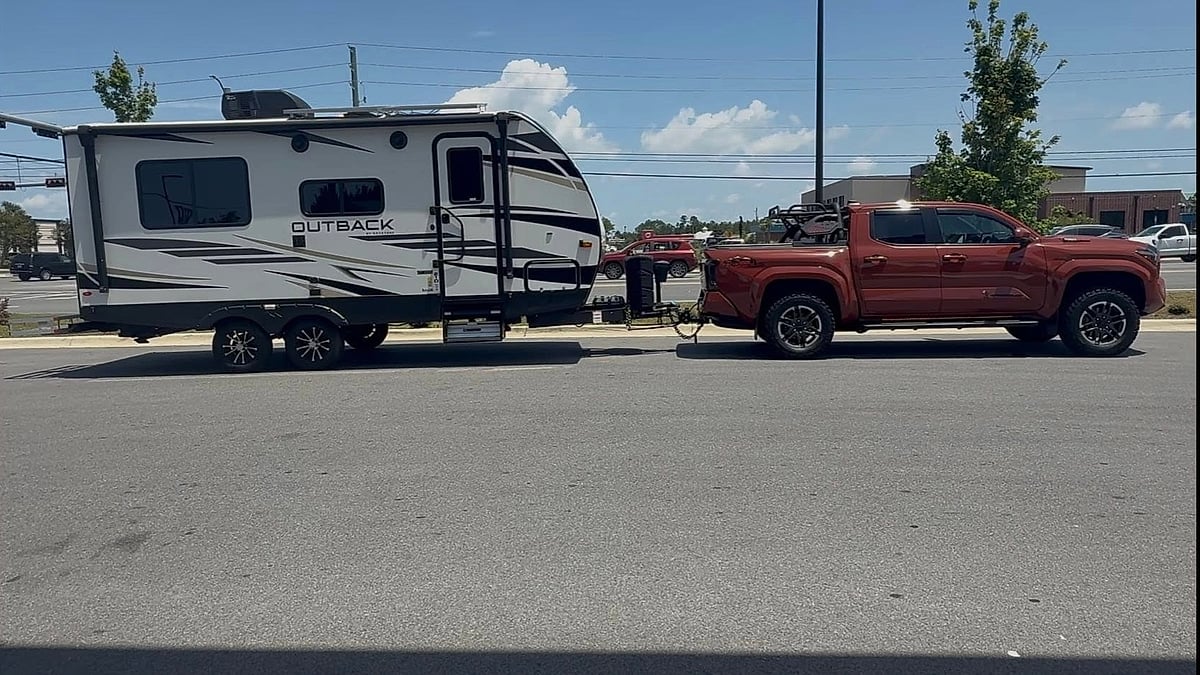
On Facebook, Lewis says the trailer weighs about 5,000 pounds empty and roughly 5,700 pounds loaded. He completed a 500-mile round trip, held approximately 65 mph for much of it, crossed a few small hills, and came away impressed by the nonhybrid Tacoma. Fuel economy generally landed between 12 and 15 mpg. A strong headwind dragged it as low as 7 mpg.
He also had an aftermarket trailer-brake controller installed by the dealer.
That is a useful owner report. Five hundred miles gives the truck enough time to reveal poor stability, weak power, bad shift behavior, inadequate cooling, or an unpleasant relationship with the trailer. Lewis reported none of that. The turbocharged Tacoma moved the Outback with enough confidence that he called it a very capable little truck.
I believe him.
I would still visit a scale before drawing any larger conclusion from the photograph.
The Photograph Proves The Airbags Work
Airbags are excellent at making a truck stand straight.
They cannot negotiate with the certification label inside the driver’s door.
Firestone’s Ride-Rite kit for the fourth-generation Tacoma can provide as much as 5,000 pounds of load-leveling support. That number sounds enormous until the important sentence arrives: the system does not increase the vehicle’s weight-carrying capacity.
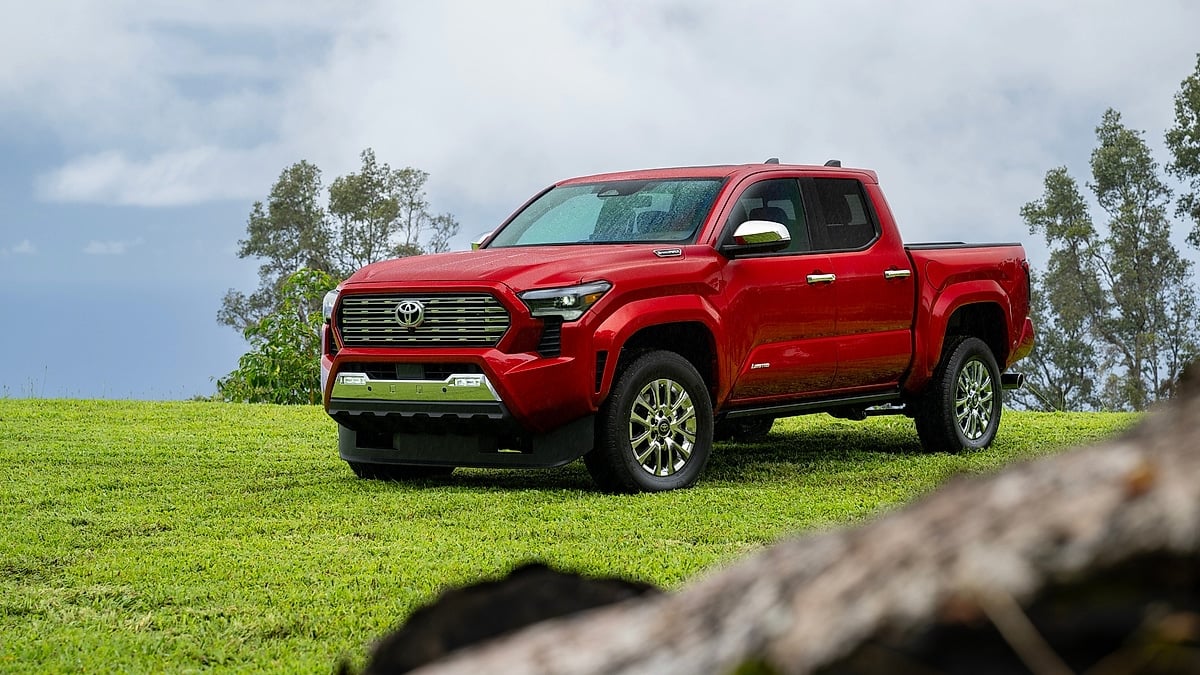
The airbags supplement the rear suspension. They can reduce squat, help prevent bottoming, calm body movement, restore headlight aim, and improve the way a loaded truck feels. Those are meaningful benefits.
The truck’s GVWR, rear-axle rating, tire limits, receiver rating, payload allowance, and maximum tongue weight remain exactly where Toyota placed them.
An overloaded truck can pose for a clean photograph.
The rear suspension may sit at factory height while the rear axle carries too much weight. The front axle may have lost load from the trailer tongue. The payload sticker may already be exceeded by passengers, bed equipment, hitch hardware, and trailer load.
Air pressure can conceal squat.
It cannot conceal weight from a certified scale.
The Missing Number Is Tongue Weight
The owner supplied the trailer’s loaded weight. The tongue figure would tell us far more about the Tacoma’s margin.
Toyota’s fourth-generation Tacoma reaches a 6,500-pound maximum tow rating only in selected configurations. Many nonhybrid Double Cab versions in Toyota’s published table carry ratings of 6,300 or 6,400 pounds. Their listed maximum tongue weight is 640 pounds.
Lewis’ 5,700-pound trailer therefore sits roughly 600 to 700 pounds below the maximum trailer rating for many likely configurations.
That sounds comfortable.
A conventional travel trailer generally needs approximately 10 to 15 percent of its loaded weight on the tongue for stable tracking. At 5,700 pounds, that range looks like this:
- 10 percent: 570 pounds
- 11 percent: 627 pounds
- 12 percent: 684 pounds
- 13 percent: 741 pounds
- 15 percent: 855 pounds
A tongue load around 11 percent would sit near Toyota’s published 640-pound ceiling. Twelve percent would exceed it.
Nobody can determine the actual number from the photograph. The trailer’s axle position, cargo placement, propane, batteries, water, food, tools, and storage compartments all affect the result.
Travel trailers often become front-heavy in ordinary use. Propane cylinders and batteries usually sit on the tongue. Owners fill forward storage compartments because they are easy to reach. Camping gear accumulates. The claimed 700-pound jump from empty to loaded does not distribute itself evenly across the frame.
The truck’s payload gets consumed at the same time.
Suppose the trailer places 640 pounds on the hitch. Add perhaps 75 to 100 pounds for hitch equipment, two adults, cargo in the cab, the bed rack visible in the photograph, and anything carried in the bed. A Tacoma with 1,400 or 1,500 pounds on its door sticker can lose its remaining margin quickly.
The national maximum payload figure of 1,705 pounds belongs to a particular configuration. It does not follow every Tacoma off the assembly line.
The sticker inside Lewis’ truck gives the only relevant allowance.
The Wind Found The Trailer’s Largest Number
Lewis reported 12 to 15 mpg during much of the trip, with fuel economy occasionally dropping to 7 mpg in heavy headwinds.
That swing makes sense once the trailer is viewed from the front.
A travel trailer may weigh 5,700 pounds, though the air sees square feet. The tall Outback body creates a large wall behind the Tacoma. At steady highway speed, aerodynamic work can dominate the fuel bill.
A headwind changes the speed of the air moving across the rig.
At a road speed of 65 mph, a 20-mph headwind produces approximately 85 mph of relative airflow. Aerodynamic drag force rises with the square of airspeed. The power needed to push through that air rises even more sharply.
Compared with still-air travel at 65 mph, the aerodynamic portion of the job can more than double in a strong headwind.
The Tacoma’s turbocharged four-cylinder can supply the power without the old V6 theatrics. The transmission finds a gear, boost rises, and the truck keeps moving. The fuel gauge records the argument.
Lewis’ 7-mpg figure carries a second consequence because the fourth-generation Tacoma has an 18.2-gallon fuel tank.
- At 15 mpg, the mathematical full-tank range is about 273 miles.
- At 12 mpg, it falls to approximately 218 miles.
- At 7 mpg, it collapses to about 127 miles.
A sensible fuel reserve shortens each of those figures. During the worst headwind, the driver may need to begin looking for fuel after roughly 100 miles.
That can become more restrictive than power or tow rating on a long trip. The Tacoma may pull the trailer willingly while the small tank decides the schedule.
The wind revealed the cost of towing a large frontal area with a midsize truck.
The Brake Controller Was The Right Upgrade
One commenter said his much lighter boat made the Tacoma’s brakes feel weak and wondered about adding trailer brakes.
Lewis had already solved that part of the setup. His dealer installed an aftermarket brake controller.
A 5,700-pound travel trailer should carry functioning brakes, correctly adjusted and matched to the controller. The controller allows the trailer to contribute to stopping rather than asking the Tacoma to convert the entire combination’s momentum into heat through four truck brakes.
The gain still needs calibration.
Too little trailer braking makes the truck do excessive work. Too much can lock or tug the trailer wheels, especially on wet pavement or loose surfaces. The manual control should produce a firm, progressive response without jerking the combination.
A brake controller improves stopping authority.
It cannot compensate for an overloaded rear axle, inadequate tongue balance, worn trailer brakes, underinflated tires, or a hitch that has not restored enough load to the Tacoma’s front axle.
Every part has one job.
The airbags manage rear ride height. The trailer brakes help stop the trailer. The hitch controls the physical connection and may distribute load if it is a weight-distributing design. None of those components changes the ratings Toyota printed for the truck.
One Scale Visit Would Finish The Article
Lewis has already completed the expensive part. He bought the trailer, installed the airbags and brake controller, and ran a 500-mile test without reporting instability or mechanical trouble.
A certified scale would supply the remaining evidence.
I would make three passes:
First, weigh the fully loaded truck and trailer exactly as they travel, with passengers, camping gear, fuel, propane, batteries, water, and hitch equipment aboard.
Second, weigh the combination with the weight-distribution spring bars released, if the setup uses them.
Third, weigh the loaded truck without the trailer.
Those figures reveal the loaded trailer weight, actual tongue load, truck weight, front-axle restoration, rear-axle load, and total combination weight. They can be compared with the Tacoma’s GVWR, front and rear axle ratings, tire capacities, receiver limit, maximum tongue weight, GCWR, and trailer rating.
If every figure fits, Lewis has a documented towing setup rather than a comment-section argument.
If the tongue exceeds 640 pounds, the answer may require moving cargo rearward carefully, reducing load, selecting a lighter trailer, or moving to a truck with more receiver and payload capacity. Cargo should never be shifted far enough rearward to create an unstable, light-tongue trailer.
The scale provides the boundary.
The road test provides the character.
Lewis’ Tacoma appears to have passed the character test. It pulled 5,700 pounds for 500 miles at 65 mph, remained composed enough to satisfy its owner, and used its turbocharged power without making the trip feel like mechanical punishment.
The Firestone system kept the truck standing properly.
Now I want the scale ticket.
A midsize pickup working near its published tow limit deserves more than a level stance and a good feeling from the driver’s seat. It deserves exact axle and tongue numbers, especially when the typical tongue-weight range brushes against Toyota’s maximum.
That evidence would make the owner’s praise far more valuable.
The Tacoma can pull the trailer.
The ticket can prove the whole combination belongs together.
Fourth-Generation Tacoma Owners, Post Your Scale Numbers
If you tow a travel trailer with a 2024-or-newer Tacoma, share the exact trim, door-sticker payload, loaded trailer weight, tongue weight, axle readings, highway speed, fuel economy, and whether airbags or a weight-distributing hitch changed the way the truck handled.
If you’ve run a similar setup, or you’ve got scale tickets that tell a different story, share it with us in the comments.
Two images by David Lewis
About The Author
Noah Washington is an automotive journalist based in Atlanta, Georgia, covering sports cars, luxury vehicles, and performance culture. His reporting focuses on explaining the engineering, design philosophy, and real-world ownership experience behind modern vehicles.
Noah has been immersed in the automotive world since his early teens, attending industry events and following the enthusiast communities that shape how cars are built and driven today. His work blends industry insight with enthusiastic storytelling, helping readers understand not just what a car is, but why it matters.
Noah is also a member of the Southeast Automotive Media Association (SAMA), a professional organization for automotive journalists and industry media in the Southeast.
His coverage regularly explores sports cars, luxury vehicles, and performance-driven segments of the automotive industry, including the evolving culture surrounding Formula Drift and enthusiast builds.
Read more of Noah's work on his author profile page.
You can also follow Noah here:
Set Torque News as Preferred Source on Google
Follow us today...