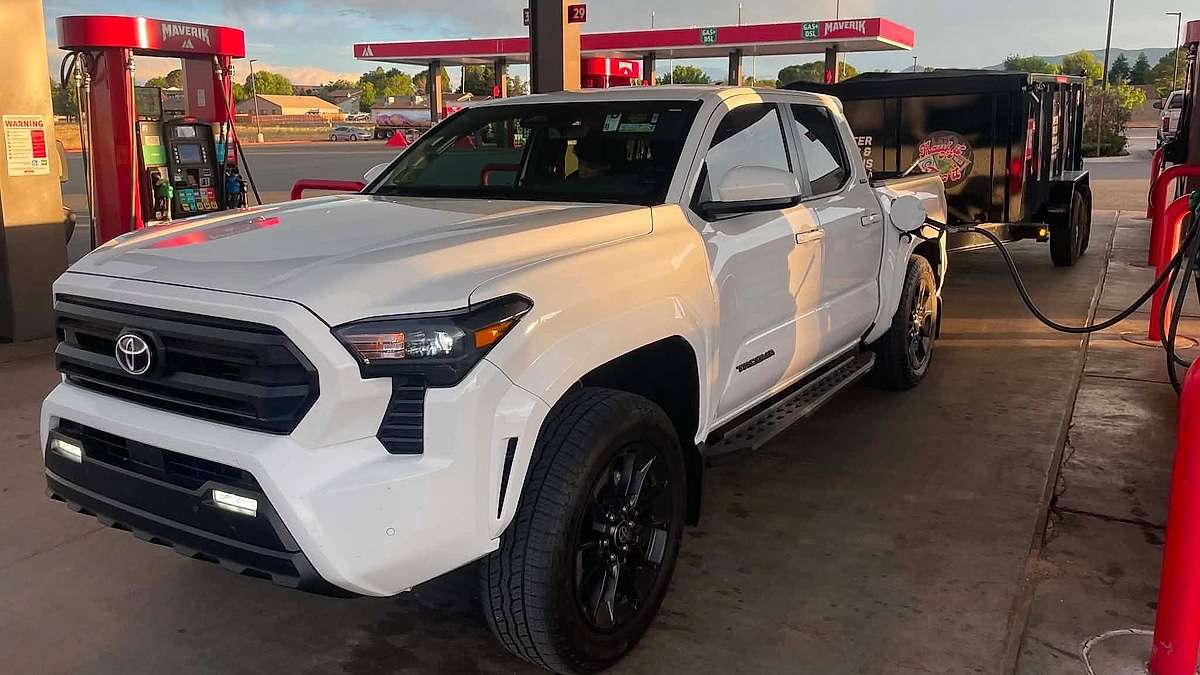

A Toyota Tacoma owner borrowed his own truck for a job that usually belongs to a 2500 HD Chevy, and the little Toyota gave him a number he did not like.
Ryan Johnson, posting in a 4th-generation Tacoma owners group, used his Tacoma for a junk-removal run about 30 miles away because his wife had the heavy-duty Chevy. The trailer weighed 4,400 pounds empty. He estimated another 1,000 pounds went into it for the ride home. Rolling hills. About 60 mph. A load that sits inside Tacoma tow-rating territory, yet large enough to remind a midsize truck what work feels like.
That was not the complaint.
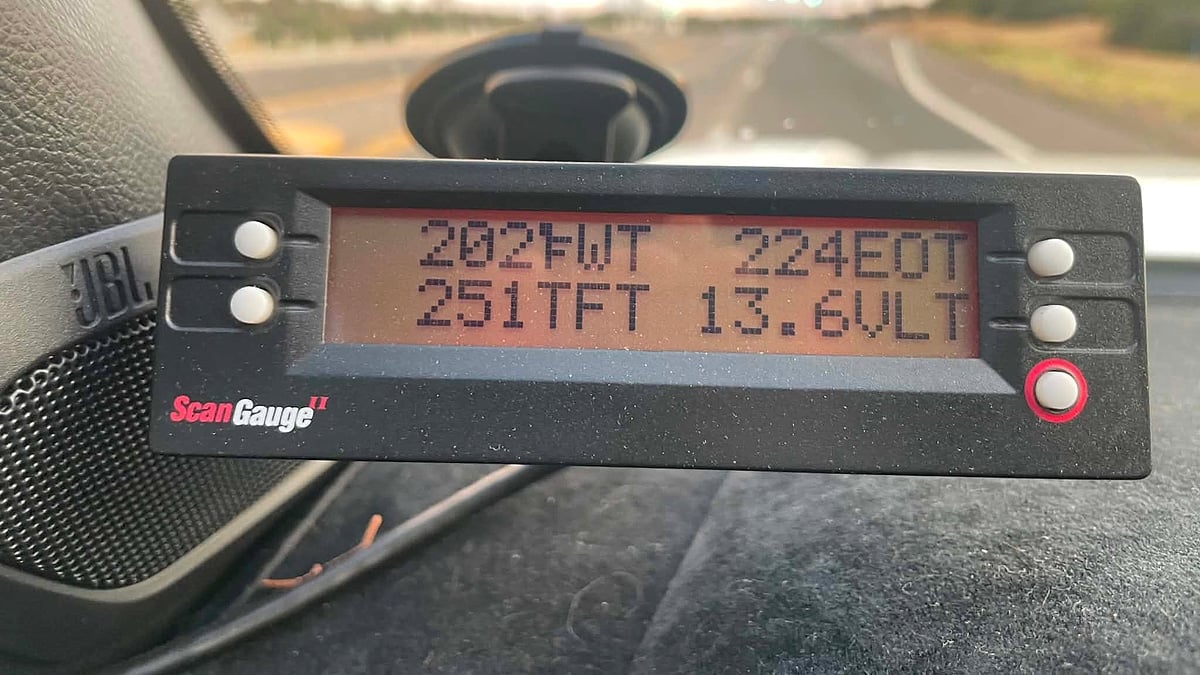
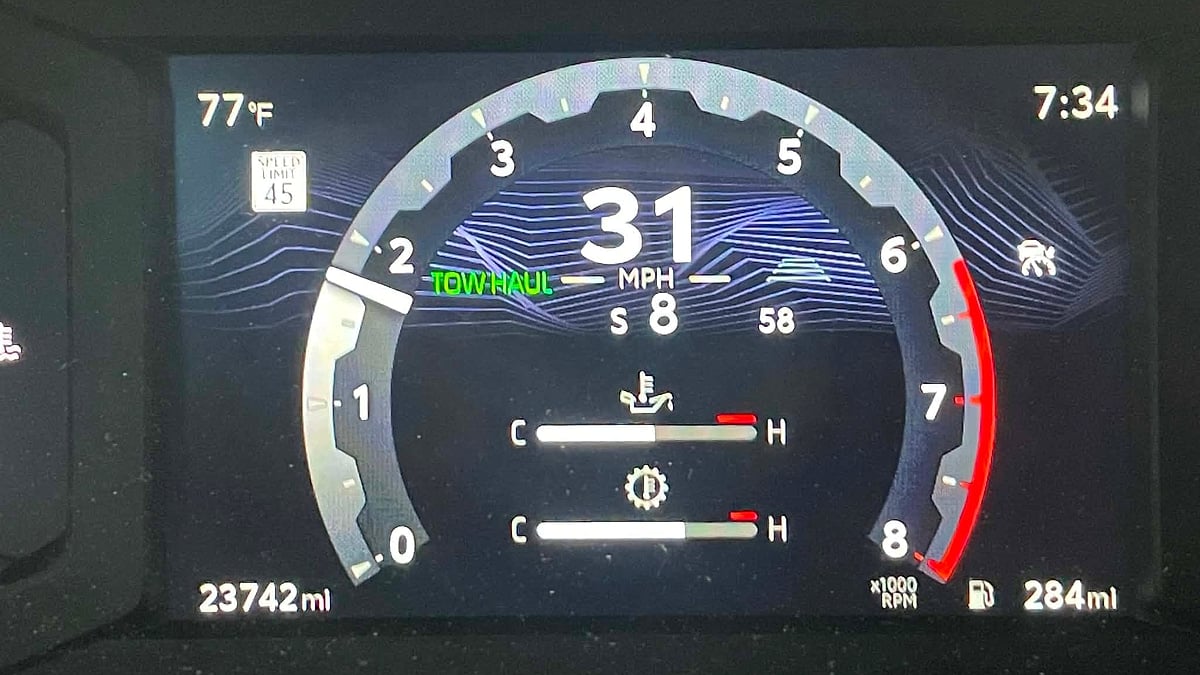
The transmission temperature sat at 240 degrees on the way out and reached 251 degrees on the way back. Johnson said he had towed the same trailer with other trucks, and even once with a 2021 4Runner Off-Road Premium, without seeing temperatures like that. The 4Runner was much slower, he admitted, but it stayed under 215 degrees in similar hilly terrain.
Why Tow Ratings Don't Tell the Whole Story
- A 5,400-pound trailer can still sit inside the Tacoma’s tow rating while pushing the truck close to its real-world thermal comfort zone.
- Tongue weight, payload, trailer drag, speed, and hills matter as much as the number stamped in the brochure.
- The new turbo Tacoma’s power makes towing feel easier, but the transmission temperature shows how hard the drivetrain is still working.
The new Tacoma pulls harder, feels stronger, and does not act strained. The gauge tells a less flattering tale. The truck can move the load. The transmission is the one sweating through its shirt.
Power can hide heat
The 4th-gen Tacoma changed the old Toyota truck formula. The 2.4-liter turbocharged i-FORCE engine gives the gas Tacoma up to 278 horsepower and 317 lb-ft of torque, backed by an 8-speed automatic. The hybrid i-FORCE MAX turns the number up further, with 326 horsepower and 465 lb-ft. On paper, this generation has the muscle old Tacoma owners begged Toyota to provide for years.
Toyota gave it the muscle.
Now owners are discovering where the heat goes.
A small turbo engine and modern automatic can make towing feel easy at the pedal. The torque comes early, the transmission keeps the engine in the meat of the powerband, and the truck no longer sounds like an old V6 being dragged up a grade by its own fingernails. That can fool a driver. The truck does not feel busy. The drivetrain still works hard.
A 5,400-pound trailer behind a Tacoma is not a casual errand. Add tongue weight, passengers, tools, junk, hills, airflow, temperature, tires, lift, accessories, and the little aerodynamic gift basket created by a utility trailer. Suddenly the phrase “within rating” has to share space with another phrase owners hate: thermal margin.
Tow rating answers one question.
Can the truck pull this weight under defined conditions?
The owner’s transmission gauge asks a meaner question.
How much heat does the truck carry while doing it?
A rated load can still be a hard load
The online argument went where these arguments always go. One camp said 240 to 250 degrees is not a disaster. Another camp said transmission fluid starts aging fast once temperatures climb past the low 200s. Someone pasted the old rule about every 20-degree rise cutting fluid life. Someone else called that AI nonsense.
I understand the instinct on both sides.
A single 251-degree reading does not mean the Tacoma is ruined. Modern transmission fluid, control logic, and heat-management strategies are more complex than the old garage charts floating around Facebook. The internet loves turning one number into an obituary.
Still, I would not wave off 251 degrees like it was a seat-heater setting.
Heat is cumulative. Fluid does not need to fail theatrically to have its life shortened. Seals, clutch material, shift quality, varnish, and long-term wear all live downstream from repeated heat. A truck that sees 240 to 251 degrees every time it pulls a moderate-to-heavy trailer through hills deserves attention.
Not panic.
Attention.
That difference matters in the mechanical sense, and I’m using the word once because it earns its keep here.
If I owned this Tacoma, I would not run to the internet for a bypass valve before the dealer saw the truck. I would document the exact load, route, speed, drive mode, outside temperature, coolant temperature, gear behavior, trailer weight, and tongue weight. I would save photos of the gauge. Then I would ask the dealer what Toyota considers normal under these conditions and whether the transmission logged any thermal events.
That is how you separate “normal but ugly” from “fix this before warranty becomes a debate.”
The hot-coolant smell is the stray fingerprint
Johnson also mentioned the smell of hot coolant when he got home.
That detail should not be buried under the transmission-temperature argument.
One commenter noted that a 202-degree coolant reading is nowhere near hot enough by itself to explain a coolant smell. I agree with the shape of that concern. A modern cooling system can smell hot after towing, especially around a turbocharged truck that has been working through hills, but a distinct coolant odor deserves a simple inspection.
Look for residue around the reservoir cap, hoses, clamps, radiator, charge-air cooling components, heater lines, and any area where a tiny leak can evaporate before it ever leaves a puddle. Check the coolant level cold. Check it again after another tow. A pressure test can end the guessing.
A transmission temperature number gets the drama. A faint coolant smell can be the smaller clue that saves time.
That is the kind of detail owners should report to the dealer exactly as experienced. Do not say, “It smelled hot.” Say, “After towing about 5,400 pounds through rolling hills at 60 mph, transmission temperature reached 251 degrees and I noticed coolant odor after parking, while coolant temperature read about 202 degrees.”
That sentence gives a technician something to work with.
Tow/Haul may not always run cooler
Another owner in the thread brought up a useful point: Tow/Haul mode can hold gears longer, keep rpm higher, sharpen response, and improve control, especially in hills. He said his Tacoma ran hotter in Tow/Haul while towing close to a fully loaded camper, while temperatures stayed lower with Tow/Haul off in some terrain.
Johnson replied that he always tows in Tow/Haul.
I do not read that as operator error. I read it as a reminder that Tow/Haul is a calibration, not a magic cooling switch.
Sometimes the mode helps because it reduces gear hunting, keeps the transmission out of lazy overdrive behavior, and improves downhill control. Sometimes it keeps the truck in a more aggressive strategy that builds more heat on a particular road with a particular load. The correct answer may change with grade, speed, trailer drag, ambient temperature, and how the transmission is managing converter lockup.
That is where a data-minded owner can learn fast.
Run the same route with the same load in Tow/Haul. Record temperature, gear behavior, speed, and rpm. Run it again without Tow/Haul if the manual and conditions allow. Do not abuse the truck. Do not chase a lower number at the expense of control. Use the test to understand what the transmission prefers on your route.
The best tow mode is the one that keeps the truck controlled, predictable, and thermally stable.
Not the one that sounds most truck-like on the button.
The 4Runner comparison cuts deeper than people think
Johnson’s 2021 4Runner comparison annoyed some people because the 4Runner was slower. That is exactly why the comparison is useful.
The old 4Runner is ancient in the way a cast-iron skillet is ancient. Body-on-frame. Naturally aspirated V6. Old-school automatic. No rush. No turbo torque masquerade. It tows like it has a calendar instead of a watch. Yet the owner says it kept the transmission cooler with the same trailer in similar terrain.
That does not automatically make the 4Runner the better tow vehicle. It was slower, and Toyota did not design it to win modern payload or power arguments. The comparison exposes the character difference between old Toyota durability theater and new Toyota performance strategy.
The old truck made struggle obvious.
The new Tacoma can hide struggle behind torque.
That is why gauges are useful. A confident accelerator pedal does not prove the drivetrain is happy. It proves the engine can answer the call.
The transmission temperature tells the longer story.
The bypass valve temptation
Several owners mentioned transmission cooler thermostat bypasses and aftermarket coolers. One said a bypass kept his transmission around 160 degrees. Another talked about a larger cooler and fan setup after repeated heat in the Sierras.
I get the urge. Truck people see heat and immediately want plumbing.
A bypass or auxiliary cooler may help some use cases. It may also create warranty questions, overcooling concerns in winter, fitment issues, leaks, and a new place for blame if the transmission later acts up. On a new 4th-gen Tacoma, I would slow down before modifying the thermal circuit.
First, get a baseline. Weigh the trailer loaded. Confirm tongue weight. Check the truck’s payload sticker, because tongue weight and cargo can run out the payload before tow rating is reached. Confirm tire pressures. Check for grille blockers, big tires, lift kits, skid plates, winches, bumper changes, or anything that changes cooling airflow and load. Ask the dealer to inspect fluid level, cooling lines, software updates, and logged data.
If Toyota says the behavior is normal and you tow this weight often, then the cooler discussion becomes fair. At that point, the question shifts from warranty diagnosis to owner use case.
A Tacoma doing occasional dump runs is one thing.
A Tacoma dragging 5,000-plus pounds through hills every week is living a different life.
The midsize-truck tax
This is where the heavy-duty Chevy in the opening becomes important.
The job usually belongs to a 2500 HD. That truck would treat a 5,400-pound trailer like a warm-up lap. More cooling capacity. More mass. More brake. More axle. More transmission designed around abuse. More everything.
The Tacoma can do the job. It cannot become a three-quarter-ton truck through badging, torque, or optimism.
Midsize trucks sell a beautiful promise: enough truck for real life without the parking-lot punishment of a full-size. That promise works until your real life starts looking like repeated heavy towing. Then the smaller truck pays its tax in heat, braking demand, payload math, and owner anxiety.
That does not make the Tacoma weak.
It makes the Tacoma honest.
A 5,400-pound trailer in hills is a big ask for a midsize pickup, especially if the route repeats. Toyota’s published maximum tow number sits as high as 6,500 pounds depending on configuration, and some Double Cab i-FORCE versions land around 6,300 to 6,400 pounds. Johnson’s trailer estimate sits under those ceilings, assuming his configuration and payload math support it. Under the number does not mean effortless. Under the number does not mean cool.
The sticker is a legal and engineering boundary.
The gauge is the truck speaking in real time.
Tacoma owners, what temps are you seeing?
If you tow with a 2024 to 2026 Tacoma, share your trailer weight, terrain, speed, Tow/Haul use, outside temperature, and peak transmission temperature. The useful comparison is not the tow rating. The useful comparison is what the truck does after 20 miles of hills with a real trailer behind it.
Images by Ryan Johnson.
About The Author
Noah Washington is an automotive journalist based in Atlanta, Georgia, covering sports cars, luxury vehicles, and performance culture. His reporting focuses on explaining the engineering, design philosophy, and real-world ownership experience behind modern vehicles.
Noah has been immersed in the automotive world since his early teens, attending industry events and following the enthusiast communities that shape how cars are built and driven today. His work blends industry insight with enthusiastic storytelling, helping readers understand not just what a car is, but why it matters.
Noah is also a member of the Southeast Automotive Media Association (SAMA), a professional organization for automotive journalists and industry media in the Southeast.
His coverage regularly explores sports cars, luxury vehicles, and performance-driven segments of the automotive industry, including the evolving culture surrounding Formula Drift and enthusiast builds.
Read more of Noah's work on his author profile page.
You can also follow Noah here:
Set Torque News as Preferred Source on Google
Follow us today...