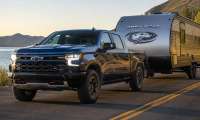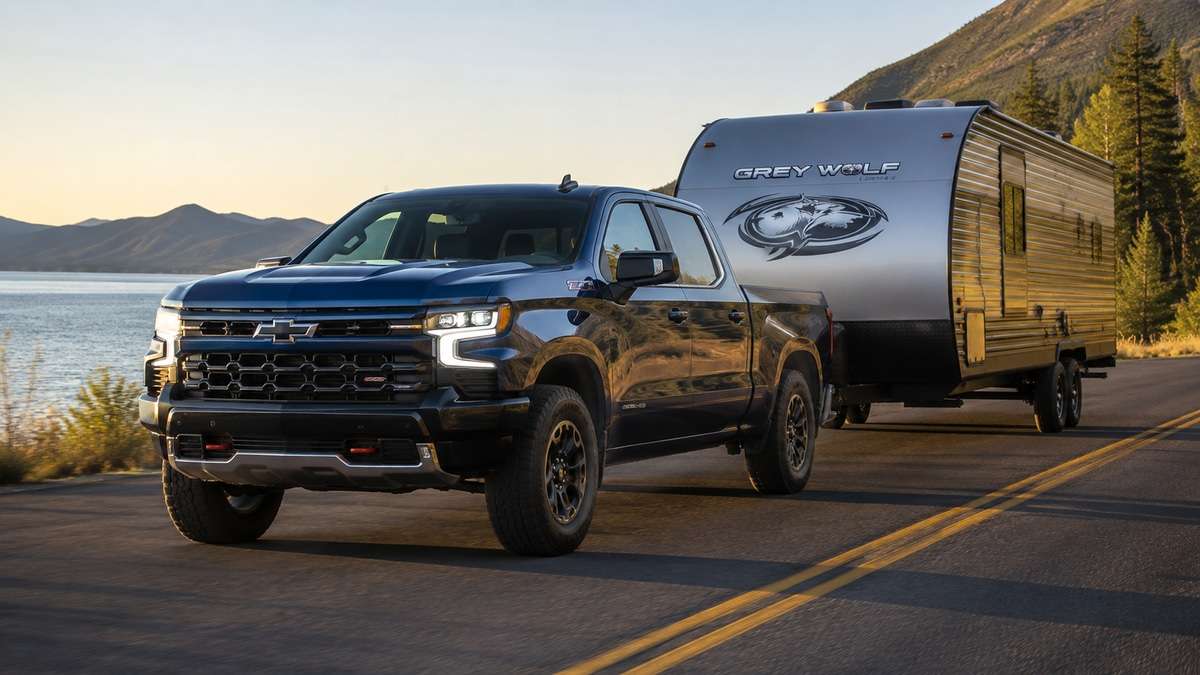

A 2025 Chevrolet Silverado 1500 Crew Cab 4x4 can receive a 13,000-pound conventional tow rating with the 3.0-liter Duramax. Choose the ZR2 with the same diesel engine, and Chevrolet lowers the number to 8,700 pounds.
That is a 4,300-pound difference, enough to separate a large travel trailer from a much smaller one. The obvious suspects are the ZR2’s lift, Multimatic DSSV suspension, off-road tires, additional weight and softer off-road tuning.
Chevrolet’s own trailering chart reveals a more complicated answer. A regular short-bed Crew Cab 4x4 Duramax without Max Trailering is rated for 9,000 pounds and carries the same 15,000-pound gross combination weight rating as the ZR2. Against that truck, the ZR2 loses only 300 pounds.
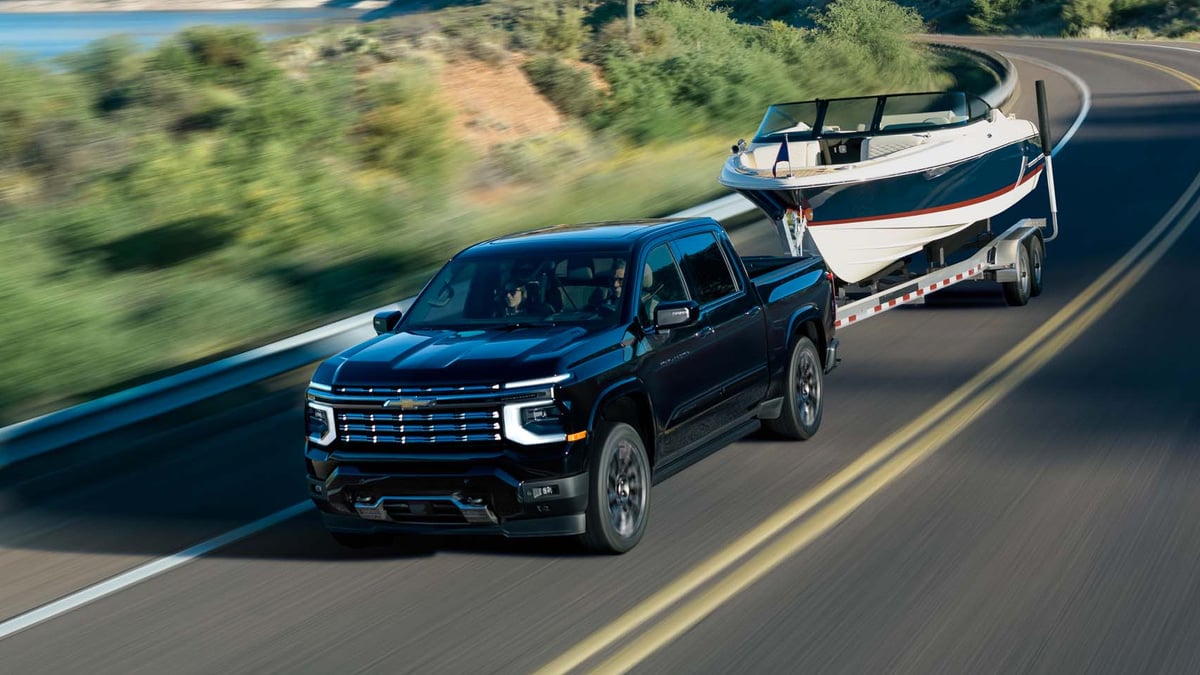
The remaining 4,000 pounds appears when Chevrolet adds Max Trailering equipment and raises the truck’s GCWR from 15,000 to 19,000 pounds.
In other words, the full 4,300-pound gap cannot be blamed on the ZR2 package alone. Chevrolet is comparing the off-road truck with a separately equipped and separately rated Max Trailering configuration.
Chevrolet’s Chart Splits the Missing 4,300 Pounds
The Chevrolet Silverado 1500’s towing limits vary considerably depending on its equipment, even within the Crew Cab, short-bed, four-wheel-drive configuration.
A standard Silverado 1500 with the 3.0-liter Duramax has a 15,000-pound gross combined weight rating and a maximum conventional trailer rating of 9,000 pounds.
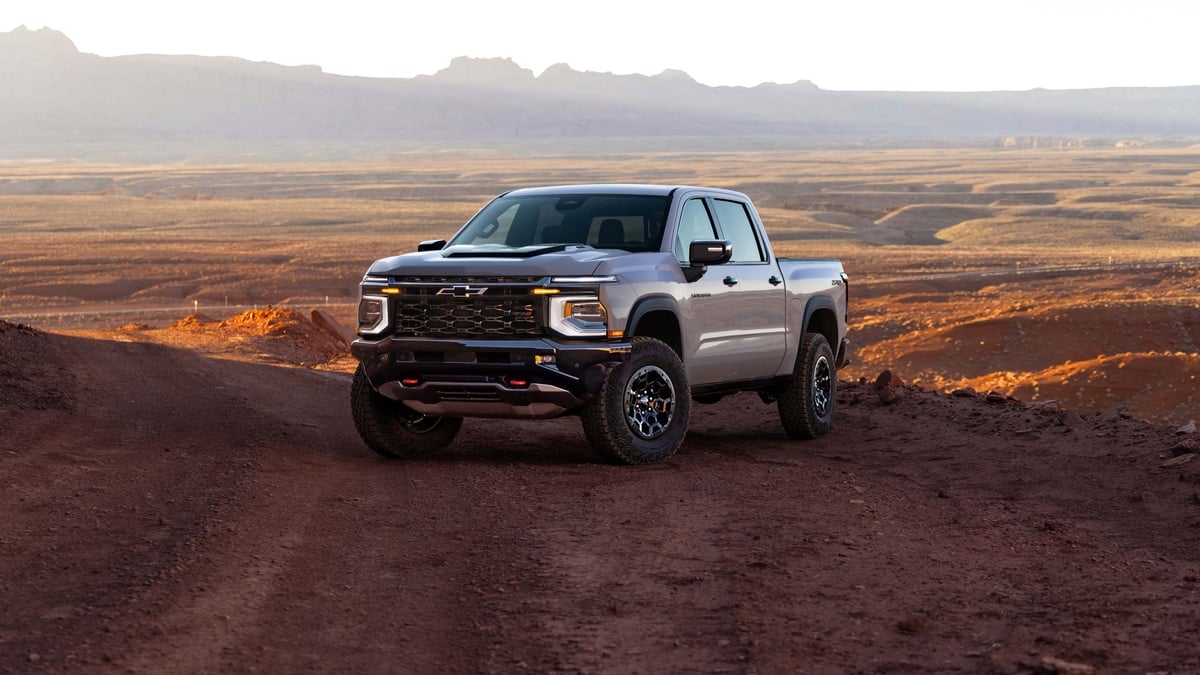
The ZR2 with the same 3.0-liter Duramax retains the 15,000-pound gross combined weight rating, but its maximum conventional trailer rating falls slightly to 8,700 pounds.
Adding the Max Trailering Package and 18-inch wheels raises the gross combined weight rating to 17,800 pounds and the maximum conventional trailer rating to 11,800 pounds.
The highest-rated version uses the Max Trailering Package with 20-inch wheels. That configuration carries a 19,000-pound gross combined weight rating and a maximum conventional trailer rating of 13,000 pounds.
Those figures divide the headline difference into two separate engineering decisions. The ZR2-specific reduction is 300 pounds when both trucks are held to a 15,000-pound GCWR. Max Trailering then adds as much as 4,000 pounds of GCWR and trailer capacity.
That distinction changes the investigation. The question is no longer whether DSSV dampers somehow erase 4,300 pounds of towing capacity. The harder question is why Chevrolet gives the Max Trailering truck a 19,000-pound GCWR while holding the Duramax ZR2 at 15,000 pounds.
The First 300 Pounds Is Consistent With the ZR2’s Additional Weight
Subtract each maximum trailer rating from its corresponding GCWR:
- Standard Duramax: 15,000 minus 9,000 equals 6,000 pounds.
- Max Trailering with 18-inch wheels: 17,800 minus 11,800 equals 6,000 pounds.
- Max Trailering with 20-inch wheels: 19,000 minus 13,000 equals 6,000 pounds.
- Duramax ZR2: 15,000 minus 8,700 equals 6,300 pounds.
Chevrolet explains that its published maximum trailer ratings use the tow vehicle’s curb weight plus standardized allowances for a 150-pound driver and a 150-pound front passenger. Options, passengers, cargo and equipment can reduce the trailer weight available to an individual truck.
The ZR2 row leaves 300 pounds more on the truck side of the equation than the other three rows. That is exactly the size of its towing reduction against the standard 15,000-pound GCWR Duramax.
This strongly suggests that the ZR2’s heavier standardized configuration accounts for much of the direct 300-pound difference. A VIN-matched comparison of actual curb weights and door labels would be needed to prove that explanation.
It cannot explain the other 4,000 pounds because the standard Duramax and ZR2 already share the same GCWR.
The 13,000-Pound Truck Has More Than the Same Engine
Max Trailering adds much more than a receiver hitch.
A representative 2025 Silverado 1500 RST Duramax window sticker lists a 9.76-inch rear axle, an enhanced cooling radiator, revised shock tuning, heavy-duty rear springs and increased gross axle weight rating as parts of the Max Trailering Package. That truck also has a 3.73 rear axle ratio and 20-inch wheels.
A representative Duramax ZR2 window sticker lists the two-inch lift, DSSV dampers, skid plates, hill-descent control, heavy-duty air filter, Goodyear Wrangler Territory tires and the standard Trailering Package. Its rear axle ratio is 3.23.
Both representative trucks list a 7,300-pound GVWR. The Max Trailering truck’s 4,000-pound GCWR advantage therefore does not come from a higher GVWR on those two window stickers.
The 3.73-to-3.23 gearing difference is one important clue. Chevrolet’s trailering guide says a higher numerical axle ratio generally allows a higher trailer rating and quicker acceleration, while a lower ratio favors fuel economy but produces a lower trailer rating.
The enhanced radiator, heavy rear springs and increased GAWR also point toward cooling and rear-axle load capacity. Chevrolet has not publicly identified which item becomes the binding limit.
The factory stickers are representative examples rather than VIN-matched certification labels. They establish that the two trucks have materially different hardware, but they do not prove that one specific spring, axle, tire or radiator creates the entire GCWR difference.
The 18-Inch Max Trailering Truck Creates Another 1,200-Pound Question
Chevrolet’s chart contains a second clue that deserves its own explanation.
The Duramax Max Trailering truck with 18-inch wheels receives a 17,800-pound GCWR and an 11,800-pound conventional tow rating. The 20-inch version rises to 19,000 pounds GCWR and 13,000 pounds of towing.
The difference is exactly 1,200 pounds in both columns. (Chevrolet)
That does not prove a 20-inch wheel creates 1,200 pounds of towing capacity. The wheel description may identify a larger configuration bundle involving tires, load ratings, axle ratios, trim restrictions, or the exact vehicle Chevrolet certified.
It does show how configuration-specific the 13,000-pound claim is. An 18-inch Max Trailering Duramax gives up 1,200 pounds even though it receives the Max Trailering hardware.
Chevrolet should explain which linked component or test result separates those two Max Trailering rows.
Chevrolet Tests More Than Engine Power
The 3.0-liter Duramax has enough torque to move all four combinations, but pulling a trailer away from a stop is only one part of a tow rating.
Chevrolet says its engineers test acceleration, handling, braking, thermal performance and structural performance when establishing GCWR and maximum trailer weight ratings. The company also identifies powertrain cooling, suspension capacity, chassis capacity, tire grip, wheelbase and steering response as factors that can change towing capability.
SAE J2807 establishes performance criteria and calculation methods for determining tow-vehicle GCWR and trailer weight ratings. That framework looks beyond whether the engine can make the truck move.
The ZR2’s higher ride height and off-road tires could affect high-speed stability, steering response or braking. Its suspension could alter rear-axle loading or front-axle restoration with a weight-distributing hitch. The 3.23 axle may create a thermal or acceleration disadvantage compared with the Max Trailering truck’s 3.73 ratio.
Those are plausible explanations. Chevrolet’s public chart does not identify the controlling one.
There is also no public evidence yet that the ZR2 uses a lower-rated receiver, weaker frame section, smaller driveshaft or less capable brake hardware. Those components deserve comparison, but they should not be presented as confirmed causes without VIN-specific labels or a parts analysis.
One Question Would Force Chevrolet to Identify the Limit
The most useful question for Chevrolet is narrow:
Which specific component or SAE J2807 performance requirement keeps the Duramax ZR2 at a 15,000-pound GCWR while the 20-inch Max Trailering Duramax receives 19,000 pounds?
A complete answer should identify whether the controlling limit is:
- The 3.23 rear axle ratio
- Rear GAWR
- Tire capacity or trailer stability
- Powertrain cooling
- Receiver or frame structure
- Braking performance
- Acceleration performance
- Suspension behavior
- A combination of several requirements
A second useful detail would be why the 18-inch Max Trailering truck stops at 17,800 pounds while the 20-inch version reaches 19,000 pounds.
The phrase “different configurations receive different ratings” would only repeat the chart. Buyers need to know which engineering limit produces the difference.
The Door Labels Could Close Most of the Case
The next step is a label comparison between a Duramax ZR2 and a Duramax RST or LTZ equipped for 13,000-pound towing.
The comparison should document:
- The Trailering Information Label and its exact GCWR, maximum trailer weight and maximum tongue load.
- The yellow occupant-and-cargo sticker.
- GVWR and front and rear GAWR.
- Tire size, load index and cold inflation requirement.
- The receiver’s weight-carrying and weight-distributing limits.
- Rear axle ratio and axle identification codes.
- Actual full-fuel front, rear and total curb weights.
Chevrolet’s guide warns that the published maximum is a line-level comparison figure. The exact truck may require a lower trailer weight after passengers, options and cargo are added, and the only way to confirm compliance is to weigh the complete loaded combination.
A parts comparison should then examine the receiver, rear springs, cooling system, axle assembly, driveshaft, brakes and relevant frame sections. The goal is to find which Max Trailering component changes the engineering ceiling and which ZR2 component prevents Chevrolet from assigning the same ceiling.
A 6,000-Pound Trailer Test Would Show the Behavioral Difference
The same 6,000-pound enclosed trailer could be placed behind both trucks without approaching either truck’s published maximum.
Each truck would need the same loaded trailer, measured tongue weight, hitch setup, tire pressures, fuel load, passengers, route, and ambient conditions.
The useful measurements would include:
- Unhitched and hitched front and rear axle weights
- Front-axle load restoration after the weight-distributing hitch is engaged
- Rear suspension compression
- Coolant, engine-oil and transmission temperatures
- Acceleration under sustained load
- Braking behavior and stopping distance
- Steering correction in crosswinds and around passing trucks
- Trailer movement during an emergency lane change
That test would reveal whether the ZR2 feels less settled, runs hotter or requires more weight-distribution correction. It would not override Chevrolet’s labels or identify the certification bottleneck by itself.
A truck can feel comfortable with a 6,000-pound trailer and still be unable to satisfy every test required for a 19,000-pound GCWR.
The Duramax Badge Does Not Guarantee the Duramax Maximum
The 4,300 pounds did not disappear in one place.
Approximately 300 pounds separates the ZR2 from a standard Duramax truck carrying the same 15,000-pound GCWR. That difference is consistent with the ZR2’s heavier certified configuration.
The other 4,000 pounds comes from comparing the ZR2 with a Max Trailering truck that receives a different axle ratio, additional cooling equipment, heavy-duty rear springs, revised shock tuning, increased GAWR, and a 19,000-pound GCWR.
The engine stays the same. The truck underneath the rating does not.
What is actually holding the Duramax ZR2 to 8,700 pounds: its 3.23 axle ratio, cooling system, off-road hardware, or Chevrolet’s stability testing? If you own a Duramax ZR2 or a Max Trailering Silverado, tell us the GCWR, maximum trailer weight, wheel size, and payload figure printed on your truck in the comments. Those numbers may help identify where the missing 4,000 pounds comes from.
About The Author
Noah Washington is an automotive journalist based in Atlanta, Georgia, covering sports cars, luxury vehicles, and performance culture. His reporting focuses on explaining the engineering, design philosophy, and real-world ownership experience behind modern vehicles.
Noah has been immersed in the automotive world since his early teens, attending industry events and following the enthusiast communities that shape how cars are built and driven today. His work blends industry insight with enthusiastic storytelling, helping readers understand not just what a car is, but why it matters.
Noah is also a member of the Southeast Automotive Media Association (SAMA), a professional organization for automotive journalists and industry media in the Southeast.
His coverage regularly explores sports cars, luxury vehicles, and performance-driven segments of the automotive industry, including the evolving culture surrounding Formula Drift and enthusiast builds.
Read more of Noah's work on his author profile page.
You can also follow Noah here:
Set Torque News as Preferred Source on Google
Follow us today...