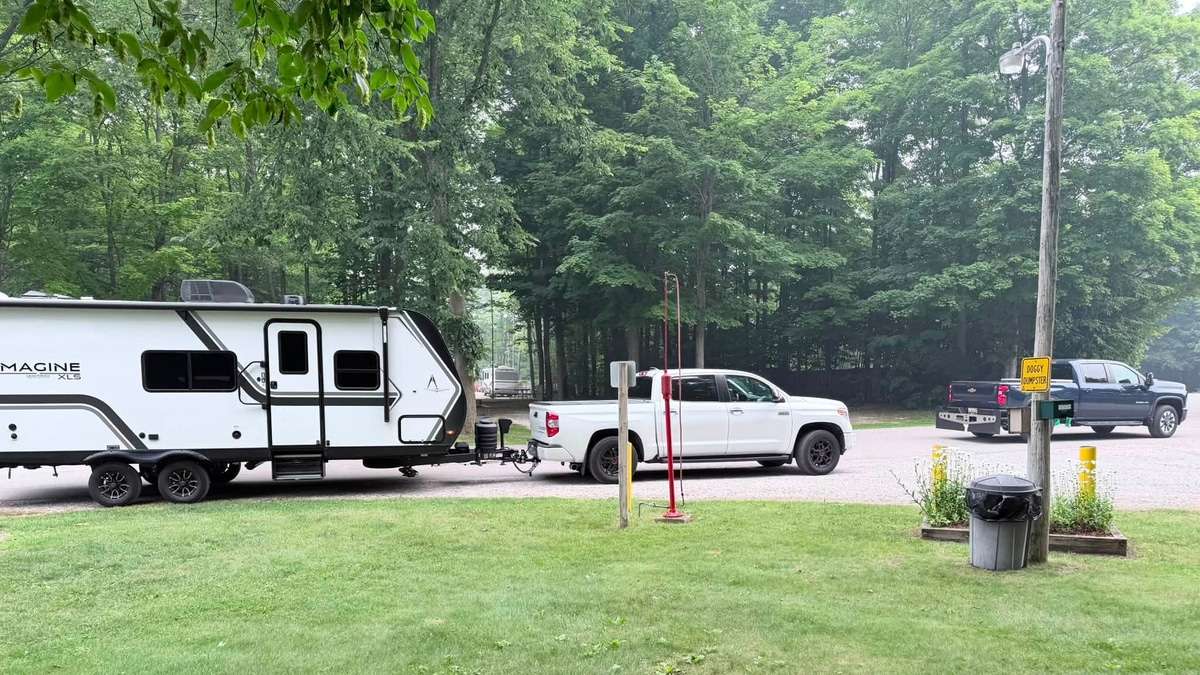

The 2021 Tundra pulled a Grand Design travel trailer from Texas to Michigan without drama. The scale numbers are more complicated, and the dates printed on the tickets change how confidently they can be interpreted.
Chris Payne retired and pointed his 2021 Toyota Tundra Platinum north. He left Dallas, met family near St. Louis, and continued toward Traverse City with a 2026 Grand Design Imagine XLS 22MLE behind him. A stop in Michigan’s Upper Peninsula was next.
The retirement itinerary sounds enviable. The towing report on Facebook sounds even better.
Payne said his Tundra felt stable with the Grand Design attached, had plenty of power on hills, and spent about 95 percent of the trip in S4. He later described its behavior around semitrucks, under heavy braking, and through turns as “remarkably stable.” He also credited TRD suspension hardware at the front and rear, which he described as torsion bars, and said the trailer has its own anti-sway capability.
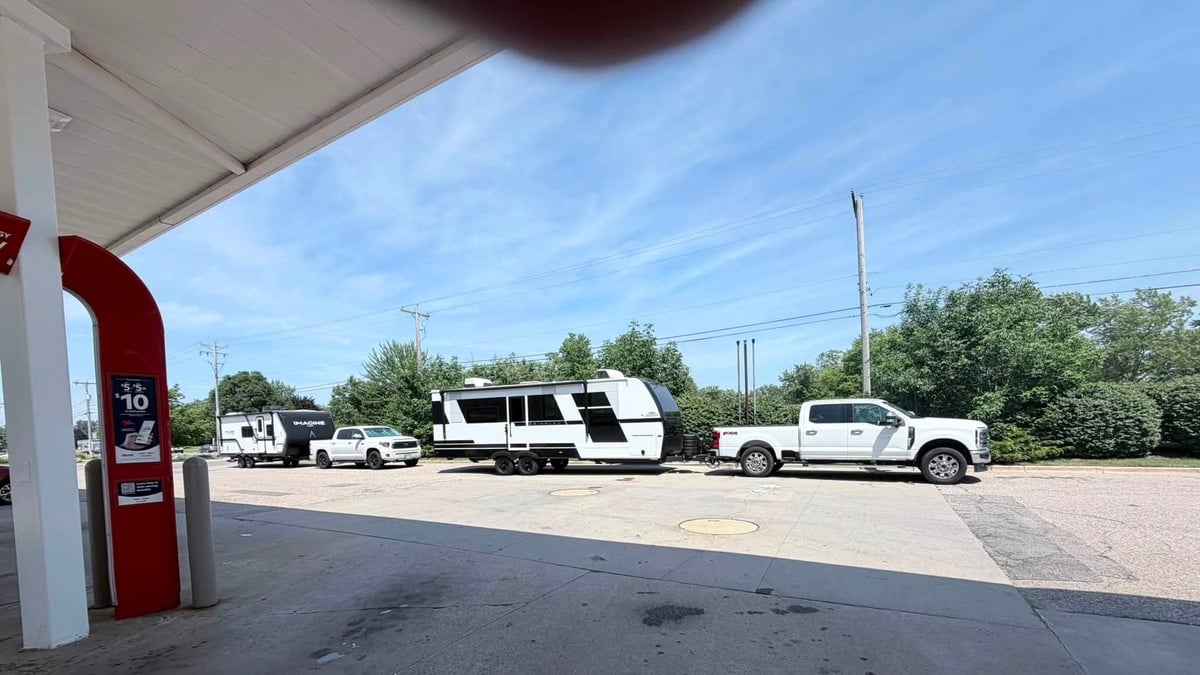
Then another owner asked for the trailer’s gross vehicle weight rating and tongue weight. Payne posted two CAT Scale tickets and initially calculated about 840 pounds on the tongue.
The tickets invited a much harder look.
The drive axle gained 1,340 pounds, but that is not the tongue weight
The truck-only ticket shows 3,460 pounds on the steer axle and 2,740 on the drive axle, for a 6,200-pound truck total. The combination ticket shows 3,320 pounds on the steer axle, 4,080 on the drive axle, and 5,460 on the trailer axles. Gross combined weight was 12,860 pounds.
Payne’s first calculation subtracted the truck’s unloaded drive-axle figure from its loaded drive-axle figure:
- 4,080 - 2,740 = 1,340 pounds.
He then subtracted roughly 500 pounds of bed cargo and arrived at 840 pounds. That method misses the weight that moved away from the Tundra’s front axle when the trailer was coupled.
The steer axle appears 140 pounds lighter in the combination ticket:
- 3,320 - 3,460 = -140 pounds.
- Looking at both truck axles produces the more useful comparison:
- Loaded truck axles: 3,320 + 4,080 = 7,400 pounds.
- Truck-only axles: 3,460 + 2,740 = 6,200 pounds.
- Apparent additional load carried by the truck: 1,200 pounds.
If Payne’s estimate of 450 to 500 pounds in the bed is accurate, and if the people, fuel, hitch hardware, and other cargo were unchanged, the remaining 700 to 750 pounds would be a reasonable estimate of the trailer load retained by the truck. Payne accepted the correction in the discussion and said the payload label on his particular Tundra is 1,180 pounds.
Under those same assumptions, adding that 700-to-750-pound truck-carried load to the 5,460 pounds resting on the trailer axles places the loaded trailer around 6,160 to 6,210 pounds. The implied tongue share is roughly 11.4 to 12.1 percent, placing the estimate slightly above Toyota’s recommended 9-to-11-percent window.
That is useful guidance for the next weigh, rather than a final measurement, because the truck-only baseline came from another year.
Payne’s response to the correction matters. Scale work is supposed to reveal an error before the road does. He brought numbers to the conversation, listened when another tower reconstructed them, and corrected his original statement.
The dates on the tickets prevent a precise verdict
There is one detail in the photographs that received less attention than the axle arithmetic. The truck-only ticket is dated September 21, 2024. The combination ticket is dated July 14, 2026. They were printed at different scales in different Texas cities, almost 22 months apart.
That gap does not make the tickets useless. It does keep them from functioning as a controlled before-and-after measurement.
The Tundra could have carried a different driver, passenger count, fuel level, tonneau cover, hitch, tools, or permanent accessories on those two days. Even a few ordinary changes can consume the 20-pound difference between the owner’s stated 1,180-pound payload allowance and the apparent 1,200 pounds added to the truck axles.
The ticket photos also do not establish whether the weight-distribution bars were engaged for the loaded pass, and the truck’s certification-label GVWR is absent.
These two tickets cannot produce an exact tongue weight or a definitive over-payload finding. They are a strong reason to weigh the rig again under controlled conditions.
The missing 140 pounds at the front axle is the number I would investigate first
Toyota’s 2021 Tundra owner’s manual tells owners using a weight-distributing hitch to return the front axle to the same weight it carried before the trailer was connected. Toyota also recommends 9 to 11 percent tongue weight for a conventional trailer, calls for a sway-control device above 2,000 pounds, and requires a weight-distributing hitch above 5,000 pounds. The certification-label GVWR and axle ratings remain hard limits.
If the two CAT tickets represented identical truck loading and the weight-distribution hitch was engaged, the steer axle would still be 140 pounds short of its truck-only value. That could mean the hitch needs adjustment. The 22-month gap means it could also reflect different loading, so it deserves measurement before adjustment.
The distinction between stability and compliance is important here. A truck can feel settled while exceeding a label value. It can also produce a misleading comparison when the baseline ticket came from another year. Driver confidence is valuable evidence about behavior, yet it cannot replace the ratings on the door sticker or a same-day set of scale passes.
A recent 2018 Tundra towing report showed the other side of that equation. Its steer axle was still 100 pounds light with the trailer connected, and the owner reported unsettling movement above 45 mph.
Payne’s truck reportedly felt composed with an apparent 140-pound front-axle loss. The comparison does not prove that either setup was correct. It shows how road feel can change with trailer shape, hitch adjustment, tires, loading, and wind even when a scale exposes a similar front-axle clue.
Toyota advertised up to 1,730 pounds of payload and up to 10,200 pounds of towing capacity across the 2021 Tundra lineup. A Platinum CrewMax with options can have far less payload, which is why Payne’s 1,180-pound label carries more authority for his truck than Toyota’s maximum. Premium equipment, occupants, bed cargo, and trailer tongue weight can spend that allowance surprisingly quickly.
One same-day three-pass weigh would answer most of the argument
Payne can turn this discussion into an unusually useful towing record with one return to a CAT Scale. The truck and trailer should be loaded exactly as they travel, including the same passengers, fuel, water, food, hitch hardware, and bed cargo.
The first pass should weigh the full combination with the weight-distribution system engaged. The second should keep the trailer connected but disengage the distribution bars. The third should weigh the truck alone without changing its occupants or cargo.
Those three readings expose the actual trailer weight, the load carried by the truck, the effect of the hitch, and the amount restored to the front axle.
The results then need to be checked against the Tundra’s door-label GVWR, front and rear gross axle weight ratings, tire ratings, receiver limits, payload sticker, and the Grand Design’s ratings. That ledger has more authority than a smooth pull, an online estimate, or a maximum printed in a brochure.
Payne’s trip remains a strong account of how a well-kept V8 Tundra can feel with a modern travel trailer. It also captures the trap waiting for half-ton owners. The engine may have power in reserve, and the chassis may feel calm, while payload disappears one passenger, tool bag, and pound of tongue weight at a time.
If you tow a similar Grand Design with a second-generation Tundra, send me your door-sticker payload and a same-day three-pass scale set. I am especially interested in the front-axle change with the weight-distribution bars engaged. That evidence would show whether Payne’s apparent 140-pound shortfall is common, easily corrected, or simply an artifact of two tickets taken almost two years apart.
Two images by Chris Payne
About The Author
Noah Washington is an automotive journalist based in Atlanta, Georgia, covering sports cars, luxury vehicles, and performance culture. His reporting focuses on explaining the engineering, design philosophy, and real-world ownership experience behind modern vehicles.
Noah has been immersed in the automotive world since his early teens, attending industry events and following the enthusiast communities that shape how cars are built and driven today. His work blends industry insight with enthusiastic storytelling, helping readers understand not just what a car is, but why it matters.
Noah is also a member of the Southeast Automotive Media Association (SAMA), a professional organization for automotive journalists and industry media in the Southeast.
His coverage regularly explores sports cars, luxury vehicles, and performance-driven segments of the automotive industry, including the evolving culture surrounding Formula Drift and enthusiast builds.
Read more of Noah's work on his author profile page.
You can also follow Noah here:
Set Torque News as Preferred Source on Google
Follow us today...