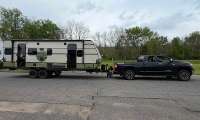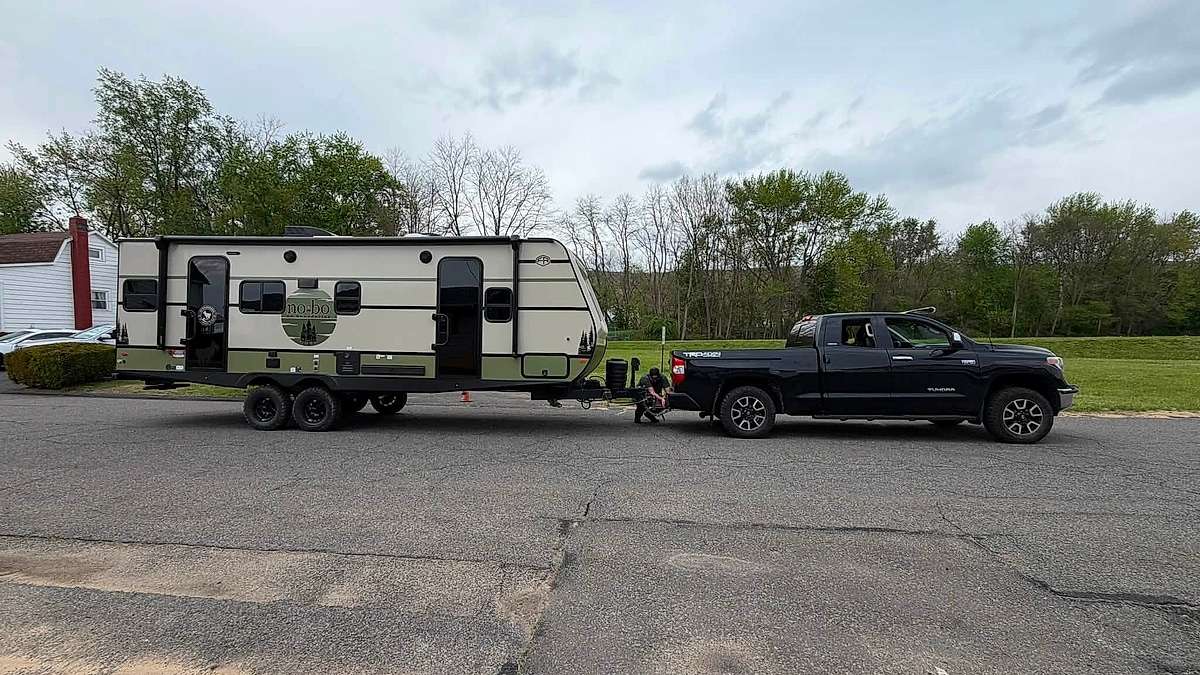

Jackie Flaherty’s Toyota Tundra did not fail to pull the trailer.
That is the easy part to misunderstand.
The 2018 Tundra completed a 350-mile round trip with a Forest River No Boundaries 20.7 Beast Mode behind it. The trailer weighed 6,120 pounds on its axles at the CAT Scale, with no water onboard. The Tundra is rated by the owner at 9,100 pounds of towing. The numbers appear comfortable if the only number someone checks is the two ratings.
The drive felt awful, according to his Facebook post.
Anything above 45 mph felt sketchy. Passing SUVs caused movement. Tractor-trailers made it worse. Wind hit the trailer, and the combination never settled. A trip that should have taken three hours took five. The owner considered turning around after the first hour.
That is the part I care about.
A tow rig can sit inside the headline rating and still behave badly enough to park it.
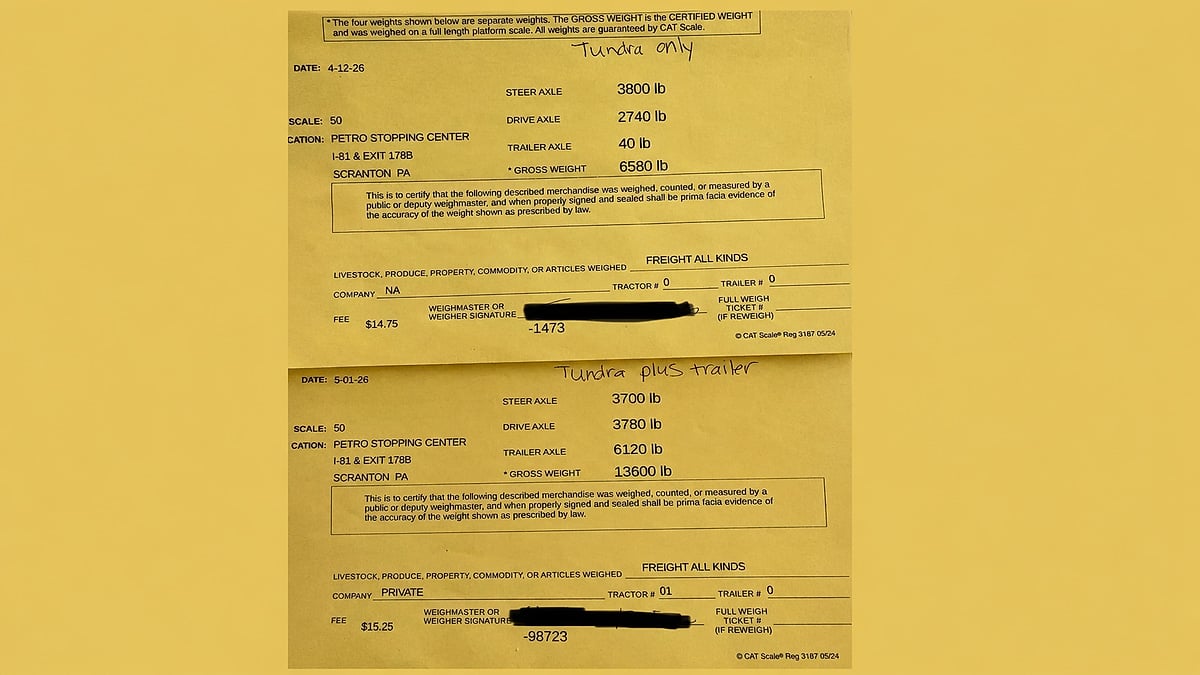
- The CAT ticket shows the Tundra carrying about 900 more pounds with the trailer attached, while the front axle is still 100 pounds lighter than the truck-only ticket.
- The trailer’s estimated gross weight appears near 7,020 pounds once tongue load is included, which puts the 900-pound net tongue load around 12.8 percent.
- The trailer may be under its 7,703-pound GVWR, but the Tundra itself may be near or over its own GVWR, depending on the door-jamb payload sticker.
The owner asked people not to say “buy a bigger truck.”
Good.
That answer may eventually appear, but it should come after the setup has been diagnosed properly. This is a solvable mechanical problem until the numbers prove otherwise.
The Scale Ticket Says The Trailer Weight Is Mostly Fine
The trailer placard lists a 7,703-pound GVWR and two 3,500-pound axles. The CAT ticket shows 6,120 pounds on the trailer axles.
That part is not alarming by itself.
Compare the combined ticket with the truck-only ticket:
Truck only:
- Steer axle: 3,800 lb
- Drive axle: 2,740 lb
- Gross: 6,580 lb
Truck plus trailer:
- Steer axle: 3,700 lb
- Drive axle: 3,780 lb
- Trailer axle: 6,120 lb
- Gross combined: 13,600 lb
Assuming the truck was loaded similarly on both tickets, the trailer added 7,020 pounds to the whole rig. The truck axles gained 900 pounds. The trailer axles carried 6,120.
That puts the apparent net tongue load at about 900 pounds. Divide 900 by 7,020, and the result is 12.8 percent.
That is a reasonable tongue percentage for a travel trailer.
So the first surprise is this: the trailer does not look too light on the tongue from the scale ticket. The common internet panic about “too little tongue weight” does not leap off the paper here.
The more interesting problem is where those 900 pounds went.
The steer axle dropped from 3,800 to 3,700. The drive axle rose from 2,740 to 3,780. The front axle lost 100 pounds with the trailer attached, even with the Blue Ox SwayPro connected.
That does not automatically condemn the hitch setup. It does say the truck did not return to its unloaded front-axle weight on that scale pass.
More importantly, the truck itself weighed 7,480 pounds with the trailer attached.
That number needs to be compared with the actual GVWR on the driver's door label.
If the truck’s GVWR is around 7,100 or 7,200 pounds, which is common for this generation, depending on configuration, the rig is already over the truck’s rating before adding water or more gear. The exact sticker decides the answer.
A tow rating cannot erase a GVWR problem.
The Missing Number Is Payload
Tundra owners talk about the 5.7-liter V8 as if it were the whole truck.
It is not.
The engine can pull. The rear axle, receiver, tires, payload label, suspension, and wheelbase decide whether the combination behaves.
This Tundra weighed 6,580 pounds without the trailer. The trailer, it weighed 7,480. That is a 900-pound increase on the truck.
Now add the items that may not have been present on both scale tickets: passengers, dogs, tools, cooler, bed cargo, bikes, firewood, hitch equipment, and any 100 pounds added to the bed during the experiment.
If the truck is already over GVWR, adding SumoSprings, airbags, or stiffer tires may improve the feeling without making the rating legal. Suspension helpers change posture. They do not change the certification label.
The door-jamb payload sticker belongs in the next photograph.
The receiver label belongs in the photograph after that.
The Rear Cargo Carrier Is A Quiet Suspect
The owner mentioned bikes and firewood on the rear cargo carrier of the trailer and said they tried adding more weight to the back of the trailer to reduce tongue weight.
I would stop doing that until the rig is stable.
A static tongue-weight percentage can look acceptable while rear-mounted cargo makes the trailer easier to yaw. Weight placed far behind the axles acts like a pendulum. The scale sees pounds. The highway feels like leverage.
A 75-pound load tucked over the axles is boring.
The same 75 pounds hanging off the rear bumper can make a trailer slower to settle after wind or passing traffic. Add bikes, firewood, a rack, and rough airflow behind a 29-foot camper, and the rear of the trailer becomes more influential than its weight suggests.
That is the piece many owners miss.
Moving the weight rearward can make the truck look better and make the trailer track worse.
For the next test, I would remove the bikes, rear cargo, and firewood entirely. Load dense cargo low and close to the trailer axles. Keep the tongue around 12 to 13 percent. Then test the rig again.
Do not chase a prettier stance by creating a worse pendulum.
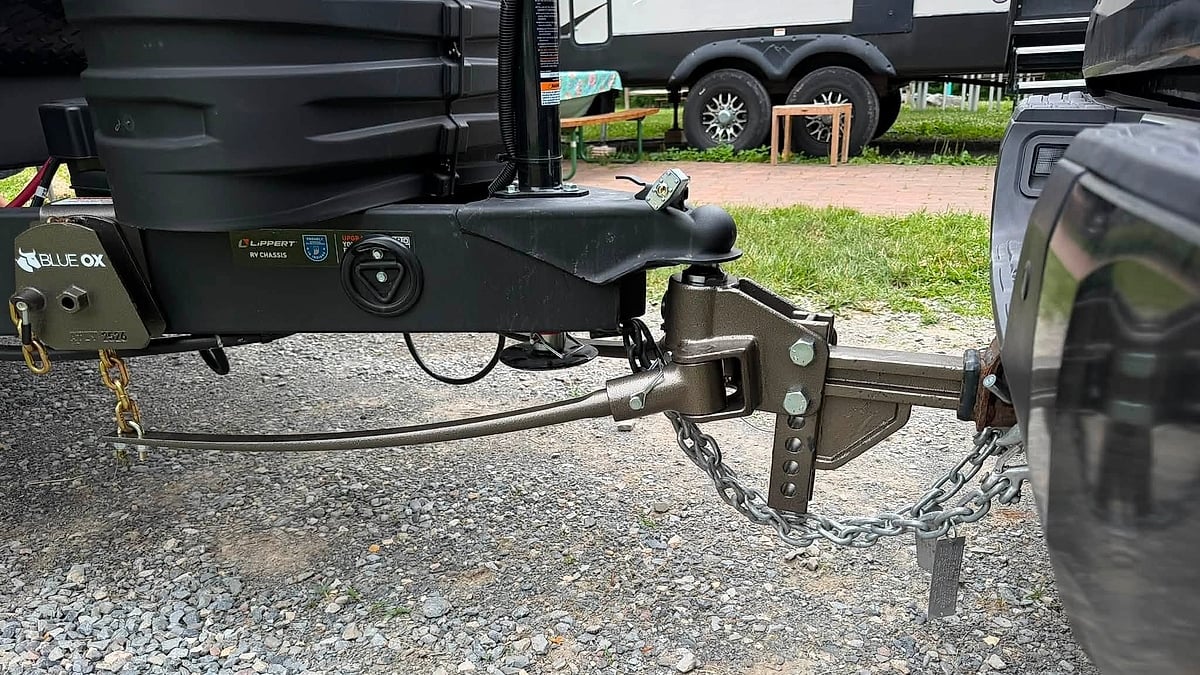
The Hitch Photo Deserves A Real Setup Session
The Blue Ox SwayPro may be the wrong size. It may be set incorrectly. It may be fine and getting blamed for a truck-weight problem.
The photograph cannot answer that.
What it does show is enough to justify a full reset with the manual in hand. The owner needs to identify the exact spring bars. Blue Ox bars are rated by tongue-weight range. A trailer with 875 to 925 pounds of measured tongue may require 1,000-pound bars if that is the true tongue load. If the weight-distribution system is transferring some load rearward to the trailer axles, the actual tongue weight at the coupler could be higher than the 900-pound net increase shown on the truck.
Wrong bars can ruin the whole exercise.
Too-soft bars may not distribute properly. Too-stiff bars can create a harsh, over-tensioned setup. Chain length, bracket position, head tilt, ball height, and trailer attitude all count. Blue Ox also says continuous sway that does not settle quickly should send the owner back to load adjustment.
That line fits this case exactly.
I would rebuild the hitch setup from zero on level pavement:
First, level the trailer by itself.
Then measure the Tundra’s front and rear wheel openings unloaded.
Then hitch the trailer with no bars and record the drop and front rise.
Then connect the bars and adjust until the front axle load or front ride height is restored according to the truck and hitch guidance, without over-tensioning the system.
Then scale it again.
A tape measure is useful. A CAT Scale is better.
Tires May Be Adding Their Own Problem
The Tundra has brand-new Goodyear Wrangler DuraTrac RT-LT tires. The owner ran 50 psi front and 55 psi rear while towing, compared with the 35 psi door-sticker pressure when empty.
That may be reasonable. It may be too soft for the actual axle loads. It may also be a tire-character issue.
Aggressive all-terrain tires can feel less planted when new because the tread blocks squirm. LT tires need pressure matched to load, but simply inflating to the sidewall maximum is crude advice. The right answer depends on axle weights, tire size, load range, wheel rating, and the tire manufacturer’s load table.
The trailer tires have their own placard: ST235/75R15 Load Range D at 65 psi cold.
Run those at the placard pressure unless the tire manufacturer and actual load data justify otherwise.
If the trailer tires were underinflated, overloaded, or scrubbing due to axle alignment, the tow experience could get ugly fast. After a 350-mile white-knuckle trip, I would inspect the trailer tires for feathering, abnormal heat patterns, sidewall issues, and uneven wear. I would also have the trailer axle alignment checked.
A trailer that steers itself sideways will make every hitch look bad.
Independent Suspension Does Not Cancel Wind
The NOBO’s Beast Mode independent suspension may help with rough-road behavior and ground clearance.
It does not repeal trailer physics.
The 20.7 is 29 feet long, 96 inches wide, and 11 feet 3 inches tall. It is a large sail behind a half-ton pickup. Its name may say 20.7, but the road sees twenty-nine feet of camper, high sidewalls, and enough surface area for wind to work with.
That is why the owner’s previous trailer experience feels so confusing. A longer or heavier trailer can tow better if the tongue weight, axle placement, tires, hitch, suspension, and aerodynamics work together. A shorter trailer can tow badly if one piece of the setup fights the rest.
Weight is only one chapter.
Length, yaw inertia, side area, hitch geometry, tire sidewall behavior, rear cargo placement, and truck loading write the ending.
What I’d Fix Before Pulling This Camper Again
This rig needs a controlled reset, not another roadside guess.
Start with the scale slips. With the trailer attached, the Tundra carried 3,700 pounds on the steer axle and 3,780 pounds on the drive axle. Truck-only, it showed 3,800 front and 2,740 rear. That means the trailer added 1,040 pounds to the rear axle while the front axle still ended up 100 pounds lighter than it was unhitched.
That is the first clue. The front end may not be wildly light, but the truck is carrying a heavy rear-axle penalty. If the Tundra’s GVWR is near the usual range for that generation, the truck may already be over its own rating before water, extra cargo, bikes, or more firewood enter the picture. A tow rating of 9,100 pounds does not rescue an overloaded truck.
- Measure wheelbase-to-trailer-length ratio. A 29-foot trailer behind a shorter-wheelbase half-ton can amplify yaw even when weights look fine. Longer trailers demand more truck in terms of wheelbase, not just tow capacity.
- Check the receiver rating under weight distribution. Many half-ton receivers are limited to ~1,000 lbs tongue weight even with a WDH. If the real tongue load is creeping higher once properly loaded, the hitch itself may be at its limit before the truck is.
- Evaluate aerodynamic mismatch, not just weight. A tall, flat-sided trailer like the NOBO creates side-force spikes that a lighter truck struggles to dampen. Stability here depends on how quickly the truck can correct yaw, not just how much it can pull.
The trailer number is less scary at first glance. The CAT slip shows 6,120 pounds on the trailer axles. Add the roughly 900-pound load transferred onto the truck, and the NOBO appears to be around 7,020 pounds loaded. Against a 7,703-pound GVWR, that is still inside the trailer’s rating. The tongue percentage works out to 12.8 percent, which should be a reasonable place for a travel trailer.
So why did it tow badly?
Because static weight and highway stability are not the same problem.
That’s the piece worth slowing down on. A CAT scale can show a tongue percentage that looks acceptable while the trailer still has too much leverage behind its axles, too much side area for the tow vehicle, poor hitch geometry, soft or mismatched spring bars, tire squirm, or an axle alignment issue. A trailer can pass the arithmetic test and still behave badly at 55 mph.
The rear cargo carrier is where I would get ruthless. Bikes and firewood behind the trailer axles may reduce tongue weight on paper, but that weight is hanging at the worst possible place for sway. It gives the trailer a more pendulum effect. It can make the rig look better in the driveway and behave worse when an SUV passes. For the next test, I would remove every pound from the rear carrier. No bikes. No firewood. No “just this one tote.” Put dense gear low and near the trailer axles, then reweigh.
Next, I would verify the Blue Ox hardware itself. The spring bars need to match the real tongue load, not the sales brochure, and not a hopeful estimate. If those bars are undersized, the hitch can look tensioned while failing to control the rig properly. If the setup is over-tensioned, it can create its own problems. Chain length, bracket placement, head angle, ball height, and bar rating all need to be checked against the manual on level pavement.
I would also stop adjusting by appearance. “Looks level” is not a setup method. Measure the truck unhitched. Measure it hitched without bars. Measure it again with the bars loaded. Then scale it in all three states. That shows how much weight the hitch is actually moving to the front axle and back to the trailer axles.
The tires deserve a separate pass. The Tundra’s new LT DuraTracs may need pressure matched to actual axle load, and fresh aggressive tread can feel nervous until it breaks in. The trailer tires should be at the placard pressure, and after a 350-mile sway episode, I would inspect them closely for abnormal wear, cupping, feathering, or heat damage. If the trailer axles are even slightly out of alignment, the hitch will get blamed for a problem that starts farther back.
I would not tow this setup again at highway speed until four questions have clean answers:
- What is the Tundra’s actual door-sticker payload and GVWR?
- What is the real loaded tongue weight with the rear carrier empty?
- What Blue Ox bar rating is installed?
- Are the NOBO’s axles and tires tracking straight?
That diagnostic order matters. Fixing the hitch tension before removing the rear cargo can hide the wrong problem. Adding SumoSprings before checking GVWR can make an overloaded truck feel less overloaded. Raising tire pressure before confirming axle weights can introduce another variable. Guessing in five directions at once is how people spend money and learn nothing.
If the truck is over GVWR after the trailer is loaded correctly, the answer gets uncomfortable. If the truck is within ratings and the sway remains, the next suspect becomes hitch setup, bar rating, tire behavior, or trailer alignment.
The important point is this: the Tundra may still be capable of towing this NOBO safely, but the current combination has not earned that trust yet. The scale slips do not show a hopeless trailer. They show a setup that needs a clean, methodical rebuild before anyone blames the truck, the camper, or the driver.
Tundra Owners, What Fixed Your Sway?
If you tow a No Boundaries, Surveyor, Imagine, Rockwood, or similar 28-to-30-foot trailer with a Tundra, share the CAT Scale numbers, tongue weight, hitch model, spring-bar rating, tire pressures, and what finally made the rig settle down.
Comment down below with your set-up.
Images by Jackie Flaherty
About The Author
Noah Washington is an automotive journalist based in Atlanta, Georgia, covering sports cars, luxury vehicles, and performance culture. His reporting focuses on explaining the engineering, design philosophy, and real-world ownership experience behind modern vehicles.
Noah has been immersed in the automotive world since his early teens, attending industry events and following the enthusiast communities that shape how cars are built and driven today. His work blends industry insight with enthusiastic storytelling, helping readers understand not just what a car is, but why it matters.
Noah is also a member of the Southeast Automotive Media Association (SAMA), a professional organization for automotive journalists and industry media in the Southeast.
His coverage regularly explores sports cars, luxury vehicles, and performance-driven segments of the automotive industry, including the evolving culture surrounding Formula Drift and enthusiast builds.
Read more of Noah's work on his author profile page.
You can also follow Noah here:
Set Torque News as Preferred Source on Google
Follow us today...