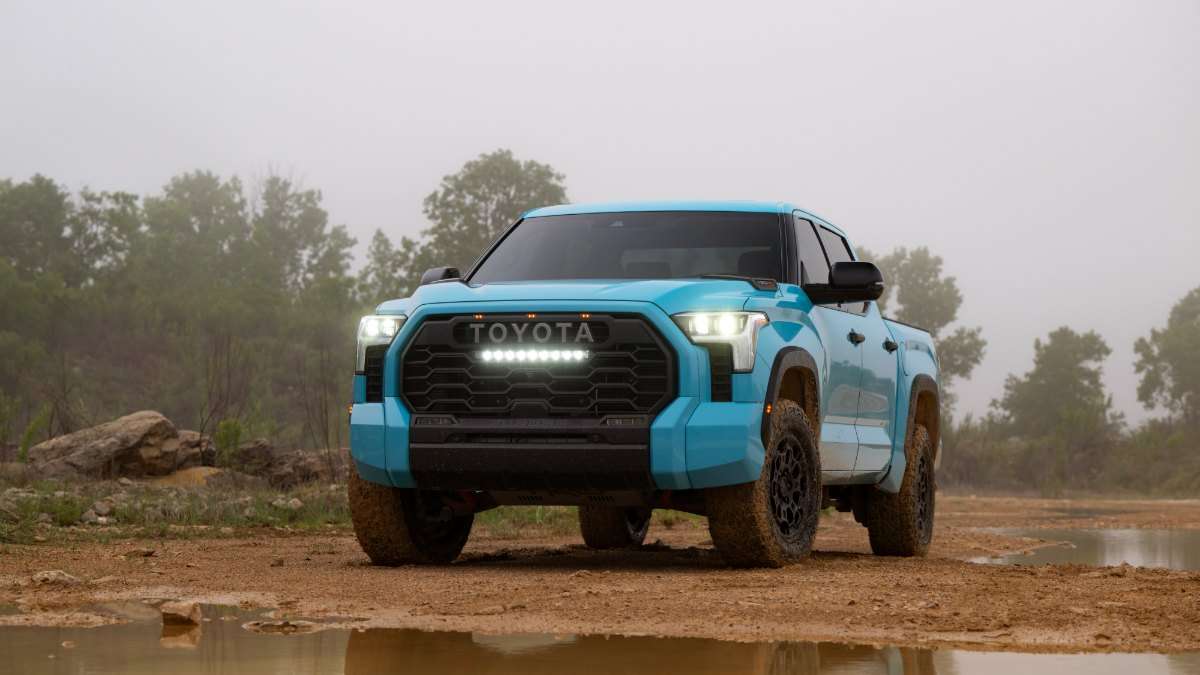

Few modern trucks invite more owner experiments than the latest Toyota Tundra. This generation has become a proving ground where every tire swap, brake job, and software setting becomes a community science project.
While manufacturers conduct controlled durability testing in the desert, Tundra owners do their own work on interstates at legal speeds that often feel like the closing minutes of a Cannonball run.
That is exactly how one 2025 Tundra Limited owner stumbled onto an unexpected fuel economy increase that has quickly become a point of conversation throughout the ownership community.
“I was following a post regarding premature rear brake wear, and I just learned how to turn off my adaptive cruise control. 25 limited just shy of 10k miles: I was surprised that as soon as I started using consistent speed cruise control, my MPG jumped almost 2 mpg, mostly hwy travel @ 80 mph with Toyo open country AT 275/65/20. I can't imagine it's only related to adaptive cruise control? I've seen a lot of folks say MPG increases for some reason right around 10k miles. Just wanted to share. Wondering if come spring, when I toss my factory tires back on, if I'll actually get the advertised mpg....”
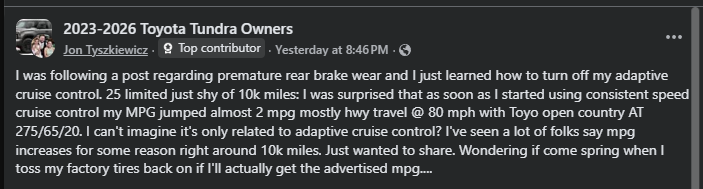
Jon’s discovery that fixed speed cruise control returned almost two extra miles per gallon at 80 mph on Toyo Open Country A/T tires was not a lab test, but it had the clarity of one. It also raised a genuine question worth exploring. Modern adaptive cruise systems constantly modulate the throttle to maintain distance, and at high speeds, even subtle corrections can cost fuel. In a truck running heavy tread all-terrain tires, that margin can become visible faster than expected.
Toyota Tundra: Expected MPG
- The Tundra’s MPG is shaped heavily by its V8/V6-hybrid powertrains, which are built for towing more than sipping fuel, so every extra pound or bit of wind resistance (including beefier tires) makes its efficiency drop more noticeably than in smaller trucks.
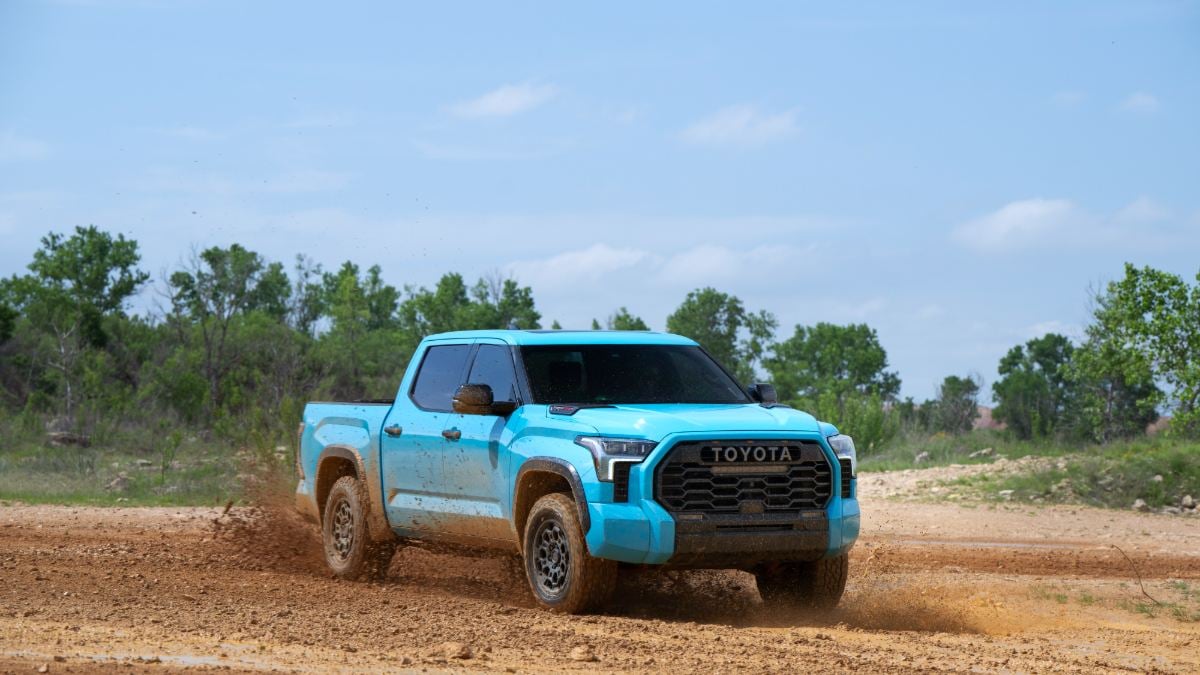
- Tires with aggressive tread patterns, like mud-terrain or oversized all-terrains, create more rolling resistance, which forces the Tundra’s engine to work harder and can trim several MPG off its highway numbers.
- Under-inflated tires widen the contact patch with the road, creating drag that quietly erodes fuel economy; keeping the Tundra’s tires at optimal PSI can return MPG gains you can actually feel on longer drives.
- Swapping to heavier wheels or larger-diameter tires adds rotational mass; because the Tundra already pulls a lot of weight, even a few extra pounds per wheel can make acceleration thirstier and reduce city MPG in particular.
What makes Jon’s observation more compelling is that he did not seek it out. His investigation began with the widespread reports of rear brake concerns that several owners have shared. Patrick Burns described having to provide a video of his truck squeaking in reverse before his dealership confirmed the condition and replaced pads and rotors at no charge. In his case, technicians attributed the issue to dissimilar metals interacting at the contact surfaces.
Owners like Robert Krawiec have also reported brake pulsation at certain speeds or on steep grades. This is the sort of real-world data that only emerges when thousands of trucks experience thousands of driving styles.
Not every Tundra owner is seeing the same overlap between adaptive cruise use and wear patterns. Chris Gilbert offered a long-term counterpoint. He has logged roughly 65,000 miles, used adaptive cruise nearly all the time, and remains on his original brakes. His fuel economy has varied between 15 and 20 mpg, with about 9 mpg while towing, and has remained largely consistent throughout his ownership. It is a reminder that variation in traffic patterns, terrain, loads, and tire selections can overshadow single variables like cruise control mode. It also underscores that the Tundra can behave differently across drivers without implying a fault in the truck or the driver.
A layer of folklore adds to the mix. Many Tundra owners speak of a notable improvement right around the 10,000-mile mark. Break-in, ECU learning, seasonal conditions, or simply more consistent driving habits could all play roles. Jon plans to remount his factory tires in spring, which may help clarify what portion of his improvement came from cruise control behavior and what portion belonged to rolling resistance. At 80 mph, aerodynamics becomes the biggest drag penalty, and tire choice is one of the easiest ways to influence it.
Adaptive cruise itself is the most intriguing element in this narrative. The technology is designed to enhance safety, particularly in changing traffic, and Toyota’s system is known for being conservative in its spacing. Some drivers appreciate that caution. Others, like commenter Gavin Rodda, prefer what he calls the old school fixed speed mode and are happy Toyota still provides it. The ability to choose between traditional and adaptive cruise gives owners more control than many modern vehicles allow. For trucks that spend long hours on clear highways, that choice can matter.
Whether Jon’s two-mile-per-gallon surprise becomes a widespread observation or remains a well-timed coincidence will depend on how many owners run the same comparison. For now, it stands as a reminder that even in an era of sensors and software, a simple button press can still reveal something worth talking about.
Image Sources: Toyota Media Center
Noah Washington is an automotive journalist based in Atlanta, Georgia. He enjoys covering the latest news in the automotive industry and conducting reviews on the latest cars. He has been in the automotive industry since 15 years old and has been featured in prominent automotive news sites. You can reach him on X and LinkedIn for tips and to follow his automotive coverage.
Set Torque News as Preferred Source on Google
Follow us today...